

7 Smart Accreditation Management Tips for CEU Success
Getting an IDCEC-approved continuing education course can feel overwhelming for manufacturers aiming to reach design professionals. The detailed standards set by the International Design Continuing Education Council mean your course must go far beyond basic content and generic objectives. If you miss any key compliance step, your submission risks falling short of expectations and wasting valuable resources.
This list gives you practical methods to turn your continuing education offerings into recognized, high-impact courses. You will learn how to audit your content, set measurable learning objectives, and adopt proven compliance checklists based on industry guidelines.
Each insight is designed to help you build confidence, avoid costly mistakes, and create educational experiences that genuinely engage architects and interior designers. Get ready to discover actionable solutions that will transform your course development approach and maximize your success.
Table of Contents
- 1. Audit Your Course Content For IDCEC Readiness
- 2. Set Clear Learning Objectives Aligned With Architect Needs
- 3. Use Systematic Compliance Checklists From Start To Finish
- 4. Streamline The Submission Process With Automation Tools
- 5. Incorporate Strategic Topic Research For Maximum Impact
- 6. Track And Report Completion Data To Drive Specifications
- 7. Refresh Existing Courses For Ongoing Accreditation Success
Quick Summary
| Key Message | Explanation |
|---|---|
| 1. Conduct a Thorough Content Audit | Ensure your course material meets IDCEC standards by focusing on learning objectives, instructional quality, and professional relevance. |
| 2. Set SMART Learning Objectives | Develop clear, measurable goals that align with architects’ needs to enhance their problem-solving capabilities. |
| 3. Utilize Compliance Checklists | Implement systematic checklists to ensure adherence to accreditation requirements and streamline the submission process. |
| 4. Leverage Automation Tools | Use automation to simplify document management and improve accuracy in the continuing education submission process. |
| 5. Regularly Update Existing Courses | Continuously refresh course content to maintain relevance and incorporate feedback for improved educational impact. |
1. Audit Your Course Content for IDCEC Readiness
Creating an IDCEC-approved continuing education course requires more than just good content. You need a strategic approach that meets the stringent requirements of the International Design Continuing Education Council.
Successful course accreditation hinges on a comprehensive content audit that ensures your material meets professional educational standards. This isn’t just about checking boxes – it’s about crafting a learning experience that design professionals find valuable and meaningful.
Your content audit should focus on several critical areas:
- Learning Objectives: Clearly define specific, measurable outcomes
- Instructional Quality: Ensure content is accurate, current, and professionally presented
- Assessment Methods: Design rigorous evaluation mechanisms that test true comprehension
- Technical Alignment: Match IDCEC’s specific formatting and structural requirements
- Professional Relevance: Demonstrate direct applicability to design practice
Professional design education isn’t about information transfer. It’s about transforming how practitioners think and solve problems.
When auditing your course, scrutinize each section through the lens of design professionals. Ask yourself: Would an architect or interior designer find this content immediately applicable to their work? Does it solve real-world challenges they encounter?
The most successful CEU courses go beyond surface-level information. They provide strategic insights that help design professionals make more informed decisions, understand emerging trends, and elevate their professional practice.
Pro tip: Schedule a peer review with experienced design professionals who can provide candid feedback on your course content’s relevance and educational impact.
2. Set Clear Learning Objectives Aligned with Architect Needs
Continuing education for design professionals requires precision beyond basic information delivery. Your learning objectives must be strategic roadmaps that transform how architects think and practice their craft.
The American Institute of Architects emphasizes that professional development goals must follow the SMART framework – Specific, Measurable, Achievable, Relevant, and Time-bound. This approach ensures your course delivers genuine value to design professionals.
Designing effective learning objectives demands understanding the unique challenges architects face:
- Technical Precision: Address complex design challenges
- Regulatory Compliance: Connect content to health and safety requirements
- Professional Growth: Offer insights that expand strategic thinking
- Practical Application: Create immediately implementable knowledge
- Industry Trends: Highlight emerging design methodologies
Learning objectives are not checklists. They are strategic bridges between current knowledge and professional excellence.
Successful learning objectives transform passive information consumption into active skill development. Each objective should answer three critical questions: What will architects learn? How will they demonstrate that learning? Why does this matter to their professional practice?
The most compelling continuing education experiences don’t just inform – they inspire architects to reimagine their approach to design challenges, regulatory requirements, and professional standards.
Pro tip: Collaborate directly with practicing architects when drafting learning objectives to ensure maximum relevance and immediate professional applicability.
3. Use Systematic Compliance Checklists from Start to Finish
Navigating continuing education accreditation is like piloting a complex machine – one missed step can derail your entire process. Compliance checklists are your mission-critical navigation system for avoiding costly mistakes.
Systematic documentation isn’t just bureaucratic tedium. It’s your strategic defense against potential accreditation rejections that can waste months of effort and thousands of dollars. Think of your compliance checklist as a professional insurance policy that protects your educational investment.
Your comprehensive compliance checklist should cover multiple critical domains:
- Course Design: Verify instructional alignment with professional standards
- Learning Objectives: Ensure precise measurability and relevance
- Content Accuracy: Validate current industry information
- Assessment Mechanisms: Design rigorous evaluation processes
- Record Keeping: Maintain meticulous documentation
- Submission Protocols: Follow exact IDCEC formatting requirements
A well-designed checklist transforms complexity into clarity.
The most effective checklists are living documents. They evolve with industry standards and capture every nuanced requirement that could potentially trigger an accreditation review. Your goal isn’t just compliance – it’s creating a repeatable system that consistently delivers high-quality educational experiences.
Successful manufacturers treat their compliance checklist as a strategic tool. It’s not about checking boxes. It’s about systematically demonstrating professional credibility and commitment to design excellence.
Pro tip: Create a digital compliance checklist template that can be quickly updated and shared across your team to ensure consistent accreditation readiness.
4. Streamline the Submission Process with Automation Tools
The days of manual continuing education submissions are over. Modern manufacturers need strategic automation that transforms tedious paperwork into efficient, error-free processes.
Automation isn’t just about saving time. It’s about creating a systematic submission workflow that reduces human error and accelerates your entire accreditation strategy.
The right automation tools can dramatically transform your CEU management approach:
- Centralized Documentation: Consolidate all submission materials in one platform
- Real-Time Tracking: Monitor compliance status instantly
- Automatic Reminders: Never miss critical deadlines
- Data Validation: Prevent submission errors before they happen
- Reporting Efficiency: Generate compliance reports with one click
- Integration Capabilities: Connect with existing management systems
Automation turns administrative complexity into strategic advantage.
Successful manufacturers recognize that technological efficiency is a competitive differentiator. By implementing sophisticated automation tools, you’re not just managing paperwork – you’re creating a scalable, reliable continuing education infrastructure.
Think of automation as your silent compliance partner. These tools work continuously in the background, ensuring every submission meets exact IDCEC requirements while freeing your team to focus on creating exceptional educational content.
Pro tip: Select automation tools that offer customizable workflows and integrate seamlessly with your existing technology ecosystem.
5. Incorporate Strategic Topic Research for Maximum Impact
Continuing education isn’t about filling time. It’s about creating transformative learning experiences that directly address the evolving needs of design professionals.
Strategic topic research goes far beyond casual brainstorming. Professional development programs demand a systematic approach that connects emerging industry trends with practical educational content.
Successful topic research requires a multifaceted strategy:
- Industry Trend Analysis: Monitor current design challenges
- Professional Demand Mapping: Identify skill gaps
- Regulatory Landscape Tracking: Stay ahead of changing requirements
- Architect Feedback Integration: Incorporate direct professional insights
- Competitive Content Differentiation: Create unique learning opportunities
- Predictive Learning Needs: Anticipate future skill requirements
Exceptional continuing education transforms information into professional capability.
The most impactful CEU courses don’t just inform. They provide strategic learning pathways that help design professionals reimagine their approach to complex challenges.
Every topic should answer a critical question: How will this content meaningfully advance an architect’s professional practice? Your research must go beyond surface-level information and deliver genuine, actionable insights that professionals can immediately apply.
Pro tip: Develop a continuous feedback loop with practicing architects to ensure your topic research remains dynamic and relevant.
6. Track and Report Completion Data to Drive Specifications
Continuing education isn’t just about delivering content. It’s about understanding how design professionals interact with your educational offerings and transforming that data into strategic opportunities.
Tracking completion metrics enables manufacturers to move beyond passive reporting and create targeted specification strategies.
Your completion data tracking should focus on several critical dimensions:
- Participant Engagement: Measure deep learning interactions
- Demographic Analysis: Understand learner professional profiles
- Course Performance Metrics: Evaluate content effectiveness
- Specification Conversion Rates: Link education to product selection
- Geographic Learning Patterns: Identify regional design trends
- Professional Development Insights: Map skill acquisition trajectories
Data transforms continuing education from a compliance requirement into a strategic business intelligence tool.
Successful manufacturers recognize that completion data is more than numbers. It’s a roadmap revealing how architects think about products, make specification decisions, and evolve their professional practices.
By systematically analyzing course completion patterns, you can develop increasingly precise educational content that directly influences specification behaviors. Your data becomes a predictive engine driving future product development and marketing strategies.
Pro tip: Implement a quarterly data review process that translates completion metrics into actionable product and educational strategy recommendations.
7. Refresh Existing Courses for Ongoing Accreditation Success
Continuing education isn’t a one-time event. It’s a dynamic process that demands continuous evolution and strategic refinement.
Successful manufacturers recognize that course accreditation is an ongoing journey of adaptation and improvement.
Refreshing existing courses requires a comprehensive approach:
- Content Currency: Update material with latest industry insights
- Regulatory Alignment: Ensure compliance with current standards
- Design Professional Feedback: Incorporate learner insights
- Technological Integration: Modernize delivery mechanisms
- Learning Experience Enhancement: Improve engagement strategies
- Specification Relevance: Realign with emerging design trends
Course refresh isn’t about minor tweaks. It’s about reimagining educational impact.
The most effective course updates transform existing content from static information into dynamic learning experiences. This means going beyond superficial revisions and fundamentally rethinking how design professionals acquire and apply knowledge.
Successful course refreshes are strategic investments that demonstrate your commitment to professional development. They signal to architects and designers that you’re not just delivering information but actively supporting their ongoing professional growth.
Pro tip: Schedule annual course audits that systematically evaluate content relevance, learner feedback, and industry evolution to drive meaningful updates.
Below is a comprehensive table summarizing the essential strategies and steps outlined in the article regarding effective development and accreditation of continuing education courses for design professionals.
| Strategy/Aspect | Key Details | Benefits |
|---|---|---|
| Audit Course Content | Conduct a thorough content review focusing on learning objectives, instructional quality, professional relevance, and IDCEC compliance requirements. | Ensures course relevance, quality, and accreditation readiness. |
| Develop Learning Objectives | Utilize the SMART framework to establish effective learning goals tailored to architects’ professional growth and practical needs. | Creates structured, impactful learning experiences. |
| Utilize Compliance Checklists | Implement comprehensive, systematic documentation and follow accreditation requirements thoroughly. | Prevents submission errors and facilitates smooth accreditation processes. |
| Automate Submission Process | Integrate automation tools for documentation management, deadline tracking, and compliance validation. | Enhances submission efficiency and reduces human errors. |
| Conduct Topic Research | Perform in-depth research on industry trends, professional demands, and regulatory changes. Incorporate direct architect feedback. | Produces topical and engaging course content. |
| Track Completion Data | Analyze metrics on participant engagement, course effectiveness, and geographic trends. Use data insights to refine course strategies. | Enables targeted improvements and supports strategic business decisions. |
| Refresh Existing Courses | Update content with current insights, maintain compliance, and enhance learning delivery mechanisms. Conduct periodic audits for improvements. | Maintains course relevance and accreditation continuity. |
Accelerate Your CEU Success with Strategic Accreditation Management
The article highlights how navigating the complexities of IDCEC accreditation demands careful content audits, clear learning objectives, and systematic compliance checklists. Many manufacturers struggle with the costly and time-consuming risks of failed accreditation submissions or inefficient content development processes that lack strategic alignment to architect needs. If you want to transform your continuing education initiative from a compliance burden into a powerful driver of specifications and revenue, you need expert guidance and proven systems.
At CEU Builder, we specialize in delivering this exact expertise with a 100% first-pass IDCEC accreditation rate. Our reverse-engineered process combines deep industry knowledge, strategic topic research, and automated compliance tools that ensure your courses exceed IDCEC requirements while engaging design professionals effectively. From our comprehensive done-for-you courses to our flexible platform empowering internal teams, we provide solutions that directly address the challenges outlined in the article.
Leverage our proven methodology to audit your content rigorously, set architect-centered learning objectives, and streamline your submission process with confidence. Learn more about how we can help you build accredited courses that create lasting specification advantages and measurable pipeline growth in our Compliance & Accreditation – CEU Builder and CEU Strategy & Best Practices – CEU Builder categories.
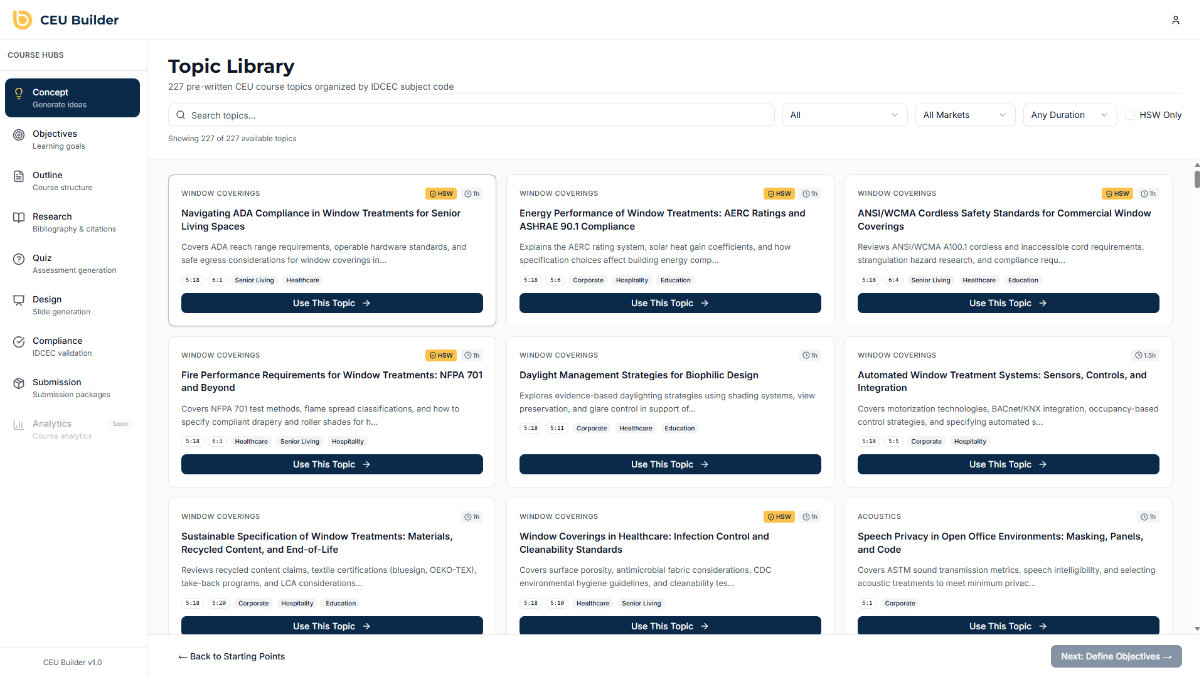
Ready to stop risking accreditation delays and unlock the full potential of continuing education for your brand? Visit CEU Builder today to explore our services and start your journey toward fast, reliable, and strategic CEU success.
Frequently Asked Questions
How can I ensure my CEU course content meets IDCEC requirements?
To ensure your CEU course content meets IDCEC requirements, conduct a comprehensive audit that reviews learning objectives, instructional quality, and assessment methods. Aim to align your materials specifically with IDCEC’s formatting and structural guidelines, focusing on relevance to design professionals.
What are some effective ways to create measurable learning objectives for CEU courses?
Create measurable learning objectives by following the SMART criteria: Specific, Measurable, Achievable, Relevant, and Time-bound. For example, if your course addresses technical design challenges, articulate an objective that ensures learners can demonstrate improvements in their design practices within six months of completion.
What steps should I include in my compliance checklist for CEU accreditation?
Your compliance checklist should include items like verifying course design alignment with professional standards, ensuring content accuracy, and implementing rigorous assessment mechanisms. Review your checklist regularly to keep it updated with any changes in educational requirements to maintain consistency in your accreditation process.
How can I effectively use automation tools for CEU submission processes?
Utilize automation tools to centralize documentation and track compliance status efficiently. For instance, setting up automatic reminders for critical submission deadlines can ensure that you never miss an opportunity, streamline your process, and significantly reduce administrative workload.
What methods can I use to refresh existing CEU courses for ongoing success?
To refresh existing CEU courses, regularly update the content to reflect current industry insights and incorporate feedback from design professionals. Schedule annual course audits to identify areas for improvement, ensuring that your educational offerings remain relevant and engaging to learners.
How can I track completion data to enhance my CEU program?
Track completion data by measuring participant engagement and analyzing course performance metrics. Implement a quarterly review process to analyze this data, allowing you to refine your educational strategy and better align your offerings with the needs of design professionals.
Recommended
