

7 Key Benefits of CEU Accreditation for Hospitality Brands
Standing out in the competitive hospitality market can feel like an uphill battle, especially when architects and designers are constantly bombarded with generic promotions. Traditional marketing often misses the mark and leaves your brand lost in the crowd. Hospitality manufacturers need smarter ways to connect with design professionals and drive real business results.
CEU accreditation offers a practical solution by transforming educational content into genuine engagement, stronger specification potential, and long-term industry authority. You can gain more than just awareness—these strategies deliver measurable impact and position your brand as a true leader architects and designers trust.
Ready to discover how CEU accreditation can reshape your approach and give you a lasting competitive edge? The insights ahead reveal actionable methods to build meaningful relationships, increase market influence, and avoid costly marketing missteps.
Table of Contents
- Boosts Architect And Designer Engagement
- Positions Your Brand As An Industry Authority
- Enables Measurable Specification Growth
- Accelerates Sales Cycle With Qualified Leads
- Reduces Marketing Spend Through Targeted Education
- Prevents Accreditation Delays And Costly Errors
- Creates Long-Term Competitive Market Advantage
Quick Summary
| Takeaway | Explanation |
|---|---|
| 1. Develop CEU Courses to Engage Designers | Create CEU courses that address designers’ real-world challenges, resulting in deeper connections and valuable professional relationships. |
| 2. Position Your Brand as a Knowledge Leader | Offer high-quality educational content to differentiate your brand as a trusted resource in the competitive hospitality design market. |
| 3. Track Engagement for Specification Growth | Use measured learning objectives to connect educational interactions with product specifications, providing insight into marketing effectiveness. |
| 4. Convert Prospects into Qualified Leads | Implement CEU courses to transform cold prospects into informed leads, accelerating the sales cycle and encouraging product consideration. |
| 5. Reduce Marketing Costs through Education | Replace traditional marketing methods with targeted educational content to optimize spending and effectively reach design professionals. |
1. Boosts Architect and Designer Engagement
Continuing Education Unit (CEU) accreditation transforms how hospitality brands connect with design professionals. By offering strategically crafted educational content, manufacturers can create powerful engagement opportunities that go far beyond traditional marketing approaches.
The key to successful architect and designer engagement lies in understanding their professional development needs. Design professionals require ongoing education to maintain their licensing requirements and stay current with industry innovations. CEU courses provide a unique platform for brands to position themselves as thought leaders and trusted resources.
When brands develop CEU courses, they unlock multiple engagement pathways:
- Provide relevant, actionable knowledge about product technologies
- Demonstrate deep industry expertise
- Create meaningful interactions beyond sales pitches
- Build long-term professional relationships
- Offer valuable continuing education credits
Interactive CEU platforms promote active participation by requiring more than passive viewing. Architects and designers engage through quizzes, discussions, and hands-on learning experiences that transform traditional marketing into genuine educational exchanges.
Effective CEU courses turn product education into a collaborative learning experience that architects and designers actually want to participate in.
Design professionals seek content that solves real-world challenges. By developing courses that address specific hospitality design problems—such as material performance, sustainability, or innovative design solutions—brands can create compelling educational experiences that naturally draw architects and designers closer.
Pro tip: Design your CEU courses with the primary goal of solving professional challenges, not just showcasing products.
2. Positions Your Brand as an Industry Authority
Establishing credibility in the competitive hospitality design market requires more than traditional marketing strategies. CEU accreditation offers a powerful mechanism for brands to distinguish themselves as genuine thought leaders in their industry.
By developing high-quality educational content, manufacturers transform their market positioning from vendors to trusted knowledge providers. AIA-approved CEU courses communicate a profound commitment to professional development and industry expertise.
Key advantages of positioning your brand as an industry authority include:
- Building trust with design professionals
- Demonstrating deep product and industry knowledge
- Creating opportunities for meaningful professional interactions
- Differentiating from competitors who rely on traditional sales approaches
- Establishing long-term credibility within the architecture and design community
Accreditation is not just a credential—it is a strategic declaration of your brand’s intellectual leadership.
Professional credentials like IACET accreditation serve as recognized marks of educational quality. These certifications signal to architects and designers that your content meets rigorous standards of excellence and provides genuine professional value.
Successful brands understand that positioning requires consistent, high-quality educational content that addresses real-world design challenges. This approach transforms your marketing from transactional pitches to valuable professional resources.
Pro tip: Develop CEU courses that solve genuine design problems rather than simply showcasing product features.
3. Enables Measurable Specification Growth
Continuing Education Units (CEUs) transform how hospitality brands track and influence architect specification decisions. By creating strategic educational content, manufacturers can directly correlate learning experiences with tangible business outcomes.
Measurable specification growth emerges through deliberate design of educational programs that connect product knowledge with architectural decision-making. Tracking leads from course completion to project specification provides unprecedented insights into marketing effectiveness.
Key strategies for driving specification growth include:
- Creating courses that solve genuine design challenges
- Developing content that highlights unique product capabilities
- Implementing robust tracking mechanisms for course completions
- Analyzing learning engagement metrics
- Correlating educational interactions with specification rates
Effective CEU programs turn educational content into a precision instrument for measuring market influence.
Modern marketing requires more than impressions—it demands actionable intelligence about specification pathways. Measurable learning objectives become the bridge between educational content and specification outcomes.
Successful brands understand that each completed course represents a potential specification touchpoint. By designing courses that provide genuine value and tracking participant behaviors manufacturers can create data-driven specification strategies.
Pro tip: Design your CEU courses with embedded tracking mechanisms that connect educational engagement directly to specification potential.
4. Accelerates Sales Cycle with Qualified Leads
Continuing Education Unit (CEU) courses transform cold sales prospects into warm leads by creating meaningful engagement opportunities with design professionals. By providing valuable educational content manufacturers can dramatically reduce traditional sales cycle timelines.
Qualified leads from CEU programs represent architects and designers who have already invested time learning about your products and solutions. This initial engagement creates a fundamentally different relationship compared to traditional outreach methods.
Key advantages of CEU-generated leads include:
- Higher intent and product knowledge
- Increased likelihood of specification
- Lower customer acquisition costs
- Faster sales cycle progression
- More informed decision-making
CEU content turns passive marketing interactions into active learning opportunities that naturally advance sales conversations.
Successful brands recognize that educational content predisposes architects to consider their products. When design professionals complete a course they gain technical understanding that positions the manufacturer as a trusted resource rather than a typical vendor.
By tracking course completions and designing strategic follow-up processes manufacturers can create a predictable lead generation system that converts educational engagement into specification opportunities.
Pro tip: Design your CEU follow-up process to provide additional value immediately after course completion to maintain engagement momentum.
5. Reduces Marketing Spend Through Targeted Education
Continuing Education Unit (CEU) programs represent a revolutionary approach to marketing that replaces broad expensive campaigns with precision-targeted educational content. By leveraging accredited courses manufacturers can reach architects and designers more efficiently than traditional advertising channels.
CEU provider status transforms marketing from a cost center to a strategic investment that generates measurable professional engagement. This approach eliminates wasteful spending on generic promotional materials that rarely connect with design professionals.
Key cost reduction strategies include:
- Replacing trade show expenses with online educational content
- Eliminating print advertising costs
- Creating evergreen marketing assets
- Developing content that serves multiple marketing objectives
- Generating leads through educational interaction
Targeted education converts marketing spending from an expense into a sophisticated lead generation engine.
Successful hospitality brands recognize that architects value knowledge over promotional materials. A well-designed CEU course can replace multiple expensive marketing touchpoints with a single high-value educational experience.
By tracking course completions and engagement metrics manufacturers can optimize their marketing investments and create more predictable specification pathways with significantly lower customer acquisition costs.
Pro tip: Design your CEU content to solve genuine professional challenges rather than creating thinly veiled product brochures.
6. Prevents Accreditation Delays and Costly Errors
Navigating the complex landscape of continuing education accreditation can be a minefield for hospitality manufacturers. Professional CEU development requires precision and deep understanding of industry-specific compliance requirements to avoid time-consuming and expensive errors.
Accreditation management demands meticulous attention to detail and comprehensive knowledge of regulatory standards. Manufacturers who lack specialized expertise often encounter frustrating delays that can derail entire educational initiatives.
Common accreditation pitfalls include:
- Incomplete learning objective documentation
- Insufficient bibliographic references
- Inadequate assessment mechanisms
- Poor content alignment with professional standards
- Lack of clear instructional design principles
Preventing accreditation errors is not just about compliance—it is about maintaining your brand’s professional reputation.
Successful brands understand that strategic course development prevents rejection. By implementing robust review processes and leveraging expert guidance manufacturers can streamline their accreditation journey and avoid costly rework.
Professional CEU providers recognize that each submission represents a critical opportunity to demonstrate industry leadership. Careful preparation transforms potential obstacles into pathways for meaningful professional education.
Pro tip: Invest in specialized accreditation support that understands the nuanced requirements of hospitality continuing education standards.
7. Creates Long-Term Competitive Market Advantage
Continuing Education Unit (CEU) accreditation is more than a compliance checkbox—it is a strategic instrument for building sustained market leadership in the hospitality industry. Manufacturers who invest in high-quality educational experiences differentiate themselves from competitors who view education as a mere administrative requirement.
Accreditation builds long-term trust by demonstrating a genuine commitment to professional development and industry excellence. This approach transforms brands from product vendors into recognized thought leaders and trusted educational resources.
Strategic competitive advantages include:
- Establishing unparalleled industry credibility
- Creating deeper professional relationships
- Positioning brand as an innovative market leader
- Generating ongoing specification opportunities
- Supporting continuous professional learning
Competitive advantage emerges not from what you sell, but from the value you consistently deliver.
Successful hospitality brands recognize that educational content is a powerful differentiator. By creating accredited courses that genuinely solve design challenges manufacturers can build intellectual capital that extends far beyond traditional marketing approaches.
The most forward-thinking organizations understand that CEU programs are long-term investments in brand reputation and professional trust. Each course becomes a strategic touchpoint that reinforces market position and drives meaningful engagement.
Pro tip: Design your CEU strategy as a multi-year commitment to professional education, not a short-term marketing tactic.
Below is a comprehensive table summarizing the main strategies, benefits, and implementations of utilizing Continuing Education Unit (CEU) accreditation for hospitality brands as discussed in the article.
| Category | Details | Advantages |
|---|---|---|
| Boosting Engagement | Strategically crafted, accredited courses encourage active participation among architects and designers, addressing educational needs effectively. | Builds professional relationships and positions the brand as a trusted resource while enhancing professional development offerings. |
| Positioning as an Authority | Developing high-quality educational content distinguishes brands as thought leaders in the competitive hospitality design market. | Establishes credibility and fosters trust within the architectural community, effectively differentiating from traditional marketing-centric competitors. |
| Driving Specification Growth | CEU programs strategically align educational content with measurable business outcomes, tracking course impact on decision-making. | Unlocks data-driven insights, enhances product specifications, and promotes optimized engagement metrics for long-term benefits. |
| Accelerating Sales Cycles | CEU-generated leads involve architects already familiar with and invested in the brand’s offerings through educational interaction. | Shortens sales timelines, improves lead quality, and enables informed decision-making by design professionals, reducing acquisition costs. |
| Reducing Marketing Costs | CEUs substitute costly traditional marketing approaches with targeted educational solutions delivered through accredited courses. | Results in significant cost savings while engaging industry professionals more effectively and fostering long-lasting professional connections. |
| Gaining Competitive Advantage | Long-term accreditation implementation transforms brands into recognized industry leaders through thoughtfully curated educational programs. | Enhances the brand’s reputation for innovation, cultivates trust, and supports an ongoing professional development framework, ensuring a sustained market leadership position. |
This table captures the article’s core points, offering a structured overview of CEU accreditation as a transformative strategy for hospitality brands.
Unlock the Full Potential of CEU Accreditation for Your Hospitality Brand
The article highlights the critical challenges hospitality manufacturers face with CEU accreditation, from accelerating architect engagement to preventing costly accreditation delays. If your goal is to build industry authority, generate measurable specifications, and reduce marketing waste, then you need a targeted strategy that transforms continuing education into a powerful growth engine. Key pain points include overcoming lengthy and error-prone accreditation processes and designing courses that genuinely solve architects’ professional challenges rather than just serve compliance needs.
At CEU Builder, we specialize in turning these challenges into opportunities. Our proven Compliance & Accreditation approach ensures a 100% first-pass IDCEC accreditation rate so you avoid costly delays. In addition, we leverage deep market insights to craft CEU courses aligned with what architects and designers actively search for, boosting specification outcomes. Learn how to harness CEU Strategy & Best Practices to position your hospitality brand as a trusted knowledge leader.
Ready to convert continuing education into clear business results?
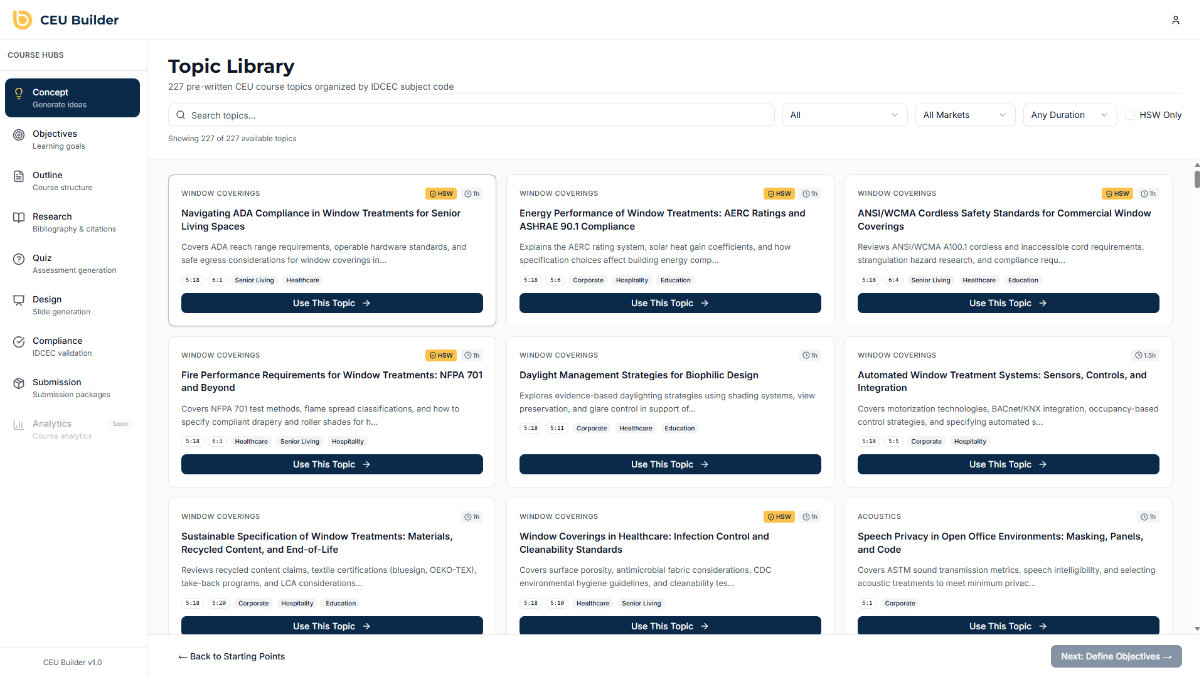
Discover how CEU Builder’s unmatched expertise and streamlined process can fast-track your CEU course development and drive lasting specification growth. Visit https://ceubuilder.com/ to start your journey towards transforming education into your most powerful marketing asset.
Frequently Asked Questions
What are the main benefits of CEU accreditation for hospitality brands?
CEU accreditation offers hospitality brands several advantages, including enhanced engagement with architects and designers, increased credibility as industry leaders, and measurable growth in specification rates. To maximize these benefits, develop CEU courses that address real design challenges, ensuring they provide genuine value and educational content.
How can CEU courses help accelerate the sales cycle for hospitality brands?
CEU courses can turn cold sales prospects into warm leads by offering valuable educational experiences that deepen engagement with design professionals. To accelerate your sales cycle, focus on creating informative content that builds trust and leads to faster decision-making among participants.
What steps should I take to develop effective CEU courses?
To create effective CEU courses, identify the specific educational needs of architects and designers, and ensure the content addresses real-world challenges. Conduct a needs assessment with potential participants and draft a course outline that aligns with their professional development goals.
How can I track the effectiveness of my CEU programs?
You can track the effectiveness of your CEU programs by implementing robust mechanisms for measuring course completions, engagement metrics, and subsequent specification rates. Use these insights to refine your courses and better connect educational content with real business outcomes.
What is the importance of preventing accreditation delays in CEU development?
Preventing accreditation delays is crucial because they can disrupt your educational initiatives and impact your brand’s reputation. Invest time in understanding compliance requirements and establish a thorough review process to ensure your CEU submissions are complete and aligned with industry standards.
How does CEU accreditation create a competitive advantage for hospitality brands?
CEU accreditation distinguishes your brand as a trusted resource and thought leader in the hospitality industry, fostering deeper professional relationships. To leverage this advantage, invest in high-quality educational experiences that solve design challenges and contribute to your long-term market positioning.
Recommended
