

Course Approval: Unlocking IDCEC Provider Benefits

Most American building product manufacturers underestimate how rigorous the IDCEC course approval process can be, with over 30 percent of initial submissions failing on their first attempt. For Vice Presidents of Marketing, understanding this approval journey is crucial since every rejected course delays time-to-market and impacts CEU program efficiency. This article breaks down what truly matters for American organizations aiming to win IDCEC approval, clarifying essential steps and revealing how to create courses that resonate with today’s design professionals.
Table of Contents
- Defining Course Approval In Continuing Education
- Types Of Course Approval: IDCEC Vs. AIA
- The Step-By-Step Course Approval Process
- Essential Requirements And Submission Guidelines
- Financial, Data, And Compliance Implications
- Pitfalls To Avoid When Seeking Approval
Key Takeaways
| Point | Details |
|---|---|
| Course Approval is Necessary | Continuing education courses must be approved by organizations like IDCEC and AIA to ensure they meet professional standards. |
| Health, Safety, and Welfare Focus | Courses must demonstrate HSW value, reflecting their relevance to professional practice in interior design and architecture. |
| Rigorous Submission Process | A multi-stage review process requires detailed documentation, expert evaluation, and possible revisions to achieve approval. |
| Avoid Common Pitfalls | Course developers should steer clear of generic content and ensure clear learning objectives to enhance approval chances. |
Defining Course Approval in Continuing Education
Continuing education course approval represents a critical process where educational content is systematically evaluated and verified to meet professional standards set by credentialing organizations like the Interior Design Continuing Education Council (IDCEC). This rigorous assessment ensures that educational materials deliver legitimate, high-quality learning experiences that advance professional knowledge and skills.
The course approval process involves multiple layers of scrutiny designed to validate the educational integrity of training materials. Professional organizations examine courses for several key criteria, including subject matter expertise, alignment with industry standards, and meaningful learning objectives. Rejection reasons can significantly impact a course’s potential for accreditation, making it essential for manufacturers and content creators to understand the precise requirements.
Within the interior design and architecture industries, course approval typically requires demonstrating how the educational content provides Health, Safety, and Welfare (HSW) value. Organizations like IDCEC mandate that approved courses contribute substantive professional development, not merely serve as marketing materials. Understanding the nuanced differences between HSW and general continuing education credits becomes crucial for content developers seeking successful course certification.
The approval process itself involves comprehensive review stages where subject matter experts evaluate course materials, learning objectives, quiz questions, and overall educational merit. Course developers must provide clear evidence of professional value, demonstrate academic rigor, and align their content with specific industry knowledge domains. Successful course approval transforms educational content from simple information into recognized professional development opportunities.
Pro Tip: Always include specific, measurable learning objectives that directly connect to professional practice to maximize your chances of course approval.
Types of Course Approval: IDCEC vs. AIA
Continuing education course approval in the architecture and interior design industries involves two primary credentialing bodies: the Interior Design Continuing Education Council (IDCEC) and the American Institute of Architects (AIA). Each organization maintains distinct standards and requirements for professional development courses, creating a nuanced landscape for content developers and educational providers.
The IDCEC focuses exclusively on interior design professionals, requiring courses to demonstrate Health, Safety, and Welfare (HSW) value specifically tailored to design practice. Manufacturers seeking to become their own IDCEC providers must navigate a specialized approval process that emphasizes design-specific professional competencies. In contrast, the AIA provides a broader architectural perspective, offering course approval for professionals across architectural disciplines and allowing for more diverse educational content.

Key differences between IDCEC and AIA course approvals include their subject matter scope, credit allocation methodologies, and specific learning objective requirements. The IDCEC typically demands more granular design-specific content, while the AIA allows for a wider range of architectural and building science topics. Both organizations require rigorous documentation, comprehensive learning objectives, and clear demonstrations of professional development value. Course developers must carefully align their educational materials with these distinct organizational standards to achieve successful accreditation.
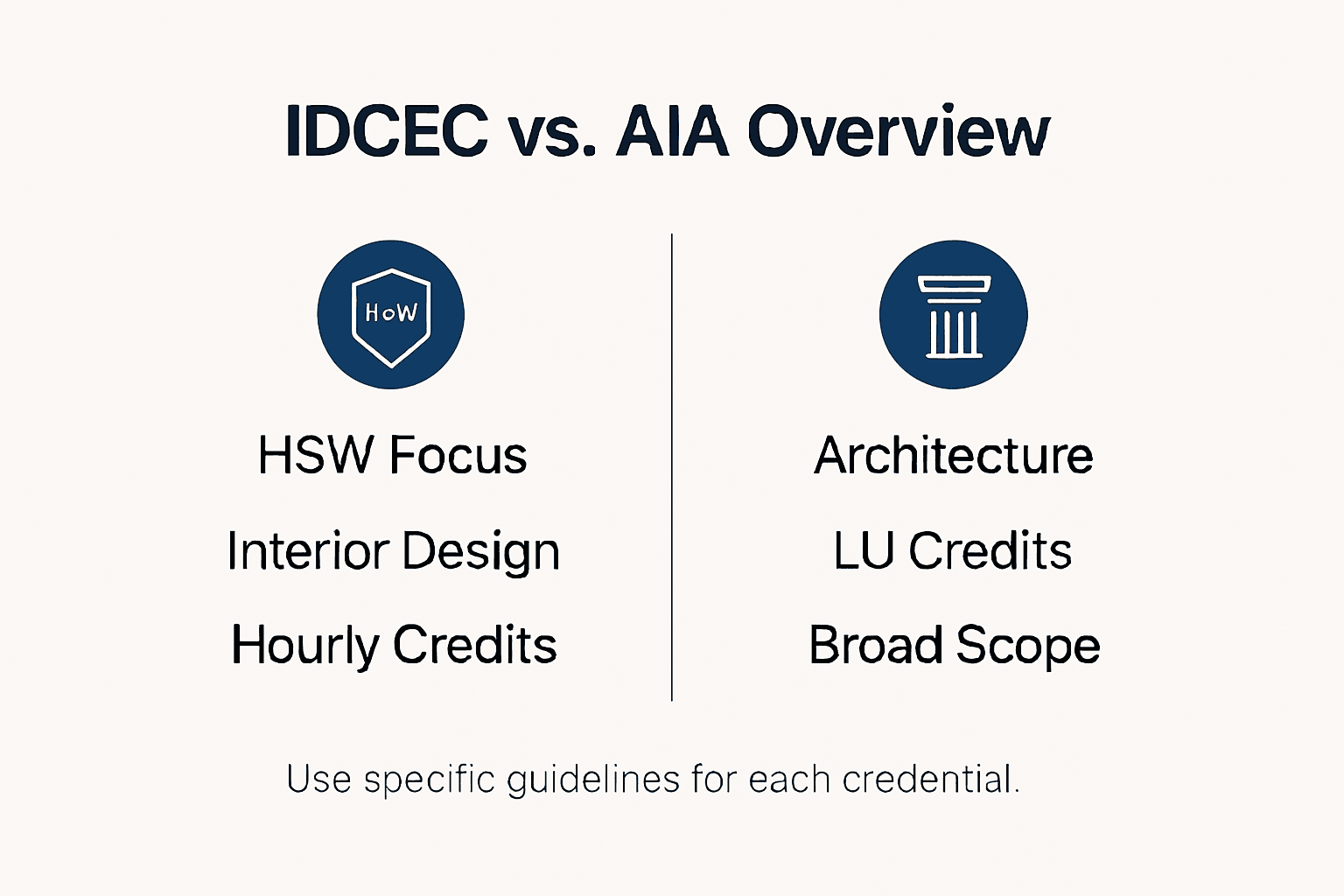
Both credentialing bodies share a fundamental commitment to maintaining high-quality professional education standards. They require detailed course outlines, precise learning objectives, and comprehensive assessment methods to ensure that continuing education genuinely advances professional knowledge and practice. Successful course approval means creating content that goes beyond basic information and provides meaningful, actionable insights for design and architectural professionals.
Here is a side-by-side comparison of IDCEC and AIA course approval standards:
| Aspect | IDCEC Requirements | AIA Requirements |
|---|---|---|
| Primary Audience | Interior design professionals | All architectural disciplines |
| Content Focus | Health, Safety, Welfare (HSW) | Wider range of topics, including building science |
| Approval Emphasis | Design-specific professional value | Broader professional growth |
| Submission Detail | Granular, design-aligned objectives | Flexible learning objectives, diverse topics |
| Assessment Rigorousness | Highly detailed, design-focused | Comprehensive, profession-wide applicability |
Pro Tip: Develop course content with specific, measurable learning objectives that directly address the unique professional development requirements of each credentialing organization.
The Step-By-Step Course Approval Process
Navigating the course approval process requires a systematic approach that transforms educational content into recognized professional development credentials. Manufacturers and content creators must meticulously prepare their materials to meet the rigorous standards set by credentialing organizations like IDCEC and AIA, ensuring their courses provide genuine value to design professionals.
How to become an IDCEC provider involves a comprehensive multi-stage review process that demands precision and strategic planning. The typical course approval journey includes several critical stages:
- Initial Content Development
- Create comprehensive course materials
- Develop detailed learning objectives
- Ensure Health, Safety, and Welfare (HSW) relevance
- Align content with professional practice standards
- Preliminary Review
- Self-assess course materials against organizational guidelines
- Verify subject matter expertise
- Confirm alignment with professional development requirements
- Prepare detailed course documentation
- Formal Submission
- Submit comprehensive course package
- Include detailed outline, learning objectives, and assessment materials
- Provide instructor qualifications
- Pay required submission fees
- Expert Evaluation
- Subject matter experts conduct thorough review
- Assess content accuracy and professional relevance
- Verify learning objective achievement potential
- Check compliance with continuing education standards
- Revision and Refinement
- Address potential feedback and recommendations
- Make necessary content adjustments
- Resubmit updated materials if required
- Demonstrate responsiveness to expert guidance
Successful course approval demands more than just creating educational content. It requires a strategic approach that demonstrates genuine commitment to professional development and industry-specific knowledge enhancement. Course developers must think beyond information delivery and focus on creating transformative learning experiences that advance professional practice.
Credentialing organizations like IDCEC and AIA maintain stringent standards to ensure that continuing education truly serves the professional growth of design and architectural practitioners. The approval process acts as a quality control mechanism, filtering out generic or marketing-driven content and elevating courses that provide substantive, actionable professional insights.
Pro Tip: Anticipate potential review feedback by conducting a rigorous internal review that simulates the credentialing organization’s evaluation process before formal submission.
Essential Requirements and Submission Guidelines
Credentialing organizations like IDCEC and AIA establish comprehensive requirements that demand meticulous attention to detail from course developers. These guidelines ensure that continuing education materials meet rigorous professional development standards, protecting the integrity of design and architectural education.
Manufacturers exploring IDCEC provider opportunities must navigate a complex landscape of submission requirements that go far beyond simple content creation. The essential submission guidelines typically encompass several critical dimensions:
Documentation Requirements
- Comprehensive course outline
- Detailed learning objectives
- Instructor qualification documentation
- Professional references
- Proof of subject matter expertise
Content Compliance Standards
- Health, Safety, and Welfare (HSW) Alignment
- Direct professional practice relevance
- Clear risk mitigation components
- Demonstrable industry impact
- Technical Accuracy
- Current industry research integration
- Verifiable source materials
- Absence of promotional content
Submission Technical Specifications
- Formatted digital course materials
- Professional presentation design
- Standardized file formats
- Comprehensive instructor guides
- Assessment and quiz materials
- Supporting multimedia resources
Successful submissions require a holistic approach that demonstrates not just informational depth, but genuine commitment to advancing professional practice. Course developers must transform educational content into strategic learning experiences that provide actionable insights, moving beyond generic information delivery to create meaningful professional development opportunities.
Credentialing bodies conduct thorough evaluations that extend well beyond surface-level content review. They assess the philosophical and practical implications of educational materials, ensuring that each approved course genuinely contributes to professional growth, ethical practice, and industry innovation.
Pro Tip: Develop a comprehensive internal checklist that mirrors credentialing organization guidelines to preemptively address potential submission gaps and increase first-pass approval probability.
Financial, Data, and Compliance Implications
The landscape of continuing education course development involves complex financial, data management, and regulatory compliance considerations that extend far beyond simple content creation. Manufacturers must navigate a multifaceted ecosystem where strategic decision making intersects with professional development standards and potential economic opportunities.
Becoming an IDCEC provider requires understanding the intricate financial implications associated with professional credentialing. The financial dimensions of course approval encompass several critical areas:
Financial Considerations
- Initial registration fees
- Course development costs
- Submission and review expenses
- Potential ongoing compliance maintenance
- Revenue generation potential through educational offerings
Data Management Implications
- Learner Data Ownership
- Complete student enrollment tracking
- Comprehensive completion record maintenance
- Privacy and security compliance requirements
- Analytics and Reporting
- Detailed engagement metrics
- Professional development impact assessment
- Regulatory reporting capabilities
Compliance Risk Management
- Adherence to professional credentialing standards
- Continuous regulatory landscape monitoring
- Documentation integrity verification
- Ethical educational content development
- Transparent reporting mechanisms
Successful providers understand that course approval is not merely an administrative task but a strategic opportunity to position their organization as a thought leader. By developing high-quality, compliant educational content, manufacturers can transform continuing education from a regulatory requirement into a powerful marketing and relationship-building tool that drives specification and industry credibility.
The financial landscape of continuing education extends beyond direct monetary considerations. Manufacturers must view course development as an investment in professional relationships, brand positioning, and long-term industry influence. The most successful providers approach credentialing as a holistic strategy that balances educational integrity, professional development, and strategic business objectives.
Pro Tip: Develop a comprehensive financial model that considers both direct costs and indirect benefits, including potential specification and brand authority gains from high-quality continuing education offerings.
Pitfalls to Avoid When Seeking Approval
Continuing education course approval demands a strategic and nuanced approach that requires manufacturers to navigate complex credentialing landscapes while avoiding common developmental missteps. Understanding these potential pitfalls becomes crucial for successful course certification and professional recognition.
Manufacturers exploring IDCEC provider opportunities must be particularly vigilant about several critical areas that can derail course approval efforts:
Content Development Pitfalls
- Overly promotional material
- Lack of clear learning objectives
- Insufficient Health, Safety, and Welfare (HSW) alignment
- Generic or outdated industry information
- Inadequate subject matter depth
Documentation and Submission Errors
- Incomplete instructor qualification records
- Inconsistent formatting
- Missing required supporting materials
- Poorly structured course outlines
- Inadequate assessment mechanisms
Compliance and Regulatory Risks
- Neglecting current industry standards
- Failing to demonstrate professional relevance
- Insufficient research documentation
- Unclear learning outcome measurements
- Lack of comprehensive source verification
Successful course developers recognize that approval is not simply about passing an administrative checkpoint. It represents a comprehensive evaluation of educational quality, professional integrity, and genuine commitment to advancing industry knowledge. Credentialing organizations seek courses that transform professional practice, not merely satisfy bureaucratic requirements.
The most sophisticated manufacturers approach course development as a strategic opportunity for thought leadership. They understand that each submitted course is an opportunity to demonstrate deep industry expertise, build professional credibility, and create meaningful learning experiences that genuinely advance design and architectural practice.
The table below summarizes common pitfalls and strategies to avoid them during course approval:
| Pitfall Area | Typical Mistake | Proactive Strategy |
|---|---|---|
| Content | Overly promotional material | Focus on educational value, avoid brand emphasis |
| Documentation | Missing instructor credentials | Prepare a thorough, verified documentation set |
| Compliance | Ignoring latest standards | Regularly review and update according to regulations |
Pro Tip: Conduct a rigorous internal peer review that simulates the credentialing organization’s evaluation process, identifying potential weaknesses before formal submission.
Take Control of Your IDCEC Course Approval and Benefits Today
The article reveals how complex and time-consuming the IDCEC course approval process can be, especially when trying to align content with Health, Safety, and Welfare (HSW) standards while avoiding costly delays and rejection reasons. If you find yourself frustrated by long approval timelines, hidden fees, or lack of control over your continuing education programs, you are not alone. Many manufacturers face similar challenges, from navigating intricate credentialing criteria to managing expensive legacy platform contracts that limit data access and inflate costs.
CEU Builder offers a transformative solution that directly addresses these pain points. Our AI-powered platform streamlines course development, mapping IDCEC subject codes and generating measurable learning objectives in minutes rather than months. By becoming your own accredited provider instead of renting space in directories, you gain full ownership of learner data and save up to 95% on costs over five years. Stop paying exorbitant fees and regain control with transparent pricing and guaranteed first-pass IDCEC approval. Discover why building your own program is smarter than relying on gatekeeper platforms like AEC Daily or RedVector by exploring why manufacturers should be their own IDCEC providers.
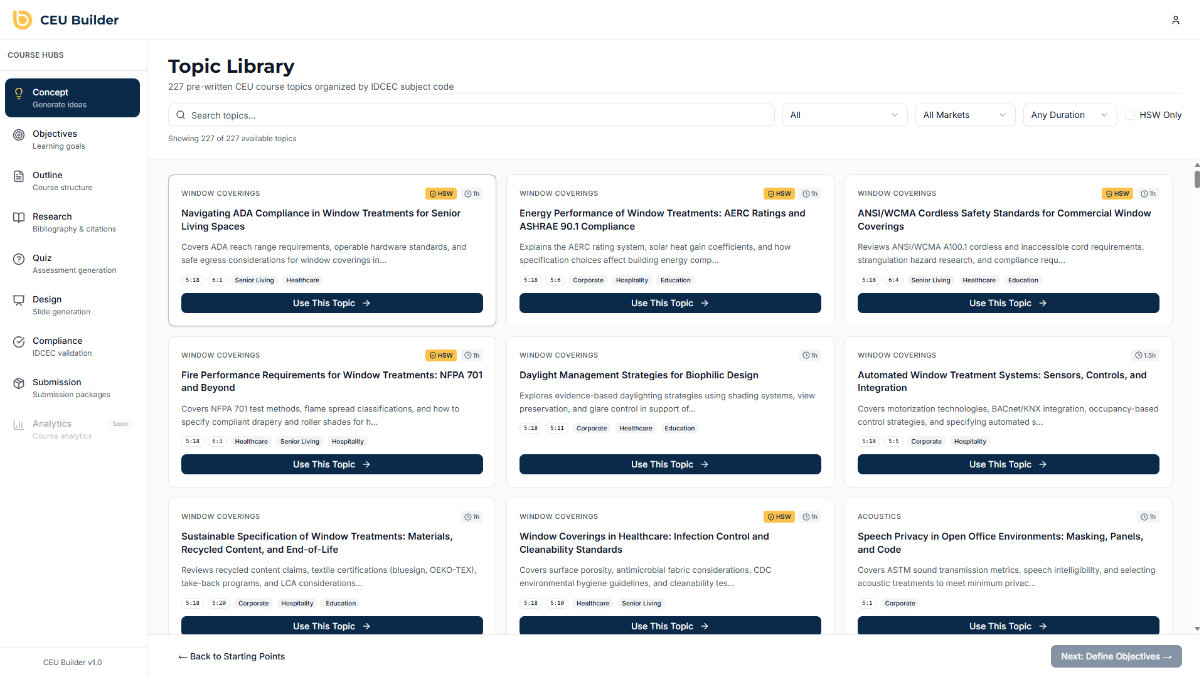
Get started now by leveraging cutting-edge AI compliance tools and a proven provider ownership model. Visit CEU Builder to unlock fast, affordable, and complete control over your interior design continuing education courses. Take the first step toward course approval success and maximize your professional development impact without the legacy platform restrictions.
Frequently Asked Questions
What is the course approval process for IDCEC providers?
The course approval process for IDCEC providers involves several stages, including initial content development, preliminary review, formal submission, expert evaluation, and possible revision based on feedback from subject matter experts.
How do I ensure my continuing education course meets IDCEC standards?
To ensure your course meets IDCEC standards, focus on creating comprehensive course materials that align with Health, Safety, and Welfare (HSW) criteria, include clear learning objectives, and demonstrate subject matter expertise. Additionally, pre-assess your course against IDCEC guidelines.
What are common reasons for IDCEC course rejection?
Common reasons for IDCEC course rejection include overly promotional material, lack of clear learning objectives, insufficient HSW alignment, outdated information, and inadequate documentation of subject matter expertise.
How can becoming an IDCEC provider benefit my organization?
Becoming an IDCEC provider allows your organization to offer accredited continuing education courses, enhance your brand’s credibility, build professional relationships in the industry, and generate potential revenue from educational offerings.
Recommended
