

CE Course Registration Process – Control Costs and Compliance

Most American building product manufacturers waste valuable staff hours each year navigating outdated CEU course registration platforms. In a market where compliance and professional development impact both reputation and revenue, even small delays can create ripple effects across your entire business. Uncover practical ways to simplify CEU course registration and take ownership over your continuing education process so you can focus on what matters most: driving specification and sales success.
Table of Contents
- What Is the CE Course Registration Process
- Types of CE Providers and Course Formats
- Essential Steps for IDCEC and AIA Compliance
- Costs, Timelines, and Common Missteps
- Provider Ownership vs. Legacy Platforms
- Data Ownership, ROI, and Long-Term Benefits
Key Takeaways
| Point | Details |
|---|---|
| CE Course Registration | Professionals must navigate a systematic platform, ensuring verification of credentials and compliance with industry requirements during registration. |
| Types of CE Providers | Select accredited providers that offer diverse course formats to suit professional development needs. |
| IDCEC and AIA Compliance | Understand and document credit requirements to maintain compliance for professional licensing effectively. |
| Data Ownership | Emphasizing data ownership allows for better tracking of educational outcomes and enhances strategic decision-making in professional development. |
What Is the CE Course Registration Process
The CE (Continuing Education) course registration process is a structured administrative workflow that enables professionals, particularly in architecture and interior design, to maintain their credentials and stay current with industry standards. This process typically involves multiple critical steps designed to ensure compliance, track educational progress, and manage professional development requirements.
Professionals seeking to register for CE courses must first navigate a systematic registration platform that manages course selection, enrollment, and documentation. The process generally includes several key components: verifying professional credentials, selecting appropriate courses that meet specific industry requirements, completing online registration forms, and ensuring payment and documentation are accurately submitted.
The registration workflow usually encompasses several strategic stages:
- Professional verification of credentials
- Course eligibility assessment
- Online platform navigation
- Course selection matching industry-specific requirements
- Payment processing
- Automatic certificate generation and tracking
Building product manufacturers and design professionals must pay close attention to specific details during registration, such as confirming IDCEC (Interior Design Continuing Education Council) subject codes, verifying Health, Safety, and Welfare (HSW) credit eligibility, and ensuring courses align with their professional development needs. The digital registration process has significantly streamlined what was previously a complex, paper-based system.
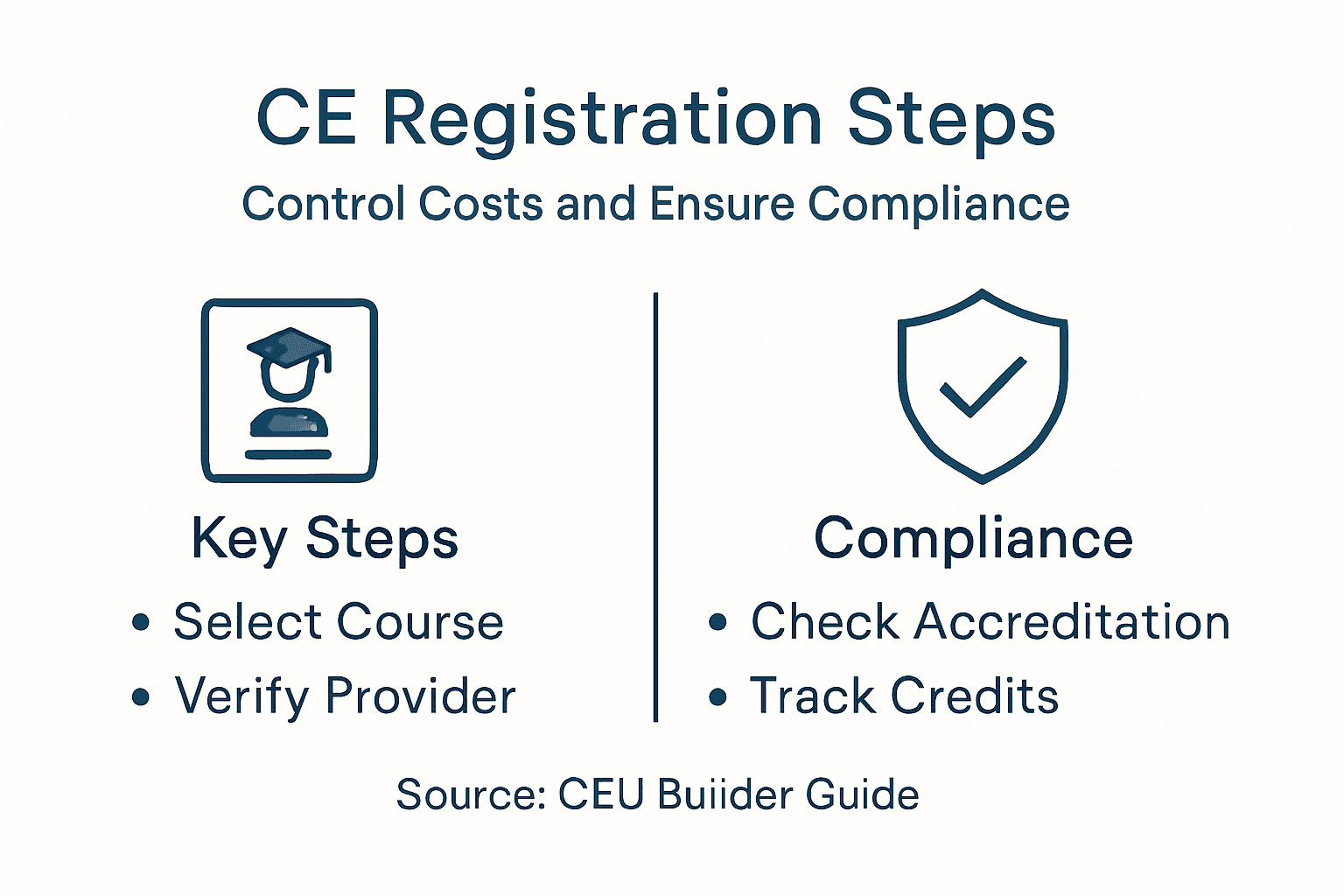
Pro tip: Keep digital copies of all course registrations and completion certificates in a centralized folder for easy access during professional license renewal periods.
Types of CE Providers and Course Formats
Continuing Education (CE) providers represent a diverse ecosystem of educational resources designed to support professional development across various industries. Course formats range from traditional live events to digital learning platforms, offering professionals flexible options for maintaining and expanding their credentials.
The primary types of CE providers can be categorized into several key groups:
- Academic institutions
- Professional associations
- Government agencies
- Industry-specific training organizations
- Online learning platforms
- Manufacturer-sponsored educational programs
Course formats have evolved significantly, now encompassing multiple delivery methods to accommodate different learning preferences and professional schedules. These formats include:
- Live conferences and workshops
- Webinars and virtual classrooms
- Self-paced online modules
- Podcast and audio learning
- Video-based training
- Interactive digital courses
- Hybrid learning experiences
For building product manufacturers and design professionals, selecting the right CE provider and course format is critical. Providers like IDCEC (Interior Design Continuing Education Council) offer specific guidelines for course content, ensuring that professionals receive high-quality, relevant educational experiences that meet industry standards and licensing requirements.

To help navigate the CE course landscape, here’s a summary of provider types and their typical benefits:
| Provider Type | Primary Benefit | Common Audience |
|---|---|---|
| Academic institutions | In-depth, accredited content | Professionals, students |
| Professional associations | Industry-specific expertise | Established professionals |
| Government agencies | Regulatory compliance focus | Licensed practitioners |
| Online learning platforms | Flexible, on-demand access | Busy or remote professionals |
| Manufacturer-sponsored programs | Product-focused learning | Industry partners, designers |
Pro tip: Always verify a CE course’s accreditation and HSW (Health, Safety, and Welfare) credit eligibility before registration to maximize professional development value.
Essential Steps for IDCEC and AIA Compliance
Building product manufacturers navigating continuing education requirements must understand the critical compliance frameworks established by the IDCEC and AIA. Compliance involves meeting specific educational and documentation standards designed to ensure professionals maintain current industry knowledge and professional credentials.
The essential compliance steps for IDCEC and AIA certification include:
- Verify Professional Credentials
- Confirm current professional licensing status
- Ensure eligibility for continuing education credits
- Understand Credit Requirements
- Identify total required Health, Safety, and Welfare (HSW) credits
- Track annual and renewal period credit needs
- Course Selection Strategy
- Choose courses from accredited providers
- Ensure content matches professional development objectives
- Documentation Management
- Maintain detailed records of completed courses
- Collect and organize completion certificates
- Submission and Reporting
- Submit credits through official IDCEC or AIA platforms
- Meet reporting deadlines for license maintenance
Manufacturers must pay particular attention to the nuanced requirements of IDCEC subject codes and AIA credit classifications, which dictate the acceptable types of educational content for professional development. Each course must be carefully evaluated to ensure it meets the specific criteria for HSW credits and professional learning objectives.
Pro tip: Create a digital folder with subfolders for each year to systematically organize and quickly retrieve your continuing education documentation for effortless license renewal.
Costs, Timelines, and Common Missteps
Continuing Education (CE) course registration involves strategic financial planning and meticulous attention to detail. Professionals often encounter complex budgeting and compliance challenges that can significantly impact their professional development and licensing status.
Cost considerations for CE courses typically include:
- Direct course registration fees
- Associated travel expenses
- Study materials and resources
- Potential membership dues
- Potential technology or platform access charges
Timeline management is equally critical, with key milestones including:
- Registration deadlines
- Course completion windows
- Credit reporting periods
- License renewal requirements
- Annual professional development cycles
Building product manufacturers and design professionals must be vigilant about common missteps that can compromise their CE compliance. Critical errors include failing to verify course accreditation, misunderstanding Health, Safety, and Welfare (HSW) credit requirements, inadequate documentation, and missing reporting deadlines. Each of these mistakes can potentially jeopardize professional credentials and create unexpected compliance gaps.
Pro tip: Create a digital spreadsheet tracking course costs, completion dates, and credit hours to proactively manage your continuing education investment and prevent compliance oversights.
Provider Ownership vs. Legacy Platforms
The landscape of continuing education platforms is rapidly transforming, with manufacturers increasingly recognizing the limitations of traditional legacy systems. Modern learning platforms emphasize flexibility and organizational control, challenging the outdated approaches of established providers.
Key differences between provider ownership and legacy platforms include:
- Data Ownership
- Legacy: Limited or restricted data access
- Provider-Owned: Complete learner data control
- Cost Structure
- Legacy: Hidden fees, annual price increases
- Provider-Owned: Transparent, predictable pricing
- Customization
- Legacy: Rigid, one-size-fits-all interfaces
- Provider-Owned: Tailored learning experiences
- Integration Capabilities
- Legacy: Limited third-party connections
- Provider-Owned: Seamless enterprise tool integration
Building product manufacturers face significant strategic challenges with legacy platforms that often charge exorbitant fees while providing minimal value. Proprietary platforms restrict innovation, charging between $50,000 to $120,000 annually for administrative services that can be dramatically streamlined through modern, AI-powered solutions. The shift towards provider ownership represents a fundamental reimagining of continuing education management, prioritizing efficiency, transparency, and professional development.
The chart below compares legacy and provider-owned CE platforms, clarifying possible business impacts:
| Factor | Legacy Platform Drawback | Provider-Owned Benefit |
|---|---|---|
| Data Control | Vendor-restricted access | Full organizational ownership |
| Pricing Model | Escalating, less transparent fees | Predictable, clear annual costs |
| Customization | Limited design and features | Custom-tailored learning experiences |
| Integration | Poor compatibility with new tools | Easy enterprise system integration |
Pro tip: Conduct a comprehensive cost-benefit analysis comparing your current legacy platform expenses against a provider-owned solution to uncover potential annual savings and operational improvements.
Data Ownership, ROI, and Long-Term Benefits
Building product manufacturers increasingly recognize that data ownership represents far more than a technical capability—it’s a strategic imperative for sustainable professional development. Demonstrating ROI through comprehensive data analysis enables organizations to transform continuing education from an administrative expense into a strategic investment.
The long-term benefits of robust data ownership include:
- Precise learner tracking and engagement metrics
- Real-time performance insights
- Customized learning pathway development
- Direct correlation between educational activities and specification outcomes
- Elimination of third-party data intermediaries
- Comprehensive compliance documentation
Financial advantages extend beyond immediate cost savings. Manufacturers can now directly measure the impact of continuing education programs by tracking metrics such as learner engagement, course completion rates, and most critically, the relationship between educational activities and actual specification conversions. This data-driven approach allows for strategic refinement of educational content, ensuring that each course delivers maximum value to both the manufacturer and design professionals.
Pro tip: Implement a quarterly data review process to analyze your continuing education program’s performance, identifying trends, learner preferences, and direct correlations with specification and sales metrics.
Take Control of Your CE Course Registration Costs and Compliance Today
The article highlights the challenges building product manufacturers face navigating the CE course registration process, including costly legacy platforms, complicated compliance steps like managing IDCEC subject codes and HSW credit requirements, and lack of data ownership. If you are tired of paying exorbitant fees and dealing with 12-18 month course development timelines without control over your provider status or learner data, there is a better way.
At CEU Builder, we empower manufacturers to become their own accredited education providers with transparent pricing, AI-powered compliance tools, and full data ownership. Unlike legacy platforms, CEU Builder drastically reduces costs and development time while giving you complete control over your continuing education programs. Learn how to streamline your IDCEC provider registration and ensure your courses meet rigorous HSW and AIA compliance standards quickly.
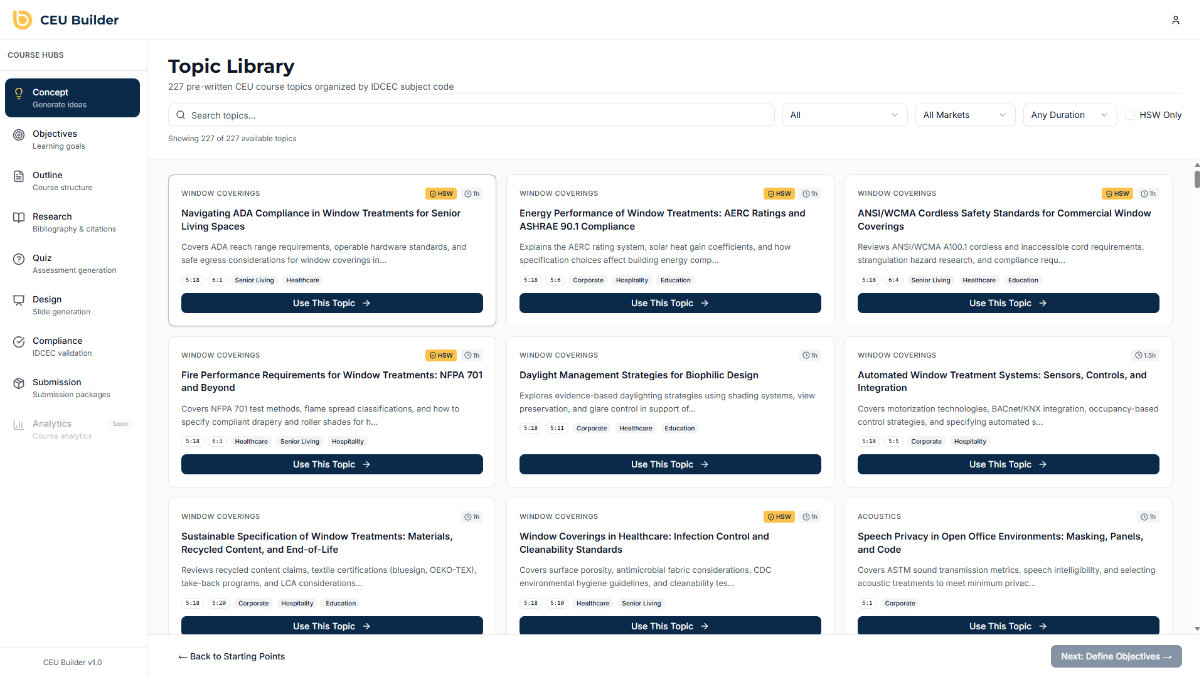
Stop renting your provider status and paying six-figure fees for what should be your own program. Visit CEU Builder to discover how you can own your CEU future, save hundreds of thousands of dollars, and take charge of compliance and ROI through smart education technology. Start building your first course in weeks, not months, and gain the clarity and control your team deserves.
Frequently Asked Questions
What is the CE course registration process?
The CE course registration process involves several steps including verifying professional credentials, selecting courses that meet industry requirements, completing online forms, and submitting payment along with necessary documentation.
How can I ensure my CE courses qualify for HSW credits?
To ensure that your CE courses qualify for Health, Safety, and Welfare (HSW) credits, verify the course accreditation and confirm that it meets the specific credit requirements outlined by relevant professional organizations like IDCEC or AIA.
What types of CE providers should I consider when choosing courses?
Consider various types of CE providers such as academic institutions, professional associations, government agencies, online learning platforms, and manufacturer-sponsored programs, each offering unique benefits and formats.
What are common mistakes to avoid during the CE course registration process?
Common mistakes include failing to verify course accreditation, misunderstanding HSW credit requirements, insufficient documentation, and missing reporting deadlines, all of which can jeopardize your professional credentials.
Recommended
- How to Become an IDCEC Provider in 2026 (Step-by-Step Guide) – CEU Builder
- CEU Builder – Stop Paying Six Figures to Be Buried in a Directory
- Services – CEU Builder
- Why Manufacturers Should Be Their Own IDCEC Provider – CEU Builder
- Access Control Management – Cloudology
- Come organizzare corsi sicurezza aziendale per la conformità – Sikuro
- Anger Management Costs – What You Really Pay For – Mastering Conflict
