

Why Approve Your Own Courses: ROI and Control

Paying over $50,000 each year for legacy CEU listings drains budgets for many American building product manufacturers. These high costs frustrate Marketing VPs who want more control, faster rollouts, and real data ownership in their education programs. By understanding what course provider approval really means, you can escape restrictive models, save resources, and turn continuing education into a strong marketing tool that drives sales.
Table of Contents
- Defining Course Provider Approval In CEU Programs
- Traditional Sponsor Model Versus Provider Ownership
- Key Benefits: Control, Speed, And Cost Savings
- Data Ownership And ROI Tracking Advantages
- Common Pitfalls With Legacy Platform Models
Key Takeaways
| Point | Details |
|---|---|
| Course Provider Approval is Essential | Organizations must complete the approval process to offer CEUs, ensuring their educational content meets professional standards. |
| Provider Ownership Enhances Control | Transitioning to the provider ownership model allows manufacturers to have complete control over course content and learner data, avoiding costs associated with traditional sponsor models. |
| Data Ownership Provides Valuable Insights | Gaining access to comprehensive learner data enables organizations to measure ROI accurately and enhance course effectiveness. |
| Legacy Platforms Present Operational Challenges | Traditional CEU platforms impose significant costs and limitations, making it crucial for manufacturers to assess their current models for potential inefficiencies. |
Defining Course Provider Approval in CEU Programs
Course provider approval represents a critical credentialing process that enables organizations to officially offer continuing education units (CEUs) within professional development frameworks. Manufacturers seeking to establish their own educational programs must navigate complex accreditation requirements that validate their instructional content and delivery methods.
The approval process involves multiple critical components, including obtaining a provider number, demonstrating compliance with professional standards, and ensuring educational activities meet specific regulatory guidelines. Organizations must prove they can develop curriculum that maintains high-quality instructional standards while addressing specific professional learning objectives. These requirements help protect the integrity of professional continuing education by establishing rigorous evaluation metrics for course development and delivery.
To successfully achieve course provider approval, manufacturers must typically complete several key steps:
- Submit detailed course curriculum for professional review
- Demonstrate instructor qualifications and expertise
- Provide comprehensive learning objective documentation
- Establish mechanisms for tracking participant completion and performance
- Comply with specific subject matter and instructional design standards
Pro tip: When preparing your course approval application, meticulously document every aspect of your curriculum development process to demonstrate comprehensive understanding of professional education standards.
Traditional Sponsor Model Versus Provider Ownership
The continuing education landscape has long been dominated by a traditional sponsor model where external organizations control course development and distribution. In this approach, manufacturers essentially rent space within existing educational platforms, surrendering significant control over their content and learner data. Partnership models in education reveal fundamental limitations of this approach, highlighting how external sponsorship constrains institutional autonomy and strategic educational initiatives.

Under the traditional sponsor model, manufacturers typically pay substantial fees to appear in course directories, with minimal control over curriculum design, learner engagement, and data tracking. These platforms act as intermediaries, charging premium rates for limited visibility and restrictive reporting mechanisms. Conversely, the provider ownership model empowers manufacturers to become direct course creators, giving them complete control over content development, delivery, and learner relationship management.
Key differences between the two models include:
- Data Ownership: Sponsor model limits manufacturer access to learner information
- Financial Control: External platforms take significant revenue percentages
- Curriculum Flexibility: Restricted content development in traditional models
- Strategic Alignment: Provider ownership allows direct educational marketing
- Cost Structure: Elimination of recurring directory listing fees
Pro tip: Calculate your total annual CEU expenses under the traditional model before transitioning to provider ownership to understand your potential cost savings and strategic advantages.
Here’s how provider ownership transforms continuing education compared to the traditional sponsor model:
| Factor | Traditional Sponsor Model | Provider Ownership Model |
|---|---|---|
| Content Customization | Limited by platform guidelines | Fully tailored to organizational goals |
| Revenue Retention | Significant platform commissions | Direct revenue for manufacturer |
| Course Launch Timeline | 12-18 months | 4-6 weeks, much faster |
| Access to Learner Data | Minimal, summary data only | Complete, real-time tracking |
| Marketing Integration | Difficult to align efforts | Direct connection with sales strategy |
Key Benefits: Control, Speed, and Cost Savings
Manufacturers seeking to transform their continuing education approach can unlock substantial advantages through provider ownership. Continuous professional development programs demonstrate significant strategic benefits, including enhanced control over content, accelerated course development, and dramatic cost reductions across multiple operational dimensions.
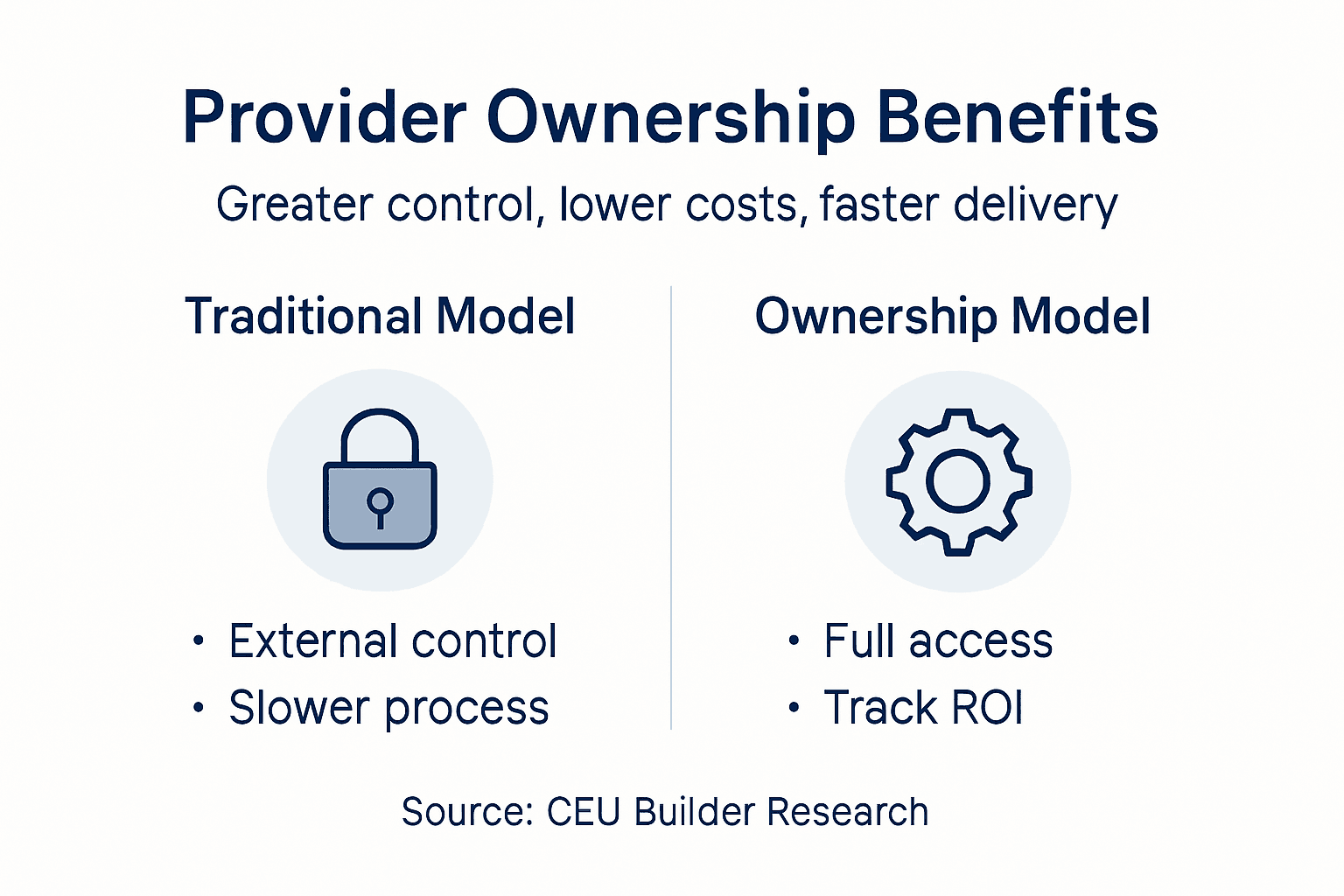
The provider ownership model fundamentally reshapes the economic landscape of continuing education. Instead of paying exorbitant fees to directory platforms, manufacturers can redirect resources toward creating targeted, high-quality educational content that directly supports their strategic marketing objectives. By eliminating intermediary costs, organizations can reinvest savings into more sophisticated course development, more engaging multimedia content, and more precise tracking of learner interactions.
Key benefits of provider ownership include:
- Complete Content Control: Design courses exactly matching organizational goals
- Rapid Course Development: Reduce timelines from 18 months to 4-6 weeks
- Direct Data Ownership: Capture and analyze complete learner engagement metrics
- Cost Efficiency: Eliminate $50,000-$120,000 annual directory listing expenses
- Strategic Marketing: Use courses as precision specification-driving tools
Pro tip: Calculate your current annual CEU expenses and compare them against a provider-owned model to reveal your potential five-year cost savings and strategic advantages.
Data Ownership and ROI Tracking Advantages
Data ownership transforms continuing education from a passive expense into a strategic asset for manufacturers. Continuous education data tracking enables unprecedented insights into learner behavior, course effectiveness, and direct specification impact that traditional platforms systematically conceal from course creators.
Under the provider ownership model, manufacturers gain complete visibility into critical performance metrics that directly correlate to business outcomes. Instead of receiving generic engagement reports, organizations can now trace precise learner journeys from course enrollment through specification recommendations, creating a comprehensive attribution model that demonstrates the tangible return on investment of their educational initiatives. This granular data allows marketing and sales teams to understand exactly how educational content drives specification and revenue generation.
Key data ownership advantages include:
- Comprehensive Learner Tracking: Monitor individual learner progression
- Direct Attribution Modeling: Connect course engagement to specification rates
- Real-Time Performance Analytics: Instant insights into course effectiveness
- Compliance Documentation: Automated reporting for professional certifications
- Strategic Content Optimization: Data-driven course design and refinement
Pro tip: Implement a systematic method for tracking learner data from initial course enrollment through final specification to create a comprehensive ROI measurement framework.
Common Pitfalls With Legacy Platform Models
Legacy continuing education platforms represent a complex web of operational challenges that systematically undermine manufacturers’ educational and marketing objectives. Legacy platform integration challenges reveal fundamental structural problems that plague traditional CEU directory models, creating significant barriers to innovation and strategic content development.
These platforms operate as technological relics, imposing hidden costs and restrictive frameworks that limit manufacturers’ ability to create responsive, targeted educational content. Typical pitfalls include exorbitant annual fees, opaque data reporting, limited customization options, and complete loss of learner relationship management. Manufacturers find themselves trapped in expensive ecosystems that provide minimal value, charging premium rates for basic administrative services while retaining complete control over critical educational assets.
Key pitfalls of legacy platform models include:
- Astronomical Pricing: $50,000-$120,000 annual directory listing fees
- Limited Data Access: Restricted learner information and engagement metrics
- Slow Course Deployment: 12-18 month development and approval cycles
- Vendor Lock-In: Minimal flexibility and high migration costs
- Lack of Strategic Alignment: One-size-fits-all educational approaches
Pro tip: Conduct a comprehensive audit of your current CEU platform expenses, including hidden fees and opportunity costs, to build a compelling business case for provider ownership.
Summary of common hidden costs and risks with legacy CEU platforms:
| Issue Category | Typical Hidden Cost | Impact on Organization |
|---|---|---|
| Annual Fees | $50,000–$120,000 yearly | Reduces budget for content improvement |
| Data Inaccessibility | Limited performance metrics | Hinders ROI measurement |
| Vendor Lock-In | High migration expenses | Limits flexibility and innovation |
| Slow Approval Process | Delayed course deployment | Missed revenue opportunities |
Take Control of Your CEU Programs and Maximize ROI Today
If you are tired of paying exorbitant fees to legacy platforms that control your provider status and hold your learner data hostage, it is time to explore the provider ownership model highlighted in the article. CEU Builder empowers building product manufacturers to become their own accredited IDCEC and AIA education providers. Stop renting your education presence and start owning your content, data, and strategic outcomes.
CEU Builder’s AI-powered platform cuts your course development from 12-18 months to just weeks and eliminates hidden fees that drain your budget. You gain 100% ownership of learner information to directly track ROI and specification impact. With transparent pricing starting at only $99/month and a guaranteed first-pass approval for Done-For-You course services, we help you break free from vendor lock-in and vastly improve your control and cost efficiency.
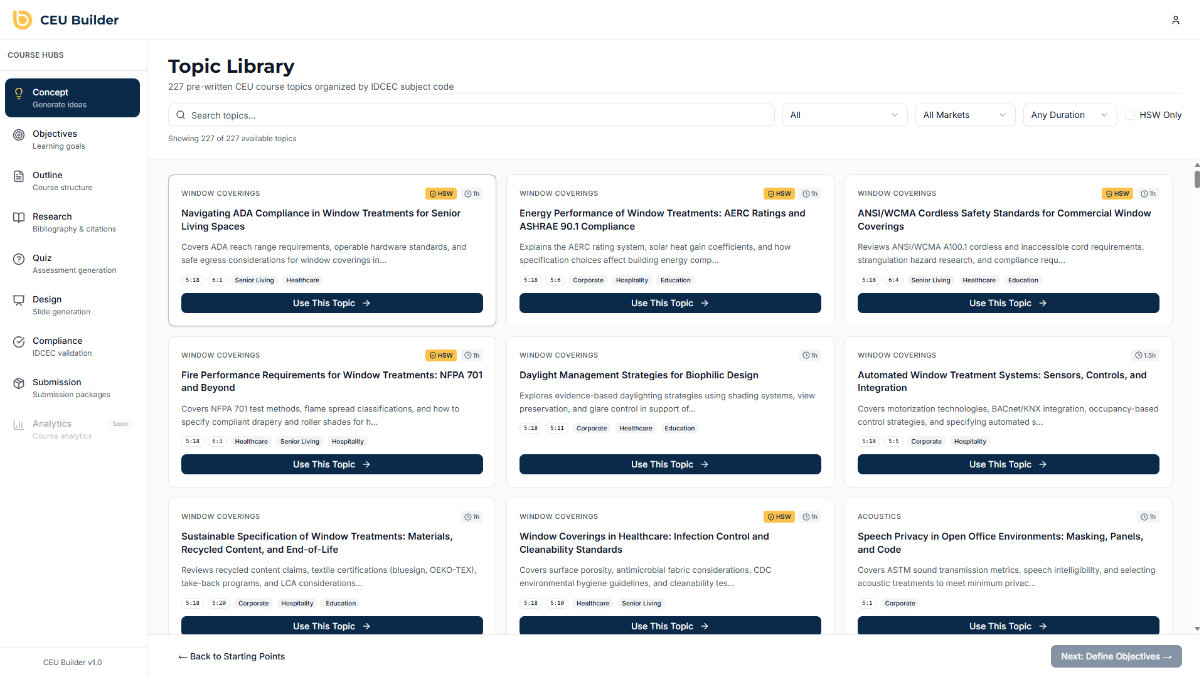
Ready to transform how you deliver continuing education and see real business results? Discover how to become your own trusted provider and unlock these benefits now at CEU Builder. Take the first step toward ownership and savings by exploring our AI Course Builder or booking a strategy call today. Don’t wait to save hundreds of thousands and own your educational future.
Frequently Asked Questions
What is course provider approval in CEU programs?
Course provider approval is the credentialing process that allows organizations to officially offer continuing education units (CEUs). It entails navigating accreditation requirements to validate instructional content and delivery methods.
What are the key benefits of transitioning to a provider ownership model for continuing education courses?
Transitioning to a provider ownership model allows manufacturers to gain complete control over course content, accelerate course development from 12-18 months to 4-6 weeks, and eliminate significant directory listing fees, leading to cost savings and enhanced strategic marketing.
How does data ownership impact the ROI of continuing education initiatives?
Data ownership allows manufacturers to gain comprehensive visibility into learner performance, enabling precise attribution of educational engagement to business outcomes. This leads to better ROI measurements and strategic content optimization.
What are common pitfalls of legacy continuing education platforms?
Common pitfalls include exorbitant annual fees, limited data access, slow course deployment processes, vendor lock-in, and a lack of flexibility, all of which can hinder organizations’ educational and marketing goals.
Recommended
