

7 Essential Steps for an Effective CEU Course Development List

Many American building product manufacturers spend over 30 percent of their annual marketing budgets on external CEU platforms, yet see little measurable return. For mid-sized teams under pressure to deliver courses that meet strict accreditation requirements, the obstacle is not intent, but efficiency and clarity. This guide cuts through the noise, showing how American companies can build compliant, high-value CEU content that actually speaks to design professionals’ real-world needs without breaking the bank.
Table of Contents
- 1. Identify Target Learners And CEU Requirements
- 2. Choose Compliant Course Topics And HSW Eligibility
- 3. Craft Clear Learning Objectives Aligned To IDCEC Standards
- 4. Design Engaging Course Outlines With AI Tools
- 5. Develop Assessments And Knowledge Checks
- 6. Prepare Submission Materials For IDCEC Approval
- 7. Track Learner Data And Monitor Course ROI
Quick Summary
| Key Message | Explanation |
|---|---|
| 1. Understand Target Audience Needs | Thoroughly research the specific learning requirements of design professionals to develop relevant CEU courses. |
| 2. Align Course Content with HSW Standards | Ensure that at least 75% of your CEU content addresses health, safety, and welfare to qualify for HSW credits. |
| 3. Create Specific Learning Objectives | Develop clear, measurable objectives that align with IDCEC standards and focus on applying skills in real-world scenarios. |
| 4. Utilize AI for Course Development | Leverage AI tools to streamline course outline creation while maintaining the quality and rigor of professional education. |
| 5. Track Data for Continuous Improvement | Analyze learner data to refine future courses and understand the return on investment from your CEU programs. |
1. Identify Target Learners and CEU Requirements
Successful continuing education courses begin with understanding precisely who needs the knowledge and what specific credentials they require. For building product manufacturers targeting architects and interior designers, this means diving deep into professional development requirements set by accreditation bodies like the Interior Design Continuing Education Council (IDCEC).
Understanding CEU requirements involves recognizing that professionals need specific types of credits to maintain their licenses. The IACET standard for continuing education provides a comprehensive framework for quantifying these educational experiences. Health Safety Welfare (HSW) credits are particularly critical for design professionals, representing specialized coursework that directly impacts professional practice.
Designers typically need 12 to 18 continuing education hours annually across different subject areas. Your course must align with specific IDCEC subject codes and learning objectives that demonstrate genuine professional value. This means creating content that goes beyond basic product information and provides substantive educational insights professionals can apply in their work.
To effectively identify target learners, manufacturers should conduct thorough research on their specific audience. This includes understanding:
Audience Demographics:
- Professional level (junior designers, senior architects)
- Specific industry segments (hospitality, healthcare, residential)
- Geographic regions with unique licensing requirements
- Career stages and learning preferences
Specific Learning Needs:
- Current knowledge gaps
- Emerging industry trends
- Technical skills requiring development
- Regulatory changes affecting design practice
Compliance Considerations:
- IDCEC subject code requirements
- HSW credit eligibility
- Learning objective specificity
- Assessment and documentation standards
Research becomes your strategic foundation. Manufacturers must move beyond assumptions and gather actual data about what design professionals genuinely need to advance their careers and meet regulatory requirements.
Pro tip: Conduct targeted surveys with your existing design clients to uncover precise learning needs and preferences before developing your CEU course content.
2. Choose Compliant Course Topics and HSW Eligibility
Successful CEU course development hinges on selecting topics that meet stringent Health Safety Welfare (HSW) credit requirements. Course content must go far beyond product marketing to provide substantive educational value that genuinely advances professional practice.
The HSW credit guidelines require that at least 75% of course content directly addresses protecting the health, safety, and welfare of building occupants. This means manufacturers must craft courses that demonstrate meaningful professional development rather than thinly veiled sales presentations.
Eligible HSW topics typically include several core categories that design professionals find valuable:
Acceptable HSW Topic Categories:
- Practice management strategies
- Project planning and development
- Sustainable design principles
- Materials performance and specification
- Building systems integration
- Occupant safety and wellness
- Regulatory compliance and standards
- Environmental impact assessment
For building product manufacturers, this means transforming product knowledge into educational content that solves real professional challenges. A flooring manufacturer might create a course exploring material selection criteria for healthcare environments, focusing on infection control, durability, and patient safety.
Successful courses require deep understanding of professional learning objectives. Your content must demonstrate:
Key HSW Content Requirements:
- Substantive professional knowledge
- Clear learning outcomes
- Evidence based information
- Practical application strategies
- Alignment with industry standards
Manufacturers must move beyond surface level information and provide genuine insights that help design professionals make informed specification decisions. This approach transforms educational content from potential sales pitch to valuable professional development resource.
Pro tip: Collaborate directly with licensed design professionals during course development to ensure your content meets rigorous HSW credit standards and provides authentic professional value.
3. Craft Clear Learning Objectives Aligned to IDCEC Standards
Crafting precise learning objectives transforms a mediocre CEU course into a powerful professional development experience. Your objectives are the strategic roadmap that guides participants through meaningful knowledge acquisition and skill development.
Designing effective learning objectives requires understanding the intricate requirements of professional continuing education. These statements must be specific, measurable, and directly aligned with IDCEC standards while providing clear expectations for course participants.
Key Components of Robust Learning Objectives:
- Specific action verbs describing learner outcomes
- Clear performance expectations
- Precise conditions for skill demonstration
- Measurable assessment criteria
- Alignment with professional practice standards
Utilizing Bloom’s Taxonomy provides a structured approach to developing comprehensive learning objectives. This framework helps manufacturers create objectives that progress from foundational knowledge to advanced application and analysis.
Objective Structure Example:
After completing this course, participants will be able to:
- Analyze material selection criteria for commercial healthcare environments
- Evaluate flooring performance standards related to infection control
- Distinguish between appropriate specifications for different healthcare zones
Successful learning objectives should answer three fundamental questions:
- What specific skill will participants learn?
- Under what conditions will they demonstrate this skill?
- What standards will define successful performance?
Manufacturers must move beyond surface level descriptions and create objectives that demonstrate genuine professional value. Your learning objectives should reflect real world challenges design professionals encounter daily.
Recommended Action Verbs by Complexity Level:
- Knowledge: Identify, List, Describe
- Comprehension: Explain, Summarize, Discuss
- Application: Demonstrate, Use, Implement
- Analysis: Compare, Evaluate, Distinguish
- Synthesis: Design, Develop, Create
- Evaluation: Critique, Recommend, Justify
Remember that IDCEC scrutinizes learning objectives carefully. Each statement must provide clear evidence of substantive educational content that goes beyond product promotion.
Pro tip: Have a licensed design professional review your learning objectives to ensure they meet professional development standards and provide genuine educational value.
4. Design Engaging Course Outlines with AI Tools
AI technology has transformed course development from a time consuming process to a strategic and efficient approach for creating compelling continuing education content. Manufacturers can now leverage intelligent tools to streamline course outline creation while maintaining rigorous professional standards.
AI powered course design enables creators to develop more dynamic and personalized learning experiences that meet the complex needs of design professionals. These tools analyze existing content patterns and generate structured outlines that align with IDCEC requirements and adult learning principles.
AI Outline Generation Capabilities:
- Rapid content structure development
- Intelligent topic sequencing
- Learning objective optimization
- Compliance requirement mapping
- Personalized content recommendations
- Automated research synthesis
Strategic AI Outline Development Process:
- Input core learning objectives
- Specify target professional audience
- Define HSW credit requirements
- Select primary educational focus areas
- Generate initial content framework
- Review and customize AI generated outline
- Validate against IDCEC standards
Successful AI powered course development requires a nuanced approach. Manufacturers must view these tools as collaborative partners that augment human expertise rather than replace professional judgment. The most effective outlines emerge from a synergy between artificial intelligence capabilities and deep industry knowledge.
Key Considerations for AI Outline Tools:
- Maintain professional authenticity
- Verify technical accuracy
- Integrate real world design challenges
- Ensure meaningful learning progression
- Align with industry best practices
AI tools excel at generating initial structures but human expertise remains critical for creating truly transformative educational experiences. Design professionals demand courses that offer genuine insights beyond surface level information.
Recommended AI Outline Refinement Strategies:
- Cross reference generated content with current industry research
- Incorporate specific manufacturer expertise
- Add practical case study examples
- Validate learning objective clarity
- Ensure consistent professional tone
Pro tip: Treat AI generated outlines as first draft templates and always have a licensed design professional review the content to ensure educational integrity and professional relevance.
5. Develop Assessments and Knowledge Checks
Effective CEU courses transform passive learning into active skill development through strategic assessment design. Knowledge checks are not mere administrative requirements but powerful tools for reinforcing professional learning and validating educational outcomes.
Assessment design fundamentals require a multifaceted approach that goes beyond traditional multiple choice quizzes. Manufacturers must create assessments that challenge design professionals to apply complex conceptual knowledge in realistic scenarios.
Assessment Design Principles:
- Align with specific learning objectives
- Reflect real world design challenges
- Provide immediate meaningful feedback
- Measure skill application not just memorization
- Support professional growth mindset
Types of Knowledge Assessment Strategies:
- Multiple Choice Questions
- Validate foundational understanding
- Test technical knowledge precision
- Quickly assess broad content comprehension
- Scenario Based Assessments
- Simulate professional decision making
- Evaluate complex problem solving skills
- Demonstrate practical knowledge application
- Short Answer Analysis Prompts
- Encourage critical thinking
- Assess depth of conceptual understanding
- Allow nuanced professional perspective exploration
Effective Assessment Techniques:
- Create questions that reflect actual design challenges
- Use realistic project scenarios
- Develop graduated difficulty levels
- Include performance based evaluation elements
- Provide clear grading rubrics
- Enable learner self reflection
Key Assessment Design Considerations:
- Connect assessment directly to learning objectives
- Ensure questions test higher order thinking skills
- Balance knowledge recall and analytical reasoning
- Create assessments that feel authentic to professional experience
- Use varied question formats to maintain engagement
Successful knowledge checks transform passive content consumption into active professional development. Each assessment should feel like a meaningful learning opportunity rather than a bureaucratic requirement.
Pro tip: Collaborate with licensed design professionals to develop assessment scenarios that authentically represent current industry challenges and professional decision making processes.
6. Prepare Submission Materials for IDCEC Approval
Successful IDCEC course approval requires meticulous documentation that demonstrates professional educational value beyond simple product marketing. Manufacturers must transform course materials into comprehensive evidence of genuine learning potential.
Submission materials documentation represents the critical bridge between course development and official recognition. Every document must communicate professional credibility and educational integrity.
Essential Submission Documentation:
- Detailed course outline
- Specific learning objectives
- Instructor qualification statements
- Assessment methodology
- HSW credit justification
- Professional relevance statement
- Participant evaluation procedures
Submission Package Components:
- Course Overview
- Clear description of educational purpose
- Targeted professional audience
- Specific learning outcomes
- Alignment with industry standards
- Learning Objective Validation
- Measurable skill acquisition goals
- Connection to professional practice
- Specific performance expectations
- Alignment with IDCEC subject codes
- Instructor Credentialing
- Professional licenses
- Industry experience
- Teaching qualifications
- Relevant expertise documentation
Strategic Documentation Approach:
- Write from learner perspective
- Emphasize practical knowledge transfer
- Demonstrate clear professional value
- Avoid promotional language
- Focus on substantive educational content
Key Submission Preparation Strategies:
- Review IDCEC guidelines meticulously
- Have licensed professionals review materials
- Validate every statement with evidence
- Ensure consistent professional tone
- Anticipate potential reviewer questions
Successful submissions transform technical information into meaningful professional development opportunities. Each document must communicate genuine commitment to design professional growth.
Pro tip: Create a submission checklist that mirrors IDCEC review criteria and have an experienced design professional perform a blind review before official submission.
7. Track Learner Data and Monitor Course ROI
Successful CEU courses transform from educational content into strategic business assets through rigorous data tracking and analysis. Understanding learner engagement goes far beyond completion rates to reveal meaningful insights that drive future course development and business growth.
Learner data analysis provides manufacturers with a powerful lens into professional development needs and specification driving behaviors. Each data point represents an opportunity to refine educational strategies and demonstrate tangible return on investment.
Key Performance Metrics to Track:
- Course completion rates
- Quiz and assessment scores
- Learner demographic information
- Engagement duration
- Post course specification behaviors
- Professional role progression
- Geographic distribution of learners
ROI Tracking Strategies:
- Correlate course attendance with specification requests
- Measure time between course completion and product inquiry
- Track specification conversion rates
- Analyze learner professional advancement
- Document knowledge skill improvements
Advanced Data Collection Methods:
- Integrated learning management systems
- Automated survey tools
- CRM tracking integrations
- Professional network analysis
- Longitudinal learner progress monitoring
Meaningful Data Insights Reveal:
- Learning preference patterns
- Knowledge gap identification
- Training effectiveness measurements
- Emerging industry skill requirements
- Potential new product development opportunities
Successful manufacturers view CEU courses as strategic intelligence gathering platforms. Each learner interaction provides valuable information that extends far beyond traditional educational metrics.
Data Privacy and Ethical Considerations:
- Obtain clear participant consent
- Anonymize individual learner information
- Comply with professional privacy regulations
- Maintain transparent data usage policies
- Provide opt out mechanisms
Reporting and Visualization Techniques:
- Create interactive dashboards
- Generate quarterly performance reports
- Develop comparative analysis frameworks
- Use visual storytelling techniques
- Highlight actionable insights
Pro tip: Implement a standardized data collection framework that seamlessly integrates learning management systems with customer relationship management platforms to create a comprehensive view of educational impact.
Below is a comprehensive table summarizing key strategies, targets, methods, and requirements outlined in the article for designing and delivering successful continuing education courses.
Own Your CEU Course Development Journey with Confidence
Creating effective and compliant CEU courses calls for a deep understanding of IDCEC requirements, HSW credit eligibility, and clear learning objectives as detailed in the “7 Essential Steps for an Effective CEU Course Development List.” Many building product manufacturers face challenges like costly legacy platform fees, long development timelines, and lack of control over their course provider status and learner data. These pain points stop companies from realizing the true value of their CEU programs or proving ROI to stakeholders.
CEU Builder empowers manufacturers to overcome these challenges by providing an AI-powered platform that streamlines the entire process from course outline creation to IDCEC submission. With features designed specifically to manage HSW eligibility, generate precise learning objectives, and automate compliance checks manufacturers can turn complex requirements into achievable milestones quickly. Our transparent pricing and provider ownership model mean you save thousands annually and retain full control of your data and education strategy.
Take the next step in bringing your CEU course vision to life with CEU Builder.
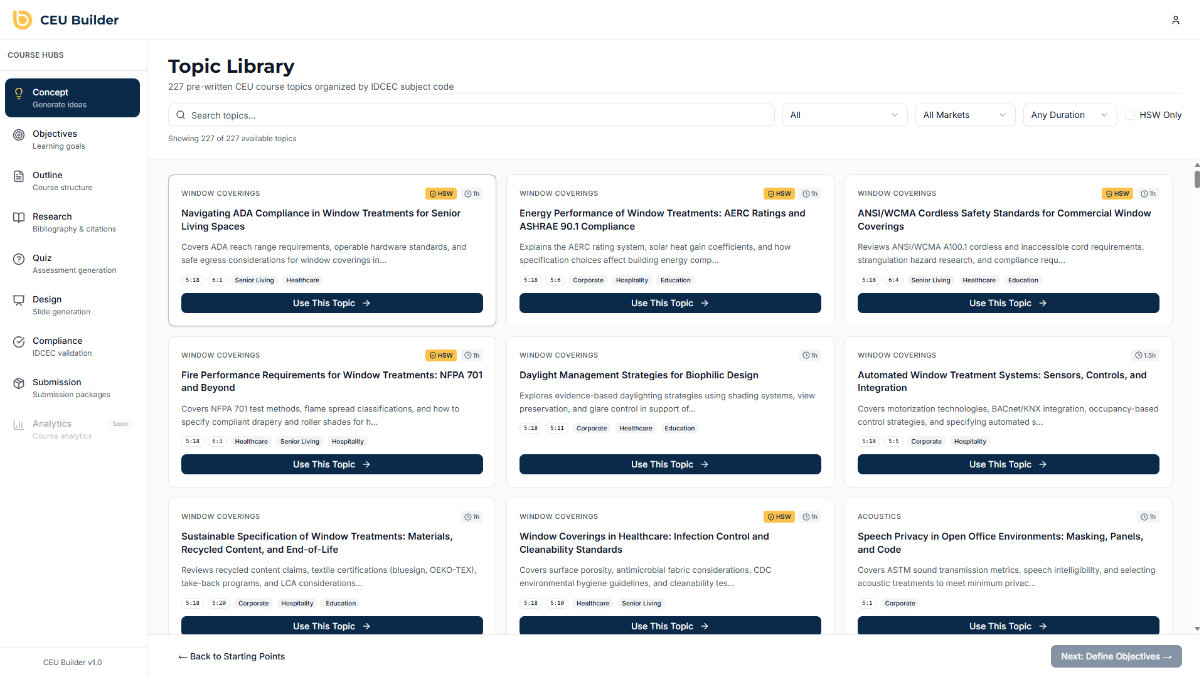
Start building IDCEC-compliant, HSW-eligible courses in weeks not months, and own your education program completely. Visit CEU Builder now to discover how to register as your own IDCEC provider and streamline your course development today. Explore our AI Course Builder tools and Done-For-You service options designed for building product manufacturers ready to control their continuing education future.
Frequently Asked Questions
How can I identify my target learners for CEU course development?
To identify your target learners, conduct thorough research on their demographics, specific industry needs, and professional development requirements. Use surveys or interviews to gather direct feedback from design professionals about their current knowledge gaps and learning preferences.
What are the key components of compliant course topics for HSW credits?
Compliant course topics must primarily focus on protecting the health, safety, and welfare of building occupants, with at least 75% of the content addressing these areas. Select topics like sustainable design principles, regulatory compliance, and materials performance to ensure alignment with HSW credit requirements.
How do I craft effective learning objectives for my CEU course?
Effective learning objectives should be specific, measurable, and aligned with professional practice standards. Use action verbs to detail the skills participants will acquire and outline the conditions and criteria for successful skill demonstration.
What steps should I take to develop meaningful assessments for my CEU courses?
To develop meaningful assessments, align them directly with your learning objectives and include various formats, such as scenario-based questions and multiple-choice quizzes. Ensure assessments reflect real-world design challenges to foster active skill development and provide immediate feedback.
How can I prepare submission materials for IDCEC approval?
Preparing submission materials requires precise documentation, including a detailed course outline, learning objectives, and assessment methodologies. Draft comprehensive evidence that focuses on the professional value of the course content and adheres to IDCEC standards to increase approval chances.
What metrics should I track to evaluate the success of my CEU courses?
Track key performance metrics like course completion rates, learner engagement duration, and assessment scores to evaluate course effectiveness. This data will help you understand learner behavior and inform future course development, ultimately optimizing the educational impact.
Recommended
