

Role of Accreditation Bodies in Continuing Education

Nearly every American sales leader in the hospitality sector faces rising costs and tighter compliance demands for continuing education programs. With over 80 percent of building product manufacturers striving to control CEU content and protect profit margins, understanding accreditation bodies becomes essential. This guide explains how these organizations affect course ownership, financial outcomes, and credibility so you can make smarter decisions about your long-term education strategy.
Table of Contents
- What Are Accreditation Bodies and Their Purpose
- Major Types and Functions in Continuing Education
- Accreditation Requirements for Course Providers
- Compliance, Data, and Financial Implications
- Comparing Provider Ownership and Directory Models
Key Takeaways
| Point | Details |
|---|---|
| Role of Accreditation Bodies | Accreditation bodies ensure that educational programs meet high professional standards to protect learners and employers. |
| Types of Accreditation | There are three main types of accreditation: Regional, National, and Programmatic, each serving distinct purposes in maintaining educational integrity. |
| Course Provider Requirements | Providers must meet strict accreditation requirements, including measurable learning objectives and documented evidence of continuous improvement. |
| Financial Implications | Accreditation requires significant resource investment but is a strategic move that enhances organizational credibility and professional relationships. |
What Are Accreditation Bodies and Their Purpose
Accreditation bodies serve as critical gatekeepers in the world of continuing education, ensuring that learning programs meet rigorous professional standards. These organizations independently validate educational content, protecting learners and employers by maintaining high-quality learning experiences across various industries.
At their core, accreditation bodies function as quality control mechanisms for educational programs. They develop comprehensive evaluation frameworks that assess curriculum design, instructor qualifications, learning outcomes, and overall educational effectiveness. By establishing clear benchmarks, these organizations help prevent substandard training from entering professional development markets. Global education quality standards are meticulously maintained through systematic review processes that examine every aspect of educational content.
The specific responsibilities of accreditation bodies typically include:
- Establishing minimum competency requirements for educational programs
- Conducting thorough program reviews and assessments
- Verifying instructor credentials and expertise
- Ensuring curriculum meets industry-specific professional standards
- Monitoring ongoing educational quality and effectiveness
For manufacturers and professionals in technical fields like hospitality and commercial interiors, accreditation bodies play an especially critical role. They provide independent verification that continuing education courses meet professional development requirements, helping organizations demonstrate their commitment to ongoing learning and skill advancement.
Pro tip: When evaluating a continuing education program, always verify its accreditation status with recognized professional bodies to ensure you’re investing in high-quality, standards-compliant learning experiences.
Major Types and Functions in Continuing Education
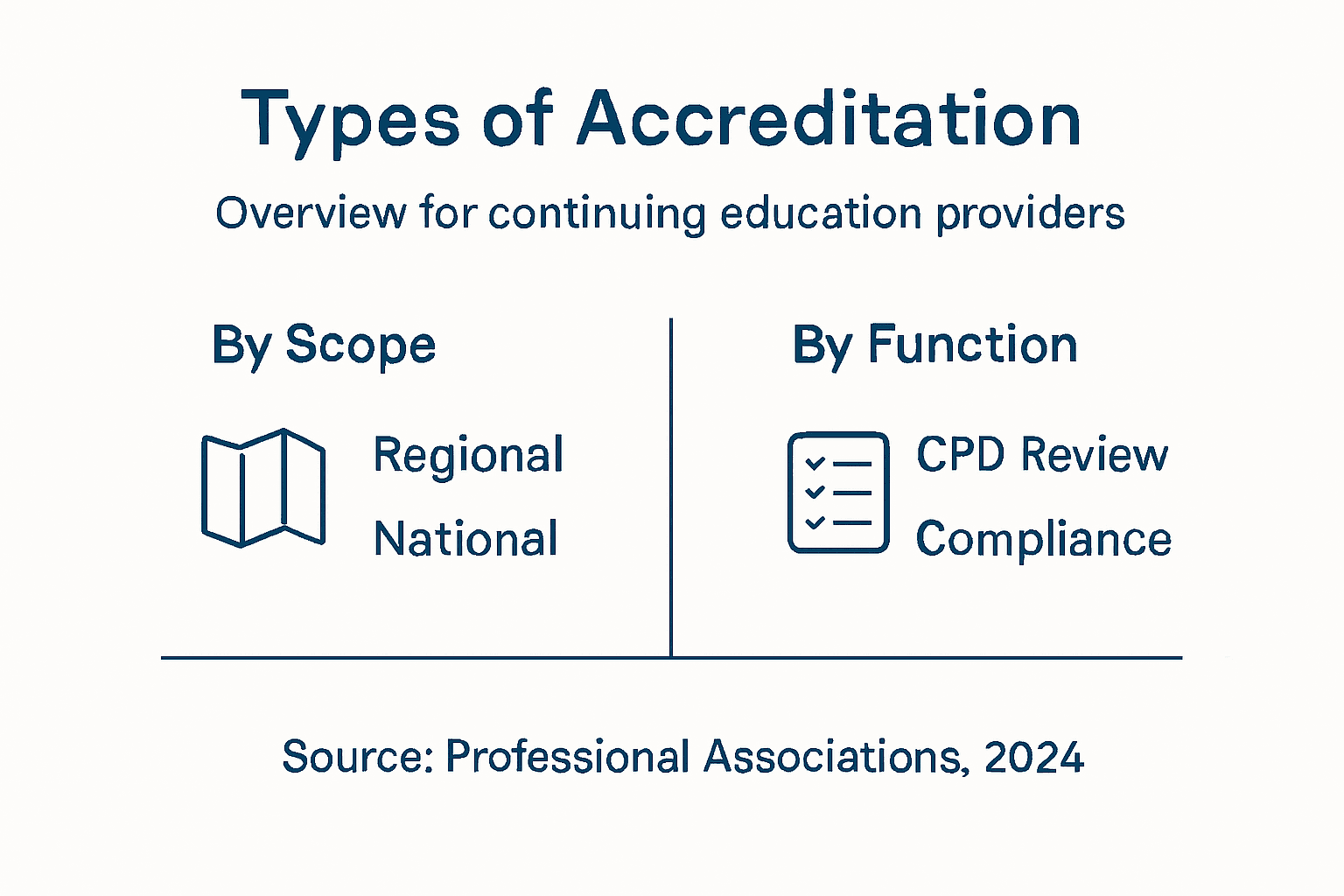
Continuing education encompasses diverse accreditation models that ensure professional learning meets rigorous quality standards. Programmatic accreditation agencies play a critical role in validating educational content across multiple professional domains, each with unique evaluation criteria and compliance requirements.
The primary types of accreditation bodies include:
- Regional Accreditors: Evaluate entire educational institutions within specific geographic boundaries, assessing overall institutional quality and comprehensive educational standards
- National Accreditors: Focus on specialized institutions or specific disciplinary sectors, providing targeted quality assessments for unique educational environments
- Programmatic Accreditors: Concentrate on specific professional programs, ensuring curriculum meets industry-specific competency and performance standards
Each accreditation type serves distinct purposes in maintaining educational integrity. CPD accreditation processes involve comprehensive evaluations that examine curriculum design, instructional methodologies, assessment strategies, and alignment with industry requirements. These rigorous reviews help professionals stay current with evolving professional standards and regulatory expectations.

For manufacturers and professionals in technical fields like hospitality and commercial interiors, understanding these accreditation mechanisms becomes crucial. They provide independent verification of educational quality, helping organizations demonstrate commitment to continuous learning and professional development.
Pro tip: Always verify the specific accreditation type relevant to your professional field to ensure you’re investing in recognized and high-quality continuing education programs.
Here is a summary comparing the three main types of accreditation bodies:
| Accreditation Type | Focus Area | Typical Scope |
|---|---|---|
| Regional Accreditors | Whole institutions | Geographic regions |
| National Accreditors | Specialized or sector-specific | Countrywide, certain fields |
| Programmatic Accreditors | Individual professional programs | Industry or discipline-based |
Accreditation Requirements for Course Providers
Continuing education course providers must navigate a complex landscape of stringent accreditation requirements that ensure educational quality and professional standards. Comprehensive accreditation standards demand meticulous attention to instructional design, content development, and ongoing quality management across multiple dimensions of educational delivery.
Key accreditation requirements typically include:
- Demonstrating clear and measurable learning objectives
- Developing professionally validated curriculum content
- Maintaining instructor qualifications and expertise
- Implementing rigorous assessment and evaluation methods
- Ensuring content independence and transparency
- Providing documented evidence of continuous improvement
Course provider compliance involves a comprehensive review process that examines the entire educational ecosystem. Accreditation bodies conduct thorough assessments to verify that educational programs meet established professional standards, focusing on instructional design, content relevance, and measurable learning outcomes.
For manufacturers in technical fields like hospitality and commercial interiors, understanding these requirements is crucial. Accreditation demonstrates a commitment to professional development, helps build credibility with architects and designers, and ensures that continuing education programs meet the highest industry standards.
Pro tip: Develop a systematic documentation process that tracks and demonstrates your compliance with accreditation requirements, making future reviews and renewals significantly smoother.
Compliance, Data, and Financial Implications
Continuing education accreditation involves complex financial and regulatory considerations that extend far beyond simple course development. Compliance challenges in professional development require organizations to invest significant resources in maintaining educational standards, tracking learner data, and ensuring ongoing regulatory adherence.
Key financial and compliance implications include:
- Resource allocation for quality assurance processes
- Costs associated with documentation and reporting
- Investment in continuous program improvement
- Tracking and managing learner participation data
- Maintaining independent and evidence-based content
- Meeting industry-specific regulatory requirements
Workforce development implications reveal that accreditation significantly impacts organizational strategy. Manufacturers must consider not just the immediate costs of compliance, but the long-term value of creating high-quality, credible continuing education programs that enhance professional capabilities and drive specification opportunities.
For building product manufacturers in hospitality and commercial interiors, understanding these financial and data implications is crucial. Accreditation is not merely an expense, but a strategic investment that can differentiate an organization, build credibility with architects and designers, and create measurable returns through enhanced professional relationships.
Pro tip: Develop a comprehensive tracking system that monetizes your continuing education efforts by connecting course participation directly to sales and specification metrics.
Comparing Provider Ownership and Directory Models
Continuing education models present distinct approaches to educational delivery, with provider ownership and directory models representing two fundamentally different strategies for professional learning. CME provider directory structures reveal complex ecosystems where organizations can choose between maintaining direct control or participating in centralized platforms.
Key differences between ownership and directory models include:
- Control over educational content and curriculum
- Data ownership and learner tracking capabilities
- Financial investment and long-term costs
- Compliance and administrative requirements
- Flexibility in course design and delivery
- Brand positioning and market perception
Joint providership models demonstrate the nuanced landscape of continuing education delivery. Manufacturers can choose between fully independent provider status, collaborative partnerships, or directory-based sponsorship, each with unique advantages and strategic implications for professional development and marketing efforts.
For building product manufacturers in hospitality and commercial interiors, the provider ownership model offers unprecedented control and strategic advantages. By becoming their own accredited providers, organizations can directly connect educational content with specification opportunities, transform learning into a marketing channel, and eliminate intermediary costs associated with traditional directory platforms.
Pro tip: Conduct a comprehensive cost-benefit analysis comparing provider ownership expenses against ongoing directory platform fees to reveal your true long-term financial strategy.
Below is a comparison of provider ownership versus directory models in continuing education:
| Model Type | Content Control | Data Access | Cost Structure |
|---|---|---|---|
| Provider Ownership | Full autonomy | Direct learner tracking | Upfront investment, lower fees |
| Directory Model | Shared with platform | Limited or indirect | Ongoing platform service fees |
Take Control of Your Continuing Education Provider Status Today
The article highlights the critical role accreditation bodies play in ensuring quality and compliance in continuing education. Yet, many building product manufacturers face frustration dealing with legacy CEU platforms that charge excessive fees, limit data ownership, and extend course development timelines. You no longer need to rely on expensive gatekeepers to meet stringent accreditation requirements or verify your program’s legitimacy.
CEU Builder empowers you to become your own IDCEC and AIA accredited education provider quickly and affordably. Our AI-powered platform streamlines compliance, helping you build fully accredited courses in weeks instead of months. Say goodbye to renting space in directories where you do not control learner data or costs. Gain full ownership of your provider status and unlock transparency and ROI tracking that legacy platforms simply cannot offer.
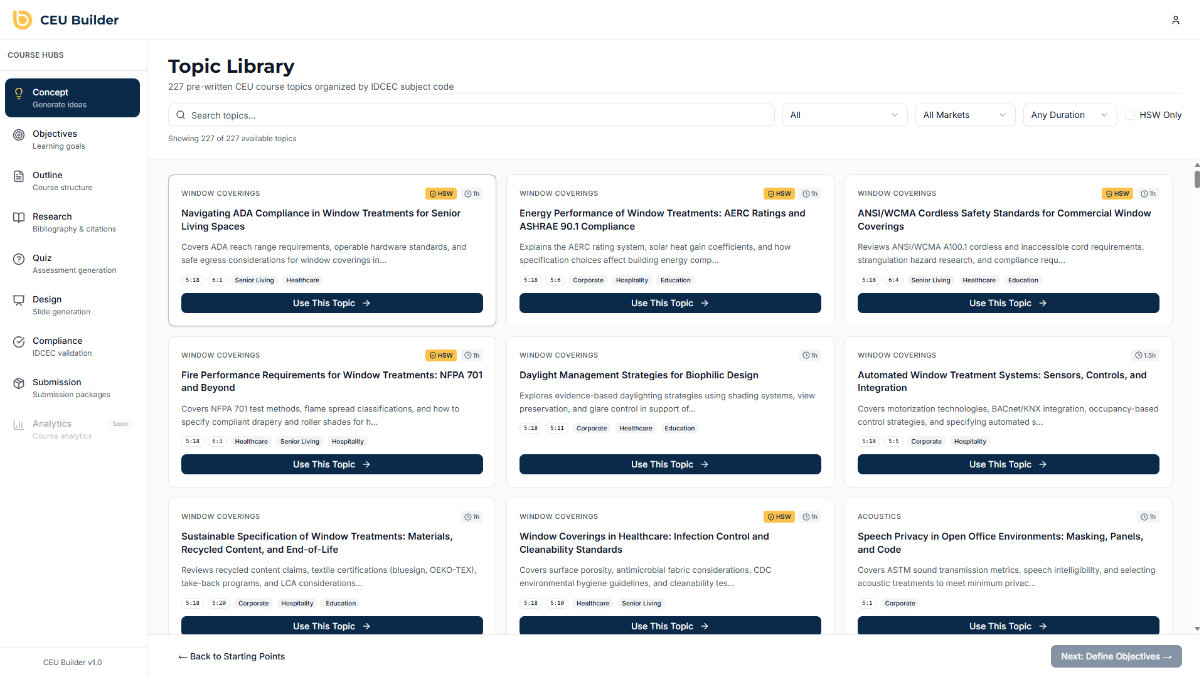
Ready to break free from outdated CEU directory models and invest in a solution designed for hospitality and commercial interiors manufacturers? Discover how CEU Builder can transform your accreditation process and course delivery with predictable pricing and unmatched speed. Visit CEU Builder to get started, learn about our provider ownership model, and explore our done-for-you course development services. Own your education future today.
Frequently Asked Questions
What are accreditation bodies in continuing education?
Accreditation bodies are organizations that evaluate and validate educational programs to ensure they meet professional standards, serving as quality control mechanisms for learning experiences across various industries.
Why is accreditation important for continuing education courses?
Accreditation is crucial as it ensures that educational programs adhere to high-quality standards, providing independent verification of the curriculum’s relevance, instructor qualifications, and overall educational effectiveness.
What types of accreditation bodies exist?
There are three primary types of accreditation bodies: regional accreditors, which evaluate entire institutions; national accreditors, which focus on specialized institutions; and programmatic accreditors, which concentrate on specific professional programs.
What are the common requirements for course providers seeking accreditation?
Course providers typically need to demonstrate clear learning objectives, develop validated curriculum content, maintain qualified instructors, implement rigorous assessments, and provide evidence of continuous improvement to meet accreditation standards.
Recommended
