

Course Credentialing: Empowering Education Providers

Building product manufacturers across North America know how quickly professional credentialing requirements can shift. Gaining direct control over CEU course development and registration as an IDCEC provider means navigating a complex field of certifications, compliance, and evolving industry standards. Understanding academic credentials and effective course approval processes helps your team safeguard brand reputation, meet client expectations, and create high-impact learning programs that support your strategic goals.
Table of Contents
- Course Credentialing Defined And Demystified
- Types Of Course Credentials For CEU Credit
- How Course Approval And Provider Status Work
- IDCEC And AIA Requirements For Providers
- Cost And Compliance Implications For Manufacturers
- Provider Ownership Versus Legacy Models
Key Takeaways
| Point | Details |
|---|---|
| Course Credentialing Validation | Educational programs need official recognition through course credentialing to confirm educational achievements and specialized training. |
| Evolving Credentials | Micro-credentials and alternative credentials provide flexible, targeted learning opportunities that align with specific industry skills. |
| Provider Ownership Shift | Moving towards provider ownership facilitates agility in course management and better alignment with industry demands compared to legacy models. |
| Cost and Compliance Management | Manufacturers must strategically plan for credentialing costs, ensuring they balance expenditures with long-term benefits and compliance risks. |
Course credentialing defined and demystified
Course credentialing represents a critical validation process where educational programs and training initiatives receive official recognition from authorized bodies. Academic credentials go far beyond traditional degrees, encompassing a comprehensive ecosystem of professional certifications, digital badges, and specialized awards that demonstrate expertise and skill mastery.
In the modern professional landscape, credentials are evolving dynamically to meet rapidly changing workforce demands. These official documents serve multiple crucial functions: verifying educational achievements, enabling professional licensure, and providing tangible proof of an individual’s specialized training. Unlike generic academic transcripts, course credentials offer targeted validation that employers increasingly prioritize when assessing candidate qualifications.
The core components of effective course credentialing typically include comprehensive documentation, standardized assessment methods, and rigorous evaluation processes. Educational institutions and professional training organizations must develop programs that not only meet industry standards but also provide clear evidence of learning outcomes. Academic credentials demonstrate completed coursework through official certificates, transcripts, and specialized recognition that validate an individual’s professional competencies.
Pro tip: When developing course credentials, focus on creating clear, measurable learning objectives that directly align with industry skill requirements and professional standards.
Types of course credentials for CEU credit
Continuing Education Unit (CEU) credentials encompass a diverse range of professional learning opportunities designed to validate specialized skills and knowledge. Micro-credentials have emerged as a flexible, targeted approach to professional development, offering short-term learning certifications that demonstrate specific competencies across various industries.

Alternative credentials are reshaping continuing education by providing non-degree pathways for skill enhancement. These credentials include professional certificates, digital badges, online bootcamps, and Massive Open Online Courses (MOOCs) that enable professionals to acquire targeted skills without committing to lengthy academic programs. Unlike traditional degree programs, these credentials offer rapid, focused learning experiences that directly address industry-specific skill requirements.
The landscape of CEU credentialing includes several primary credential types: professional certificates, digital badges, continuing education units, industry-specific certifications, and stackable credentials. Micro-credentials support flexible learning opportunities that complement traditional qualifications, allowing professionals to continuously update their skill sets in response to evolving workplace demands. These credentials can be offered by educational institutions, professional associations, private training organizations, and industry-specific regulatory bodies.
Here is a comparison of primary CEU credential types and their benefits:
| Credential Type | Typical Duration | Key Employer Benefit |
|---|---|---|
| Micro-credential | Few days/weeks | Demonstrates specific, in-demand skill |
| Professional Certificate | Several weeks/months | Validates broader competency in a field |
| Digital Badge | Hours up to a week | Provides proof of mastery of a niche topic |
| Industry Certification | Several months | Satisfies industry licensure or regulatory needs |
| Stackable Credential | Varies | Enables custom learning pathways for advancement |
Pro tip: Prioritize credentials from recognized providers that offer clear pathways for skill validation and demonstrate direct alignment with current industry standards and employer expectations.
How course approval and provider status work
Course approval and provider status represent a critical validation process that ensures educational programs meet rigorous professional standards. Provider certification involves a comprehensive assessment of an organization’s ability to deliver high-quality continuing education that meets industry-specific requirements and professional development needs.
Course approval requires comprehensive documentation that demonstrates an organization’s capacity to develop and deliver meaningful educational experiences. The process typically involves submitting detailed applications that outline course content, learning objectives, instructional methods, and evaluation strategies. Accrediting bodies carefully review these submissions to verify that the proposed educational program meets established professional standards and provides genuine value to participants.
The core components of obtaining and maintaining provider status include demonstrating administrative competence, developing robust curriculum design, ensuring qualified instructional personnel, and implementing effective assessment mechanisms. Professional organizations require providers to establish dedicated units responsible for continuing education management, maintain ethical standards, and consistently deliver high-quality learning experiences. Providers must also be prepared for ongoing review processes that periodically assess their compliance with evolving professional education standards.
Pro tip: Develop a comprehensive documentation system that meticulously tracks course development, instructor qualifications, and learning outcomes to streamline the approval and maintenance of your provider status.
IDCEC and AIA requirements for providers
The Interior Design Continuing Education Council (IDCEC) and the American Institute of Architects (AIA) have established distinct yet complementary frameworks for continuing education credentialing that manufacturers and education providers must carefully navigate. Provider certification demands meticulous adherence to specific guidelines that ensure educational quality and professional relevance.
AIA mandates rigorous continuing education requirements for licensed architects, focusing particularly on health, safety, and welfare topics that directly impact professional practice. These requirements create a structured pathway for professionals to maintain and enhance their skills, with many state licensing boards accepting AIA transcripts as valid proof of ongoing professional development.
IDCEC provider registration involves comprehensive submission processes that require annual registration fees, course submission fees, and strict adherence to non-promotional content guidelines. Providers must demonstrate their ability to deliver high-quality educational experiences by submitting detailed course materials, including scripts, handouts, and clear learning objectives. Both organizations emphasize transparency, professional integrity, and measurable learning outcomes as critical components of their provider approval processes.
Pro tip: Develop a systematic approach to documentation that anticipates and addresses the specific requirements of both IDCEC and AIA, ensuring comprehensive compliance and smooth provider certification.
Cost and compliance implications for manufacturers
Manufacturers entering the continuing education credentialing landscape face complex financial and regulatory challenges that require strategic planning and robust infrastructure. Credentialing costs extend far beyond simple registration fees, encompassing comprehensive investments in content development, technology integration, and ongoing compliance management.
Digital credentialing platforms help mitigate compliance risks by providing secure, verifiable record-keeping that aligns with evolving regulatory standards. The potential financial penalties for non-compliance can be substantial, ranging from significant monetary fines to severe reputational damage that could undermine years of market positioning and brand trust.
Credential programs demand significant organizational investment that goes beyond immediate monetary expenses. Manufacturers must consider long-term strategies that balance program development costs with potential returns, including enhanced brand awareness, improved customer engagement, and increased specification opportunities. Successful credentialing requires a holistic approach that integrates technological solutions, rigorous content development, and continuous adaptation to industry standards.
Pro tip: Conduct a comprehensive cost-benefit analysis that includes not just direct expenses, but potential long-term value generation from your credentialing initiatives.
Provider ownership versus legacy models
The evolving landscape of continuing education has created a fundamental shift from traditional centralized credentialing models to more agile, provider-driven approaches. Provider ownership represents a transformative paradigm that empowers organizations to take direct control of their educational credentialing strategies, moving beyond the limitations of legacy institutional frameworks.
Alternative credentialing models emphasize decentralized approaches that prioritize flexibility, market responsiveness, and strategic alignment. Legacy models typically involve complex, bureaucratic processes where educational providers have minimal autonomy, while provider ownership enables direct management of course development, delivery, and credentialing requirements. This shift allows for more rapid adaptation to industry needs, faster content updates, and more targeted learning experiences.
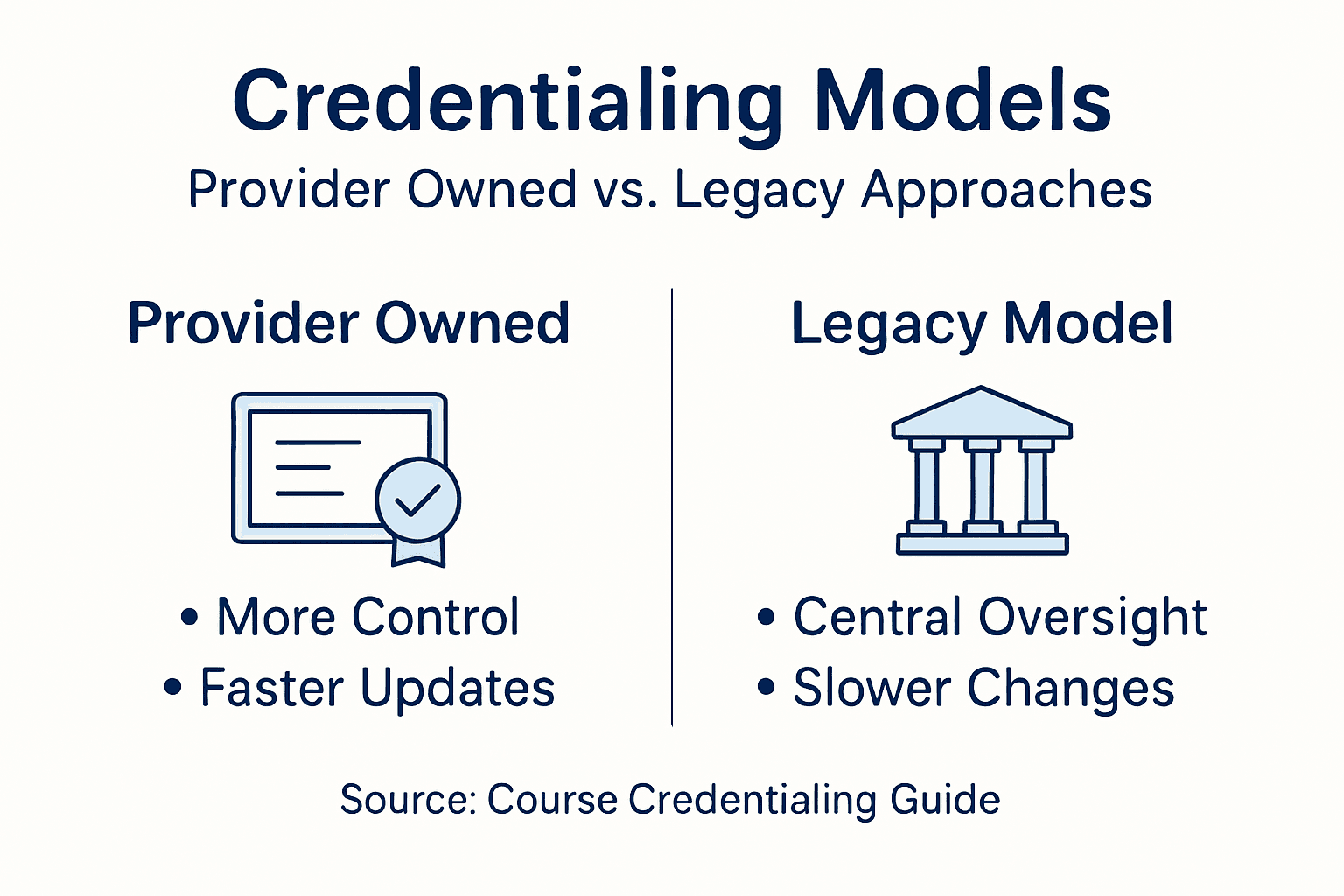
Micro-credentialing frameworks are increasingly supporting provider autonomy by creating scalable, learner-centric models that prioritize practical skill development. The key differences between provider ownership and legacy models include control over curriculum, revenue generation, data ownership, and the ability to quickly respond to emerging industry trends. Provider-owned models offer greater transparency, more direct engagement with learners, and the potential for more innovative, targeted educational offerings.
This table summarizes the differences between provider ownership and legacy models:
| Feature | Provider Ownership | Legacy Model |
|---|---|---|
| Curriculum Control | Direct and flexible | Centralized and fixed |
| Speed of Updates | Rapid course changes | Slow approval cycles |
| Revenue Retention | Higher for provider | Lower, shared with third parties |
| Data Ownership | Full, by provider | Limited, managed externally |
Pro tip: Evaluate your current credentialing approach by mapping out the specific constraints of your existing model and identifying opportunities for increased provider autonomy and strategic control.
Take Control of Your Course Credentialing and Provider Status
The article highlights key challenges in course credentialing such as lengthy approval times, lack of provider ownership, complex compliance requirements, and cost inefficiencies. If you are a building product manufacturer tired of renting IDCEC or AIA provider status through legacy CEU platforms, these pain points will sound familiar. You want clear ownership of your credentials, faster course development cycles, and total control over your learner data and compliance without exorbitant fees or administrative headaches.
CEU Builder offers a proven path to become your own accredited provider while dramatically reducing your credentialing costs and timelines. Our AI-powered platform empowers you to build fully compliant, HSW-eligible CEU courses in just weeks instead of over a year. Unlike traditional providers, you maintain 100% data ownership and control every aspect of your continuing education program. Explore how our transparent pricing and guaranteed IDCEC course approval save you from hidden fees and vendor lock-in. Learn more about our provider ownership approach on the CEU Builder homepage and discover how you can revolutionize your education offerings with Done-For-You course development services for guaranteed success.
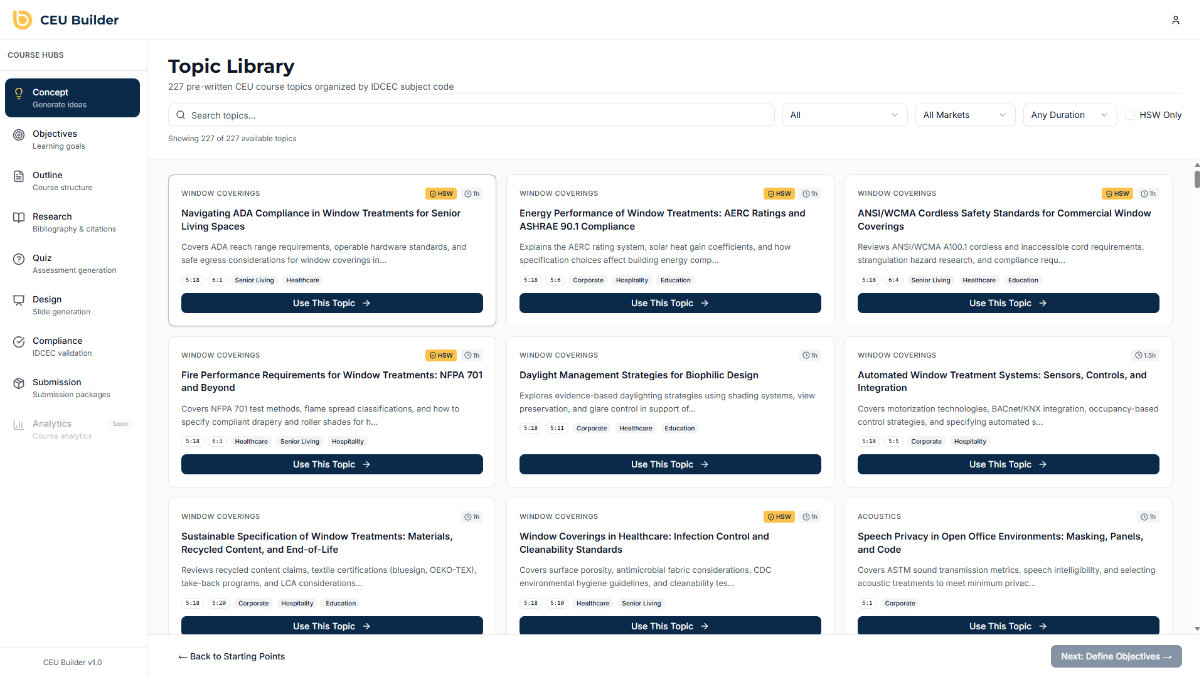
Stop paying six-figure fees to be buried in someone else’s directory. Own your provider status, accelerate your course approval, and maximize your ROI with CEU Builder. Visit https://ceubuilder.com/ today to start building your future as a fully independent, compliant education provider.
Frequently Asked Questions
What is course credentialing?
Course credentialing is the process through which educational programs and training initiatives receive official recognition from authorized bodies, validating the knowledge and skills learned by participants.
What types of credentials are available for continuing education?
Common types of credentials for continuing education include micro-credentials, professional certificates, digital badges, industry certifications, and stackable credentials, each serving different purposes and durations of learning.
How does course approval work for providers?
Course approval involves a thorough documentation process where providers submit detailed applications outlining course content, learning objectives, and instructional strategies to ensure compliance with established professional standards.
What are the implications of cost and compliance for manufacturers?
Manufacturers face financial and regulatory challenges when entering the credentialing landscape, which includes not only registration fees but also significant investments in content development and technology to meet compliance standards.
Recommended
