

Continuing Education Compliance Guide for Manufacturers

Transitioning from costly legacy CEU platforms can feel daunting when compliance and credibility are on the line. For VPs of Marketing at North American building product manufacturers, the shift to a self-managed, accredited continuing education program is not just about cutting expenses. It is about gaining control, demonstrating expertise, and building direct relationships with your audience. This guide breaks down step-by-step how to achieve provider status that meets industry and regulatory standards, setting you up for success from day one.
Table of Contents
- Step 1: Assess Requirements For Provider Status
- Step 2: Register As An Accredited CEU Provider
- Step 3: Develop Courses To Meet Compliance Standards
- Step 4: Submit Courses For IDCEC And AIA Approval
- Step 5: Verify And Track Ongoing Compliance
Quick Summary
| Important Insight | Explanation |
|---|---|
| 1. Understand Accreditation Requirements | Research your specific industry accreditation body and state regulations to ensure compliance before developing courses. |
| 2. Register with IDCEC or Other Bodies | Complete the registration process with IDCEC to officially obtain provider status and start offering accredited courses. |
| 3. Develop Compliant Educational Content | Create courses that meet learning objectives, assessment requirements, and Health, Safety, and Welfare standards for successful review. |
| 4. Submit Courses for Approval Promptly | Use the IDCEC provider portal for course submission, ensuring all materials are complete to avoid delays in the approval process. |
| 5. Maintain Compliance and Records | Establish a system to track learner data, course accuracy, and regulatory updates to retain your accreditation status and improve quality. |
Step 1: Assess requirements for provider status
Before you invest time and money into becoming your own continuing education provider, you need to understand what qualifications and regulations you’ll need to meet. This step involves researching the specific accreditation body requirements for your industry, understanding state-level regulations, and documenting what your organization already has in place versus what you’ll need to build. Getting this right from the start saves you months of headaches down the road.
Start by identifying which accreditation body governs your industry. For interior designers and architects, that’s primarily IDCEC (Interior Design Continuing Education Council). Your manufacturer sits in the commercial interior design ecosystem, which means IDCEC accreditation is likely your primary path. IDCEC has specific requirements for who can serve as a provider: you’ll need to register your organization, designate a qualified course developer, and demonstrate that your courses meet their subject matter standards. The good news is that becoming an IDCEC provider is surprisingly straightforward compared to other regulatory pathways. You complete their application, pay the one-time registration fee, and you’re in.
But IDCEC is only part of the picture. You also need to understand continuing education provider requirements at the federal and state levels, which vary depending on where your customers are located and whether they need Health, Safety, and Welfare (HSW) credited courses. Some states have reciprocal agreements that simplify this process. Understanding state reciprocal frameworks can actually reduce your compliance burden if you’re serving architects and designers across multiple jurisdictions. This means one approval in your home state can often translate to recognition in other states, rather than requiring separate submissions to each state licensing board.
Next, assess your internal capacity. Do you have someone on your marketing or product team who can dedicate time to course development? Do you have subject matter experts available to validate course content? Are you comfortable managing an LMS (learning management system) and handling student data? Some manufacturers outsource this through Done-For-You services, while others prefer to build everything themselves using a platform. There’s no wrong choice here, but understanding your team’s capacity determines which path you take and what timeline is realistic for your first course launch.
Finally, document your starting position. Gather any existing educational materials, presentations, or training content your company already has. Check if you’ve ever paid for memberships in professional organizations that might already provide some accreditation pathways. Review your current spending with legacy CEU platforms like AEC Daily or RedVector. All of this gives you a baseline to work from and helps you calculate the true ROI when you transition to owning your provider status.
Pro tip: Contact IDCEC directly before you start building your first course and ask them to review your course topic and proposed learning objectives before you invest in full course development, this eliminates surprises during the submission process and dramatically increases your approval odds.
Step 2: Register as an accredited CEU provider
Now that you understand the requirements, it’s time to officially register with your accreditation body. This step transforms your organization from a manufacturer that sponsors courses through third-party platforms into a legitimate, recognized CEU provider in your own right. The registration process is more straightforward than most manufacturers expect, and once complete, you’ll have full authority to develop and deliver continuing education credits to your customers.
Start with IDCEC since that’s likely your primary accreditation body for interior design continuing education. Visit the IDCEC website and download their provider application. The application asks for basic organizational information, proof that you have a qualified course developer on staff or available as a consultant, and documentation of your course development process. You’ll need to identify who will oversee course development and compliance with IDCEC standards. This doesn’t require a full-time employee; many manufacturers designate their Marketing Director, Product Manager, or hire a freelance course developer. IDCEC reviews your application, you pay the one-time registration fee (currently around $440), and within a few weeks, you receive your provider number. That number is your credential for offering IDCEC-approved continuing education to architects and designers.
If you’re also serving markets that require additional accreditation, investigate other bodies. Some manufacturers pursue IACET accreditation standards to expand their reach beyond interior design into broader continuing education markets. Others pursue CCE continuing education provider credentials if they’re targeting counselors, social workers, or other professions. Each accreditation body has its own application process and fee structure, but the work you do to meet IDCEC standards translates well to other bodies because they all care about the same core elements: qualified instructors, clear learning objectives, proper assessment, and documented compliance.
Here is a comparison of key accreditation bodies relevant for continuing education providers:
| Accreditation Body | Primary Audience | Application Fee | Unique Characteristics |
|---|---|---|---|
| IDCEC | Interior designers, architects | ~$440 one-time | Streamlined process, recognized for HSW credit |
| AIA | Architects | Varies | Preferred for architects seeking AIA credits |
| IACET | Broad, all fields | Varies | Follows ANSI standards, respected cross-industry |
| CCE | Counselors, social workers | Varies | Adapts for behavioral health professions |
Once you’re registered, you’ll receive provider documentation and access to your provider portal or dashboard. This is where you’ll submit individual courses for approval before they go live. Many manufacturers make the mistake of thinking registration means they can immediately launch courses, but each course still needs individual approval. That approval process typically takes two to four weeks with IDCEC, depending on how complete your submission is and whether they request clarifications. Plan your timeline accordingly. If you submit a course outline that’s incomplete or doesn’t clearly map to IDCEC subject codes, expect revision requests that add weeks to your timeline. This is why getting feedback early from your accreditation body pays off.
You’ll also need to designate authorized representatives who can manage your account, submit courses, and handle student records. Most manufacturers designate two to three people so that vacations and job changes don’t create bottlenecks in your approval process. Make sure whoever you designate understands IDCEC requirements and knows how to complete a course submission form correctly. If you’re using a course development platform like CEU Builder, your rep can submit directly from the platform without manually filling out forms, which significantly reduces errors and speeds up approval.
Pro tip: Submit your first course application immediately after registration approval while your accreditation body has your organization fresh in their mind; they tend to process submissions faster when they’ve just accredited you, and you’ll establish momentum for your provider program.
Step 3: Develop courses to meet compliance standards
This is where your content comes to life. Course development is the actual work of creating educational material that educates architects and designers while meeting IDCEC compliance standards. You’re not just writing slides; you’re building structured learning experiences with clear objectives, proper assessment, and documented outcomes that prove learners actually gained knowledge.
Start by understanding the foundation of compliant course design. The ANSI/IACET 2018 standard for continuing education establishes a framework that covers learning outcomes, content requirements, assessment methods, and evaluation processes. This standard matters because IDCEC aligns with these principles, meaning if you follow IACET guidelines, you’re building courses that will pass IDCEC review. Start with learning outcomes. These aren’t vague statements like “learners will understand flooring options.” They’re specific, measurable statements like “learners will identify three installation methods for luxury vinyl plank in commercial spaces and describe the durability advantages of each.” Every learning outcome should be observable and testable through your quiz or assessment. This is what separates compliant CEU courses from generic product pitches. Your course isn’t about selling your flooring system; it’s about teaching designers how to specify materials that meet performance requirements. The product knowledge matters, but only as evidence supporting the educational content.

Next, structure your content around those learning outcomes. Break your course into logical modules that build on each other. A 45-minute course might have four modules of 10 to 12 minutes each, with a quiz at the end. Within each module, include text, images, and video that reinforce the learning outcome. Avoid information overload. One core idea per module keeps learners engaged and makes assessment straightforward. When you’re tempted to add a tangent about your company history or product capabilities, ask yourself: does this help learners achieve the stated learning outcome? If no, cut it. Compliance reviewers notice when courses stray from their stated objectives.
You’ll also need to address Health, Safety, and Welfare (HSW) eligibility. Not all courses qualify as HSW, and IDCEC is strict about this. HSW means the content addresses health, safety, or welfare issues that impact the built environment or user safety. A course on sustainable material sourcing probably doesn’t qualify as HSW. A course on accessibility standards or fire rated assembly design almost certainly does. IDCEC publishes guidelines on HSW eligibility, and getting this right matters because HSW credits carry more weight with architects and designers. If you claim HSW status incorrectly, your course fails review, and you’ll need to resubmit without the HSW claim.
Assessment is your compliance proof point. Your course needs a quiz that tests whether learners actually achieved the learning outcomes. A ten-question quiz for a 45-minute course is typical. Each question should connect directly to a learning outcome, and correct answers should require learners to apply knowledge, not just recall facts. Avoid trick questions or questions testing minutiae unrelated to your learning outcomes. IDCEC reviewers look at quizzes to ensure they’re reasonable and fairly test the content. If your quiz questions don’t align with your stated learning outcomes, your course fails review.
Finally, document everything. Keep records of who developed the course, when it was developed, what sources informed the content, and how it was reviewed internally before submission. This documentation protects you if IDCEC asks clarifying questions during review. It also protects you if learners later challenge the content quality. You’re building a provider track record. Your first course sets the standard for all future courses, so get the details right now.
Pro tip: Build your first course on a topic where you have deep expertise and can cite current research or industry standards, this dramatically increases your first pass approval odds and establishes credibility with your accreditation body for future submissions.
Step 4: Submit courses for IDCEC and AIA approval
Your course is built, reviewed internally, and ready to go public. Now comes the formal submission process where you send your course materials to IDCEC and potentially AIA for official approval. This is a straightforward but detail-oriented process that requires attention to formatting, documentation, and submission requirements. Getting this step right means approval in three weeks instead of three months of revision requests.
Start with IDCEC since that’s your primary accreditation body. Log into the IDCEC provider portal using your provider credentials. You’ll find a submission form asking for course title, learning outcomes, course description, target audience, and estimated completion time. Then you’ll upload your course materials. IDCEC requires comprehensive course materials including presentation slides and detailed instructor notes. If you’re using video, provide the video file or link. If you’re using a learning management system like CEU Builder, you may be able to submit a link to your live course rather than uploading individual files, which simplifies the process significantly. Be meticulous about formatting. Remove any company logos, branding, or proprietary product names that distract from the educational content. IDCEC reviewers want to see education, not marketing. Include clear headers that match your learning outcomes, and make sure your quiz questions are visible and well-formatted. A poorly formatted submission gets sent back for revision before it’s even technically reviewed.
Include supplementary documentation with your submission. Provide a brief biography of your course developer or instructor showing relevant expertise. If you’re making claims about industry standards or best practices, cite your sources. Include any references or resources you drew from. This documentation shows IDCEC that your course is grounded in legitimate educational content, not opinion. If your course qualifies as HSW (Health, Safety, and Welfare), explicitly state that in your submission and explain how the content addresses health, safety, or welfare in the built environment. Don’t make IDCEC guess. If HSW eligibility is unclear, they’ll request clarification, which adds weeks to your approval timeline.
Prepare for the revision cycle. IDCEC averages three weeks for approval, but that timeline assumes your submission is complete and correct on the first try. Most first submissions get feedback requesting clarifications or minor revisions. Common revision requests include rewriting learning outcomes to be more specific, adding or removing quiz questions to better align with content, or clarifying how course content meets HSW standards. When IDCEC sends feedback, respond promptly and directly address every comment. Don’t argue with feedback; instead, show IDCEC that you understand their concerns and have revised accordingly. Providers who respond quickly and thoroughly get approved faster.
If you’re also pursuing AIA approval, that’s a separate submission to AIA’s approval body. AIA has its own submission process and approval timeline. Some manufacturers pursue both IDCEC and AIA approval to maximize reach, since some architects prefer AIA credits. However, the additional effort and cost may not be justified for your first course. Focus on IDCEC approval first, establish a successful provider track record, then explore AIA approval for future courses if your target market specifically requests it. The good news is that a course approved by IDCEC can often be resubmitted to AIA with minimal modifications, since both bodies care about the same core principles: clear learning outcomes, proper assessment, and qualified instruction.
Once you receive approval, IDCEC assigns your course an approval number and it goes live in their directory. You can now promote that course to architects and designers. Your provider status is real. Your course is officially accredited. You own this relationship with learners. When someone completes your course, you have their data, their completion records, and their email address for future marketing. That’s the power of provider ownership.
Pro tip: Submit your course on a Tuesday or Wednesday so that if IDCEC has immediate questions, you can respond that same week rather than waiting until the following week, this reduces your total approval timeline by five to ten business days.
Step 5: Verify and track ongoing compliance
Approval is just the beginning. Your provider status requires ongoing compliance verification to maintain your accreditation and demonstrate to IDCEC that you’re running a legitimate, quality education program. This step involves maintaining accurate records, monitoring your courses, handling learner data responsibly, and staying current with any regulatory changes that affect your program. Getting this right protects your provider status and builds trust with your accreditation body.
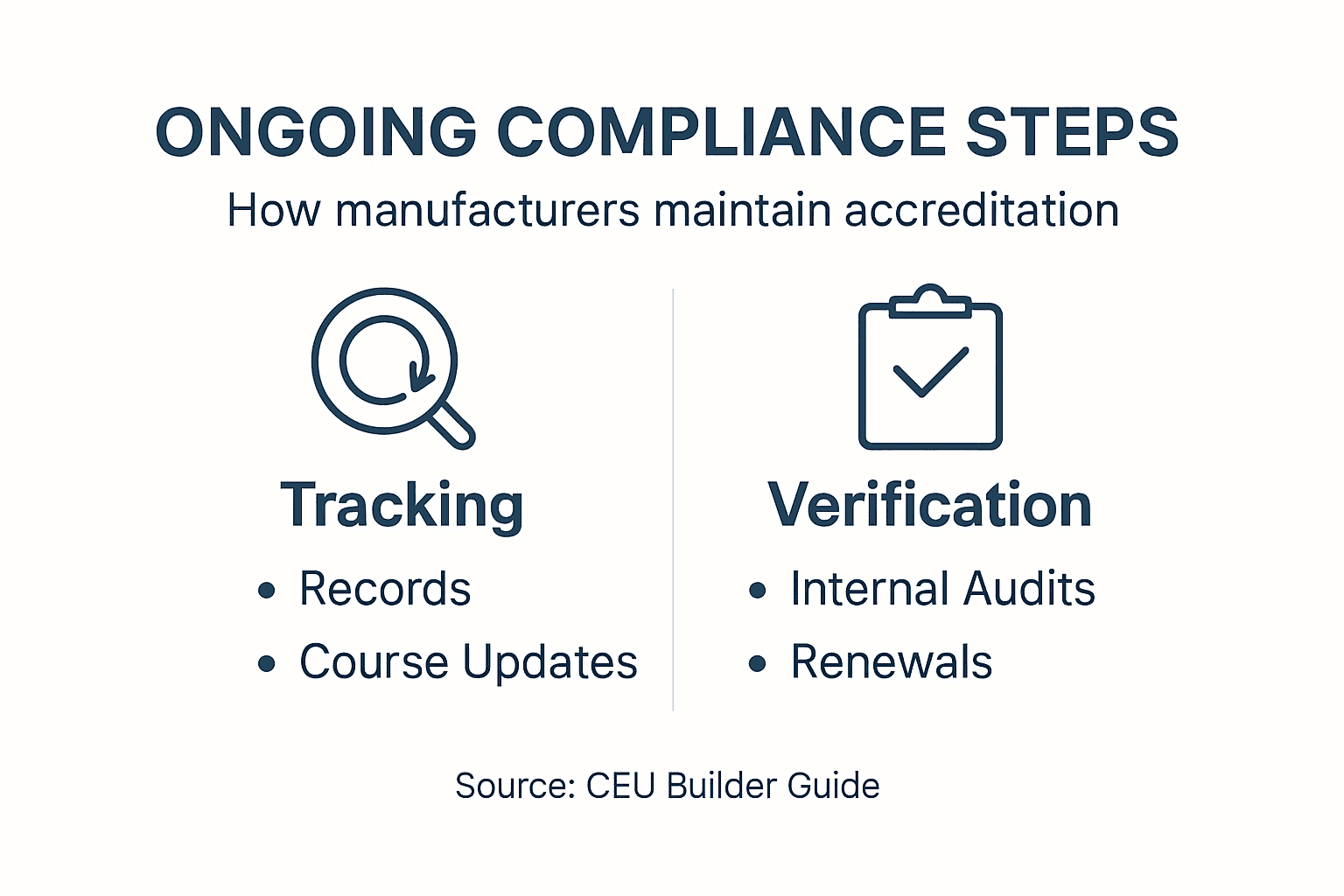
Start by establishing a compliance tracking system. You need to document everything related to your courses and learners. Keep records of who completed each course, when they completed it, their quiz scores, and when they received their certificates. IDCEC may request this information during random audits or when reviewing your provider status for renewal. Many manufacturers use their learning management system to automate this tracking, since a platform like CEU Builder generates completion reports automatically. However, if you’re managing courses across multiple platforms, you’ll need a manual system to consolidate this data. Create a spreadsheet or database that tracks course title, approval date, number of learners enrolled, completion rates, and any revisions or updates you’ve made to the course. This documentation shows IDCEC that you’re actively managing your program and maintaining educational quality.
Monitor your courses for accuracy and currency. Educational content ages. Industry standards change. New research emerges. A course you built two years ago may need updates to stay current with best practices. Set a review schedule, perhaps annually, where you assess whether your course content still reflects current industry standards. If you discover outdated information, update it and resubmit the revised course to IDCEC for approval. Some accreditation bodies allow minor content updates without resubmission, but major changes require formal review. Staying current with continuing education compliance tracking systems like those used by other professional certification bodies helps you understand industry expectations for ongoing course maintenance. Don’t let your courses become stale. Learners notice outdated content, and so do accreditation reviewers.
Handle learner data with care. Your learners have completed educational activities and earned credits toward their professional requirements. Their data is valuable and sensitive. Protect it. Store completion records securely. If a learner requests proof of completion, respond promptly and professionally. If a learner disputes their quiz score or completion status, have documentation available to resolve the issue. Maintain privacy by only sharing learner information with the learner themselves or, with proper authorization, with their employer or state licensing board. Some manufacturers get requests from architects asking for transcripts of all their completed CEU courses. Have a process in place to verify the architect’s identity before releasing transcripts.
Stay informed about regulatory changes. IDCEC updates its requirements periodically. New state regulations may affect your target market. Industry standards may shift. Subscribe to IDCEC communications so you know when new guidelines are published. Join industry associations relevant to your product category, since many announce regulatory changes to their members before they become widespread. If a significant regulatory change affects your courses, be proactive in updating them. Manufacturers who stay ahead of regulatory changes maintain strong relationships with their accreditation bodies.
Prepare for renewal. IDCEC provider status typically requires annual renewal or biennial renewal depending on your accreditation body. You’ll need to submit a renewal application with updated information about your organization, your courses, and your compliance track record. This is routine but requires timely action. Mark your calendar well in advance so you don’t miss renewal deadlines. A lapsed provider status means your courses can no longer award CEU credits until you reapply and get re-approved, which disrupts your educational program and frustrates learners.
Finally, conduct periodic internal audits of your compliance practices. Review a sample of completed courses from your portfolio. Check whether learning outcomes are clear, whether quiz questions align with content, whether instructor qualifications are documented, and whether all submissions were processed correctly. This self-audit catches issues before IDCEC audits you and demonstrates that you take compliance seriously. It also creates a continuous improvement mindset within your organization.
This table summarizes ongoing compliance tasks for CEU providers to maintain accredited status:
| Task | Purpose | Suggested Frequency |
|---|---|---|
| Audit course content | Ensure information is current and accurate | Annually |
| Track learner completion | Meet audit requirements, handle disputes | Continuous, as courses run |
| Update courses for standards | Meet changes in regulations | As new rules are issued |
| Prepare renewal documents | Maintain uninterrupted provider status | 1-2 months before expiration |
| Conduct internal audits | Identify compliance issues early | Quarterly or semiannually |
Pro tip: Implement a quarterly compliance checklist where you verify that all active courses still meet current IDCEC standards, all learner records are complete and accurate, and any pending course updates have been submitted for approval, this small discipline prevents compliance surprises and keeps your provider status ironclad.
Take Control of Your Continuing Education Compliance with CEU Builder
The challenges of navigating IDCEC provider registration, course development, and ongoing compliance can feel overwhelming. From mastering Health, Safety, and Welfare (HSW) eligibility to handling complex submission requirements and tracking learner data, manufacturers face costly delays and hidden fees with legacy platforms. If your goal is to own your provider status, reduce course approval timelines, and unlock full data ownership, you need a solution built for your unique CEU compliance needs.
CEU Builder offers an AI-powered platform designed specifically for building product manufacturers seeking to become accredited CEU providers quickly and cost-effectively. Whether you want to build your own courses or leverage our Done-For-You services, our platform helps you streamline IDCEC course approval, ensures compliance with subject codes and assessments, and tracks ongoing accreditation requirements with ease. Stop renting your provider status from costly directories and start owning your educational future with transparent pricing starting at just $99/month.
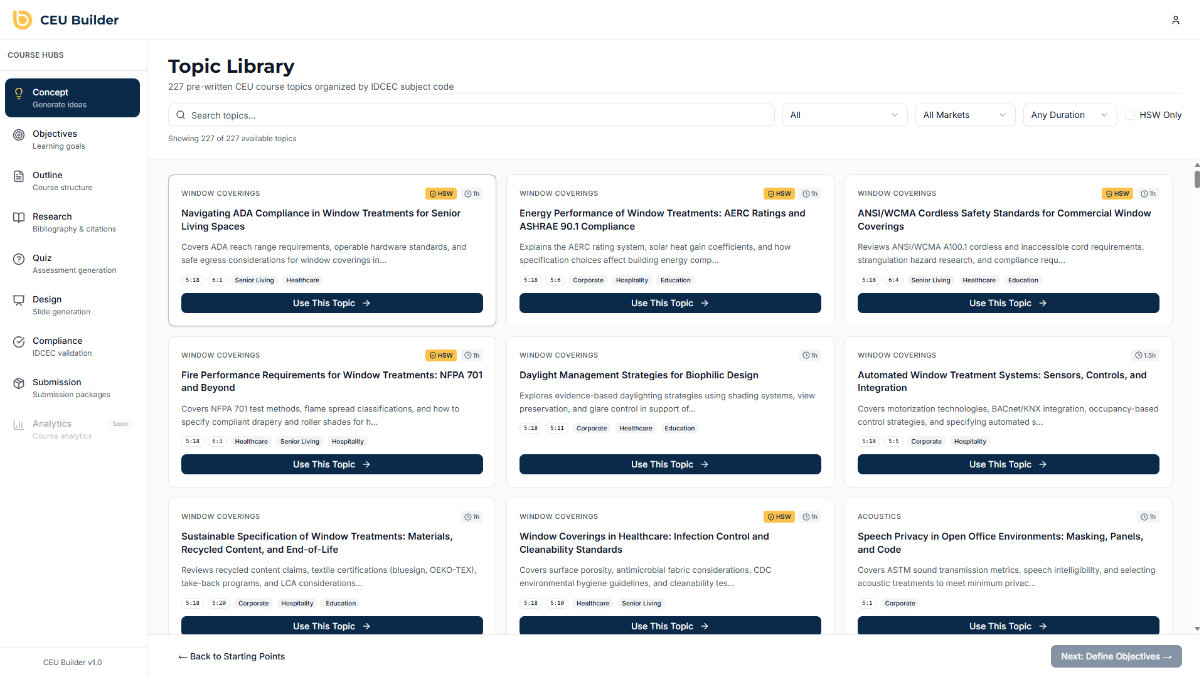
Ready to accelerate your CEU program while cutting 85% to 95% of legacy platform costs? Visit CEU Builder to explore how our provider ownership model and AI compliance tools can transform your continuing education strategy today. Don’t wait—gain full control over your CEU courses, learner data, and compliance processes now.
Frequently Asked Questions
What are the steps to assess requirements for provider status as a manufacturer?
To assess requirements for provider status, start by identifying the relevant accreditation body for your industry, such as IDCEC for interior design. Next, research state-level regulations and document your existing educational materials to determine what additional resources you will need for compliance.
How do I register my organization as an accredited Continuing Education Unit (CEU) provider?
To register as a CEU provider, download the provider application from the accreditation body’s website, such as IDCEC. Fill out the application with your organizational details and submit proof of a qualified course developer and your course development process.
What elements should be included when developing compliant CEU courses?
When developing CEU courses, include clear learning outcomes, structured content, and a quiz that aligns with the learning objectives. Make sure to document everything and keep course content focused on measurable educational goals, which helps increase approval chances.
What is the process for submitting courses for approval?
The submission process involves logging into the provider portal, completing a detailed submission form, and uploading comprehensive course materials. Pay close attention to formatting and include any supplementary documentation to enhance your submission’s chances of approval.
How do I track ongoing compliance after becoming an accredited CEU provider?
To track ongoing compliance, maintain accurate records of learner data, monitor course content for currency, and prepare for any necessary course updates. Conduct periodic audits and create a checklist to ensure all courses remain compliant and up to date, which helps prevent potential lapses in accreditation.
What should I do if my course submission receives revision requests from IDCEC?
If your course submission receives revision requests, promptly address the feedback by making the necessary changes and clarifying any unclear aspects. Respond directly to each comment to demonstrate your understanding, which can substantially reduce the time it takes to get your course approved.
Recommended
- How to Optimize Continuing Education for CEU Success – CEU Builder
- CE Course Registration Process – Control Costs and Compliance – CEU Builder
- 7 Types of CEU Courses Every Manufacturer Should Know – CEU Builder
- Master Course Accreditation Workflow for Manufacturers – CEU Builder
- Paint Correction and Ceramic Coating Training Course – CDC Detailing LLC
