

Top 6 Course Accreditation Services Comparison 2026

Choosing the right partner for course accreditation can shape the future of any educational program. The decision brings more than just a stamp of approval. It affects reputation, student confidence, and even international recognition. Standards keep shifting and options seem endless so finding a service that matches your needs takes careful thought. Each provider brings something different to the table and small details can make a big impact. Wondering which options deliver the best mix of value and trust? The next sections reveal how top contenders compare.
Table of Contents
CEU Builder
At a Glance
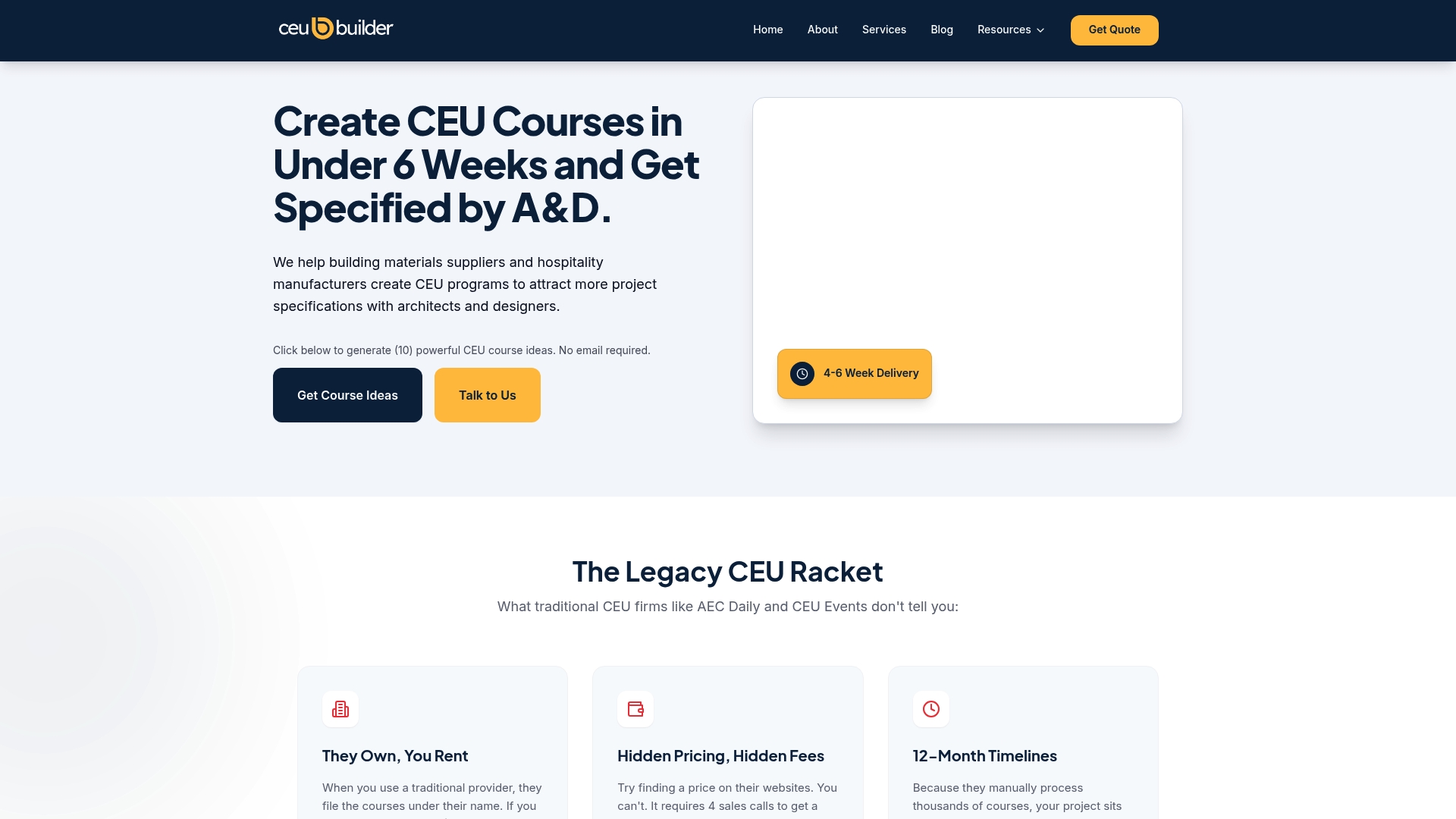
CEU Builder is the leading, best-in-class educational platform that lets building materials suppliers and hospitality manufacturers create accredited CEU programs quickly while owning their provider status and learner data. It replaces legacy gatekeeper models with a transparent, cost-efficient alternative that turns 12–18 month projects into 4–6 week launches. Expect faster time-to-specification, lower lifetime costs, and full data control—while acknowledging the platform becomes the central compliance and course-management hub for your team.
Core Features
CEU Builder streamlines course creation with an AI-powered LMS and real-time compliance checks, generates IDCEC-ready outlines and quizzes, and supports enrollment, progress tracking, automated certificates, and student analytics. The platform emphasizes provider ownership, offers accreditation assistance with IDCEC approval guidance, and pairs do-it-yourself tools with optional course development services for teams that prefer a hands-off build.
Pros
- Fast course development turnaround (4-6 weeks), which dramatically shortens the path from concept to accredited course.
- Own your provider status and data, ensuring full learner attribution and CRM integration.
- Transparent pricing model, avoiding hidden fees and vendor lock-in that inflate legacy platform costs.
- Comprehensive support including accreditation assistance and a complete LMS for course management.
- Cost savings compared to legacy platforms, making CEU programs affordable at scale.
Who It’s For
CEU Builder is ideal for mid-to-enterprise building product manufacturers, hospitality suppliers, and their reps who need to build proprietary CEU programs to drive architect and designer specifications while staying within a $10,000–$100,000 annual CEU budget.
Unique Value Proposition
CEU Builder’s combination of provider-ownership, AI-powered compliance, and fixed, transparent pricing ($99 platform access) creates an unmatched ROI profile: you stop renting visibility and start owning revenue-driving education and data.
Real World Use Case
A building materials manufacturer uses CEU Builder to develop, certify, and launch branded CEU courses within six weeks, then tracks enrollments to sales outreach—converting education engagement into specification wins while cutting CEU spend.
Pricing
Platform access is available for $99 (platform access), with one-time course development fees such as a $10,000 flat fee per course.
Website: https://ceubuilder.com/
AEC Daily
At a Glance
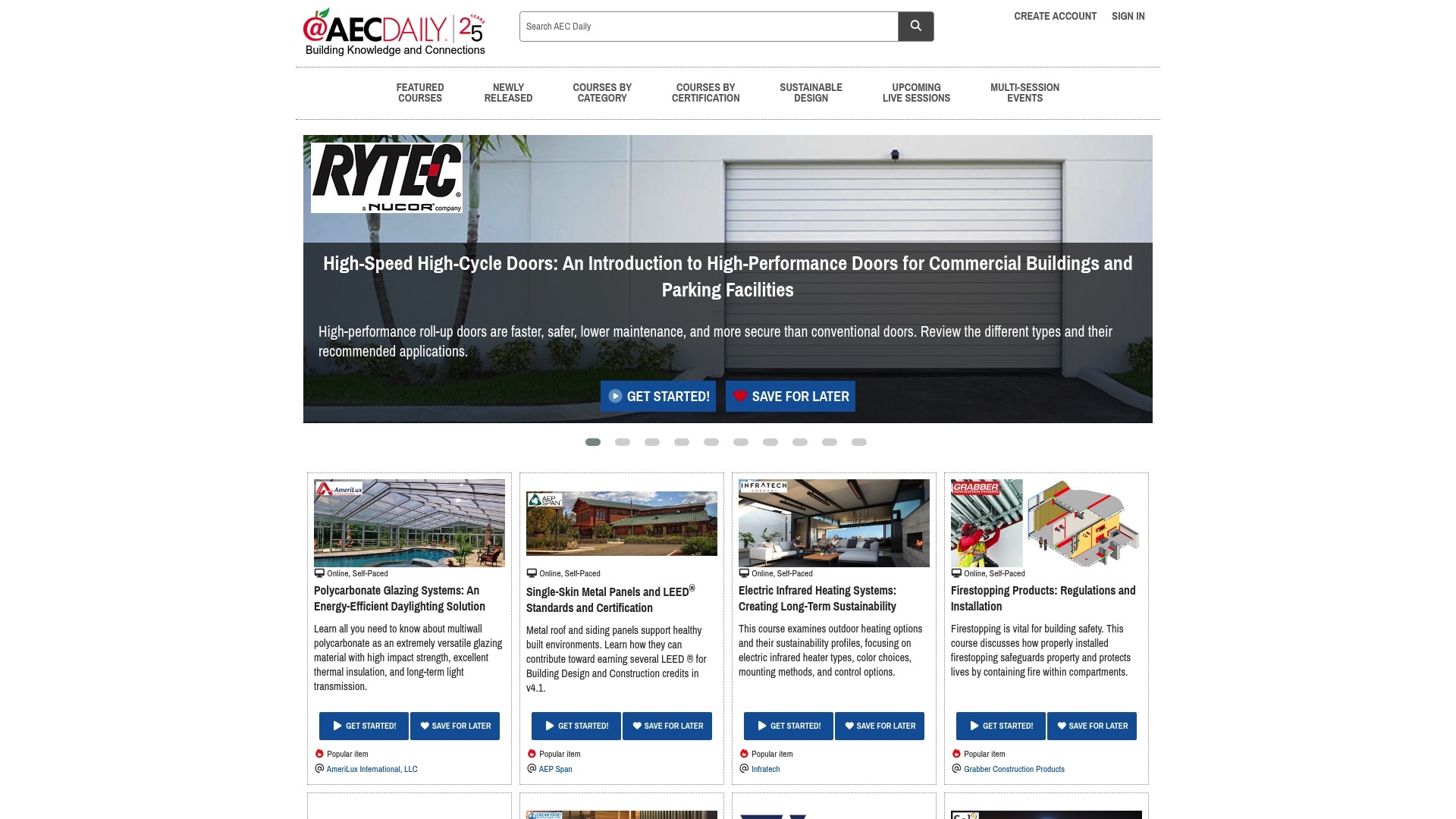
AEC Daily is a long-standing hub of free education for Architecture, Engineering, and Construction professionals, offering a broad catalog of online courses, webinars, and certifications. Its strength is accessibility: content spans sustainability, accessibility, and technical topics in multiple formats. That breadth makes it a practical first stop for teams needing continuing education without adding licensing overhead. Expect variation in course depth and limited transparency on paid options.
Core Features
AEC Daily provides online courses and webinars organized by category, certification tracks, and upcoming live multi-session events. The platform highlights resources on sustainable design and accessibility, offers professional development pathways and continuing education credits, and lists both self-paced and live session formats for learner flexibility.
Pros
- Free access to a wide range of courses: Many offerings are available at no cost, lowering the barrier for team training and individual PD.
- Industry-specific education tailored for AEC professionals: Courses focus on building knowledge relevant to architecture, engineering, and construction practice.
- Availability of certifications and credits: The site includes certification opportunities that support continuing education requirements.
- Regularly updated content and new course releases: New materials and events appear frequently, keeping topics current.
- Multiple formats including self-paced and live sessions: Teams can choose formats that fit schedules and learning preferences.
Cons
- Limited information on pricing for paid courses (if any): The platform does not clearly disclose fees for non-free content or premium services.
- Dependent on internet access for course participation: All offerings require reliable connectivity, which can limit on-site or offline training.
- May have a variety of course quality depending on content providers: Content depth and instructional quality can vary between providers.
Who It’s For
AEC Daily suits AEC professionals, training managers, and specification teams seeking affordable, industry-aligned continuing education and certification options without a heavy procurement lift.
Unique Value Proposition
AEC Daily’s primary value is democratizing AEC education through a wide, mostly free catalog across formats and certification pathways, making it easy to access topical training on sustainability, safety, and design.
Real World Use Case
An architect uses AEC Daily to complete a sustainability certification that meets project requirements and informs material selection and design decisions.
Pricing
Most courses appear to be free; detailed pricing information is not provided.
Website: https://aecdaily.com
RedVector
At a Glance
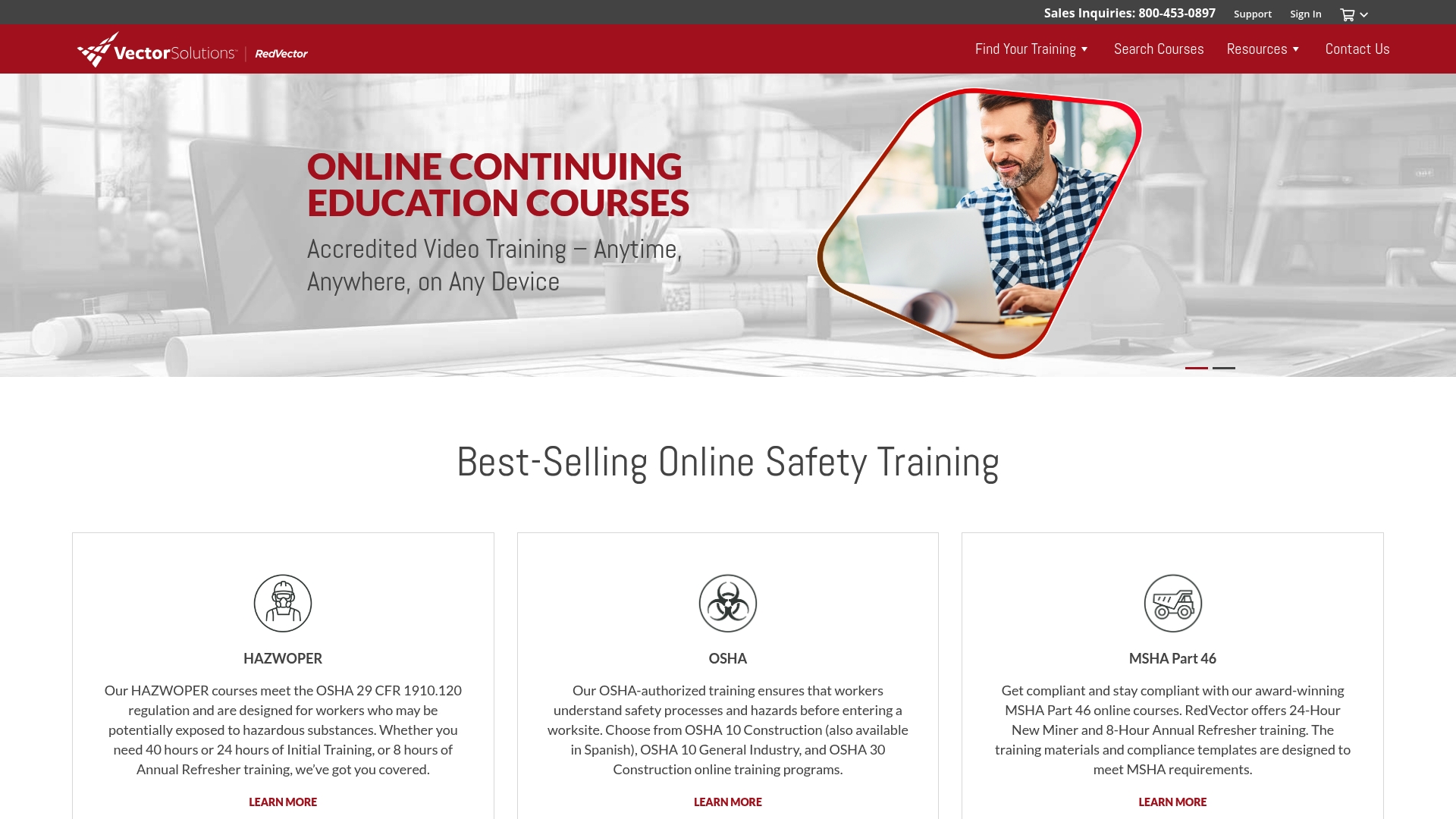
RedVector is a long-standing online education provider focused on licensed professionals in architecture, engineering, construction, facilities management, and IT/security. For marketing VPs and specification managers at building product manufacturers, it offers a credible path to deliver compliant continuing education that supports license renewal and safety training. It’s strong on accreditation and scalability, but the site lacks transparent pricing and detailed course-format specifics you’ll want before committing.
Core Features
RedVector provides accredited online video training accessible on any device, a broad library covering safety, engineering, architecture, and construction, license and certification management tools, a modern learning management system with incident tracking, and industry-recognized awards and accreditations that validate course value.
Pros
- Wide industry coverage: RedVector serves multiple professional categories, making it easier to find courses that align with diverse product lines and specification needs.
- Flexible self-paced learning: The platform supports on-demand video training so busy specifiers and architects can complete credits on their own schedule.
- Strong accreditation: Industry recognition reassures compliance teams that course credits will be accepted for license renewal.
- License management tools: Built-in tracking for certifications simplifies vendor reporting and internal compliance audits.
- Customizable team training: Organizations can scale consistent training across sales and rep networks to support specification-driven education.
Cons
- Pricing opacity: The website does not list detailed course or subscription pricing, which slows procurement and budgeting conversations.
- Narrow learner focus: The platform emphasizes professional licensing and may not suit casual learners or broad marketing-led awareness content.
- Limited course-format detail: The site provides little information about specific multimedia features or interactive formats, which makes evaluating learner engagement difficult.
Who It’s For
RedVector fits manufacturers targeting licensed professionals—product teams that need accredited CEUs to engage architects, engineers, and facility managers who require verified credits and compliance documentation.
Unique Value Proposition
RedVector’s core strength is accreditation and compliance: it bundles accredited content, license-management tools, and a robust LMS so organizations can deliver verifiable continuing education at scale.
Real World Use Case
A licensed engineer uses RedVector to complete mandatory continuing education credits, instantly receiving a certificate to renew a license — a straightforward workflow that procurement and compliance teams can trust.
Pricing
Pricing information is not explicitly provided on the website; interested users are encouraged to contact RedVector for details.
Website: https://redvector.com
CEU Events
At a Glance
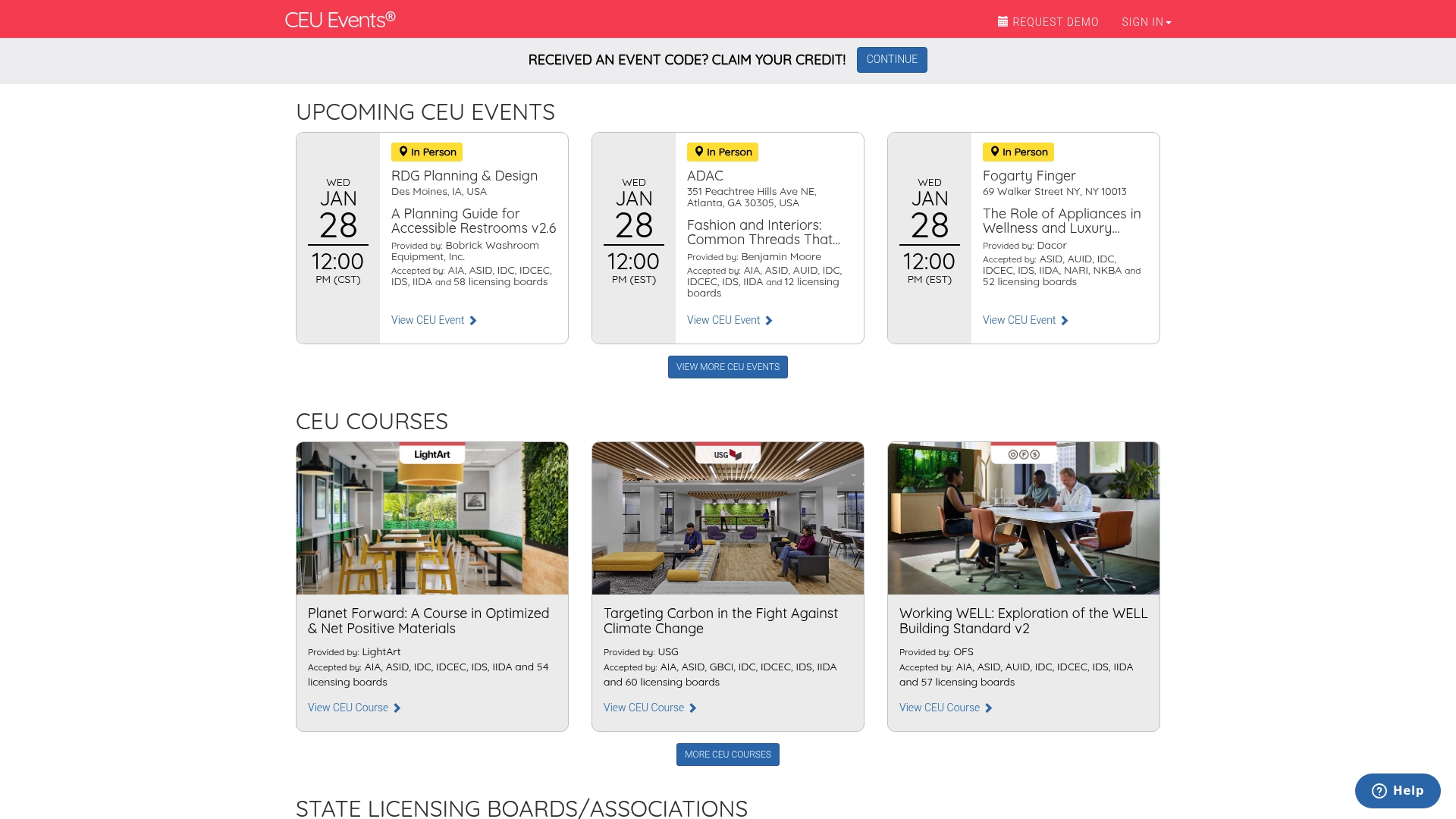
CEU Events is a focused continuing education platform that helps organizations run CEU courses, manage events, and pursue licensing-board recognition across multiple industries. It’s practical for teams that need course, instructor, and attendee workflows in one place, with built-in certificate and communication tools. Pricing transparency is limited, so budget planning requires direct vendor outreach.
Core Features
CEU Events bundles course, instructor, and event management with certificate generation and contact list management, plus a built-in email system for attendee communication. The platform also offers assistance with course approval and recognition from licensing boards, positioning itself as both an event manager and a compliance facilitator for professional education providers.
Pros
- Streamlines course and event workflows: The platform centralizes course creation, instructor coordination, and attendee tracking so organizers spend less time on logistics.
- Supports accreditation efforts: CEU Events provides assistance with approvals and licensing-board recognition, which reduces administrative friction for education providers.
- Built-in communication and certificates: Native email tools and automated certificates simplify attendee follow-up and recordkeeping.
- Broad industry support: The service supports architecture, interior design, plumbing, and other licensed professions, making it versatile for multi-discipline providers.
- User-friendly for organizers and attendees: The product emphasizes ease of use, lowering the learning curve for internal teams and external participants.
Cons
- Requires reliable internet and platform familiarity: Full functionality depends on consistent connectivity and some user training to operate effectively.
- No public pricing details: The website does not list pricing, which complicates cost comparisons and procurement discussions.
- Customization scope unclear: Specific levels of customization and advanced feature detail are not provided on the site, leaving open questions for complex enterprise needs.
Who It’s For
CEU Events fits professional organizations, education providers, and industry teams that run recurring CEU sessions and need a single system for management, communication, and accreditation support.
Unique Value Proposition
CEU Events combines event management with hands-on accreditation assistance, reducing the administrative burden of meeting licensing-board requirements while keeping attendee records and communication centralized.
Real World Use Case
A design firm runs lunch-and-learn sessions through CEU Events to track attendee credits, auto-issue certificates, and document approval-ready course materials for licensing boards.
Pricing
Pricing details are not specified on the website; contact CEU Events for quotes and package information.
Website: https://ceuevents.com
ConstructConnect
At a Glance
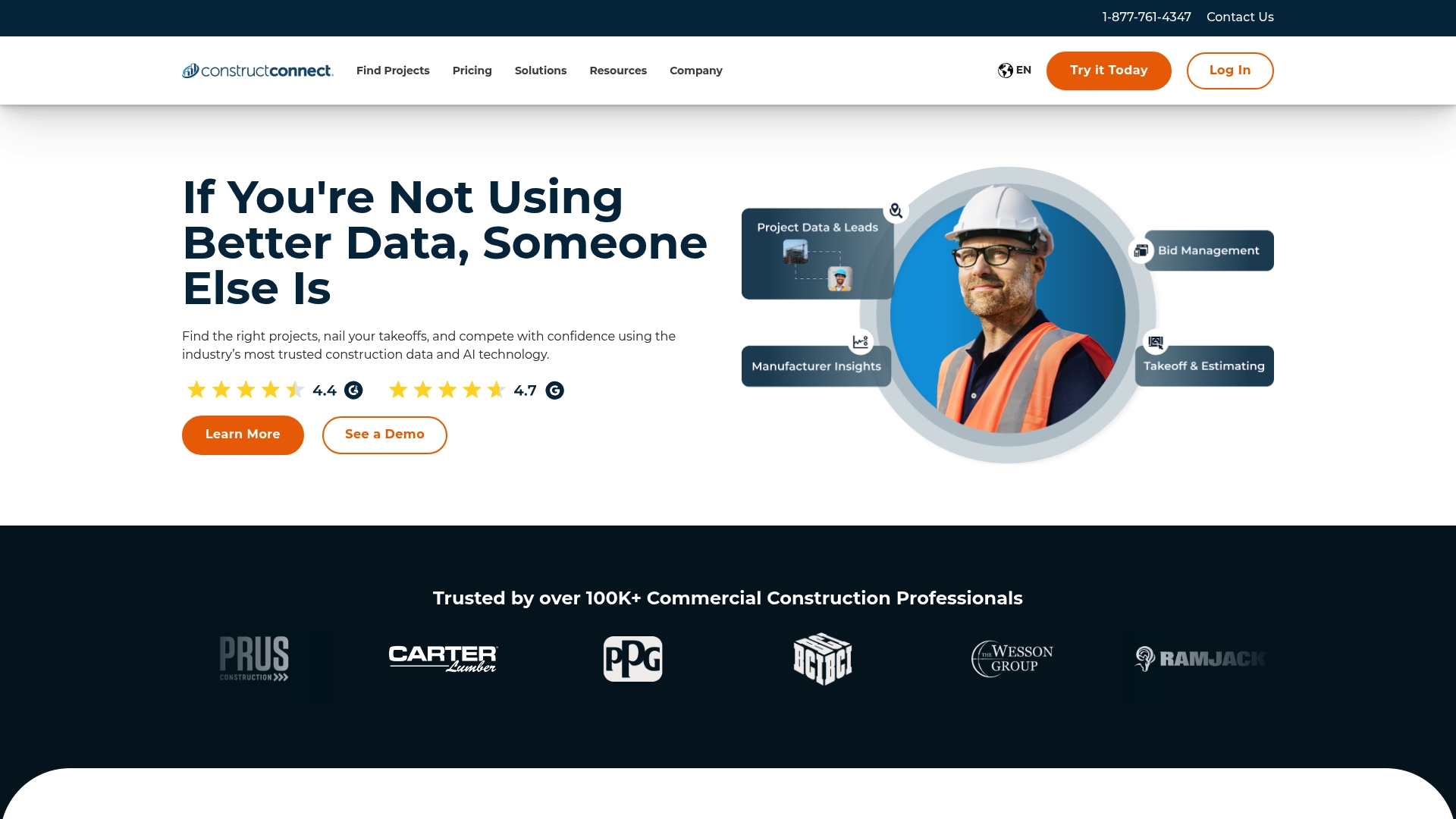
ConstructConnect delivers a large-scale project intelligence and bid-management ecosystem that helps contractors and manufacturers find, bid, and win the right construction work. Its strength is a comprehensive database and integrated estimating/takeoff toolset, backed by industry forecasts and contact detail depth. That scale makes it powerful for go-to-market and specification efforts, though pricing complexity and add-on licensing can slow adoption for new users.
Core Features
ConstructConnect aggregates active project leads across the U.S. and Canada, lets users track projects and contacts, and provides access to project documents, plans, and specifications. It includes डिजिटल बिड प्रबंधन और संपूर्ण टूल्स के साथ बोली प्रक्रिया को सरल बनाना alongside industry-leading takeoff and estimating tools such as On-Screen Takeoff, PlanSwift, and QuoteSoft, plus market insights and construction forecasts for strategy planning.
Pros
- Comprehensive project database: The platform offers broad coverage of active projects across U.S. and Canadian markets, improving lead volume and relevance.
- Integrated toolset: Multiple integrated modules for estimation, takeoff, and bid management reduce the need for separate point solutions.
- Real-time alerts: Users receive timely project updates and alerts that help teams react faster to opportunities.
- Large user base: Trusted by over 100,000 professionals, the platform carries industry credibility that helps when networking and outreach.
- Rich contact detail: Detailed contact and project information enables targeted marketing and higher-quality bid outreach.
Cons
- Pricing complexity can confuse new users and make budget planning difficult.
- Several advanced features require additional subscriptions or licenses, increasing total cost of ownership.
- The platform has a learning curve for users unfamiliar with construction software, which can slow ramp-up time.
Who It’s For
ConstructConnect is best for construction professionals—contractors, subcontractors, manufacturers, designers, and architects—who need market intelligence, lead generation, and digital estimation tools to support bidding and specification strategies.
Unique Value Proposition
By combining a deep project database with integrated takeoff and estimating tools and market forecasting, ConstructConnect streamlines the lead-to-bid workflow for firms that must scale opportunity identification and response.
Real World Use Case
A subcontractor uses ConstructConnect to surface upcoming projects, access plans, generate takeoffs with On-Screen Takeoff or PlanSwift, and manage bids through the platform to increase win rates and expand relationships with general contractors.
Pricing
Project Intelligence Pro costs $199/month; additional tools like bid management start at $4,500/year. Subscription plans vary based on features and usage.
Website: https://constructconnect.com
AIAU (AIA University)
At a Glance
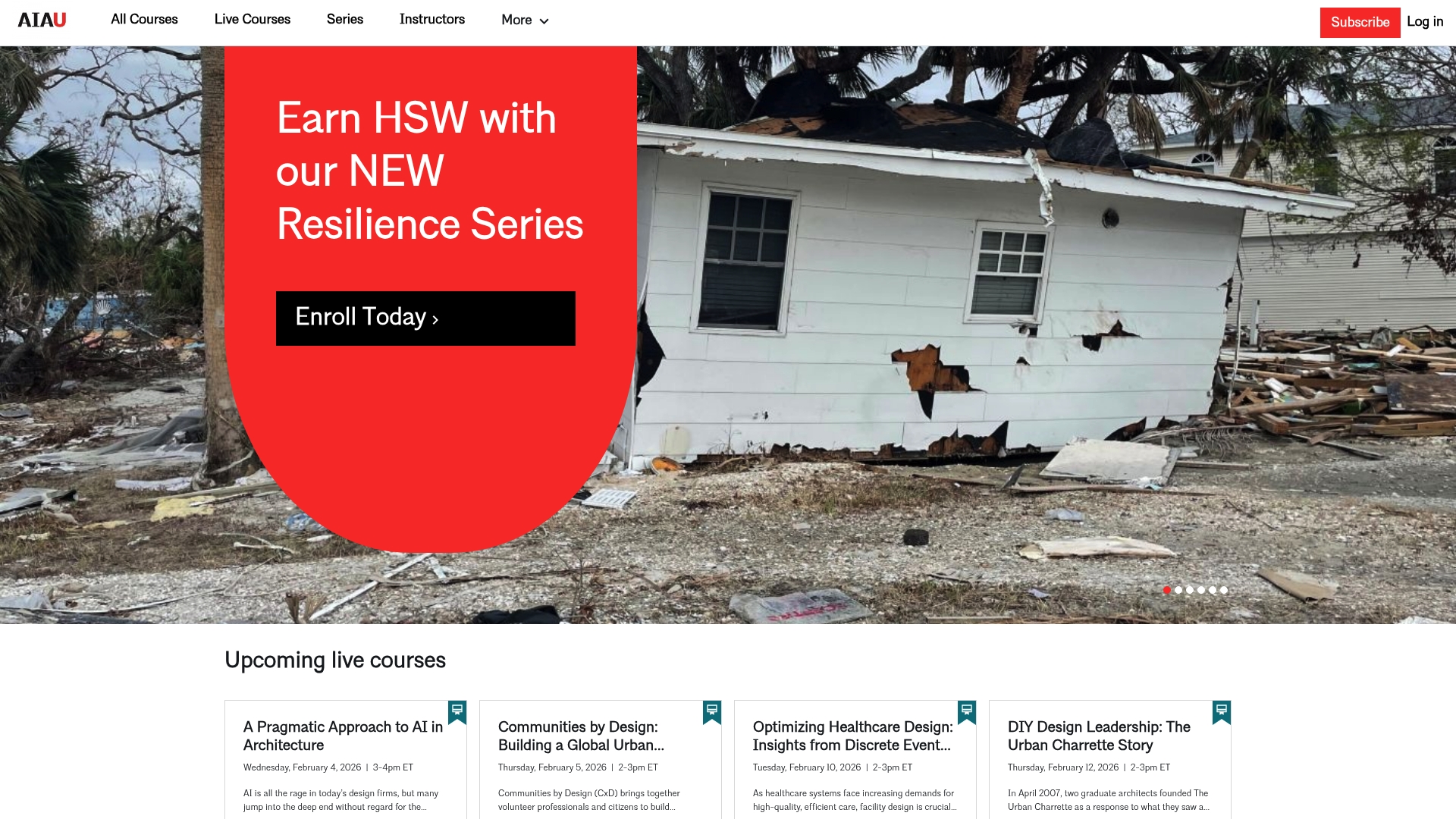
AIAU is the American Institute of Architects’ official online learning hub, offering a broad catalog of live and on-demand courses focused on architecture and allied subjects. It’s strong for professionals who need reliable CE credits, curated series on topics like sustainability and healthcare, and credentials backed by a recognized institution. Access flexibility and Credly digital badging increase practical value. However, subscription gates and higher non-member pricing can add friction for manufacturers evaluating CEU strategies.
Core Features
AIAU provides a wide range of courses in live and on-demand formats, specialized series on topics such as sustainability, AI, healthcare, and urban planning, and continuing education (CE) credits for licensure requirements. The platform uses industry experts as instructors, supports subscription-based access alongside individual course purchases, and integrates digital badging via Credly for earned credentials.
Pros
- Extensive course catalog: AIAU covers many architecture and design topics, giving learners diverse options for continuing education.
- Flexible delivery formats: Both live webinars and on-demand courses let teams train around project schedules and travel.
- CE credit availability: Many offerings provide CE credits that directly support licensing renewal and professional obligations.
- Accessible pricing models: Courses are available individually or via subscription, which can lower per-course costs for frequent users.
- Credly badging partnership: Digital badges make completions easier to verify and share with specifiers or procurement teams.
Cons
- Subscription-dependent access: Some series and valuable content may be locked behind subscription tiers, limiting ad-hoc access.
- Higher cost for non-members: Non-member pricing can make regular use more expensive for teams without AIA affiliation.
- Limited niche specialization: Content may not deeply cover highly specific manufacturer topics important to specification managers.
Who It’s For
AIAU suits architects, architectural students, and design professionals who need accredited continuing education from a trusted industry body. It’s ideal for teams prioritizing licensure compliance, broad professional development, and recognized credentials.
Unique Value Proposition
AIAU’s unique strength is its AIA affiliation: institutional credibility plus a broad, expert-led curriculum and Credly-backed digital badges that verify learning—helpful when demonstrating professional competency to clients and specifiers.
Real World Use Case
An architect takes an on-demand sustainable design course on AIAU to earn CE credits required for license renewal while immediately applying new strategies to a hospitality project’s specification package.
Pricing
Most courses are sold individually or included in subscription plans; prices generally range from $0 to $150 per course, with member discounts available.
Website: https://aiau.aia.org
Continuing Education Platforms Comparison
This table provides a comprehensive overview of six tools geared towards professionals seeking continuing education in architecture, engineering, construction, and design. It compares their features, unique strengths, and pricing, assisting organizations and individuals in selecting the best platform to meet their learning needs effectively.
| Platform | Core Features | Pros | Suitable For | Pricing |
|---|---|---|---|---|
| CEU Builder | AI-powered LMS, accreditation assistance, IDCEC-compliant tools | Provider ownership of data, fast course creation (4-6 weeks), cost transparency, comprehensive LMS | Manufacturers needing to launch CEU programs under $100,000/year | $99 platform access, $10,000 per custom course development |
| AEC Daily | Free-access courses, wide topic coverage, certifications provided | Free offerings, industry-specific content, wide accessibility, multiple formats | AEC professionals and specification teams seeking accessible continuing education options at no cost | Free; paid options pricing undisclosed |
| RedVector | Accredited online video training, license management tools, comprehensive library | Comprehensive courses for licensed professionals, accreditation, scalable team training | Licensed professionals needing mandatory CE credits and large teams | Pricing not disclosed |
| CEU Events | Event and course management, automated certificates, built-in communication tools | Easy-to-use for organizers, supports accreditation, broad applicability across industries | Teams managing regular CEU events and needing centralized systems | Pricing not disclosed |
| ConstructConnect | Project intelligence tools, estimating software, real-time alerts, and bid management | Comprehensive project database, integration of bid management tools | Contractors and manufacturers focused on lead exposure, bid processing, and market forecasting | Starts at $199/month; advanced plans increase cost |
| AIAU | Live and on-demand CEU courses, expert instructors, integrated Credly badging system | Broad architecture-focused topics, flexible access formats, accredits required continuing education credits | Architects and design professionals looking for industry-recognized credentials and educational advancement | $0 to $150 per course, subscriptions available for members |
Take Control of Your CEU Provider Status and Cut Costs Today
The “Top 6 Course Accreditation Services Comparison 2026” highlights the high costs, long development timelines, and lack of data ownership that burden manufacturers relying on legacy CEU platforms like AEC Daily, RedVector, and CEU Events. If you are frustrated by paying $50,000 to $120,000 annually without owning your provider status or learner data, this is your chance to change the game. CEU Builder empowers building product manufacturers to become their own IDCEC and AIA accredited providers with an AI-powered platform that slashes course development time from 12-18 months to just 4-6 weeks.
Stop renting your place in someone else’s directory and start owning your CEU program with transparent pricing at only $99/month. Gain full control over your learner data, enjoy automatic compliance checks, and leverage our Done-For-You course development services for guaranteed first-pass IDCEC approval. This ownership model unlocks dramatic cost savings and real ROI by turning education attendance into specification wins with precise learner attribution.
Ready to ditch legacy CEU platforms and revolutionize your continuing education strategy? Explore how CEU Builder’s provider ownership model, AI-powered compliance tools, and unmatched speed deliver revolutionary benefits to manufacturers like you.
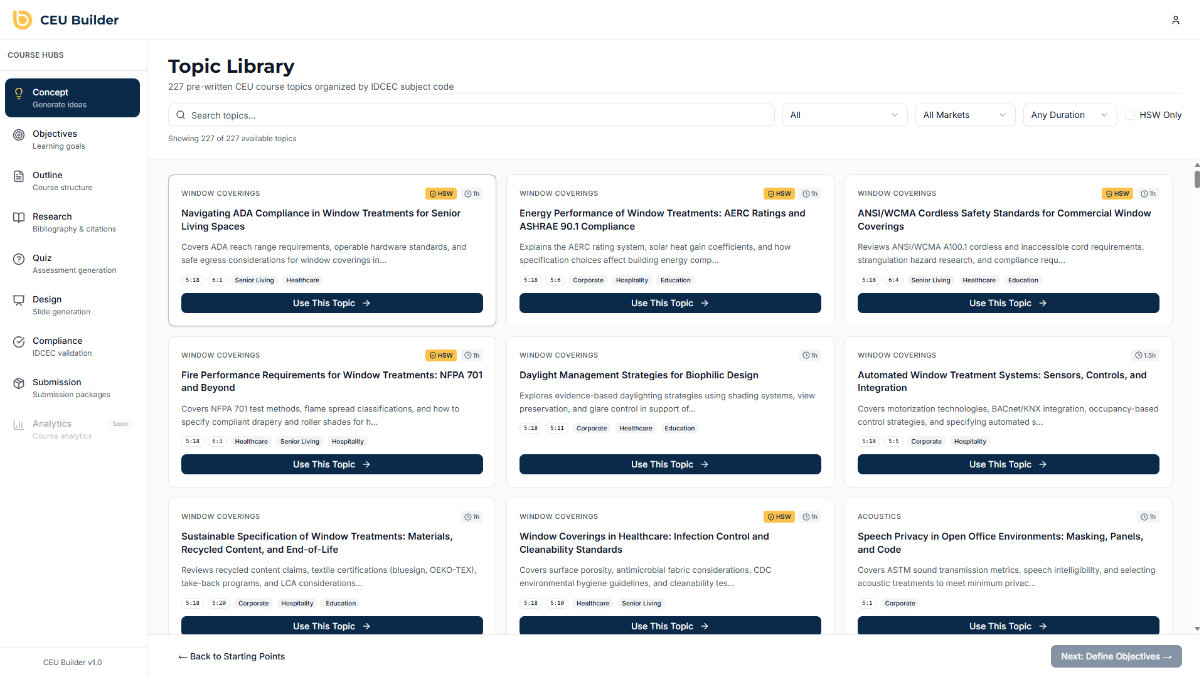
Take charge today and launch your first accredited CEU course in weeks instead of over a year. Visit CEU Builder to get started and see why manufacturers are choosing to own their future instead of renting visibility.
Frequently Asked Questions
What factors should I consider when choosing a course accreditation service?
Choosing a course accreditation service should involve evaluating factors like accreditation recognition, course development support, pricing transparency, and ease of use. Identify your specific needs, such as whether you require assistance with compliance documentation or flexibility in course formats, and then compare services based on these criteria.
How do I determine if an accreditation service is reputable?
To determine the reputation of an accreditation service, check for industry recognition, read user reviews, and verify if they are aligned with recognized certification bodies. Conduct research to see if their courses are accepted for licensure renewal in your specific profession or field.
What is the typical turnaround time for course accreditation?
The typical turnaround time for course accreditation varies but can range from a few weeks to several months, depending on the service and complexity of the course materials. Plan to allow at least 4 to 6 weeks for most accreditation processes to ensure you meet your timeline for course delivery.
Can I track the progress of my course accreditation application?
Most course accreditation services offer a way to track the progress of your application through their online platforms. Ensure to ask about this feature and follow up regularly to stay updated on your application’s status.
What costs are associated with using a course accreditation service?
Costs associated with course accreditation services may include an initial application fee, ongoing subscription costs, and potential charges for course development assistance. Review each service’s pricing model carefully to budget accordingly and ask for a breakdown of all fees involved.
How can I maximize the effectiveness of the accredited courses I create?
To maximize the effectiveness of your accredited courses, focus on aligning your content with current industry standards and learner needs. Gather feedback from participants and continuously refine your materials to improve engagement and maintain compliance with accreditation requirements.
Recommended
- Role of Accreditation Bodies in Continuing Education – CEU Builder
- Master the Course Accreditation Process for CEU Providers – CEU Builder
- Master Course Accreditation Workflow for Manufacturers – CEU Builder
- Accreditation Management: Fast-Tracking CEU Delivery – CEU Builder
- Navigating the Global Internal Audit Standards | CPE Training Events
