

Why CEU Accreditation Matters for Manufacturers

Finding a path to credible CEU accreditation can feel overwhelming for any American hospitality manufacturer navigating the strict requirements of IDCEC. The need for cost-effective, recognized continuing education is more urgent than ever as architects and interior designers demand proof of quality from their course providers. This guide clarifies key accreditation concepts and lays out the practical steps to help you gain control over your offerings and own your valuable learner data.
Table of Contents
- Defining CEU Accreditation and Key Concepts
- Types of CEU Accreditation in Design Industries
- How Accreditation Works for Manufacturers
- Compliance Requirements and Approval Processes
- Financial Impact and Data Ownership Advantages
- Comparing Provider Ownership vs Directory Sponsorship
Key Takeaways
| Point | Details |
|---|---|
| Understanding CEU Accreditation | It validates educational offerings against established quality standards, crucial for architects and designers. |
| Cost Comparison | Choosing between provider ownership and directory sponsorship can save manufacturers significantly over time by owning their data and reducing annual fees. |
| Course Development Process | Manufacturers should be aware of the detailed requirements for compliance to avoid submission rejections, which can waste time and resources. |
| Type of Accreditation Matters | Knowing whether to pursue IDCEC or AIA accreditation influences course strategies and audience engagement effectively. |
Defining CEU Accreditation and Key Concepts
CEU accreditation is fundamentally about trust. It’s the formal process that validates your educational offerings meet established quality standards set by recognized accrediting bodies. When you hear about IDCEC (Interior Design Continuing Education Council) or AIA (American Institute of Architects) accreditation, you’re looking at two of the most respected gatekeepers in the design and architecture industries. These organizations have spent decades developing standards that ensure continuing education courses deliver actual, measurable value to design professionals. CEU accreditation refers to formal evaluation against established standards developed by experts, ensuring programs meet or exceed specific educational quality criteria tailored to your industry and learners.
For manufacturers operating in hospitality, commercial interiors, healthcare, and multi-family residential markets, accreditation serves a dual purpose. On one side, it protects your credibility. Architects and interior designers won’t invest 1 to 2 hours in your course if they can’t earn recognized continuing education credits. On the other side, accreditation protects you legally and operationally. It means you’re following compliance rules around Health, Safety, and Welfare (HSW) content eligibility, subject code classification, and learning objective development. You can’t just slap “CEU approved” on a marketing video and call it education. The accrediting body audits this. They verify your quiz construction, your speaker qualifications, and your learning outcomes align with what you promised.
Here’s where accreditation gets practical for your organization. You have two fundamental paths: become your own IDCEC provider (where you own the accreditation status and learner data directly), or sponsor courses through platforms like AEC Daily, RedVector, or CEU Events (where those platforms own the provider relationship and you rent the space). The first option requires a one-time $440 IDCEC registration fee and puts you in control of your brand, your data, and your course revisions. The second option means paying $50,000 to $120,000 annually with hidden renewal fees, featured placement charges, and analytics add-ons that chip away at your budget year after year. The role of accreditation bodies in continuing education becomes clearer once you understand this distinction. You’re not just choosing a compliance checkbox. You’re choosing whether you own your future or rent it.
Pro tip: Before selecting your accreditation path, calculate your 5-year cost projection with legacy platforms ($375,000+ total when accounting for annual increases) versus owning your provider status ($60,000 to $100,000 total), then map your expected course volume. This single comparison often clarifies the ownership question immediately.
Types of CEU Accreditation in Design Industries
Not all CEU credits are created equal. The design and architecture industries recognize multiple types of accreditation, each serving different purposes and audiences. Understanding which accreditation type matters for your manufacturer depends on who you’re trying to reach and what problems you’re solving for them.
The most prominent split in the design world is between IDCEC accreditation and AIA accreditation. IDCEC (Interior Design Continuing Education Council) focuses specifically on interior designers and covers everything from hospitality design to healthcare environments to commercial interiors. AIA (American Institute of Architects) accreditation targets architects and has slightly different content requirements and learner expectations. Some courses qualify for both, but that requires meeting both sets of standards simultaneously, which is more complex than it sounds. Beyond these two, you’ll encounter discipline-specific accreditations ensuring compliance with industry standards, including specialized certifications in areas like sustainable design, universal design, or specific product categories. Each type carries different weight with different professional groups. A designer earning IDCEC credits sees direct value toward their state licensing requirements. An architect earning AIA credits does the same. But if you’re a manufacturer selling hospitality furniture, knowing whether your audience needs IDCEC, AIA, or both changes your entire content strategy.
Then there’s the distinction between Health, Safety, and Welfare (HSW) credits and general education credits. HSW credits are restricted to courses covering topics like life safety codes, accessibility standards, or ergonomic safety principles. These carry more restrictive rules and require specific content alignment, but they’re highly valued because many states mandate HSW credits for designer and architect relicensing. General education credits have fewer restrictions and let you cover topics like design trends, material selection, or product innovation. Most manufacturers discover they can build 2 to 3 HSW courses and 5 to 7 general education courses that appeal to their target audience. The strategy isn’t choosing one over the other. It’s building a portfolio that meets learner requirements while showcasing your products and expertise across both categories.
Here’s what confuses most manufacturers: the accreditation type doesn’t appear on your course title. Your learner sees “Designing Hospitality Spaces with Sustainable Materials” not “IDCEC General Education Course.” The accreditation type lives in the metadata, the compliance paperwork, and the approval process. But it determines whether architects will recognize your course, whether designers can claim credits toward licensing renewal, and whether you meet the technical requirements for submission. Understanding which CEU path drives more specifications helps you allocate your development resources to the accreditation type that reaches your actual buying influence. Most manufacturers find that IDCEC courses generate stronger engagement from interior designers making specification decisions, while AIA courses open doors with architects at earlier project phases.
Here’s a concise comparison of IDCEC and AIA CEU accreditations for manufacturers:
| Criteria | IDCEC Accreditation | AIA Accreditation |
|---|---|---|
| Primary Audience | Interior designers | Architects |
| Typical Course Topics | Hospitality, interiors, finishes | Architecture, codes, structures |
| Credit Value | Fulfills designer licensing | Counts for architect renewal |
| HSW Content Eligibility | Mandatory for HSW-designated | Mandatory for HSW-designated |
| Course Standards | IDCEC-specific requirements | AIA-specific requirements |
| Brand Exposure | Direct to designers | Direct to architects |
Pro tip: Map your top 10 target accounts and identify whether the primary decision makers hold IDCEC or AIA credentials, then build your first course portfolio to match that credentialing split rather than trying to serve both equally from the start.
How Accreditation Works for Manufacturers
The accreditation process for manufacturers breaks down into three distinct phases: registration, course development and submission, and ongoing compliance. Understanding this workflow removes the mystery and helps you budget both time and money accurately.

First comes provider registration. You submit your company information to IDCEC (or AIA if pursuing that path), pay the one-time registration fee, and become an official provider. This is the foundation. Without it, you cannot submit courses for approval. The registration process typically takes 2 to 4 weeks and requires basic company documentation, proof of insurance, and identification of your course coordinator. Once approved, you receive your provider number and access to the submission portal. At this stage, meeting industry-defined educational standards ensures your organization aligns with workforce competency and operational requirements that accrediting bodies expect from providers. You’re essentially declaring to the design and architecture industries that your company takes continuing education seriously.
Second comes course development and submission. This is where most manufacturers struggle without proper guidance. You build your course outline, develop learning objectives aligned to the accreditation body’s subject codes, create your content (video, slides, written materials), construct a quiz that actually tests the learning objectives, and write speaker notes or scripts. Then you submit everything to IDCEC or AIA for review. Their reviewers examine whether your learning objectives match your content, whether your quiz questions test those objectives, whether your subject code classification is accurate, and whether HSW content (if claimed) actually meets their definitions. This phase typically takes 8 to 12 weeks if you’re building it yourself, or 4 to 6 weeks if you work with a specialized partner who handles the compliance mapping. Rejection on first submission happens to about 40 percent of manufacturers submitting independently because they miss technical requirements. Common rejection reasons include vague learning objectives, quiz questions that don’t align to objectives, incorrect subject code classification, or overstated HSW content claims.
Third comes approval and ongoing management. Once approved, your course lives in the IDCEC or AIA database and becomes discoverable by designers and architects. But accreditation doesn’t end there. You must maintain compliance through annual reporting, update courses when content becomes outdated, and follow procedures if you modify course content. Maintaining up-to-date records and certifications ensures you stay legitimate and eligible for continued provider status. Most manufacturers underestimate this maintenance load. A course you launched two years ago needs refresh materials, updated statistics, or revised product photography. The accrediting body may issue new guidance on HSW eligibility or subject code definitions that affect your existing courses. You’re not building courses and forgetting them. You’re building a portfolio that requires quarterly attention to stay current and compliant.
Here’s the practical reality: a manufacturer building a single course might invest 120 to 160 hours of internal time across outline development, content creation, quiz construction, and submission management. A manufacturer building 3 to 4 courses annually needs a dedicated coordinator spending 30 to 40 percent of their time on accreditation compliance and maintenance. This is why many manufacturers choose done-for-you course development services that handle the compliance work upfront and guarantee first-pass approval, cutting both timeline and internal resource burden.
Pro tip: Before building your first course, document your current team’s time allocation to CEU administration, multiply by your annual salary expense, then compare that annual cost against one-time course development services; most manufacturers discover outsourcing the technical compliance work saves 60 to 80 percent on total cost of ownership.
Compliance Requirements and Approval Processes
Compliance in CEU accreditation isn’t optional or flexible. The accrediting bodies (IDCEC and AIA) enforce specific technical standards that you must meet before your course gets approved. Think of it as the difference between a course that looks good and a course that actually passes inspection. Most manufacturers underestimate how detailed these requirements are, which explains why roughly 40 percent of first-time submissions get rejected.
The compliance checklist breaks down into five core areas. First, learning objectives must be specific, measurable, and written from the learner’s perspective. Not “This course covers sustainable hospitality design” but rather “Upon completion, learners will be able to identify three sustainable material options that meet code requirements for commercial hospitality spaces.” That specificity matters because reviewers will compare every quiz question back to your learning objectives. If a quiz question doesn’t clearly test an objective, your course gets flagged. Second, subject code classification requires mapping your course to IDCEC’s approved subject codes. You cannot invent your own category. Your course fits into existing codes like “Hospitality Design,” “Sustainable Design,” or “Materials and Finishes.” Pick the wrong code and your course becomes invisible to the right audience. Third, HSW content requirements demand that if you claim Health, Safety, and Welfare credits, your content must directly address life safety, accessibility, or ergonomic principles. You cannot claim HSW credit for a course about design trends just because you mention universal design principles in passing. Fourth, quiz construction means your questions must directly test the learning objectives using appropriate cognitive levels. A quiz asking architects to list material options tests recall. A quiz asking them to analyze trade-offs between materials tests higher-level thinking. IDCEC prefers questions that test analysis or application, not simple recall. Fifth, reviewing compliance status annually ensures your provider information stays current and your courses maintain their approved status as industry standards evolve.
The approval workflow itself follows a predictable path. You submit your course through the IDCEC or AIA portal with all required documentation: course outline, learning objectives, content files, quiz with answer key, and speaker notes. The accrediting body assigns your submission to a reviewer, typically someone with expertise in your subject area. They examine whether your content actually delivers on your learning objectives, whether your quiz questions are well-written and aligned to those objectives, whether your subject code is accurate, and whether you’ve made any unsupported claims about HSW eligibility. This review takes 2 to 4 weeks. If approved on first submission, your course goes live within days. If rejected, you receive detailed feedback specifying exactly what failed. Common rejection reasons include learning objectives that are too vague, quiz questions that don’t align to objectives, subject code misclassification, or HSW claims that don’t match the content. You then revise and resubmit. Most manufacturers need one revision cycle. Some need two if the initial submission had multiple issues.
Ongoing compliance requires annual reporting to IDCEC confirming that your courses remain current and that you’ve maintained provider insurance. You must also maintain robust systems for internal controls and transparent operations, monitoring adherence to accreditation rules and mitigating risks that could affect your provider status. If your course content becomes outdated or your provider information changes, you submit updates promptly. IDCEC periodically audits providers to verify courses match their submitted materials and that learner data is being handled correctly. This audit happens randomly, but most manufacturers see one every 2 to 3 years. It’s not a problem if you’re maintaining accurate records and keeping courses current.
Pro tip: Before submitting your first course, have someone from your A&D channel team review your learning objectives and quiz questions to verify they actually test whether an architect or designer could apply what they learned to a real project; internal bias often makes weak objectives look stronger than they are to the people who built them.
Financial Impact and Data Ownership Advantages
Let me cut straight to the economics. A manufacturer paying AEC Daily, RedVector, or CEU Events $50,000 to $120,000 annually for 5 years invests between $375,000 and $600,000 in a system where you own nothing. You don’t own your provider status. You don’t own your learner data. You don’t own your course content. The platform owns all of it. You’re renting access to a directory where other manufacturers also live, competing for the same featured placement fees that cost another $8,000 to $25,000 per year. Compare that to owning your provider status. A one-time $440 IDCEC registration fee plus $99 per month ($1,188 annually) for CEU Builder’s platform means you invest roughly $6,000 to $8,000 per year. Over 5 years, that’s $30,000 to $40,000 total. The math is brutal for legacy platforms once you map it across your 5-year plan.
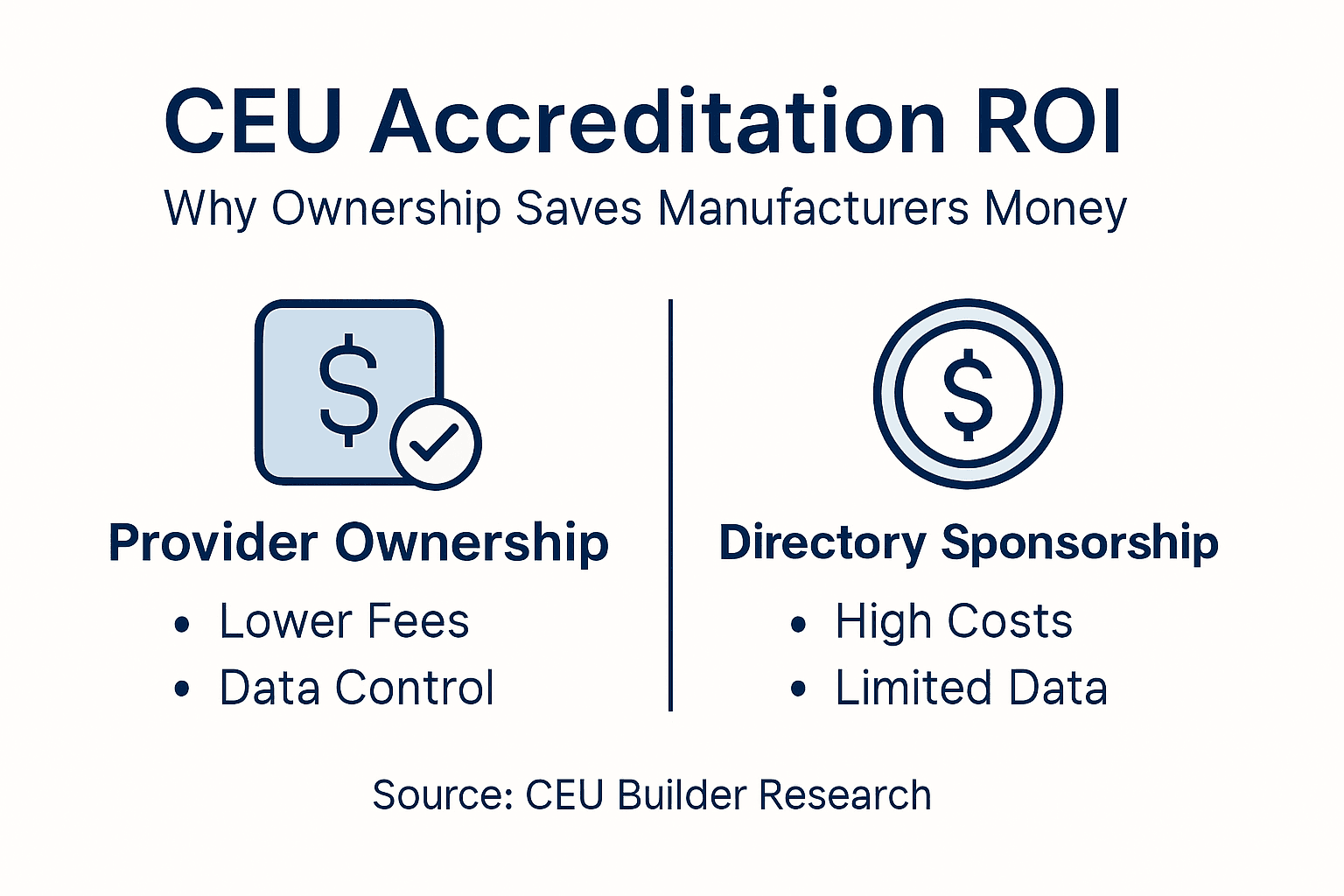
But the financial advantage goes deeper than annual fees. Data ownership is where real competitive advantage lives. When you own your provider status and control your platform, every person who enrolls in your course gives you their professional information. You know their name, their company, their role, their email, and critically, which specific course topics they cared enough to complete. That’s intelligence. You can integrate that data into your CRM and map the enrollment patterns to specification wins. Did architects from a specific firm take your course on sustainable hospitality finishes? Did that correlate with a specification opportunity 6 weeks later? You’ll never know if your learner data lives in AEC Daily’s black box. With your own platform, you can see exactly how CEU attendance connects to sales pipeline activity. This capability transforms CEU from a compliance checkbox into a specification-driving tool that justifies its existence on its own ROI.
When you control sensitive operational data through secure protocols, you gain trust with your A&D channel while protecting competitive information. You decide who accesses your enrollment data, how it’s analyzed, and when it gets shared with your sales team. Legacy platforms collect this data on your behalf but never share it meaningfully. They offer basic reporting that shows you how many people took your course, not who they were or what they actually learned. Your owned platform gives you everything. Additionally, accredited status signals financial and operational reliability to investors and stakeholders, which can support capital-raising efforts if you’re pursuing growth initiatives. Being your own IDCEC provider demonstrates that your organization has invested in compliance infrastructure and educational credibility, assets that strengthen your brand positioning in conversations with enterprise buyers.
Here’s the hidden cost nobody discusses: platform price increases. Legacy CEU platforms increase fees 10 to 18 percent annually. That $60,000 contract becomes $71,000 in year two, $84,000 in year three. Over 5 years, you’re looking at annual escalations totaling $40,000 to $80,000 in extra cost. CEU Builder’s $99 per month price is locked forever. No increases. No surprise renewal fees. No featured placement charges to stay visible. This pricing certainty lets you budget accurately and forecast CEU ROI with confidence. Most manufacturers discover that after year two, owning their provider status costs 60 to 70 percent less than legacy platforms. After year five, the savings exceed $300,000.
The final advantage is speed to value. Building a course on your platform takes 8 to 12 weeks (DIY) or 4 to 6 weeks (done-for-you). Legacy platforms take 12 to 18 months because they’re managing dozens of manufacturers simultaneously and their approval process is bottlenecked. Every month your course is delayed is a month you’re not capturing learner data, not building brand authority with architects and designers, and not driving specifications. Speed compounds into financial advantage over time.
Pro tip: Build a 5-year financial model comparing your current legacy platform costs (including annual increases of 12 to 15 percent) against owned provider status with CEU Builder, then share that model with your CFO and VP of Sales; most manufacturers secure immediate budget approval once they see the data ownership advantage and total cost of ownership reduction.
Comparing Provider Ownership vs Directory Sponsorship
This distinction matters more than you think. When you become your own IDCEC provider, you own the accreditation. When you sponsor a course through AEC Daily or RedVector, you rent access to their provider status. The difference sounds subtle. It’s not.
Provider ownership means you register directly with IDCEC, receive your own provider number, and submit courses under your company’s name and credentials. You control the approval process, the course content, the pricing, and the learner data. You’re responsible for compliance, annual reporting, and maintaining provider standards. Architects and interior designers see your company name as the course provider, not “AEC Daily presents a course sponsored by [Your Company].” When someone completes your course, IDCEC records it as completion of a course offered by your organization. Your brand gets the credibility. You get the data. In contrast, directory sponsorship means you pay a platform like AEC Daily to list your course in their provider directory. They own the provider relationship with IDCEC. They submit your course under their provider status. You’re a sponsor within their ecosystem. Your company name appears somewhere on the listing, but the course is technically offered by AEC Daily. When learners complete it, the data flows to AEC Daily first. You get a report later. You don’t have direct access to learner information, and you can’t integrate that data into your CRM or sales systems.
The operational implications run deep. As a provider, you decide when to update your courses, what pricing strategy to use, and how to market them. You can run promotions, bundle courses, or create custom learning paths for specific customer groups. You own the marketing assets. You own the email addresses of everyone who enrolls. As a sponsor, you’re bound by the platform’s policies. They decide when courses go live. They control pricing through their featured placement model. They send the marketing emails. They own the relationships. Provider ownership involves direct management and control of accredited program content, maintaining data integrity and accountability for your organization’s reputation. This responsibility also means you control the narrative. If your course receives positive reviews, you see those reviews and can leverage them in your sales conversations. If learners have questions, you can respond directly. As a sponsor, the platform mediates those interactions.
Compliance and renewal reflect the ownership gap as well. As a provider, you submit annual compliance reports directly to IDCEC confirming your courses remain current and your provider status is legitimate. It’s straightforward. As a sponsor, you’re subject to the platform’s renewal cycles, their price increases, and their hidden fees. They might increase your featured placement costs or introduce new analytics charges. Sponsors focus on maintaining up-to-date listings and supporting access, while providers bear substantive responsibility for program delivery and compliance standards. The platform controls the leverage. They know you’ve invested heavily in your course development and won’t abandon it easily. They can raise fees with confidence.
Here’s the clearest comparison. Provider ownership costs you $440 one-time plus $99 per month. Directory sponsorship costs you $50,000 to $120,000 annually with 10 to 18 percent increases every year. Provider ownership gives you 100 percent of your learner data. Directory sponsorship gives you a CSV export after the quarter ends. Provider ownership means your course lives under your brand in a searchable database. Directory sponsorship means your course lives under their brand and you pay extra to stay visible. Provider ownership is a 4 to 6 week development cycle. Directory sponsorship is 12 to 18 months because the platform has dozens of manufacturers waiting. The choice gets obvious when you actually compare the two side by side.
Below is a clear cost and control summary between provider ownership and directory sponsorship:
| Factor | Provider Ownership | Directory Sponsorship |
|---|---|---|
| 5-Year Estimated Cost | $30,000 to $40,000 | $375,000 to $600,000 |
| Data Ownership | Full, direct access | Limited, delayed reports |
| Brand Visibility | Under your company name | Platform brand prioritized |
| Timeline to Market | 4–12 weeks | 12–18 months |
| Control Over Courses | Full control, instant updates | Platform controls, slow updates |
Pro tip: Calculate your 5-year cost comparison including annual fee increases, featured placement charges, analytics fees, and lost productivity from slow approval timelines for directory sponsorship, then compare that total against owned provider status; most manufacturers find the break-even point happens in year 2.
Own Your CEU Accreditation and Transform Your Manufacturer CEU Programs
The article highlights the costly challenges and lack of control manufacturers face when they rely on legacy CEU directories. Hidden fees, slow course approval timelines, missing learner data access, and losing provider ownership are common pain points that stall growth and diminish ROI. If you are tired of renting your CEU presence and want to own your provider status with full control over your course content and learner data, it is time to explore a better way.
At CEU Builder, we empower manufacturers like you to become your own IDCEC and AIA accredited provider for a fraction of the traditional cost. Our AI-powered compliance tools fast-track course creation and approval in weeks, not months. You gain 100 percent data ownership to directly measure how your CEU programs influence specifications — no more opaque reporting from third-party platforms. Discover how you can drastically reduce costs while taking full command of your continuing education strategy on CEU Builder.
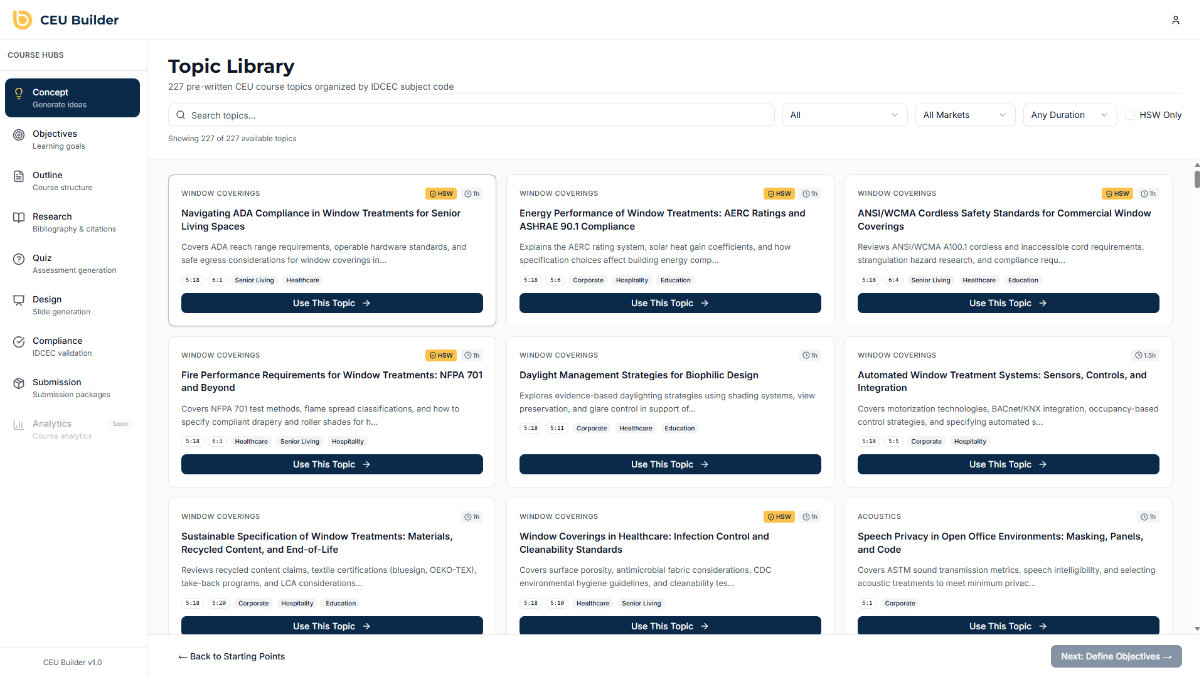
Ready to stop paying six figures to rent CEU listings and start building your own accredited program with transparent pricing and full data control? Visit CEU Builder to learn about our provider ownership model. See how our AI-powered course builder and done-for-you services can help you launch compliant, engaging CEU courses faster and with guaranteed approval. Own your future—take the first step today.
Frequently Asked Questions
What is CEU accreditation and why is it important for manufacturers?
CEU accreditation is a formal process that validates educational offerings meet quality standards set by recognized accrediting bodies. For manufacturers, it enhances credibility, ensures compliance with industry regulations, and increases the likelihood that design professionals will engage with your courses.
How does IDCEC accreditation differ from AIA accreditation?
IDCEC accreditation specifically targets interior designers, covering topics relevant to their field like hospitality design and healthcare environments. In contrast, AIA accreditation focuses on architects, addressing their unique content requirements and expectations. Understanding which accreditation to pursue is crucial for reaching your intended audience effectively.
What are the compliance requirements for CEU course approval?
Compliance requires meeting several standards, including developing specific, measurable learning objectives, correctly classifying subject codes, and adhering to Health, Safety, and Welfare (HSW) content guidelines. Proper quiz construction and ongoing course management are also essential for maintaining provider status.
What are the financial implications of owning CEU accreditation versus using a sponsorship model?
Owning your CEU provider status typically involves a one-time registration fee and lower annual costs, leading to substantial savings over time compared to directory sponsorship, which can incur high annual fees and hidden costs. Additionally, owning your accreditation enables you to maintain full control over learner data and course content.
Recommended
- Accreditation Management: Maximizing ROI for Manufacturers – CEU Builder
- Master the Course Accreditation Process for CEU Providers – CEU Builder
- IDCEC vs AIA Credits: Which CEU Path Drives More Specs for Manufacturers? – CEU Builder
- Role of Accreditation Bodies in Continuing Education – CEU Builder
- The Ultimate Guide to Third Party Tested Supplements: Ensuring Quality – Nutribliss Inc.
- Clean Beauty Certification: What It Really Means – Pure Light Botanical Beauty
