

Course Approval Steps for IDCEC Providers

Frustration mounts when launch timelines stall because a course is stuck in approval limbo. For Marketing Directors at North American hospitality and commercial interiors manufacturers, the IDCEC course approval process offers remarkable transparency and faster decisions—with most courses reviewed in about three weeks thanks to a modern, web-based system. This guide unpacks every critical step, requirement, and best practice so your CEU courses can move efficiently from concept to approval while you maintain control over costs and valuable educational data.
Table of Contents
- What Is the Course Approval Process?
- Types of Approved CEU Courses
- Core Requirements for Course Submission
- IDCEC Provider Registration Steps
- Course Costs, Timelines, and Compliance
- Common Rejection Reasons to Avoid
Key Takeaways
| Point | Details |
|---|---|
| Course Submission Timeline | The IDCEC course approval process typically takes about 3 weeks, but revisions can extend this timeline significantly. Submitting early is essential to accommodate potential feedback. |
| Compliance Requirements | Courses must be educational, non-proprietary, and align with IDCEC subject codes to gain approval. Ensure content does not promote specific products to avoid rejection. |
| Learning Objectives | Clearly defined learning objectives help IDCEC reviewers assess the course’s educational value. Vague goals lead to rejections, so specificity is key. |
| Provider Registration | Register as an IDCEC provider through their online portal, with specific categories available. A one-time annual fee and course submission fees apply. |
What Is the Course Approval Process?
The IDCEC course approval process is straightforward but requires attention to detail. After you register as an IDCEC provider, you submit your course through an online portal where IDCEC staff evaluates it against their standards. The entire process typically takes about 3 weeks from submission to decision.
Here’s what happens during review. IDCEC examiners check that your course content is non-proprietary and genuinely educational rather than sales-focused. They verify your learning objectives align with IDCEC subject codes, confirm the course meets Health, Safety, and Welfare (HSW) requirements if you’re claiming those credits, and ensure your quiz questions accurately assess what students actually learned. Think of it like a checklist: educational value, yes or no? Compliance with standards, yes or no? Proprietary material, yes or no?
The automated web-based system significantly reduced approval times compared to the old paper-based approach. You can monitor your submission status through your provider dashboard, so you’re never wondering where things stand. Communication from IDCEC comes directly to your account, eliminating back-and-forth emails.
Submissions that need revisions get flagged during the review period. IDCEC won’t outright reject courses; instead, they’ll identify specific sections requiring modification. You then resubmit those changes, and the clock restarts on the 3-week review window. This is why submitting early matters. If you wait until the last minute and your course needs revisions, you’re looking at 6 weeks minimum before launch.
Payment for your submission happens online when you register as a provider. There’s a one-time registration fee ($440) and then submission fees per course. You pay once per course, and once approved, that course lives in the IDCEC directory indefinitely. No annual renewal fees. No hidden charges buried in your contract.
Pro tip: Submit your course at least 4 weeks before your intended launch date to account for potential revision requests and avoid rushed resubmissions that introduce errors.
Types of Approved CEU Courses
IDCEC approves multiple formats of continuing education, but they all share one requirement: genuine educational value. Your course can be delivered as an in-person lecture, a live webinar, or self-paced distance learning. The delivery method doesn’t matter to IDCEC. What matters is that your content educates interior designers without pushing your products.
Courses fall into two main buckets. Health, Safety, and Welfare (HSW) courses address codes, standards, accessibility, fire safety, and sustainability topics directly affecting occupant wellbeing. General education courses cover broader design topics like space planning, material selection, color theory, or project management. HSW courses are more valuable because many states require designers to earn HSW credits specifically. General courses count toward overall CE requirements but don’t satisfy HSW mandates.
Here’s the critical distinction: IDCEC approves content focused on generic, non-proprietary education. You can’t submit a course that’s basically a product demo disguised as education. A hospitality flooring manufacturer could teach “Specifying Durable Flooring for High-Traffic Hospitality Spaces”—that’s educational and relevant. But “Why You Should Buy Our Brand’s Flooring” gets rejected immediately. The line between education and marketing matters.
Within these types, you can structure courses as recorded videos, live instructor-led sessions, interactive modules with quizzes, or PDF-based content. Some manufacturers use hybrid approaches: a recorded video plus a live Q&A session. As long as students meet the learning objectives and pass an assessment, the format works. Most hospitality manufacturers find that 45-60 minute HSW videos with downloadable resources perform best with architects and designers.
Here is a quick comparison of HSW and General CEU courses under IDCEC approval:
| Course Type | Focus Areas | Typical Audience Needs | Impact on License Renewal |
|---|---|---|---|
| Health, Safety, Welfare (HSW) | Codes, accessibility, fire safety, sustainability | High demand; often state-mandated | Satisfies HSW credit requirements |
| General Education | Design principles, project management, materials | Broader design knowledge | Counts toward total CE hours |
Pro tip: Start with one HSW course addressing a pain point your buyers face—like ADA compliance or fire code updates—because HSW credits have higher demand and approval rates than general education courses.
Core Requirements for Course Submission
Before you hit submit, your course needs to be complete. You’ll upload presentation slides, speaker notes, a detailed course outline, and learning objectives. IDCEC also requires a bibliography or justification statement explaining where your content comes from. Think of it as showing your work. They want to see that your educational material is based on research, codes, industry standards, or expert knowledge.

The biggest barrier most manufacturers hit is the proprietary content rule. You cannot include product names, logos, or promotional material in your course. Your slides can feature your brand on a title slide or closing slide, but the meat of the course must be generic and educational. A lighting manufacturer teaching “Color Rendering Index and Its Impact on Hospitality Design” works. “Our LED Fixtures Deliver Superior CRI” does not. The line matters.
IDCEC submission requires that all material be educational, clear, and exclude product names from the instructional content itself. Sales presentations, entertainment, or purely promotional activities get rejected. Your course must teach designers something useful they can apply to projects, regardless of whether they ever buy your products.
You also need to define clear learning objectives. These answer: What will designers know or be able to do after completing this course? Instead of “Learn about sustainable materials,” write “Identify three sustainable flooring options that meet commercial durability standards and explain their environmental certifications.” Specific objectives help IDCEC reviewers verify your quiz actually assesses what you promised to teach.
File formats matter too. Submit PowerPoint slides, PDFs, and speaker notes in standard formats. Keep file sizes reasonable. Include a complete bibliography with sources cited properly. If you’re teaching about ADA standards, cite the actual ADA guidelines. If you’re covering fire safety codes, reference the specific building code editions you’re using.
Pro tip: Before submission, audit your slides and speaker notes with a non-expert reviewer who works outside your company to catch subtle product promotion you might have missed.
IDCEC Provider Registration Steps
Becoming an IDCEC provider starts with registration. You’ll head to the IDCEC website and create an account on their online portal. This is where everything happens: registration, course submissions, approval tracking, and certificate management. Without an account, you cannot submit courses.
Next, you’ll select your provider category. IDCEC offers three options: individual provider (if you’re a solo consultant or freelancer), corporate provider (if you represent a manufacturer or company), or preferred provider (for organizations with established track records). Most hospitality manufacturers register as corporate providers since they’re representing their company, not themselves personally.
Then comes the application and payment. You’ll fill out the provider application form with your company details, contact information, and business classification. Registration requires paying an annual fee online based on your provider type, and the amount varies depending on which calendar quarter you register. IDCEC accepts online payment only. No checks, no bank drafts, no purchase orders. Wire transfer or credit card only.
The fee is one-time annually. If you register in January, you pay the full year rate. If you register in October, you pay a prorated amount for that quarter plus the next three quarters. Registration must be renewed each year, but the renewal process is quick.
Once you complete registration and payment, your account activates immediately. You can now access the course submission portal and upload your first course. You’ll receive login credentials and a dashboard where you can track submission status, view IDCEC communications, and manage your provider profile.
Before submitting any course, double-check your account settings. Make sure your contact information is current because IDCEC communicates directly through your account dashboard and email.
Pro tip: Register early in the quarter you want to launch your first course, giving yourself time to prepare materials and submit without calendar pressure.
Course Costs, Timelines, and Compliance
The cost structure for IDCEC is transparent and predictable. You pay an annual provider registration fee (prorated based on registration quarter) plus a per-course submission fee. Both are paid online when you register and submit. No hidden charges. No surprise renewal fees. No featured placement upgrades. You pay once per course, and that course stays in the IDCEC directory indefinitely.
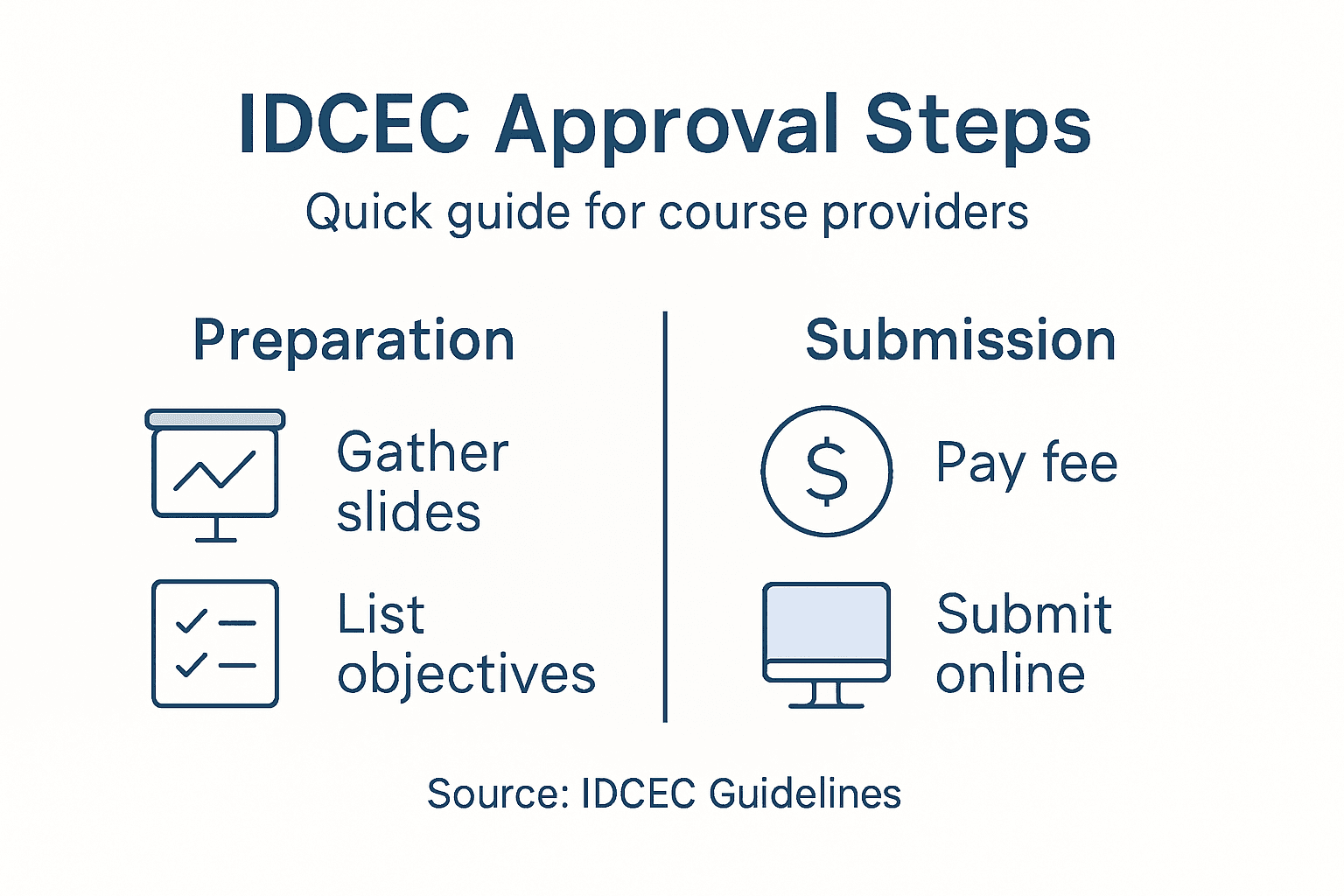
The timeline is where IDCEC shines compared to legacy platforms. The automated approval system processes courses within approximately 3 weeks, significantly faster than the old paper-based workflow. This assumes your course is compliant on first submission. If IDCEC flags issues requiring revisions, the 3-week clock restarts after you resubmit.
Compliance determines everything. IDCEC’s review process checks that your content is educational, non-proprietary, and meets their subject code guidelines. Their automated system reduces administrative burden on both sides. You submit materials through the portal, IDCEC reviews them systematically, and you get clear feedback on approval or required changes.
The biggest compliance issue manufacturers face is proprietary content. If your course sounds like a sales pitch, it gets rejected. IDCEC reviewers ask: Is this teaching interior designers something useful? Or is this promoting your products? Generic educational content passes. Promotional material fails. That’s the line.
Payment compliance matters too. Course submission requires payment per course in addition to annual registration fees, and IDCEC accepts online payment only. Your submission won’t process without payment cleared. Budget accordingly and don’t wait until the last minute to submit if you need the course live by a specific date.
Timeline planning requires thinking backward. If you want a course live in 8 weeks, submit in week 2 to account for potential revisions. If your course needs changes, you need buffer time for resubmission.
Pro tip: Build compliance into your course content from day one rather than creating it and hoping IDCEC approves it, because revision rounds eat your timeline and delay launch.
Common Rejection Reasons to Avoid
IDCEC rejection happens. But most rejections are preventable. Understanding why courses get denied lets you build approval into your submission from the start instead of discovering problems after submission.
The most common rejection reason is incomplete submission materials. You submit slides but forget speaker notes. You include an outline but no learning objectives. IDCEC needs the complete package: presentation slides, detailed speaker notes, learning objectives, a bibliography, and a course outline. Missing even one piece gets your submission flagged. Insufficient material such as lack of slides or speaker notes causes frequent rejections.
Proprietarity is the second killer. Your slides mention your brand name in the course body. Your speaker notes recommend your products. Your examples feature your company exclusively. IDCEC sees this as promotional content, not education. Remember: your title slide and closing slide can feature your brand. The middle 90 percent must be generic and educational. A lighting manufacturer teaching color rendering index should never mention their specific LED fixture model.
File size violations trip up more submissions than you’d think. Large files exceeding 5MB without proper external links get rejected. If your video is 200MB, host it externally and provide a link instead of embedding it in your submission package. Test your file sizes before uploading.
Missing or weak learning objectives sink courses too. Vague objectives like “Learn about sustainable design” don’t work. Specific objectives do: “Identify three sustainability certifications for commercial flooring and explain the environmental standards each certifies.” IDCEC uses objectives to verify your quiz actually assesses what you claim to teach.
Bibliographies matter more than many manufacturers realize. If you’re teaching about building codes, cite the actual code editions. If referencing research, include the studies. A bibliography shows your content comes from legitimate sources, not imagination.
To help avoid common pitfalls, here’s a summary of the most frequent course rejection reasons and how to prevent them:
| Rejection Reason | Description | Prevention Tip |
|---|---|---|
| Incomplete Materials | Missing slides, notes, objectives, or outline | Double-check checklist before submitting |
| Proprietary Content | Branded names, logos, or promotion present | Keep content generic and educational |
| Large File Sizes | Exceeding 5MB limits or improper links | Use external links for large files |
| Vague Objectives | Learning goals are too broad or unclear | Write specific, measurable objectives |
| Poor Bibliography | Insufficient or missing references | Cite all sources and standards |
Pro tip: Create a pre-submission checklist covering slides, speaker notes, objectives, bibliography, file sizes, and proprietary content, then have someone outside your department review it before uploading.
Take Control of Your IDCEC Course Approvals with CEU Builder
Navigating the intricacies of the IDCEC course approval process can be challenging and time-consuming, especially when dealing with proprietary content restrictions and strict compliance requirements like HSW eligibility. If you want to avoid costly delays, repeated revisions, and endless back-and-forth with reviewers, you need a solution that streamlines every step while empowering you to own your provider status and learner data.
CEU Builder is designed exactly for manufacturers like you who face these frustrations. Our AI-powered platform accelerates course development and ensures your submissions align perfectly with IDCEC standards. Whether you want to build self-paced hospitality CEU courses or comprehensive HSW content, CEU Builder helps you create compliant, non-proprietary courses quickly so you meet deadlines and maximize ROI without paying legacy directory fees.
- AI-driven compliance validation for learning objectives, quizzes, and HSW credit eligibility
- Full control as your own IDCEC provider with zero hidden fees and lifetime course listings
- Superior turnaround times getting your course approved in weeks instead of months
Learn how to become your own IDCEC provider and stop paying six-figure annual fees just to rent your education space. Join manufacturers who save $300,000+ over five years by switching to CEU Builder.
Start building your compliant courses now and see why first-pass IDCEC approval rates with our platform exceed 90%.
Discover Done-For-You development services guaranteed to get your first course approved fast and hassle free.
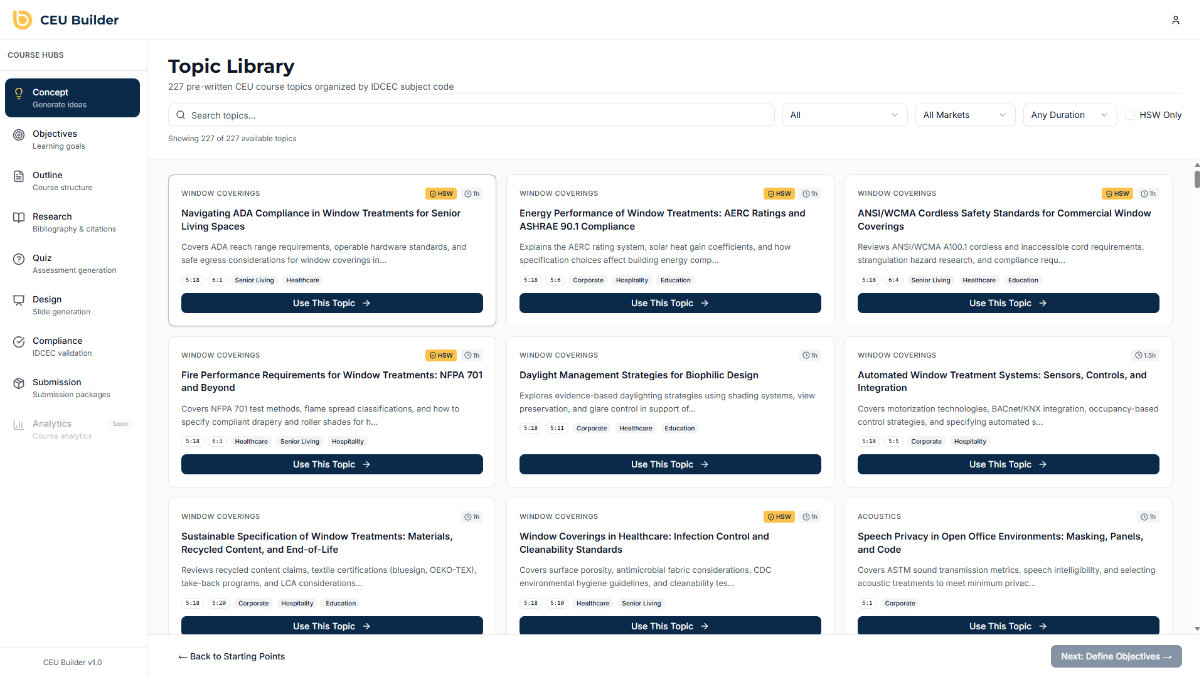
Ready to accelerate your IDCEC course approval and own your continuing education future? Visit https://ceubuilder.com/ today and take the first step toward true provider ownership with transparent pricing and industry-leading compliance tools.
Frequently Asked Questions
What is the IDCEC course approval process?
The IDCEC course approval process involves submitting your course through an online portal after registering as an IDCEC provider. The review takes about 3 weeks, focusing on the educational value and compliance with standards.
What types of courses are eligible for IDCEC approval?
IDCEC approves courses in two main categories: Health, Safety, and Welfare (HSW) courses, which address topics affecting occupant wellbeing, and General Education courses that cover broader design principles.
What are the core requirements for submitting a course to IDCEC?
Core requirements include uploading presentation slides, speaker notes, a course outline, learning objectives, and a bibliography demonstrating the educational material’s basis in credible sources.
What are common reasons for course submission rejections?
Common rejection reasons include incomplete materials, proprietary content, large file sizes, vague learning objectives, and poor bibliography citations. Ensuring all components are educational and following submission guidelines can help avoid these issues.
Recommended
