

How to Offer CEU Courses for Hospitality Manufacturers
Finding ways to stand out in the fiercely competitive North American hospitality sector is no simple task for Marketing Directors. When it comes to educating architects and interior designers, developing accredited CEU courses can be the differentiator your company needs. By mastering industry standards set by organizations like the International Association for Continuing Education and Training and tailoring course content to the exact needs of design professionals, you position your furniture offerings for better specification and recognition.
Table of Contents
- Step 1: Identify Accredited CEU Requirements And Audience Needs
- Step 2: Develop Strategic Course Content Aligned To Specification Goals
- Step 3: Ensure Compliance And Prepare IDCEC Accreditation Materials
- Step 4: Submit For Approval And Optimize Course Delivery Systems
- Step 5: Track Results And Refine For Ongoing Success
Quick Summary
| Key Insight | Explanation |
|---|---|
| 1. Understand Accreditation Standards | Familiarize yourself with professional standards like those from the International Association for Continuing Education and Training for effective CEU course development. |
| 2. Identify Audience Needs | Conduct surveys to pinpoint knowledge gaps and learning preferences among design professionals before crafting your CEU content. |
| 3. Ensure Compliance in Submissions | Prepare detailed accreditation materials, focusing on learning objectives, course outlines, and bibliography to meet IDCEC requirements effectively. |
| 4. Optimize Course Delivery Systems | Implement technology-enabled learning platforms for efficient tracking and engagement to support professional development in your CEU programs. |
| 5. Continuously Measure and Refine | Track key performance metrics to transform your CEU course into a valuable educational resource, ensuring ongoing improvement and relevance. |
Step 1: Identify Accredited CEU Requirements and Audience Needs
Successfully developing continuing education units (CEUs) for hospitality manufacturers requires strategic understanding of professional accreditation standards and audience learning needs. This section will help you map out the critical requirements for creating compelling, compliant educational content.
The first step in developing accredited CEU courses involves thoroughly understanding professional standards from recognized bodies. The International Association for Continuing Education and Training sets rigorous guidelines that demand high-quality content meeting specific educational criteria. These standards ensure that courses provide meaningful professional development rather than generic marketing materials.
To create an effective CEU course for hospitality manufacturers, you must focus on identifying precise audience needs. Design professionals like architects and interior designers require educational content that not only fulfills their continuing education requirements but also provides actionable insights into product specifications and industry trends. Key considerations include:
- Addressing specific technical knowledge gaps in hospitality design
- Providing content that connects directly to specification decision-making
- Creating materials that demonstrate deep understanding of manufacturing processes
- Ensuring compliance with professional licensing board requirements
Successful CEU development requires aligning your course content with the professional development requirements of your target audience. By understanding both accreditation standards and audience learning objectives, you can create courses that serve as valuable educational resources.
Pro tip: Conduct preliminary research by surveying design professionals about their current knowledge gaps and learning preferences before developing your course content.
Step 2: Develop Strategic Course Content Aligned to Specification Goals
Developing strategic CEU course content requires a systematic approach that transforms educational materials into powerful specification tools for hospitality manufacturers. Your goal is to create courses that not only meet accreditation standards but also drive meaningful product understanding among design professionals.
To achieve this, focus on integrating industry-specific technical regulations and quality management practices into your course design. Effective content must bridge the gap between theoretical knowledge and practical application, addressing specific challenges faced by architects and interior designers when specifying manufacturing products. Key strategic elements include:
- Highlighting unique product performance characteristics
- Demonstrating compliance with international standards
- Providing real-world application scenarios
- Connecting technical specifications to design outcomes
Course development should prioritize depth and practical relevance. Design content that goes beyond surface-level information by incorporating technical insights, case studies, and specification guidelines that help design professionals make informed decisions. Each module should offer clear learning objectives that directly relate to product selection, performance evaluation, and industry best practices.
Strategic CEU content transforms educational materials from compliance requirements into powerful specification tools.
Pro tip: Collaborate directly with your technical team to ensure course content reflects the most current and nuanced product specifications and performance characteristics.

Step 3: Ensure Compliance and Prepare IDCEC Accreditation Materials
Preparing IDCEC accreditation materials requires meticulous attention to detail and a strategic approach to meeting rigorous professional education standards. Your goal is to craft a comprehensive submission that demonstrates both educational value and technical precision.
Begin by carefully reviewing the step-by-step accreditation guide for IDCEC providers. The submission process demands comprehensive documentation that proves your course meets professional learning standards. Critical components of a successful accreditation package include:
- Detailed learning objectives that align with IDCEC requirements
- Comprehensive course outline demonstrating educational depth
- Professional bibliography with current, credible sources
- Precise exam questions testing substantive learning outcomes
- Clear instructional design methodology
- Explicit connections between course content and industry practices
Documentation must showcase the course’s ability to deliver meaningful professional development. Every section of your submission should reflect strategic educational planning that goes beyond simple compliance. Your materials must convincingly demonstrate how the course will help design professionals enhance their technical knowledge and specification capabilities.
IDCEC accreditation is not just about passing a review – it’s about creating genuinely valuable educational experiences.
Pro tip: Review previous successful IDCEC course submissions to understand the precise formatting, depth, and style of documentation that consistently receives approval.
Step 4: Submit for Approval and Optimize Course Delivery Systems
Transitioning from course development to submission requires a strategic approach that maximizes both approval potential and learning effectiveness. Your goal is to create a seamless pathway from course creation to professional education delivery that meets rigorous industry standards.
Optimize your course delivery by implementing technology-enabled learning platforms that support comprehensive tracking and engagement. Successful submission and deployment involve multiple critical components:
- Selecting a robust learning management system (LMS)
- Implementing automated tracking mechanisms
- Creating scalable delivery infrastructure
- Ensuring consistent content accessibility
- Developing comprehensive reporting capabilities
- Maintaining professional learner experience standards
Your submission process should demonstrate not just educational content quality, but also technical capability to deliver professional development consistently. This means preparing documentation that proves your technological infrastructure can support comprehensive learner engagement, track completion rates, and provide detailed performance insights.
Here’s how key course delivery features support ongoing CEU program success:
| Delivery Feature | Description | Business Impact |
|---|---|---|
| Automated Tracking | Monitors learner progress in real time | Enables accurate completion reporting |
| Scalable Infrastructure | Supports increasing enrollment numbers | Allows program growth without issues |
| Accessible Content | Materials available on any device | Boosts engagement and satisfaction |
| Reporting Capabilities | Provides detailed analytics dashboards | Informs strategic content improvements |
Technology transforms continuing education from a compliance requirement into a strategic learning experience.
Pro tip: Test your entire course delivery system thoroughly before final submission, simulating multiple user scenarios to identify potential technical or accessibility barriers.
Step 5: Track Results and Refine for Ongoing Success
Successful CEU course delivery extends far beyond initial creation and submission. Your ongoing strategy must focus on continuous performance measurement and strategic refinement to ensure long-term value for both your organization and design professionals.
To effectively track your course’s impact, implement a systematic approach to measuring what predicts revenue. Critical metrics to monitor include:
- Total course completions
- Learner engagement rates
- Specification conversion metrics
- Architect feedback and satisfaction scores
- Repeat enrollment percentages
- Knowledge retention test results
Track these metrics consistently to understand your course’s true performance beyond surface-level completion numbers. Your goal is to transform raw data into actionable insights that continuously improve educational content and drive meaningful specification outcomes. This approach turns your CEU course from a compliance requirement into a strategic business development tool.
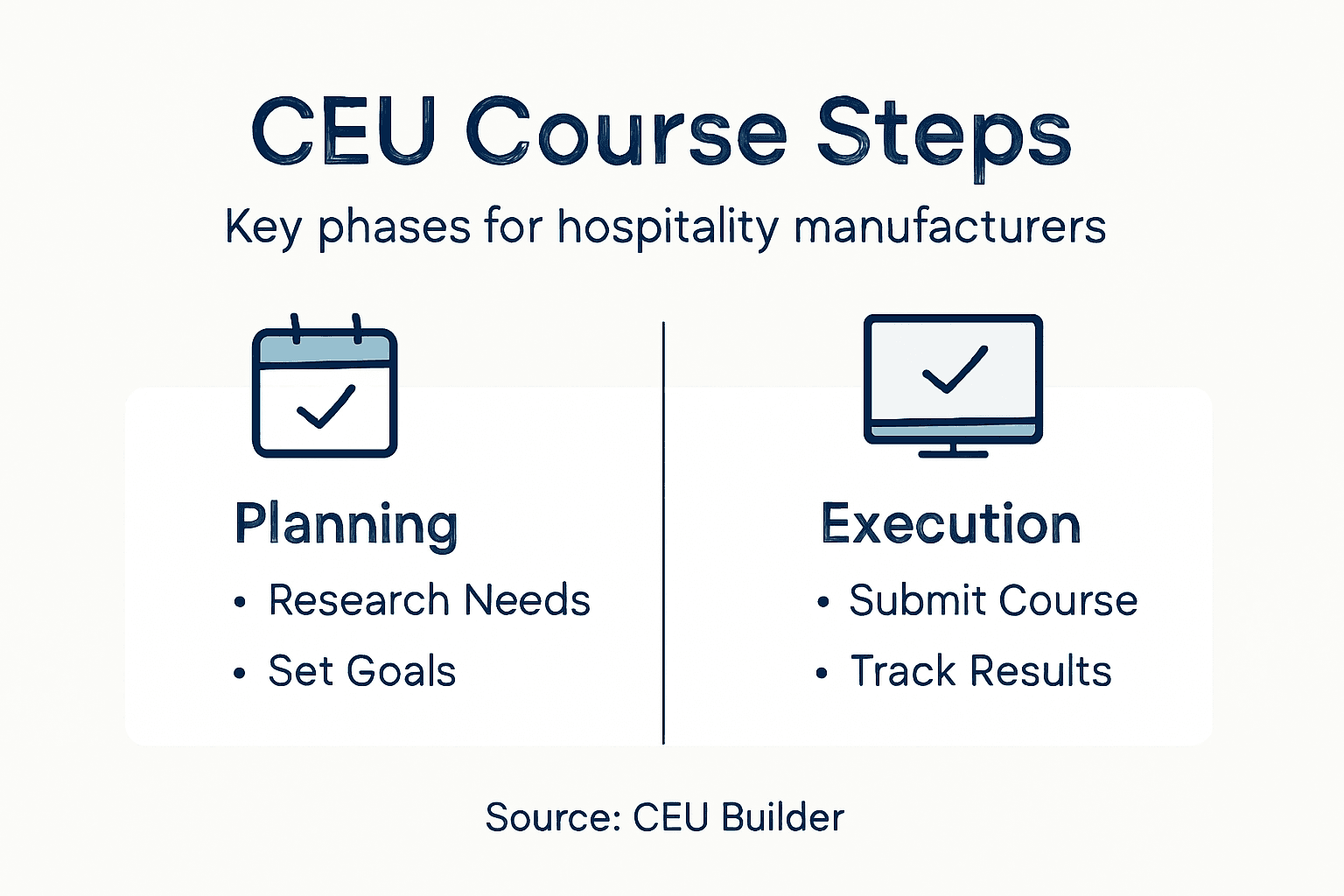
Summary of essential metrics for evaluating CEU course effectiveness:
| Metric | Why It Matters | How to Use It |
|---|---|---|
| Learner Engagement Rate | Assesses real user interaction | Optimize content formats |
| Specification Conversion Rate | Links learning to actual outcomes | Adapt selling strategies |
| Repeat Enrollment Percentage | Measures course value perception | Guide course refinement |
| Knowledge Test Results | Proves knowledge transfer | Validate module clarity |
Measurement is not about collecting data – it’s about understanding the story behind the numbers.
Pro tip: Create a quarterly review process where you analyze course performance data, solicit direct architect feedback, and make targeted improvements to maintain course relevance and impact.
Elevate Your Hospitality CEU Course Strategy with CEU Builder
Offering accredited CEU courses for hospitality manufacturers is a powerful way to engage architects and interior designers who control key specifications. Yet, navigating the complex IDCEC accreditation process while creating strategic, relevant content that drives specification outcomes can be challenging. This article highlights how understanding accreditation requirements, aligning course content with specification goals, and measuring ongoing impact are critical to success.
At CEU Builder, we specialize in transforming CEU development from a compliance burden into a business growth engine. Our 100% first-pass IDCEC approval rate and deep industry expertise help manufacturers create courses that architects want to take and that impact real specification decisions. Whether you want a fully managed service or a platform with AI tools for your internal team, we provide tailored solutions to accelerate your CEU program delivery.
Explore strategies on our CEU Strategy & Best Practices – CEU Builder page and learn how to optimize your educational offerings to win in hospitality specification. For insights into how CEUs fit into your overall market approach, visit Marketplaces & Distribution – CEU Builder. Ready to transform your continuing education approach? Visit CEU Builder to discover how our proven processes and expert team can fast-track your success.
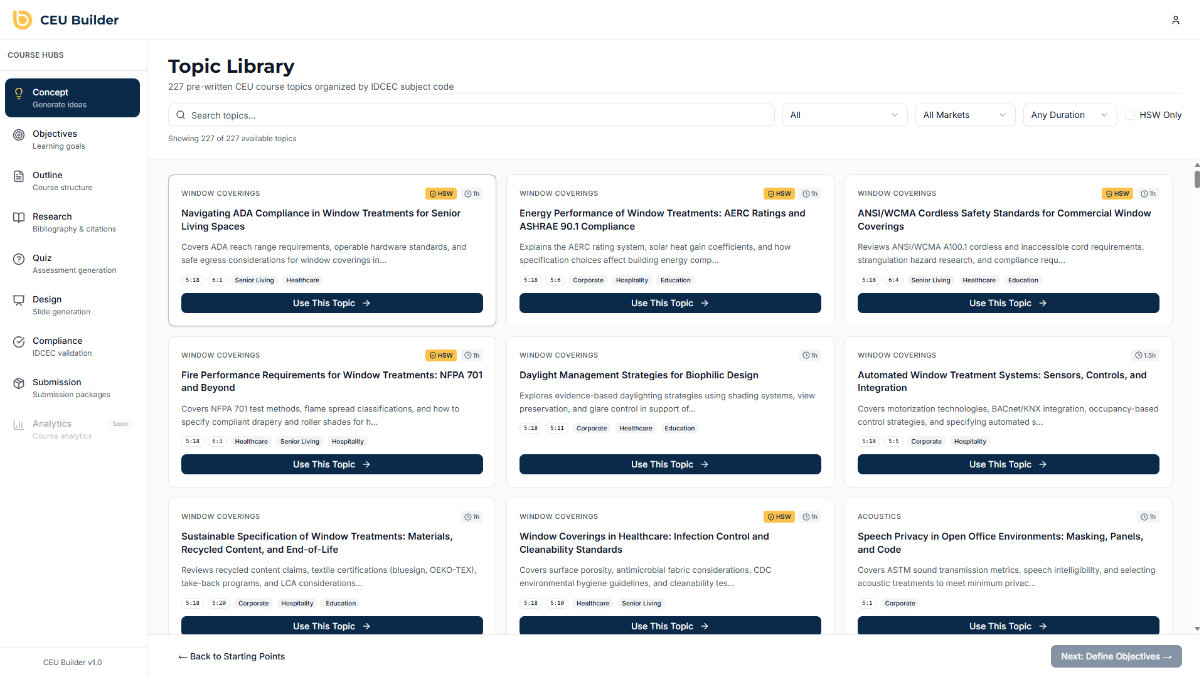
Take the next step toward converting CEU courses into a strategic tool for sustained revenue growth. Contact CEU Builder today to start your journey toward accreditation and specification influence.
Frequently Asked Questions
What are the key steps to develop CEU courses for hospitality manufacturers?
To develop CEU courses, start by identifying accredited CEU requirements and understanding the specific learning needs of your audience. Next, create course content that aligns with industry standards and specification goals, ensuring compliance before submitting for accreditation.
How can I ensure my CEU course meets professional accreditation standards?
To meet professional accreditation standards, review the accreditation guidelines from recognized bodies and structure your course to fulfill their requirements. Prepare detailed learning objectives, a comprehensive course outline, and relevant materials documenting your course’s educational value.
What should I include in the accreditation materials for IDCEC?
Your accreditation materials for IDCEC should include detailed learning objectives that align with their requirements, a comprehensive course outline, a professional bibliography, and precise exam questions. Ensure that every document clearly demonstrates how the course meets professional learning standards.
How do I track the success of my CEU courses after they are launched?
To track the success of your CEU courses, regularly monitor key metrics such as course completions, learner engagement rates, and specification conversion metrics. Set a quarterly review process to analyze this data and gather architect feedback to identify areas for improvement.
What technology features should I implement for effective CEU course delivery?
Implement technology features such as an automated tracking system for learner progress, a scalable infrastructure for increased enrollment, and accessible content for all devices. Additionally, ensure robust reporting capabilities to track course performance and engagement accurately.
How can I engage design professionals in my CEU courses?
Engage design professionals by offering course content that addresses their specific knowledge gaps and practical applications within hospitality design. Consider incorporating case studies and real-world scenarios that enhance relevance and encourage higher enrollment rates.
Recommended
