

Accreditation Management: Fast-Tracking CEU Delivery

Most American construction product manufacturers underestimate just how complex accreditation management has become. With over 50 percent of CEU course submissions delayed by documentation errors, every missed deadline means lost engagement with architects and design professionals. This article unpacks essential strategies for staying ahead of evolving compliance standards, helping your team deliver courses faster while maximizing value for your North American audience.
Table of Contents
- Defining Accreditation Management in CEU Compliance
- Types of Accreditation: AIA, IDCEC, and Others
- Accreditation Workflow: Course Submission to Approval
- Essential Requirements and Recordkeeping Standards
- Risks, Delays, and Costly Mistakes to Avoid
Key Takeaways
| Point | Details |
|---|---|
| Accreditation as a Strategic Tool | Modern accreditation management focuses on continuous improvement and educational value, transforming compliance into a strategic advantage for manufacturers. |
| Diverse Accreditation Types | Various accreditation bodies like AIA and IDCEC have distinct criteria; manufacturers must tailor CEU courses to meet these specific requirements. |
| Importance of Documentation | Effective recordkeeping is essential; manufacturers should implement a systematic documentation process to streamline course development and accreditation. |
| Risk Mitigation | Common pitfalls such as incomplete documentation can complicate approvals; proactive strategies should be put in place to avoid costly mistakes and delays. |
Defining Accreditation Management in CEU Compliance
Accreditation management represents more than a bureaucratic checklist – it’s a strategic process of ensuring educational quality and professional development standards in continuing education. For construction product manufacturers, this means meticulously navigating complex compliance requirements while delivering meaningful learning experiences for architects and design professionals.
Traditionally, accreditation has been viewed as a static verification process. However, contemporary perspectives suggest a more dynamic approach. Continuous improvement is central to modern accreditation frameworks, transforming it from a mere compliance exercise into a strategic tool for institutional growth. In the context of continuing education units (CEUs), this means creating courses that not only meet regulatory standards but also provide genuine value to professional learners.
The core components of effective accreditation management involve comprehensive documentation, rigorous quality control, and strategic alignment with industry standards. This requires manufacturers to develop courses that meet specific health, safety, and welfare (HSW) criteria, undergo meticulous review processes, and maintain transparent records of course development, delivery, and participant outcomes. By reimagining accreditation from a compliance-driven to a learning-centered approach, manufacturers can transform mandatory education into a powerful engagement tool.
Pro tip: Invest in a systematic documentation process that tracks every stage of course development, from initial concept to final accreditation, to streamline future submissions and reduce potential compliance roadblocks.
Types of Accreditation: AIA, IDCEC, and Others
Continuing education accreditation is not a one-size-fits-all process. Different professional organizations have developed specialized frameworks to ensure quality and standardization across various industry sectors. Comprehensive research reveals multiple accreditation types with unique evaluation criteria and professional development standards.
Two primary accreditation bodies dominate the architecture and interior design landscape: the American Institute of Architects (AIA) and the Interior Design Continuing Education Council (IDCEC). AIA focuses specifically on architectural professionals, requiring courses that demonstrate direct relevance to design practice, technical knowledge, and health, safety, and welfare (HSW) standards. IDCEC, by contrast, serves interior designers with a more nuanced approach to continuing education that emphasizes both technical skill development and professional practice insights.
Comparative analysis of accreditation agencies highlights significant variations in their enforcement mechanisms and quality assurance processes. Beyond AIA and IDCEC, other notable accreditation bodies include the National Council for Interior Design Qualification (NCIDQ), which provides additional credentialing for interior design professionals, and state-specific licensing boards that may have unique continuing education requirements. Manufacturers seeking to develop CEU courses must carefully navigate these complex regulatory landscapes, understanding the specific criteria and expectations of each accrediting organization.
Here’s a comparison of leading CEU accreditation bodies and their primary focus areas:
| Accrediting Body | Primary Audience | Key Focus Areas | Unique Feature |
|---|---|---|---|
| AIA | Architects | Health, safety, welfare (HSW), design practice | Strict HSW alignment required |
| IDCEC | Interior Designers | Technical skill, professional insights | Flexible credit types |
| NCIDQ | Interior Designers | Qualification exam preparation | Additional credential layering |
| State Boards | Licensed Professionals | State-specific requirements | Varies by jurisdiction |
Pro tip: Develop a cross-reference matrix of different accreditation requirements to streamline course development and ensure maximum compatibility across multiple professional credentialing bodies.
Accreditation Workflow: Course Submission to Approval
Accreditation workflows transform complex documentation processes into strategic pathways for continuing education course approval. Detailed step-by-step analysis reveals critical stages from initial course submission through comprehensive review and final accreditation, requiring manufacturers to navigate intricate compliance requirements with precision and efficiency.
The typical accreditation workflow encompasses several interconnected stages. Initially, manufacturers must compile comprehensive course documentation, including detailed learning objectives, instructor credentials, content outlines, and health, safety, and welfare (HSW) alignment. Advanced academic management systems now facilitate systematic tracking and automation of course submission and evaluation processes, significantly reducing manual administrative burdens and expediting review timelines.

Each accreditation body maintains unique evaluation criteria, demanding manufacturers develop flexible course materials that can be quickly adapted to different professional standards. Successful submissions require meticulous attention to documentation accuracy, clear demonstration of educational value, and precise alignment with specific accrediting organization requirements. Manufacturers must anticipate potential review challenges, preparing comprehensive supporting materials that preemptively address potential compliance questions or content gaps.
Pro tip: Create a standardized internal checklist that cross-references requirements from multiple accreditation bodies, enabling faster course development and reducing potential rejection risks.
Essential Requirements and Recordkeeping Standards
Recordkeeping standards represent the backbone of successful accreditation management, transforming administrative documentation from a mundane task to a strategic compliance mechanism. Comprehensive document management practices are critical for maintaining the integrity and accessibility of continuing education records, requiring manufacturers to implement robust, systematic approaches to information preservation and retrieval.
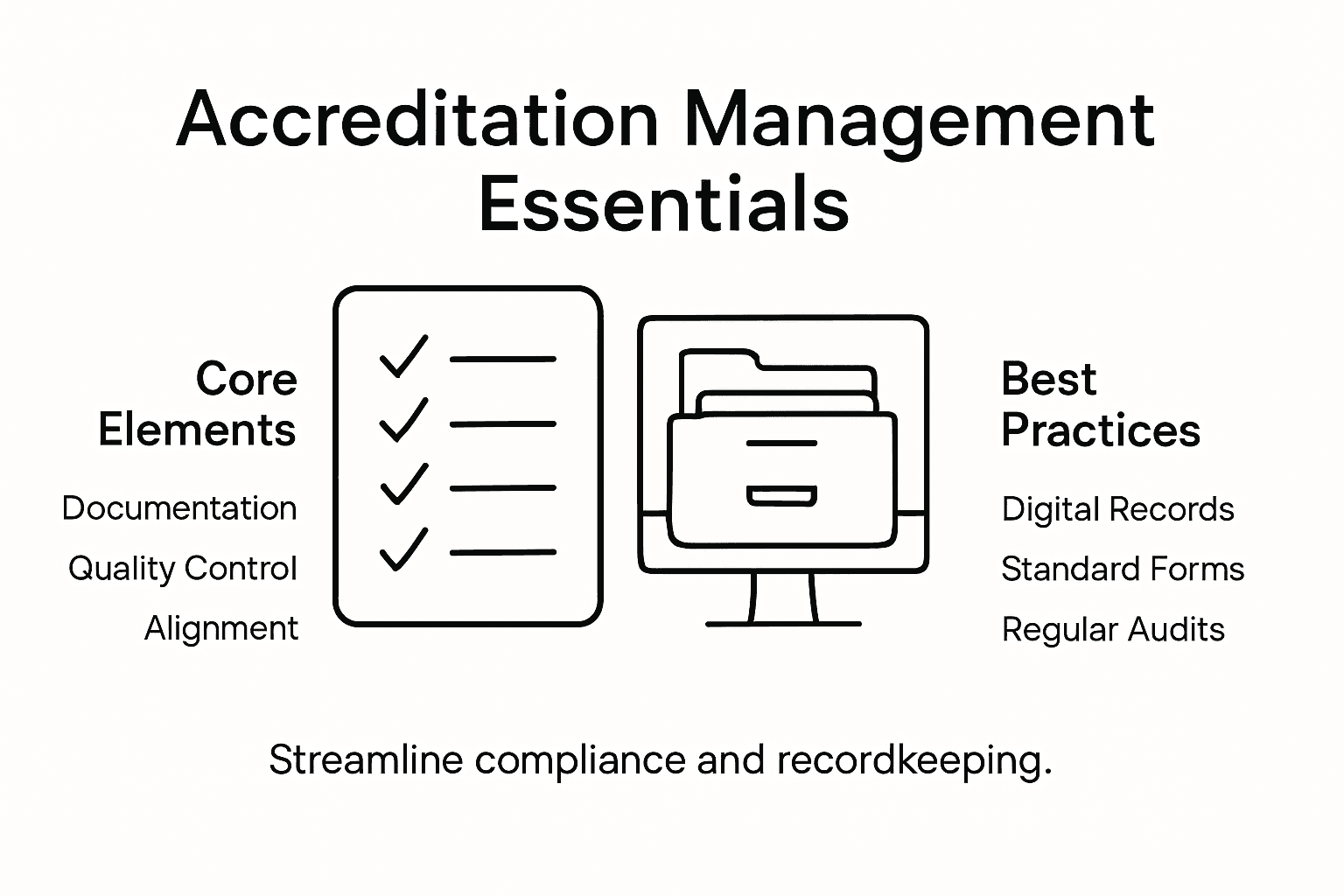
The essential requirements for effective recordkeeping encompass multiple critical dimensions. Manufacturers must develop secure, centralized electronic storage systems that enable version control, maintain detailed audit trails, and categorize documents according to specific accreditation criteria. Successful compliance strategies demand data-driven decision-making and regular self-assessments that document continuous improvement efforts, ensuring that every piece of documentation serves a strategic purpose beyond mere regulatory fulfillment.
Key documentation requirements typically include comprehensive course materials, instructor credentials, participant attendance records, learning outcome assessments, and detailed tracking of professional development hours. Manufacturers must establish standardized templates and protocols that facilitate consistent documentation across different courses and accreditation bodies. This approach not only streamlines the compliance process but also provides a transparent, auditable record of educational quality and professional development initiatives.
Pro tip: Implement a digital document management system with automated tagging and archiving capabilities to create a seamless, searchable repository of accreditation-related records.
Risks, Delays, and Costly Mistakes to Avoid
Continuing education accreditation presents a minefield of potential risks that can derail even the most meticulously planned course development efforts. Comprehensive research identifies critical vulnerabilities in the accreditation process, highlighting how incomplete documentation and misalignment with agency standards can substantially prolong approval timelines, transforming what should be a straightforward submission into a complex, time-consuming ordeal.
Systematic analysis reveals multiple workflow coordination challenges that can introduce significant delays and financial risks. Common mistakes include fragmented documentation, inconsistent standard adherence, and failure to anticipate specific accreditation body requirements. Manufacturers frequently underestimate the granular details required for course approval, such as precise health, safety, and welfare (HSW) alignment, instructor credential verification, and comprehensive learning outcome documentation. These oversights can trigger multiple review cycles, forcing expensive course redesigns and potentially preventing timely market entry for educational content.
Specific high-risk areas demand manufacturers develop proactive mitigation strategies. These include maintaining rigorous version control of course materials, establishing clear communication protocols with accrediting agencies, conducting preliminary internal reviews that simulate external evaluation processes, and creating flexible course frameworks that can be quickly adapted to meet varied professional standards. Understanding the nuanced requirements of different accreditation bodies like AIA and IDCEC becomes crucial in preventing costly submission rejections and minimizing potential revenue interruptions.
Below is a breakdown of common risks in accreditation workflows and effective mitigation strategies:
| Risk Area | Common Problem | Effective Solution |
|---|---|---|
| Documentation | Incomplete records | Implement templates and audit trails |
| Standard Alignment | Overlooked criteria | Cross-reference regulations proactively |
| Communication | Agency disconnects | Schedule regular status updates |
| Version Control | Outdated materials | Use centralized, tracked repositories |
Pro tip: Develop a comprehensive compliance checklist that cross-references requirements from multiple accreditation bodies, enabling rapid identification and correction of potential submission vulnerabilities before official review.
Accelerate Your CEU Accreditation with CEU Builder
The article highlights the complex challenges manufacturers face in accreditation management such as navigating multiple standards, avoiding costly compliance mistakes, and managing extensive documentation throughout the course approval workflow. If you are tired of delayed CEU course delivery and the high costs caused by fragmented processes and opaque middlemen, it is time to consider a faster, smarter alternative. CEU Builder empowers manufacturers and construction product companies to become their own AIA and IDCEC providers allowing full control over course content, branding, and data. This approach directly addresses pain points like incomplete records, misaligned standards, and protracted submission timelines by streamlining accreditation management with a single platform.

Take control of your CEU delivery timeline starting today. With CEU Builder you can launch accredited courses within 4 to 6 weeks instead of waiting up to 18 months. Benefit from transparent pricing, complete ownership of the approval process, and tailored services that emphasize compliance and driving product sales. Don’t let compliance complexity delay your market impact. Visit CEU Builder now to streamline your accreditation workflow and transform continuing education into a competitive advantage. Learn more about our platform and how we simplify accreditation management to help you fast-track CEU delivery.
Frequently Asked Questions
What is accreditation management in CEU compliance?
Accreditation management in CEU compliance is a strategic process that ensures educational quality and professional development standards are met, helping manufacturers navigate compliance requirements while providing valuable learning experiences for professionals.
What are the key components of effective accreditation management?
Key components include comprehensive documentation, rigorous quality control, and strategic alignment with industry standards. This involves developing courses that meet health, safety, and welfare criteria, as well as maintaining transparent records throughout course development and delivery.
What types of accreditation are relevant for continuing education units (CEUs)?
The primary accreditation bodies for CEUs in the architecture and design fields include the American Institute of Architects (AIA) and the Interior Design Continuing Education Council (IDCEC). Each has its own evaluation criteria and professional development focus.
What are common risks and mistakes to avoid in the accreditation process?
Common risks include incomplete documentation, misalignment with agency standards, and outdated materials. To avoid these, manufacturers should implement rigorous documentation practices, maintain version control, and regularly communicate with accrediting agencies.
Recommended
