

CEU Course Approval: How It Drives Specification
Finding ways to stand out with architects often feels like a race against time. Fast, efficient CEU course approval is more than a box to check—it is the gateway to deeper engagement and driving product choice in competitive hospitality markets. By mastering the steps and aligning with industry benchmarks, manufacturers can turn professional education into a powerful tool for lasting specification and market influence.
Table of Contents
- What Is CEU Course Approval?
- Types Of CEU Accreditation And Their Impact
- The Step-By-Step CEU Approval Process
- Essential IDCEC Requirements For Approval
- Common Mistakes That Delay Accreditation
- Business Impact Of Fast CEU Course Approval
Key Takeaways
| Point | Details |
|---|---|
| Importance of CEU Course Approval | CEU course approval ensures educational programs meet professional standards, enhancing their credibility in the industry. |
| Documentation and Process | Successful approval requires meticulous documentation, including learning objectives and instructor qualifications, submitted well in advance. |
| Types of Accreditation | Different accreditation types cater to specific needs; understanding these can help tailor programs effectively. |
| Business Impact of Rapid Approval | Fast CEU course approval allows for quicker market entry and improved stakeholder engagement, enriching overall organizational reputation. |
What Is CEU Course Approval?
Continuing Education Unit (CEU) course approval represents the critical process by which professional educational programs secure official recognition for delivering valuable learning experiences. CEU course approval validates that an educational offering meets specific standards required by professional licensing and accreditation bodies, ensuring that participants receive high-quality, standardized instruction.
In the context of professional development, continuing education units serve as a standardized measurement for tracking participation in non-academic learning programs. The approval process involves several key components that guarantee educational integrity:
- Comprehensive curriculum review
- Verification of instructor qualifications
- Assessment of learning objectives
- Alignment with professional standards
- Evaluation of instructional methodologies
Professional organizations like the Interior Design Continuing Education Council (IDCEC) play a crucial role in managing CEU course approval. These organizations establish rigorous criteria that courses must meet to receive official accreditation. Approval signals that an educational program has undergone thorough scrutiny and meets industry-recognized benchmarks for professional learning.
CEU course approval transforms educational content from simple information delivery into a recognized, credible professional development tool.
The approval process typically involves submitting detailed course documentation, including learning outcomes, instructor credentials, and comprehensive instructional materials. Reviewers meticulously examine these submissions to ensure they meet stringent educational and professional standards.
Reasons for CEU Course Approval:
- Maintain professional licensing requirements
- Demonstrate educational quality
- Provide recognized continuing education credits
- Ensure standardized learning experiences
- Support ongoing professional development
Pro tip: When preparing a CEU course for approval, focus on creating clear, measurable learning objectives that directly address professional competency requirements.
For manufacturers and educational providers, understanding the course approval process becomes crucial in developing programs that not only educate but also meet strict professional standards and regulatory requirements.
Types of CEU Accreditation and Their Impact
Continuing Education Unit (CEU) accreditation is not a one-size-fits-all process, but rather a nuanced ecosystem of recognition that varies across different professional disciplines and organizational requirements. Professional accreditation organizations play a critical role in establishing standards that validate educational experiences and ensure meaningful professional development.
The primary types of CEU accreditation include:
- Institutional Accreditation: Validates entire educational organizations
- Program-Specific Accreditation: Focuses on individual course quality
- Discipline-Specific Accreditation: Tailored to unique professional standards
- National-Level Accreditation: Recognized across broader geographic regions
- International Accreditation: Provides global educational recognition
Professional sectors approach CEU accreditation differently based on their unique requirements. Continuing education types range from live events to enduring materials like online modules, podcasts, and journal-based learning, each with specific accreditation criteria.
Here’s a comparison of common CEU accreditation types and their typical industry applications:
| Accreditation Type | Scope of Recognition | Ideal For |
|---|---|---|
| Institutional Accreditation | Entire organization | Colleges, large providers |
| Program-Specific | Single courses or programs | Course developers, trainers |
| Discipline-Specific | Specific professions | Architects, designers |
| National-Level | Across the country | Major industry bodies |
| International | Multiple countries or regions | Global professional networks |
Accreditation transforms educational content from optional learning to essential professional development.
Key Impact Areas of CEU Accreditation:
- Ensures educational quality and consistency
- Supports professional licensing requirements
- Enables cross-organizational credit recognition
- Provides standardized learning benchmarks
- Maintains professional competency standards
Manufacturers seeking to develop CEU courses must understand these nuanced accreditation landscapes to create truly valuable educational experiences that resonate with design professionals and meet rigorous industry standards.
Pro tip: Select an accreditation pathway that aligns closely with your target professional audience’s specific continuing education requirements and regulatory expectations.
By understanding the complex accreditation management landscape, educational providers can strategically position their courses for maximum impact and recognition.
The Step-By-Step CEU Approval Process
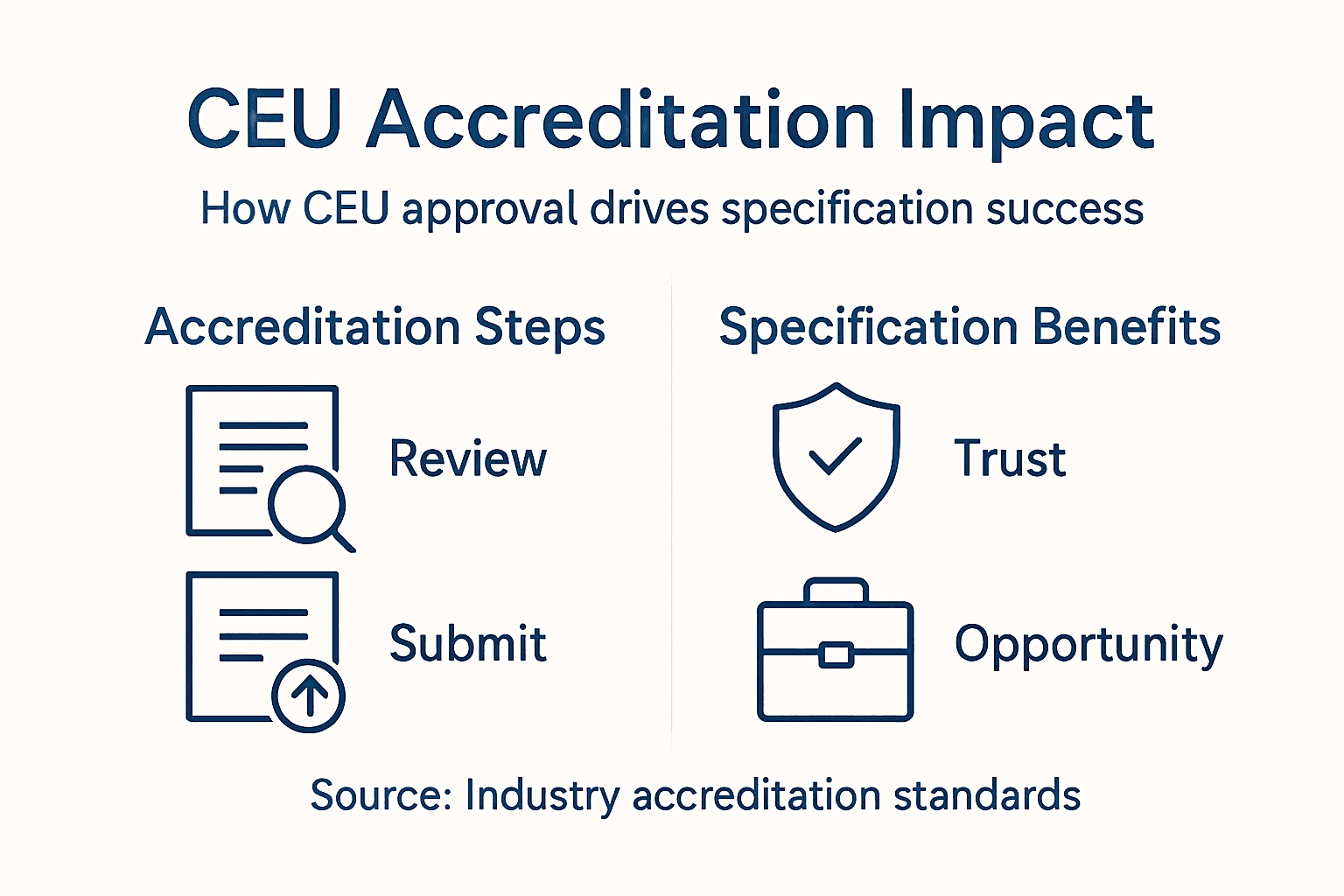
The CEU approval process is a meticulous journey that transforms educational content into professionally recognized learning experiences. Accreditation application processes require manufacturers and educational providers to navigate complex requirements with precision and strategic planning.
The fundamental steps in the CEU approval process include:
- Initial program design and content development
- Comprehensive documentation preparation
- Alignment with professional standards
- Submission to accrediting organization
- Detailed review and potential revision
- Final approval and certification
Each stage demands rigorous attention to detail and adherence to specific guidelines. Professional development requirements typically mandate thorough documentation that demonstrates the educational program’s value and compliance with industry standards.
Successful CEU approval transforms educational content from a simple presentation into a recognized professional development opportunity.
Key Documentation Requirements:
- Detailed learning objectives
- Instructor qualifications
- Comprehensive course outline
- Assessment and evaluation methods
- Evidence of educational integrity
Most accrediting bodies require submission materials at least three weeks before the planned course delivery, allowing sufficient time for comprehensive review and potential modifications.
Critical Submission Elements:
- Precise learning outcomes
- Instructor credentials
- Content relevance verification
- Alignment with professional standards
- Clear assessment methodologies
Pro tip: Prepare your documentation meticulously, anticipating potential reviewer questions and ensuring every aspect of your course demonstrates professional educational standards.
Manufacturers can significantly streamline their CEU approval process by understanding these intricate requirements and systematically addressing each component with strategic precision.

Essential IDCEC Requirements for Approval
The Interior Design Continuing Education Council (IDCEC) maintains stringent standards to ensure the quality and integrity of professional education programs. Provider registration requirements form the critical foundation for course approval, demanding meticulous attention to multiple detailed criteria.
Key IDCEC approval requirements encompass:
- Non-proprietary educational content
- Minimum one-hour course duration
- Clear, measurable learning objectives
- Qualified instructor credentials
- Comprehensive participant evaluation mechanisms
- Detailed presentation materials
- Transparent fee structures
- Professional, non-promotional content
The approval process scrutinizes every aspect of educational programming to maintain professional development standards. Content submission guidelines explicitly exclude certain types of materials that do not qualify as legitimate continuing education.
IDCEC requirements transform educational content from marketing material into meaningful professional learning experiences.
Automatic Disqualification Factors:
- Sales presentations
- Travel-related content
- Entertainment materials
- Purely promotional presentations
- Insufficient instructional depth
Manufacturers must understand that IDCEC evaluates courses through a comprehensive lens, focusing on educational value rather than product promotion. The review process typically spans three weeks, with high standards for rejection.
Critical Content Evaluation Criteria:
- Substantive instructional material
- Evidence-based learning approaches
- Clear subject matter categorization
- Comprehensive documentation
- Measurable learning outcomes
Pro tip: Design your course content with an educator’s mindset, prioritizing learning objectives over promotional messaging to increase approval likelihood.
By understanding these submission guidelines, manufacturers can strategically develop courses that meet IDCEC’s rigorous educational standards.
Common Mistakes That Delay Accreditation
The path to CEU course approval is fraught with potential pitfalls that can significantly extend the accreditation timeline. Accreditation application challenges reveal a complex landscape where seemingly minor errors can derail an entire submission process.
Most common mistakes that trigger accreditation delays include:
- Insufficient course documentation
- Proprietary content embedded in presentations
- Missing bibliography or justification statements
- Oversized file submissions
- Incomplete application materials
- Lack of clear learning objectives
- Inadequate instructor credential verification
- Non-compliance with non-promotional content guidelines
Manufacturers often underestimate the meticulous nature of educational accreditation standards. The review process demands precision in every submitted document, with reviewers scrutinizing each component for compliance.
A single overlooked detail can transform a promising educational course into a delayed or rejected submission.
Top Rejection Triggers:
- Including company logos within course materials
- Presenting content as a sales pitch
- Failing to demonstrate educational value
- Submitting incomplete instructor documentation
- Neglecting proper citation and references
The accreditation landscape requires a strategic approach that prioritizes educational integrity over marketing objectives. Manufacturers must recognize that CEU courses are fundamentally about knowledge transfer, not product promotion.
Strategic Submission Elements:
- Comprehensive, non-promotional content
- Clear, measurable learning outcomes
- Professionally formatted materials
- Thorough instructor background documentation
- External references and bibliography
Pro tip: Treat your CEU course submission like an academic paper, focusing on educational substance and rigorous documentation rather than promotional messaging.
Navigating the complexities of course accreditation workflow requires a methodical approach that anticipates and addresses potential review obstacles.
Business Impact of Fast CEU Course Approval
In the competitive landscape of professional education, rapid course accreditation represents a strategic differentiator that can significantly transform a manufacturer’s market positioning. The speed of CEU course approval directly correlates with an organization’s ability to capture market opportunities, engage design professionals, and drive product specification.
Key business advantages of fast CEU course approval include:
- Accelerated market entry
- Reduced administrative overhead
- Enhanced organizational credibility
- Faster revenue generation
- Improved stakeholder relationships
- Competitive market differentiation
- Quicker response to industry trends
- More efficient workforce development
Manufacturers who streamline their course approval workflow gain substantial strategic advantages. Rapid accreditation enables organizations to quickly convert educational content into valuable professional development resources, creating immediate market engagement opportunities.
The following table summarizes how fast CEU course approval impacts business goals:
| Business Goal | Impact of Fast Approval | Example Benefit |
|---|---|---|
| Market Entry Speed | Faster product launches | Early industry positioning |
| Stakeholder Engagement | Quicker audience education | Higher attendance rates |
| Administrative Efficiency | Reduced review cycles | Lower staff workload |
| Revenue Generation | Shorter sales cycle | More course enrollments |
| Brand Perception | Improved professional image | Greater client trust |
Speed in course approval transforms educational content from a potential liability into a powerful business asset.
Business Acceleration Metrics:
- Reduced time-to-market for educational programs
- Increased architect engagement rates
- Higher specification conversion potential
- Lower administrative compliance costs
- Enhanced brand perception among design professionals
The ability to quickly develop and approve CEU courses allows manufacturers to stay ahead of industry trends, positioning themselves as thought leaders who prioritize professional education and continuous learning.
Strategic Advantages:
- Immediate market responsiveness
- Proactive knowledge sharing
- Faster specification opportunities
- Enhanced professional network development
- Continuous learning infrastructure
Pro tip: Treat your CEU course development as a strategic business initiative, not just a compliance requirement, to maximize its potential impact.
By understanding and leveraging the course credentialing process, manufacturers can transform continuing education from an administrative task into a powerful business development strategy.
Accelerate Your CEU Course Approval and Drive Specification Success
Navigating the complex world of CEU course approval can feel overwhelming with strict IDCEC requirements and the risk of costly delays. This article highlights the critical challenges manufacturers face such as rigid accreditation processes, proprietary content restrictions, and the need for clear, measurable learning objectives that truly drive architect and designer engagement. At CEU Builder, we understand these pain points deeply. Our expert team and proprietary methodology ensure your course not only meets but exceeds accreditation standards with a 100 percent first-pass approval rate.
By leveraging our Compliance & Accreditation expertise, you can transform education into a powerful demand generation engine that influences product specifications. Our strategic approach aligns course content with what architects actively seek, delivering measurable business impact while avoiding common submission pitfalls. Partnering with CEU Builder means cutting through the noise and accelerating your pathway to market with confidence.
Isn’t it time you turned CEU course approval from a frustrating hurdle into a competitive advantage?

Explore how our done-for-you or platform solutions can fast-track your CEU development and maximize specification opportunities. Visit CEU Builder today to start building your accredited courses with expert guidance and industry-leading results. Discover more insights in our General resources to stay informed and ahead of the curve.
Frequently Asked Questions
What is CEU course approval?
CEU course approval is the process by which educational programs receive official recognition for meeting specific standards required by professional licensing and accreditation bodies, validating the quality of continuing education.
Why is CEU course approval important for professional development?
CEU course approval is important because it ensures that the educational program meets industry standards, provides recognized continuing education credits, and supports compliance with professional licensing requirements.
What are the key elements required for CEU course approval?
Key elements for CEU course approval include comprehensive curriculum review, verification of instructor qualifications, measurable learning objectives, alignment with professional standards, and evaluation of instructional methodologies.
What common mistakes should be avoided during the CEU accreditation process?
Common mistakes include insufficient course documentation, proprietary content in presentations, lack of clear learning objectives, and non-compliance with non-promotional content guidelines.
Recommended
