

Master the Course Accreditation Process for CEU Providers

Most American building product manufacturers waste thousands each year on outdated CEU platforms that offer little flexibility. For Marketing VPs in hospitality, the pressure to deliver accredited training efficiently keeps rising while costs seem to spiral out of control. With new accreditation methods, you can cut expenses and regain control—without sacrificing quality or compliance. This guide reveals the tangible steps you need to evaluate eligibility and transition to smarter solutions that match your needs.
Table of Contents
- Step 1: Evaluate Eligibility For Provider Accreditation
- Step 2: Register As An Official Course Provider
- Step 3: Develop Compliant Course Materials And Objectives
- Step 4: Submit Courses For Formal Accreditation Review
- Step 5: Verify Course Approval And Implement Tracking Systems
Quick Summary
| Key Point | Explanation |
|---|---|
| 1. Assess Institutional Eligibility | Conduct a thorough evaluation of your organization’s mission and programs to ensure compliance with accreditation standards. |
| 2. Gather Essential Documentation | Compile key documents like mission statements and training delivery evidence to demonstrate operational capabilities. |
| 3. Develop Rigorous Course Materials | Create detailed course objectives and instructional materials that exceed accreditation requirements for quality and effectiveness. |
| 4. Prepare for Formal Review Process | Submit comprehensive materials for accreditation review, showcasing accountability and thorough institutional strategies. |
| 5. Implement Effective Tracking Systems | Establish tracking mechanisms to monitor compliance and course performance, ensuring ongoing adherence to accreditation standards. |
Step 1: Evaluate eligibility for provider accreditation
Evaluating your eligibility for continuing education provider accreditation requires strategic preparation and understanding of specific institutional requirements. Your primary goal is to demonstrate operational capability and alignment with professional standards, ensuring your organization meets the necessary criteria for delivering quality educational content.
The first critical aspect involves comprehensive institutional assessment by examining your organization’s mission, educational programs, and commitment to continuous improvement. Accreditation bodies like the Higher Learning Commission focus on verifying that your training programs serve the public good and maintain consistent quality standards. You will need to prepare documentation that clearly illustrates your operational processes, including proof of your ability to develop curriculum, issue certificates, and conduct internal quality reviews.
Key documentation typically includes your organizational mission statement, detailed course development workflows, evidence of previous training delivery, management review records, and proof of systematic quality control mechanisms. Professional accreditation services recommend conducting thorough internal audits before submitting your application to identify and address potential gaps in your educational infrastructure.
Here’s a summary of the documentation needed for provider accreditation eligibility:
| Documentation Type | Purpose | Example Contents |
|---|---|---|
| Mission Statement | Demonstrates organizational goals | Statement, strategic objectives |
| Course Development Workflow | Shows curriculum creation process | Flowcharts, timelines, policies |
| Training Delivery Evidence | Proves capability to deliver content | Attendance logs, feedback reports |
| Quality Control Records | Ensures systematic review and standards | Audit reports, improvement plans |
| Management Review Documentation | Validates oversight and improvement | Meeting notes, decision records |
Pro tip: Create a comprehensive accreditation readiness checklist that maps your current capabilities against official accreditation requirements, helping you proactively identify and resolve potential compliance issues before formal submission.
Step 2: Register as an official course provider
Registering as an official course provider represents a critical milestone in establishing your organization’s credibility within the continuing education landscape. This process transforms your educational initiative from a concept to a formally recognized training platform with official standing.
The registration process begins with comprehensive eligibility assessment by preparing and submitting detailed documentation that demonstrates your institutional readiness. You will need to compile a comprehensive application package that includes your organizational mission statement, financial statements, strategic educational plans, and evidence of operational capabilities. Professional accreditation bodies require thorough documentation proving your capacity to deliver high quality educational content consistently and meet established industry standards.
Specifically, your registration application must clearly illustrate your operational infrastructure, including course development processes, instructor qualifications, student management systems, and quality control mechanisms. Many accreditation organizations also require proof that continuing education is a primary focus of your organization, with documented strategies for curriculum development, learner assessment, and ongoing educational quality maintenance. Prepare to provide extensive documentation that showcases your commitment to professional educational standards and your ability to deliver meaningful learning experiences.

Pro tip: Create a dedicated digital folder with all required registration documents pre-organized, ensuring you can quickly respond to any additional information requests from accreditation reviewers.
Step 3: Develop compliant course materials and objectives
Developing compliant course materials represents a critical phase in your continuing education provider journey, requiring meticulous attention to detail and strategic alignment with professional accreditation standards. Your goal is to create educational content that not only meets but exceeds industry expectations for quality and learning effectiveness.
Your course development process must focus on creating rigorous learning objectives that clearly define expected student outcomes and demonstrate meaningful educational value. Professional accreditation bodies require course materials that showcase comprehensive instructional design, incorporating specific measurable goals that reflect industry knowledge and practical application. This means crafting objectives that go beyond simple knowledge transfer and emphasize critical thinking, skill development, and real world problem solving capabilities.
Each course material component must systematically address specific learning domains, ensuring comprehensive coverage of technical content, practical skills, and professional competencies. Your documentation should include detailed lesson plans, assessment strategies, learning resources, and clear connections between course objectives and broader educational missions. Pay special attention to creating learning objectives that are specific, measurable, achievable, relevant, and time bound metrics that demonstrate your commitment to delivering high quality educational experiences.
Pro tip: Develop a standardized template for course objective documentation that includes explicit alignment columns connecting each learning goal to industry standards and professional competency requirements.
Step 4: Submit courses for formal accreditation review
Submitting your courses for formal accreditation represents the most critical validation stage in your continuing education provider journey. This process transforms your carefully developed educational materials into an officially recognized and professionally validated learning experience.
Your submission will involve comprehensive documentation and peer review that scrutinizes every aspect of your course design and institutional capabilities. Accrediting bodies require a detailed self study report that demonstrates your commitment to educational excellence, including comprehensive evidence of curricular rigor, institutional resources, governance structures, and alignment with professional standards. This means preparing an extensive application package that goes far beyond simple course materials and showcases your organization’s comprehensive approach to educational quality.
The formal review process involves external experts who will meticulously evaluate your submission across multiple dimensions. They will assess not just the content of your courses, but also the underlying educational philosophy, assessment strategies, learning outcomes, and institutional infrastructure that supports your educational mission. Prepare to provide comprehensive documentation that includes detailed lesson plans, student learning objectives, assessment methodologies, faculty qualifications, and clear evidence of how your courses meet or exceed industry specific continuing education standards.
Pro tip: Create a comprehensive digital checklist that maps each section of your accreditation submission to specific reviewer evaluation criteria, ensuring you address every potential assessment point before final submission.
Step 5: Verify course approval and implement tracking systems
Verifying course approval and establishing robust tracking systems represents the final critical phase in your continuing education provider accreditation journey. Your goal is to create a systematic approach for monitoring course compliance and maintaining ongoing institutional credibility.
The implementation of comprehensive compliance tracking mechanisms requires meticulous record keeping and proactive management of participant data and course performance metrics. You will need to develop an integrated system that captures essential information such as participant completion rates, course engagement statistics, certificate issuance, and periodic review documentation. This tracking infrastructure serves multiple purposes beyond administrative necessity by providing actionable insights into your educational program performance and ensuring continuous alignment with accreditation standards.
Your tracking system should include detailed documentation protocols that enable real time monitoring of course effectiveness and participant outcomes. This means creating digital repositories for participant records, automated certificate generation, comprehensive reporting capabilities, and systematic processes for ongoing quality assurance. Pay special attention to developing flexible tracking mechanisms that can adapt to evolving accreditation requirements and provide transparent documentation for future review cycles.
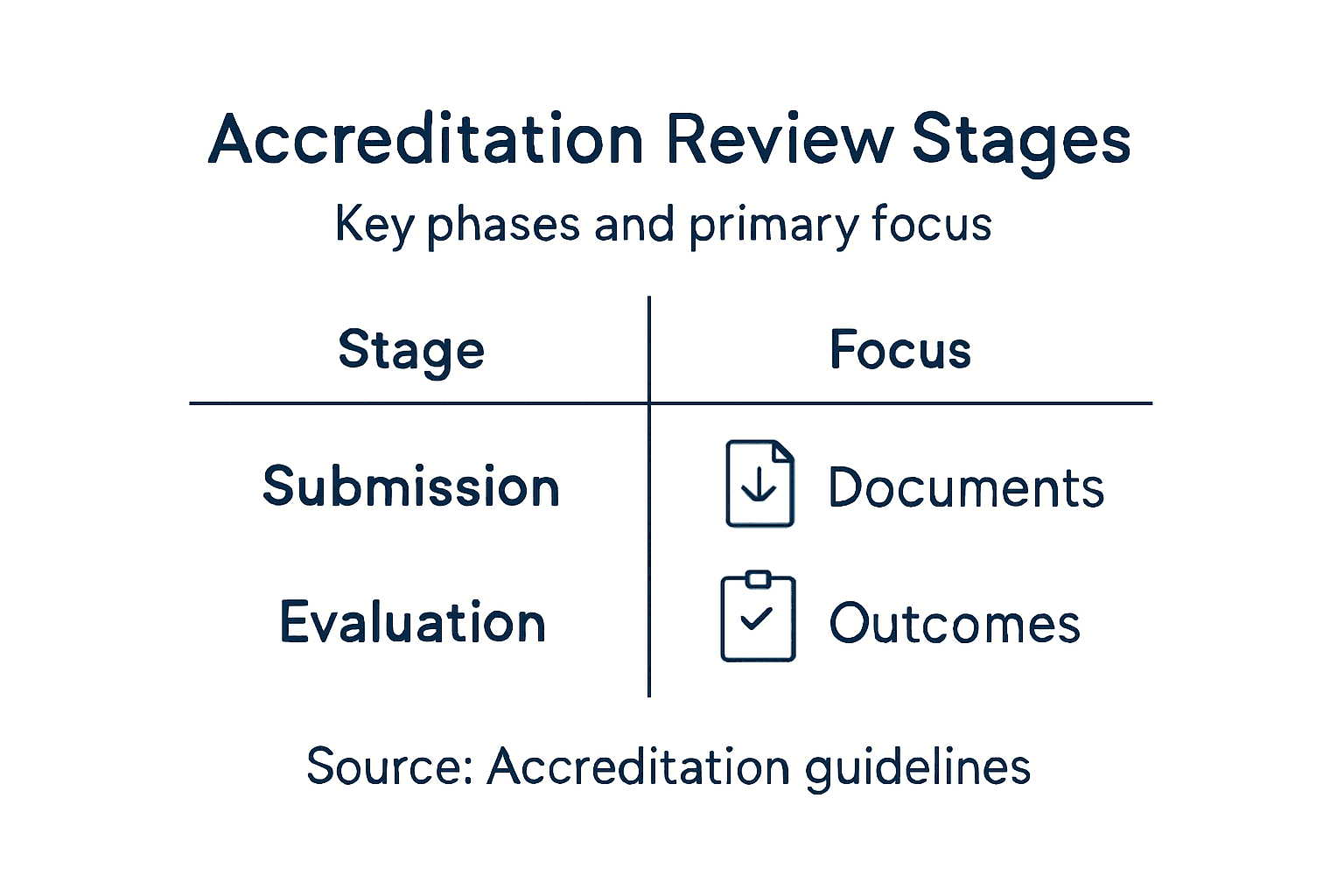
Compare common accreditation stages and their main focus areas:
| Stage | Primary Focus | Reviewer Interest |
|---|---|---|
| Eligibility Evaluation | Operational capability | Mission, policies, audits |
| Registration | Institutional readiness | Financials, strategy, infrastructure |
| Course Material Development | Instructional design quality | Objectives, assessment strategies |
| Formal Review | Holistic educational standards | Governance, outcomes, faculty |
| Approval & Tracking | Ongoing compliance monitoring | Data systems, reporting |
Pro tip: Design your tracking system with export and integration capabilities that allow seamless data transfer between your learning management platform and external accreditation reporting systems.
Simplify Your Course Accreditation Journey and Own Your Provider Status
Mastering the complex steps of provider accreditation, from eligibility evaluation to compliance tracking, requires clear processes and reliable tools. If you are overwhelmed by lengthy IDCEC registration timelines, complicated course material development, and tracking compliance across multiple courses, you are not alone. Many manufacturers face costly delays and limited control under legacy CEU platforms that keep you locked in as a sponsor rather than a true provider.
CEU Builder offers a revolutionary solution designed to put the power back in your hands. Our AI-powered platform streamlines IDCEC provider registration, accelerates course development, and ensures compliance with built-in validation tools. You get full ownership of your provider status, seamless learner data integration, and transparent pricing with no hidden fees. Say goodbye to 18-month waits and exorbitant six-figure renewal costs. With our solution, you can build accredited courses in just 4–6 weeks while maintaining all compliance tracking in one centralized system.
Discover how CEU Builder can transform your continuing education program and take control of your accreditation process today.
Explore accelerated course development with AI-powered compliance checks.
Learn why owning your provider status matters and maximize ROI for your CEU programs now.
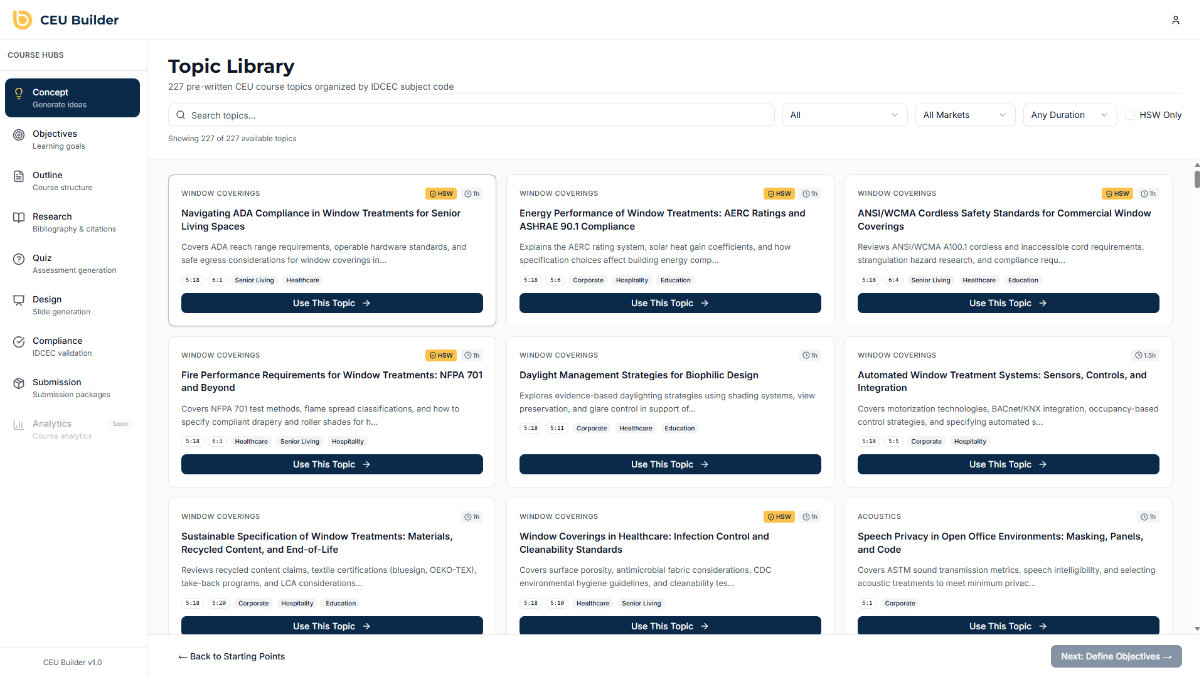
Stop paying to rent your identity as a CEU provider. Own your status today with CEU Builder and accelerate your path to accreditation with confidence. Visit https://ceubuilder.com/ and get started now.
Frequently Asked Questions
How do I evaluate my eligibility for continuing education provider accreditation?
To evaluate your eligibility for continuing education provider accreditation, conduct a comprehensive assessment of your organization’s mission and educational programs. Gather key documentation, such as your mission statement and curriculum development workflow, to ensure you meet the accreditation criteria.
What documents are needed to register as an official course provider?
When registering as an official course provider, you need to compile several documents, including your mission statement, financial statements, and evidence of operational capabilities. Organize these documents in a dedicated folder to streamline the submission process and address any additional requests promptly.
How can I ensure my course materials align with accreditation standards?
To ensure your course materials align with accreditation standards, focus on developing rigorous learning objectives that demonstrate measurable student outcomes. Use a standardized template to document these objectives clearly and connect them to industry requirements, enhancing the quality of your educational content.
What steps should I follow to submit my courses for formal accreditation review?
Begin your formal accreditation submission by preparing a detailed self-study report that showcases your commitment to educational excellence. Include comprehensive documentation that covers curricular rigor and institutional resources, ensuring you address all evaluation criteria outlined in the accreditation process.
How do I track compliance and maintain ongoing accreditation?
To maintain ongoing accreditation, implement a robust tracking system to monitor course compliance and participant outcomes. Regularly document completion rates and course engagement metrics to ensure alignment with accreditation requirements, making adjustments as necessary to improve educational quality.
Recommended
- Role of Accreditation Bodies in Continuing Education – CEU Builder
- Master Course Accreditation Workflow for Manufacturers – CEU Builder
- How to Optimize Continuing Education for CEU Success – CEU Builder
- Accreditation Management: Fast-Tracking CEU Delivery – CEU Builder
- Industry Accreditation in Security – Why It Matters|BM
- CLIA Certification: Lab Accreditation Programs Explained
- Come organizzare corsi sicurezza aziendale per la conformità – Sikuro
