

Course Accreditation: Why Provider Control Matters

Finding an affordable path to accredited continuing education often feels like an uphill climb for American building product manufacturers. The challenge is more than just ticking regulatory boxes or chasing temporary compliance. Accreditation serves as a quality assurance signal recognized by architects and designers across North America, directly impacting trust, market reach, and data control. This article explains how provider-owned accreditation empowers manufacturers to cut CEU costs, centralize learner data, and establish educational credibility that drives lasting specification conversations.
Table of Contents
- Defining Course Accreditation And Its Impact
- Major Types Of Course Accreditation Standards
- Accreditation In Continuing Education Programs
- Provider Responsibilities And Compliance Requirements
- Cost Factors And Provider Ownership Benefits
- Risks Of Legacy Platforms And Best Practices
Key Takeaways
| Point | Details |
|---|---|
| Importance of Accreditation | Course accreditation signals quality assurance and increases trust among architects and designers by ensuring courses meet established educational standards. |
| Provider Control Benefits | Owning your accreditation status allows for faster course development, control over learner data, and improved market positioning, translating into significant cost savings and operational efficiency. |
| Strategic Focus on HSW Courses | Prioritizing HSW (Health, Safety, Welfare) accredited courses can maximize learner engagement and fulfill regulatory requirements, offering high perceived value. |
| Operational Responsibilities | As an accredited provider, maintaining compliance, transparency, and quality standards is crucial for ongoing accreditation and successful course delivery. |
Defining course accreditation and its impact
Course accreditation isn’t just bureaucratic overhead or a checkbox on a compliance list. It’s a quality assurance mechanism that signals to architects, designers, and other professionals that your continuing education meets recognized standards. At its core, accreditation is a peer review process where independent experts evaluate whether your courses meet predetermined educational quality and integrity standards. For manufacturers, understanding what accreditation actually does (and doesn’t do) is fundamental to making smarter decisions about how you deliver education to your target market.
Let’s break down what accreditation means in practical terms. When your course earns accreditation from a body like IDCEC (Interior Design Continuing Education Council) or AIA (American Institute of Architects), you’re essentially saying: “This course was built against established quality criteria, vetted by experts in the field, and meets professional standards for continuing education.” The accreditation process typically involves submitting your course outline, learning objectives, and assessment methods for review. Accreditors then check whether your course actually delivers what it claims, whether the content is current and accurate, and whether learners can demonstrate they’ve absorbed the material. This rigorous external evaluation protects learners and strengthens the credibility of your educational offering. For you as a manufacturer, accreditation means your sales teams can confidently tell architects and designers that the education you’re providing isn’t just product information masquerading as learning—it’s legitimate, structured continuing education that counts toward their professional development requirements.
The impact of accreditation extends far beyond the classroom. When you control your own accreditation status as a provider (rather than renting space in someone else’s directory), you own several critical advantages. First, accredited courses position your brand as an educator, not just a vendor. Architects and designers are more likely to engage with content they trust, and accreditation builds that trust. Second, accreditation enables your sales and specification teams to use education as a legitimate relationship driver. Instead of pushing product features, you’re offering genuine professional development that helps designers solve their projects better—which naturally positions your products as solutions. Third, accreditation data becomes proprietary. You capture learner information, completion rates, and engagement metrics that allow you to track which professionals are engaging with your education and when they might be receptive to specification conversations. Legacy platforms like AEC Daily control this data, which means they know which architects are learning about your products while you’re left guessing. When you’re your own accredited provider, that intelligence belongs to you.
There’s also a regulatory dimension worth considering. Professional licensing boards in most states require continuing education for architects and interior designers, and many specify that courses must come from accredited providers. A course without accreditation might be excellent content, but it doesn’t count toward CE requirements—which means busy professionals simply won’t take it, regardless of how valuable it is. Accreditation is what makes your course eligible and countable. This is especially true for HSW (Health, Safety, Welfare) courses, which have stricter requirements and higher regulatory oversight. Accreditation bodies set specific criteria for what qualifies as legitimate continuing education, and understanding those criteria prevents costly rejections and keeps your course pipeline moving forward instead of stalling in revision cycles.
The real impact lands on your bottom line. Manufacturers paying AEC Daily or RedVector $50,000 to $120,000 annually are essentially renting accreditation status and learner data access. You do all the work—you research topics, you present the material, you build relationships with design teams—but the accreditation provider owns the student records and controls the narrative. When you become your own accredited provider through IDCEC (a one-time $440 registration fee), you flip that equation. Your accreditation status is permanent and yours to keep. Your learner data belongs to you. Your course development timeline shrinks from 18 months to 4 to 6 weeks because you’re not navigating legacy approval bureaucracies. Over a five-year period, the cost difference is staggering: $280,000 to $400,000 in savings while maintaining 100% control over your educational assets and learner relationships.
Pro tip: When evaluating whether to build accredited courses, focus on HSW topics first—these have the highest demand from architects and designers and generate the most learner engagement, making them your fastest path to ROI and proving the value of provider ownership.
Major types of course accreditation standards
Accreditation standards aren’t one-size-fits-all. Different types of accreditation serve different purposes, and understanding which ones matter for your manufacturer CEU programs is critical. The primary distinction lies between institutional accreditation (which evaluates an entire organization) and programmatic or specialized accreditation (which focuses on specific programs or disciplines). For building product manufacturers creating continuing education courses, you’re dealing exclusively with specialized accreditation. IDCEC and AIA don’t accredit your entire company—they accredit your individual courses or your status as a continuing education provider. This distinction matters because it means you don’t need to worry about institutional governance structures or regional accreditation bodies. Instead, you’re navigating subject-specific standards designed for professional continuing education in architecture and interior design.
Within specialized accreditation, there are two main tracks you’ll encounter. The first is general continuing education accreditation, which applies to most courses you’ll build. These courses cover industry trends, product knowledge, best practices, and design strategies that help architects and designers do their jobs better. IDCEC accredits these under various subject codes (from flooring and acoustics to lighting and finishes), and the standards focus on whether your course has clear learning objectives, relevant content, appropriate assessment methods, and qualified instructors. The second track is HSW (Health, Safety, Welfare) accreditation, which has stricter requirements because it addresses professional and public safety issues. HSW courses cover topics like fire safety, accessibility compliance, material toxicity, indoor air quality, and structural integrity. When a course qualifies as HSW, it typically carries higher perceived value because it directly impacts building safety and occupant welfare. Architects and designers are required to take HSW credits—often 1 to 2 credits per year depending on state regulations—which means HSW courses have built-in demand. The tradeoff is that HSW courses face more rigorous scrutiny during the accreditation review process. Your learning objectives must explicitly connect to health, safety, or welfare outcomes, your content must be vetted for accuracy, and your assessment must genuinely measure whether learners understand the safety implications.
Another important distinction involves specialized accreditation criteria that vary by accrediting body. IDCEC, AIA, and other accrediting organizations each maintain their own standards frameworks. IDCEC focuses on interior design continuing education and uses a subject code system to categorize courses (roughly 40+ codes covering everything from materials to business practice). AIA standards emphasize professional practice and ethics for architects, with different credit types (such as HSW, Health, Safety, Welfare vs. LU, Learning Units). Some manufacturers need courses approved by both IDCEC and AIA to reach both audience segments. Understanding which accrediting body your target audience actually uses is essential. If your products appeal primarily to interior designers specifying hospitality projects, IDCEC accreditation is your priority. If you’re selling to architects designing mixed-use or healthcare facilities, AIA accreditation matters more. Many sophisticated manufacturers pursue both, which adds complexity but maximizes reach.
Here’s what makes provider control so valuable: when you own your accreditation status with IDCEC or AIA, you control which accreditation type and level your courses receive. Legacy directory platforms make these decisions for you or constrain your options based on their platform architecture. They might bundle your course into a generic category, limit your ability to pursue HSW designation, or require you to follow their course template rather than optimizing for your specific learning outcomes. When you’re your own provider, you can strategically choose which courses to pursue as HSW (higher demand, stricter standards, more perceived value) and which to position as general CEU. You can tailor your course design to maximize approval likelihood while maintaining educational integrity. You can also iterate and improve. If your first course doesn’t clear accreditation on the first pass, you own the revision process instead of arguing with a directory platform’s approval team.

The practical implication for your marketing and sales teams is significant. You can honestly tell architects and designers: “This is an IDCEC-accredited HSW course”—which means it counts toward their mandatory HSW requirements and comes from a legitimate, vetted provider. That positioning is worth real money in terms of engagement and perceived credibility. HSW courses consistently generate higher completion rates than general CEU because professionals know they’re checking a regulatory box while learning something valuable. When you control your own accreditation, you can build a course portfolio that balances quick wins (general CEU courses that appeal broadly) with high-value plays (HSW courses that address specific regulatory requirements and generate premium engagement).
Pro tip: Build your first accredited course as a general CEU course to learn the approval process, then leverage that experience to pursue HSW designation for your second course—HSW carries stricter review but also delivers higher learner demand and specification impact.
Accreditation in continuing education programs
Continuing education accreditation exists in its own ecosystem separate from traditional higher education. While universities pursue regional or national institutional accreditation, professional development programs for architects, designers, and other licensed practitioners operate under specialized continuing education frameworks. This distinction matters because the standards, approval processes, and regulatory requirements differ significantly. In the architecture and interior design space, accreditation bodies like IDCEC and AIA have built entire quality assurance systems designed specifically for professional continuing education. They understand that architects and designers need flexible, focused learning experiences that can be delivered in 1 to 8 hours rather than semester-long courses. They also recognize that the content must connect directly to professional practice—whether that’s keeping designers current on new materials, updating them on code changes, or teaching them about emerging sustainability standards. The accreditation frameworks for continuing education programs reflect these realities. They’re faster to navigate than institutional accreditation (typically 4 to 8 weeks vs. 12 to 18 months), they’re more affordable, and they’re specifically designed to ensure that a 1-hour course on acoustic panel selection or a 2-hour workshop on HSW compliance meets rigorous quality standards without unnecessary bureaucratic overhead.
Beyond industry-specific bodies, broader accreditation organizations also play a role in continuing education quality assurance. IACET sets quality standards for continuing education units across multiple disciplines and industries, establishing consistent criteria that help ensure professional development programs deliver real learning outcomes rather than just checking boxes. IACET accreditation signals that your course meets internationally recognized standards for learning design, assessment, and continuous improvement. For manufacturers, this means that when you pursue IDCEC accreditation (which aligns with IACET principles), you’re building courses that meet standards recognized not just in North America but globally. Similarly, ACCET accredits non-traditional continuing education providers including corporate training departments, making it relevant for manufacturers who want to formalize their educational credibility beyond just individual course accreditation. If your company wants to position itself as a legitimate learning organization—not just a product vendor offering education as a marketing tool—ACCET provider status adds institutional credibility. Some sophisticated manufacturers pursue both course-level accreditation (IDCEC for individual courses) and provider-level accreditation (ACCET for institutional recognition). This dual approach signals commitment to education quality at every level.
The practical reality for most manufacturers is that you don’t need to navigate multiple accreditation bodies simultaneously. Focus on IDCEC if your target audience is interior designers in hospitality, commercial, or residential sectors. Focus on AIA if you’re selling to architects. If you’re pursuing a broader educational mission and want to serve multiple audiences, then exploring how IACET-aligned accreditation and provider credibility fit into your strategy makes sense. But here’s the critical insight: the accreditation landscape for continuing education is designed to be accessible. Unlike institutional accreditation, which involves comprehensive self-studies, site visits, and multi-year evaluation cycles, continuing education accreditation is straightforward. You submit your course outline, learning objectives, and assessment methods. An expert reviewer—typically someone with deep expertise in your subject area—evaluates whether your course actually teaches what it claims and whether learners can demonstrate competency. If your course meets standards, you’re approved. If it doesn’t, you receive specific feedback and can revise and resubmit. This is why the first-pass approval rate for professionally developed courses is so high. The standards aren’t designed to exclude; they’re designed to ensure quality.
Below is a summary of major continuing education accrediting bodies and their relevance for manufacturers:
| Accrediting Body | Target Audience | Focus Areas | Strategic Benefit for Manufacturers |
|---|---|---|---|
| IDCEC | Interior Designers | CEU and HSW, subject codes | Hospitality & residential sectors |
| AIA | Architects | CEU and HSW, ethics, practice | Healthcare & commercial projects |
| IACET | Multiple industries | Quality standards for CEUs | Global recognition, process design |
| ACCET | Corporate trainers | Provider-level accreditation | Institutional credibility potential |
The reason provider control matters in this context is that legacy directory platforms often treat accreditation as a gatekeeping mechanism rather than a quality assurance tool. They control the submission process, manage revisions, and ultimately decide whether to push your course through to approval or delay it indefinitely. They benefit from slower approvals because each revision cycle justifies their service fees. When you’re your own accredited provider, you own the accreditation relationship. If your course gets rejected, you own the revision. If you want to refresh your course annually, you control that process. You can experiment with different course formats, topics, and delivery methods because you’re not constrained by a legacy platform’s template or approval backlog. You also capture the full value of accreditation—which is its ability to signal quality and build trust with your audience. When an architect sees an IDCEC-accredited course with your company as the provider, they’re seeing your commitment to quality education, not someone else’s platform. That brand association is worth real money in terms of specification impact and learner engagement.
Pro tip: When choosing which courses to develop first, prioritize topics where accreditation directly addresses architect and designer pain points—like HSW requirements, code compliance updates, or material specification challenges—because these create natural demand and higher completion rates that prove ROI faster.
Provider responsibilities and compliance requirements
Once you register as your own accredited continuing education provider with IDCEC or AIA, you’re not just buying a credential. You’re assuming specific legal and operational responsibilities. These aren’t onerous, but they matter. Accredited providers must maintain rigorous administrative, fiscal, and academic standards as outlined by accrediting bodies. For you as a manufacturer, this translates into concrete obligations: you must keep accurate records of who takes your courses and when, you must ensure your instructors are qualified to teach the material, you must assess whether learners actually learned what your course claims to teach, and you must be transparent about how you’re delivering the education. You also can’t make false claims about accreditation status. If your course is accredited for 1 CEU, you can’t advertise it as 2 CEUs. If it’s accredited as general CEU but not HSW, you can’t tell architects it counts as HSW. These seem like obvious rules, but they exist because legacy platforms have been caught overstating accreditation scope to inflate the perceived value of their offerings. When you’re your own provider, the accrediting body holds you directly accountable, not some intermediary.
The compliance responsibilities break down into manageable categories. First, you must maintain operational transparency. This means keeping documentation of your course development process, your instructors’ qualifications, and your assessment methods. IDCEC and AIA periodically audit providers to ensure courses are being delivered as approved. You might receive a request asking for proof that your instructor actually has expertise in the subject matter, or documentation showing how your course assessments measure learning outcomes. You need to be able to provide this within days, not weeks. Second, you must implement continuous improvement processes. This doesn’t mean you need a formal quality assurance department. It means that if learners consistently score poorly on your assessment questions, you need to revise the course or the questions. If completion rates are unusually low, you should investigate why and make adjustments. If learners provide feedback that the content is outdated, you need to update it. Accrediting bodies want to see that you’re monitoring your courses and responding to feedback. Third, providers must support compliance with regulatory frameworks and manage communications around accreditation status. This includes promptly addressing any complaints from learners, being honest about course scope and prerequisites, and maintaining records that accreditors can review.
On the financial side, there are fewer restrictions than you might expect. IDCEC doesn’t mandate specific pricing for your courses or prohibit you from monetizing your education. You can charge architects and designers to take your courses, or you can offer them free as a relationship driver. You can require registration or allow walk-ins. You control these business decisions completely. The compliance obligation is simply that whatever pricing or delivery model you use, you must be transparent about it and consistent with how you represent it to learners. If your course registration page says “free,” you can’t charge at the door. If you offer discounts to certain groups, you need to apply them consistently. The fiscal responsibility is primarily about keeping records of revenue and expenses related to your CEU program, especially if you’re audited.
The reporting obligations are straightforward for manufacturers. After learners complete your course, you submit attendance records to IDCEC (if IDCEC-accredited) or AIA (if AIA-accredited). This includes the learner’s name, completion date, credit hours earned, and sometimes their email or ID. The accrediting body uses this data to maintain its database of accredited courses and to verify that learners have earned the credits they claim. You’re not required to submit marketing data, learner feedback, or engagement metrics. You only report attendance and completion. This is actually a massive advantage compared to legacy platforms, which sometimes demand access to all learner data under the guise of compliance. When you’re your own provider, you report only what’s necessary, and you keep everything else proprietary.
Here’s what makes provider control valuable in the compliance context: when you own your accreditation, compliance is between you and the accrediting body. You’re not navigating a legacy platform’s interpretation of compliance rules or waiting for them to decide whether you’ve met standards. You submit your course for approval, it gets reviewed against clear criteria, and you receive a yes or no. If there are issues, you fix them and resubmit. You also don’t face unexpected compliance costs. Legacy platforms sometimes demand additional fees for “compliance audits” or “data security verification.” When you’re your own provider, your only fees are the accrediting body’s renewal fees (typically annual and modest) and your platform costs (like CEU Builder at $99 per month, locked forever, no hidden fees). There’s no surprise invoicing, no “featured placement” compliance fees, no sudden price increases. You know exactly what compliance costs and you control the timeline for course updates and refreshes.
Pro tip: Document your course development and instructor qualifications from day one—maintain a simple folder with learning objectives, content sources, instructor bios, and assessment rubrics—so when an accreditor audits you, you can provide everything within hours instead of scrambling to reconstruct your process.
Cost factors and provider ownership benefits
Let’s talk about the financial reality. When you’re paying AEC Daily, RedVector, or CEU Events $50,000 to $120,000 annually, you think you’re paying for access to their platform and directory. The truth is more complicated. Legacy CEU platforms have built a pricing model that disguises true costs through hidden fees and annual increases. Your base directory fee might be $40,000, but then they add $8,000 to $15,000 for featured placement so architects actually see your courses. They add $3,000 to $8,000 for analytics so you can see who completed your courses. They add $5,000 to $15,000 for email marketing capabilities. They add renewal fees, price increases of 10 to 18 percent annually, and “compliance verification” fees that seem to appear whenever your contract is up for renewal. Over five years, the manufacturers we work with were paying $280,000 to $400,000 to these platforms while owning nothing. The accreditation status belonged to the platform. The learner data belonged to the platform. The course approval timelines were controlled by the platform. When you’re your own provider, the financial equation inverts completely.
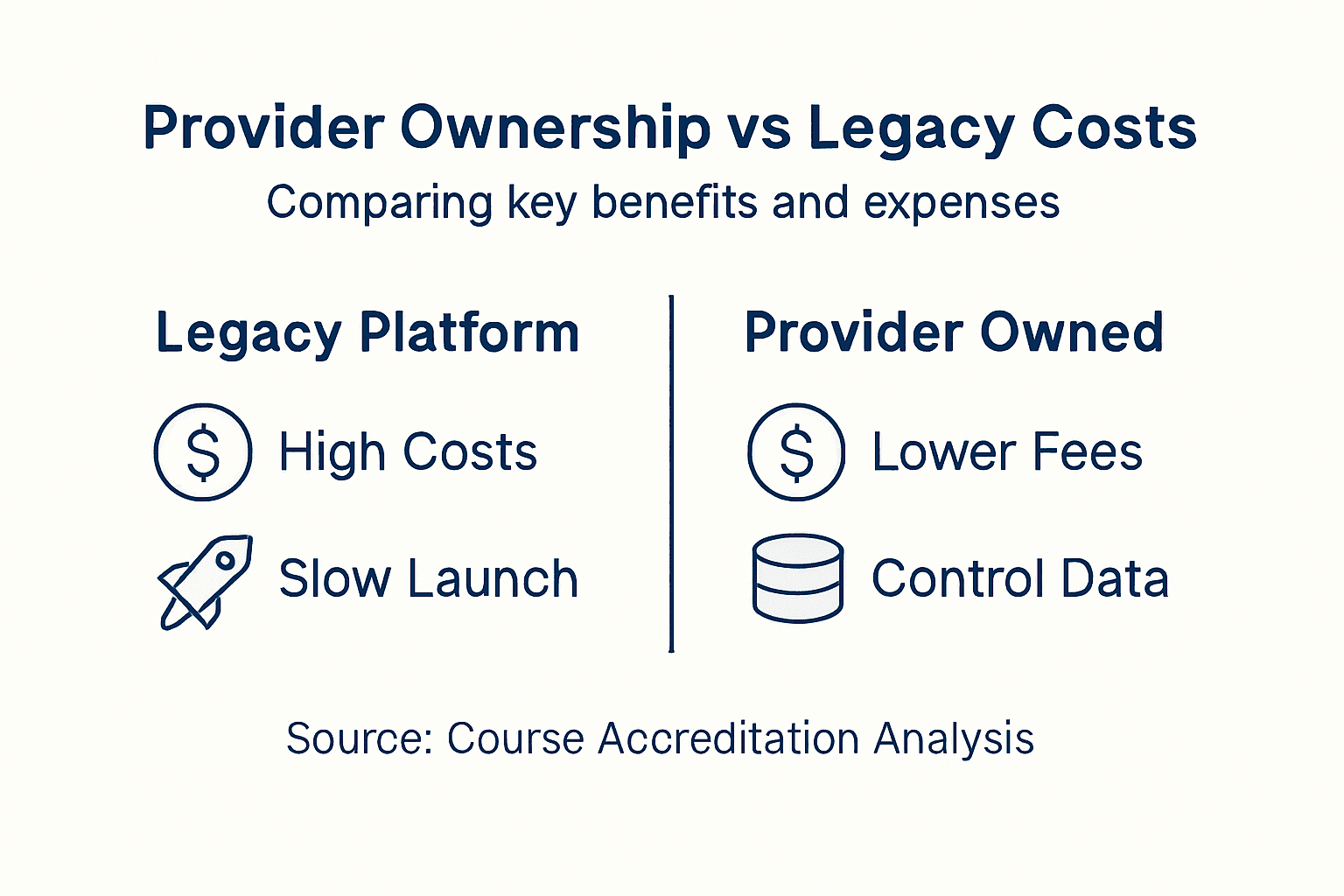
Becoming your own IDCEC provider costs $440 as a one-time registration fee. That’s it for accreditation status. You own it permanently. Your ongoing platform costs are $99 per month with CEU Builder, price locked forever with no hidden fees. That’s $1,188 per year. Over five years, you’re spending $6,440 total. Compare that to the legacy platform cost of $280,000 to $400,000, and the math becomes impossible to ignore. You’re saving $273,000 to $393,000 over five years while maintaining 100 percent control over your accreditation status, your learner data, your course approval timeline, and your educational assets. But the cost analysis goes deeper than simple platform fees. Accreditation delivers competitive advantage through market differentiation, increased visibility, and access to certification programs that legacy platforms limit. When you’re your own provider, you can leverage your IDCEC-accredited status in your marketing, your sales conversations, and your brand positioning. You can tell architects and designers: “We’re an IDCEC-accredited education provider.” That positioning costs legacy platforms extra money (featured placement fees) but costs you nothing because you own the provider status outright.
There’s also an indirect cost embedded in legacy platform pricing: the cost of slow course development. When it takes 18 months to launch a new course through AEC Daily, you’re losing months of potential engagement, specification impact, and learner enrollment. You’re also paying 18 months of subscription fees for a course that isn’t generating any value yet. When you’re your own provider using AI-powered course development, you can launch courses in 4 to 6 weeks (Done-For-You) or 8 to 12 weeks (DIY platform). That acceleration translates directly into faster ROI. Your first course starts generating learner engagement, data, and specification impact within two months instead of eighteen. Your second course launches while your first is still generating momentum. By year two, you have three to four accredited courses in market, all generating learner data that belongs to you. By year three, you have a full library of accredited courses that position your brand as an education authority rather than just another product vendor. Legacy platforms never achieve this velocity because they’re constrained by their own approval bureaucracies and because they benefit from slower timelines.
The ownership benefits extend beyond cost savings into operational control and strategic flexibility. When you own your accreditation status, you control which courses you develop, which topics you address, and which accreditation types you pursue. You can decide strategically that your first two courses should be general CEU (faster to approve, broader appeal) and your third should be HSW (higher demand, premium positioning). You can decide to refresh your course annually instead of every three years. You can decide to experiment with different formats, delivery methods, or instructor combinations without waiting for platform approval. You can integrate your course platform directly with your CRM so that learner enrollment data automatically feeds into your sales team’s tracking systems. Legacy platforms don’t offer this flexibility because they’re built on one-size-fits-all architecture that maximizes their efficiency, not yours. The economics of accreditation show that providers benefit from enhanced reputation, increased enrollment, and competitive advantage that justify the investment. For manufacturers, that competitive advantage comes from owning your education instead of renting it from a directory gatekeeper.
Here’s what gets lost in cost comparisons between legacy platforms and provider ownership: the value of your learner data. When an architect completes your IDCEC-accredited course on HSW compliance, you capture their email, completion date, engagement metrics, and assessment scores. That data tells you which architects are investing time in learning about your products. That data is worth real money because it identifies hot prospects for specification conversations. Legacy platforms capture this data and use it for themselves. They sell aggregate reporting that shows you trends without giving you individual learner details. When you own your provider status, all that data belongs to you. You can export it to your CRM. You can use it to identify high-engagement learners for direct outreach. You can use it to personalize follow-up conversations. You can track whether learners who completed your course actually specified your products six months later. That attribution data is what transforms CEU from a marketing cost center into a specification-driving sales tool.
Here’s a comparison of legacy platform accreditation versus direct provider ownership for manufacturers:
| Criteria | Legacy Platform (e.g., AEC Daily) | Provider Ownership (IDCEC) |
|---|---|---|
| Initial Accreditation Cost | $50,000–$120,000/year | $440 one-time registration |
| Data Ownership | Platform controls learner data | Manufacturer owns all data |
| Course Approval Timeline | 12–18 months | 4–6 weeks |
| Flexibility in Course Design | Platform sets limitations | Manufacturer controls content |
| Hidden Fees/Annual Increases | Common, unpredictable costs | Transparent, fixed pricing |
| Marketing Positioning | Platform-branded education | Manufacturer-branded education |
| Ability to Integrate with CRM | Manual, limited options | Direct, real-time integration |
| Risk of Vendor Lock-In | High (difficult migration) | Low (migration is simple) |
Pro tip: Calculate your true five-year CEU cost including hidden fees, failed course submissions, and delayed launches—most manufacturers discover they’re spending 4 to 5 times more than the base directory fee, which makes the $6,440 investment in provider ownership look like the best marketing decision they’ll make this year.
Risks of legacy platforms and best practices
Legacy CEU platforms weren’t built yesterday. Many of them were designed 15 to 20 years ago when the world of continuing education looked fundamentally different. They’ve been patched and updated incrementally, but they’re built on old architecture that creates real operational risks for manufacturers. Legacy systems create data silos, security vulnerabilities, and integration challenges that hinder modern educational delivery. For you as a manufacturer, this translates into tangible problems. Your learner data lives in their system, siloed away from your CRM, your marketing automation, and your sales team’s tracking systems. If you want to see which architects completed your courses, you can’t just query your own database. You have to download a spreadsheet from their portal, manually match names to your CRM records, and hope the data format hasn’t changed since last quarter. If you want to integrate course completion data into your marketing automation to trigger follow-up sequences, you’re stuck. Most legacy platforms offer basic email reporting but not genuine API integration. Security is another concern. Older platforms were built before modern cybersecurity standards became table stakes. They handle sensitive learner data (names, emails, completion records) with infrastructure that’s been bolted onto decades-old code. When security breaches happen in the CEU industry (and they do), it’s usually legacy platforms that get hit because their architecture wasn’t designed for modern threats.
Vendor lock-in is perhaps the most insidious risk. When you build your entire CEU program on AEC Daily or RedVector, you become hostage to their platform decisions. If they decide to change their pricing, you have limited alternatives because migrating your courses away means resubmitting everything for accreditation through a new provider. If they sunset a feature you depend on, you have no control. If they sell the company to a competitor who decides to consolidate platforms, your courses might simply disappear into their system. You’ve invested years building a course library, developing instructor relationships, and generating learner data, and it all lives on their servers under their control. When contract renewal time comes around and they announce a 25 percent price increase, you’re faced with an impossible choice: pay the increase or lose your entire CEU program and start over. This isn’t hypothetical. We’ve talked to manufacturers who’ve experienced exactly this scenario, and the financial and operational damage is substantial.
Best practices for managing CEU programs involve building systems that give you control and visibility. First, adopt modern platforms that enable continuous monitoring, workflow automation, and real-time data integration rather than relying on legacy systems that require manual workarounds. Modern platforms like CEU Builder were built from the ground up with accreditation compliance, data ownership, and integration in mind. You maintain 100 percent control over your learner data, you can export it anytime, and you can integrate it with your other business systems. You get real-time visibility into course performance, learner engagement, and completion rates instead of waiting for quarterly reports. Second, establish clear governance around accreditation status. Document your courses, maintain your compliance records, and keep your instructors’ qualifications current. This protects you from accreditation rejections and makes audits straightforward. Third, build redundancy into your strategy. Don’t put all your courses on one platform. If you’re using a legacy directory, supplement it with your own accredited provider status so you’re not completely dependent on their approval timelines or pricing decisions. Fourth, implement regular audits of your CEU program performance. Track which courses generate the most learner engagement, which topics resonate with architects and designers, and which courses actually drive specification conversations. Use this data to inform which courses to refresh, which to retire, and which new topics to develop.
The best practice that matters most for manufacturers is simple: own your accreditation status instead of renting it. When you’re your own IDCEC provider, you eliminate vendor lock-in risk entirely. You’re no longer hostage to a legacy platform’s pricing decisions, feature roadmap, or corporate strategy. You control your accreditation status, your learner data, your course approval timeline, and your educational brand. If you decide to switch platforms (say, from CEU Builder to another modern LMS), you can do so without losing accreditation. Your courses remain IDCEC-accredited because your accreditation status is independent of any single platform. This autonomy is worth far more than the modest cost savings. It’s worth organizational peace of mind. You’re building a sustainable, long-term educational program that belongs to your company, not to a directory gatekeeper. The risk of legacy platforms isn’t just financial. It’s strategic. When you’re dependent on AEC Daily for accreditation status and learner data, you’re outsourcing a core part of your specification-driving strategy to a vendor whose interests don’t align with yours. When you own your accreditation, your interests and your learner data work together seamlessly toward your strategic goal of specification impact and revenue growth.
Pro tip: Before renewing your legacy platform contract, calculate the true five-year cost including hidden fees and opportunity costs from delayed course launches, then compare it to the $6,440 investment in becoming your own IDCEC provider—the difference will likely push you toward provider ownership faster than any other single factor.
Take Control of Your Course Accreditation and Unlock True Value
The article highlights the critical challenges manufacturers face when relying on legacy CEU platforms: lack of provider ownership, hidden fees, slow accreditation timelines, and loss of learner data control. These pain points directly translate into lost revenue potential and strategic disadvantage. If you’re tired of paying six-figure fees just to rent your accreditation status and want to own your education program end-to-end, CEU Builder offers the solution built specifically for manufacturers like you seeking provider control, transparent pricing, and accelerated course development.
Our AI-powered platform helps you become your own IDCEC and AIA accredited provider with a straightforward one-time registration fee and a $99/month platform fee locked forever. Unlike legacy platforms, you keep 100% of your learner data, dramatically reduce your course development timeline from 18 months to as little as 4 to 6 weeks, and gain complete autonomy over your accreditation status and compliance process. With features like automated IDCEC reporting, HSW eligibility checking, and CRM integration, CEU Builder empowers your marketing and specification teams to prove ROI with direct attribution between course completions and product specifications.
Stop renting your CEU program from gatekeepers. Own it. Control it. Grow it. Learn more about how CEU Builder can transform your continuing education strategy at CEU Builder.
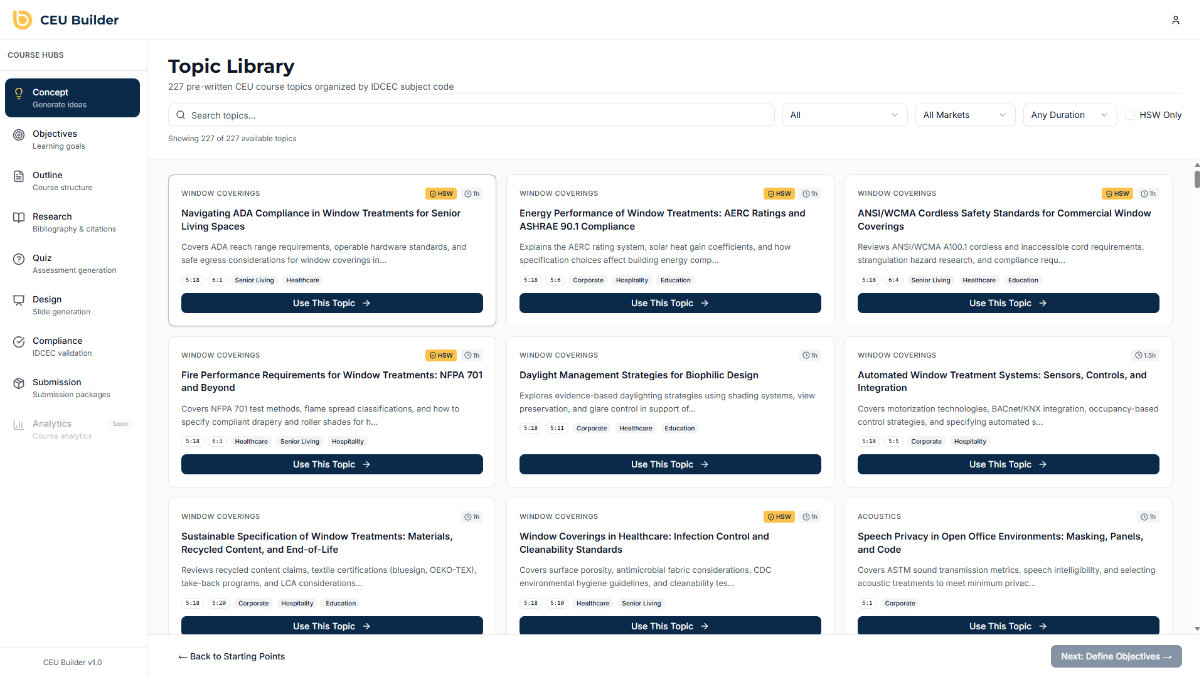
Ready to take the next step toward provider ownership and cost savings? Visit CEU Builder to start your free trial or book a strategy call to explore our Done-For-You course development services. Own your accreditation. Own your data. Own your future.
Frequently Asked Questions
What is course accreditation and why is it important?
Course accreditation is a quality assurance process where independent experts evaluate whether a course meets specific educational standards. It’s important because it signals to professionals that the education offered meets recognized standards, ensuring content quality and relevance.
How does controlling accreditation status benefit manufacturers?
By controlling their own accreditation status, manufacturers can position themselves as credible educators, utilize educational content as a relationship driver, and own valuable learner data, which informs targeted marketing and engagement strategies.
What are the differences between general CEU courses and HSW-accredited courses?
General CEU courses cover a broad range of industry trends and best practices, while HSW-accredited courses focus on health, safety, and welfare issues that are legally required for professional licensure, thus carrying higher perceived value and demand among architects and designers.
What are the risks of using legacy CEU platforms for accreditation?
Legacy CEU platforms often create data silos, security vulnerabilities, and expose manufacturers to vendor lock-in risks, as they control course approvals, learner data, and pricing. This dependence can hinder operational flexibility and limit strategic decisions.
Recommended
- Role of Accreditation Bodies in Continuing Education – CEU Builder
- Master the Course Accreditation Process for CEU Providers – CEU Builder
- Why Approve Your Own Courses: ROI and Control – CEU Builder
- Accreditation Management: Maximizing ROI for Manufacturers – CEU Builder
- Understanding HACCP Basics: Ensuring Food Safety – Probe IT
