

Course Approval Process: Securing IDCEC Accreditation
Securing IDCEC course approval can feel daunting when your team balances educational outreach with the realities of product specification in hospitality settings. Marketing Directors at global furniture manufacturers know that aligning with IDCEC not only reinforces your reputation in the design community but also directly impacts engagement with specifiers. This guide breaks down the structured submission and review process so you can transform your educational content into an accredited resource that drives meaningful industry connections.
Table of Contents
- Defining The Course Approval Process
- Types Of Providers And Course Categories
- Essential IDCEC Submission Requirements
- Navigating Review, Revisions, And Compliance
- Financial Obligations And Common Pitfalls
Key Takeaways
| Point | Details |
|---|---|
| Course Approval Process | The IDCEC Course Approval Process requires providers to submit various documentation, including a PowerPoint presentation and a bibliography, ensuring educational quality and compliance. |
| Provider Types and Opportunities | Providers can be categorized as Individual, Corporate, or Preferred, each offering different advantages and targeting distinct audiences in the interior design field. |
| Financial Considerations | Providers must be aware of recurring fees and budget for both direct and indirect costs associated with course submissions to avoid financial pitfalls. |
| Review Process Insights | Understanding common reasons for submission challenges and maintaining non-promotional content are key to successfully navigating the IDCEC course review process. |
Defining the Course Approval Process
The IDCEC Course Approval Process represents a critical pathway for providers seeking to deliver continuing education programs in interior design. This structured evaluation ensures that educational content meets rigorous professional standards, maintaining the integrity of designer learning experiences.
Navigating the course approval journey involves several key steps and strategic considerations. IDCEC has implemented an automated web-based system designed to streamline submission and review, significantly reducing processing times and improving overall efficiency.
The core components of the course approval process include:
- Initial provider registration
- Comprehensive course content review
- Evaluation of learning objectives
- Assessment of supporting materials
- Verification of educational quality standards
When submitting courses for approval, providers must prepare a detailed package that demonstrates educational value and compliance. This typically involves:
- Creating a structured PowerPoint presentation
- Developing clear learning objectives
- Compiling a comprehensive bibliography
- Ensuring content meets IDCEC’s professional standards
Successful course approval hinges on presenting high-quality, design-relevant educational content that serves professional development needs.
The review process itself generally takes approximately three weeks, during which IDCEC’s expert reviewers meticulously examine each submission. Providers can track their application status through the secure online portal, receiving transparent communication about their course’s progress.
Pro tip: Carefully review IDCEC’s submission guidelines and prepare all documentation thoroughly before uploading to minimize potential delays in the approval process.
Types of Providers and Course Categories
The IDCEC Continuing Education Provider System offers diverse opportunities for professionals to develop and deliver educational content across interior design disciplines. Provider categories represent distinct pathways for educational content creation, each with unique requirements and opportunities.

IDCEC recognizes multiple provider types, categorized based on organizational structure and professional context:
Here’s a summary comparing IDCEC provider types and their opportunities:
| Provider Type | Key Characteristics | Advantages | Typical Audience |
|---|---|---|---|
| Individual Provider | Independent, self-managed courses | Flexibility, tailored content | Freelance designers |
| Corporate Provider | Organized programs, team collaboration | Robust resources, broader reach | Design firms, companies |
| Preferred Provider | Recognized, consistent high standards | Priority access, enhanced trust | Accredited institutions |
- Individual Providers: Independent professionals creating educational content
- Corporate Providers: Organizations developing comprehensive training programs
- Preferred Providers: Established entities with proven track records of high-quality educational offerings
Course delivery methods encompass multiple formats designed to accommodate different learning preferences:
- In-person lectures and seminars
- Online webinars and workshops
- Self-study modules
- Hybrid learning experiences
Professional development in interior design requires flexible, accessible educational approaches that meet diverse learning needs.
Each course category must adhere to strict non-proprietary content guidelines, ensuring educational integrity and preventing overtly promotional material. Providers must demonstrate that their content serves genuine professional development objectives, focusing on knowledge expansion rather than direct product marketing.
The course approval process demands rigorous standards across all provider types. Submitted courses undergo comprehensive review to verify:
- Relevance to interior design practice
- Educational value
- Compliance with professional learning objectives
- Absence of explicit commercial bias
- Alignment with current industry standards
Pro tip: Carefully document your course’s educational methodology and learning outcomes to increase the likelihood of successful IDCEC course approval.
Essential IDCEC Submission Requirements
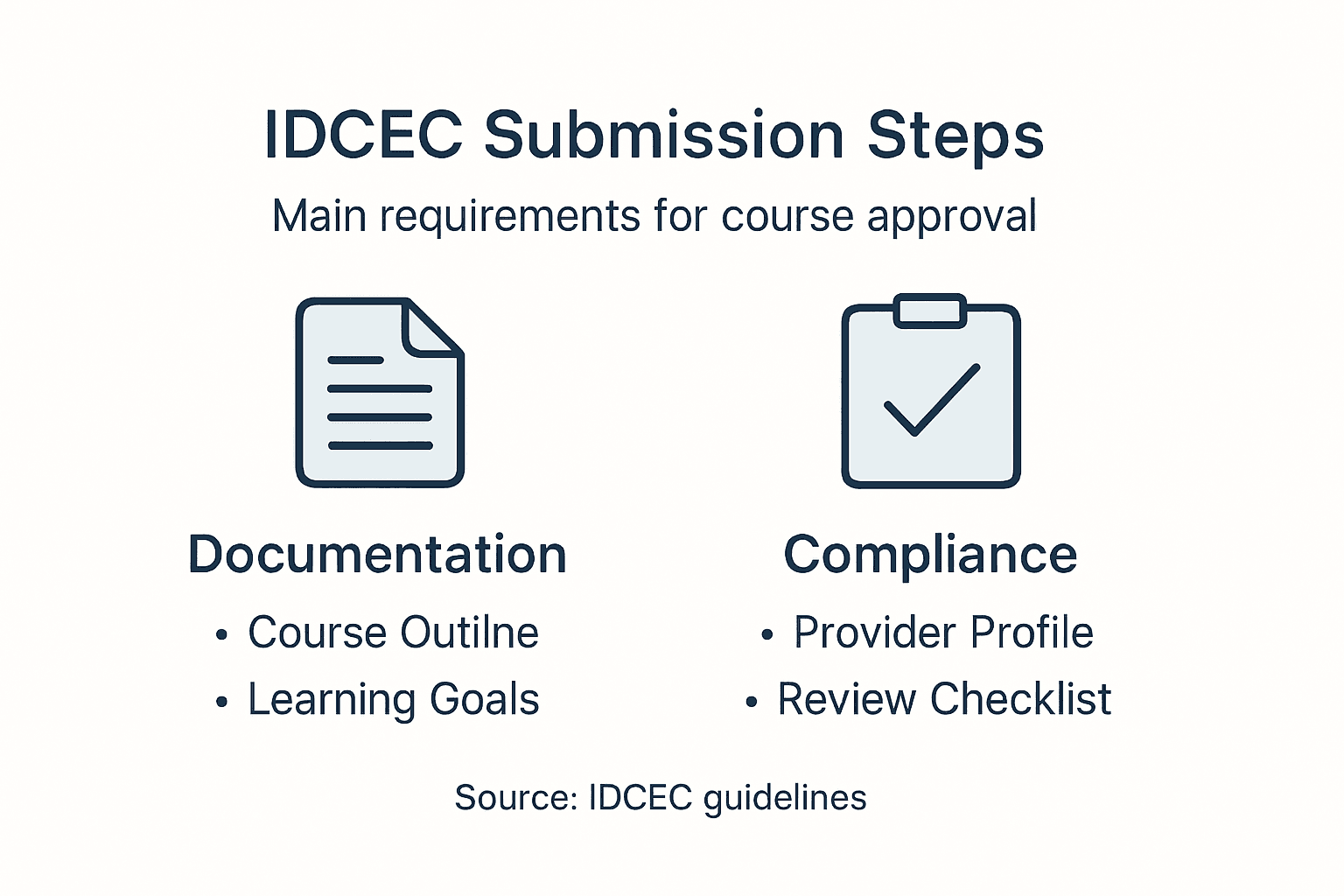
Successful IDCEC course approval hinges on meeting a comprehensive set of submission requirements that ensure educational quality and professional standards. Providers must navigate detailed documentation guidelines designed to maintain the integrity of continuing education offerings.
The core submission requirements encompass several critical elements:
- Complete provider registration documentation
- Comprehensive course materials package
- Non-proprietary educational content
- Detailed learning objectives
- Supporting bibliography and references
- Appropriate subject index coding
Critical documentation for submission typically includes:
- Fully developed PowerPoint presentation
- Comprehensive speaking notes
- Detailed learning outcome statements
- Professional bibliography
- CEU calculation worksheets
IDCEC submission requirements are structured to ensure that educational content serves genuine professional development needs, not marketing objectives.
Financial considerations are also integral to the submission process. Providers must be prepared to:
- Pay online submission fees
- Cover annual provider registration costs
- Ensure electronic file submissions meet specific size limits
- Provide externally linked materials if file sizes exceed constraints
The review process scrutinizes submissions for multiple compliance factors, including:
- Educational content relevance
- Absence of excessive branding
- Alignment with professional learning standards
- Proper subject categorization
- Accurate CEU hour calculations
Pro tip: Prepare a comprehensive submission package with meticulous attention to detail, anticipating potential review challenges to expedite the approval process.
Navigating Review, Revisions, and Compliance
The IDCEC course review process represents a critical pathway for maintaining educational standards in interior design continuing education. Automated review systems have transformed the approval workflow, enabling faster and more transparent course evaluations.
The typical review timeline encompasses several key stages:
- Initial submission review
- Comprehensive content evaluation
- Potential revision requests
- Final compliance assessment
- Approval or rejection determination
Common reasons for course submission challenges include:
- Insufficient supporting documentation
- Proprietary content violations
- Incomplete bibliography
- Inadequate learning objectives
- Excessive marketing language
The review process exists to protect the integrity of professional continuing education, not to create unnecessary barriers for providers.
Providers must be prepared for potential revision scenarios by understanding IDCEC compliance requirements. This includes:
- Maintaining non-promotional educational content
- Providing comprehensive supporting materials
- Ensuring clear, measurable learning outcomes
- Adhering to subject matter guidelines
- Demonstrating professional relevance
Tracking the review process involves:
- Regular online dashboard monitoring
- Prompt response to reviewer communications
- Systematic documentation preparation
- Strategic anticipation of potential feedback
- Meticulous attention to detail
Pro tip: Develop a comprehensive submission checklist that addresses potential compliance issues before initial file upload to minimize review complications.
Financial Obligations and Common Pitfalls
The IDCEC continuing education ecosystem involves specific financial requirements that providers must carefully navigate. Provider registration fees follow a structured payment model designed to support ongoing quality assurance and administrative processes.
Financial obligations for IDCEC providers include:
- Annual provider registration fee
- Prorated initial registration costs
- Per-course submission fees
- Online payment requirements
- Credit card as the sole payment method
The primary financial challenges providers encounter involve:
- Misunderstanding fee structures
- Failing to budget for recurring costs
- Missing payment deadlines
- Incomplete registration processes
- Unexpected administrative expenses
Financial compliance is not just about paying fees, but understanding the strategic investment in professional education.
Cost considerations extend beyond simple monetary transactions. Providers must account for potential indirect expenses such as:
Below is a reference table highlighting common financial pitfalls and how to avoid them:
| Pitfall | Business Impact | Prevention Strategy |
|---|---|---|
| Missing payment deadlines | Delays approval, extra fees | Schedule reminders and track due dates |
| Misunderstanding fee model | Budget shortfalls, disruptions | Review all costs before registration |
| Overlooking indirect costs | Unexpected expenses, lower ROI | Plan for development and admin overhead |
- Content development time
- Potential revision costs
- Administrative overhead
- Potential resubmission fees
- Compliance documentation preparation
Key financial best practices include:
- Maintaining accurate financial records
- Understanding full cost implications
- Budgeting for annual and per-course expenses
- Tracking all submission-related costs
- Planning for potential additional investments
Pro tip: Create a dedicated financial tracking spreadsheet specifically for IDCEC-related expenses to maintain clear visibility into your continuing education investment.
Simplify Your IDCEC Course Approval Journey with Expert Support
Navigating the IDCEC course approval process can be a complex challenge for many providers who face strict compliance requirements and detailed submission demands. If you are aiming for seamless accreditation that avoids costly delays and maximizes your course’s professional impact, understanding the pitfalls of documentation, learning objectives, and non-proprietary content is essential. This article highlights those exact challenges, making it clear that expert guidance and efficient systems are vital for first-time success.
At CEU Builder, we uniquely specialize in transforming these challenges into smooth, predictable outcomes. Leveraging a 100% first-pass approval rate, our services eliminate the frustration of repeated submissions. Whether you need full-service course development or powerful tools to manage accreditation in-house, our tailored solutions reduce complexity and accelerate your path to market. Explore further insights in our Compliance & Accreditation – CEU Builder content to master the nuances of IDCEC requirements and stay ahead in your professional education journey.
Ready to secure IDCEC accreditation without the wait and wasted effort?
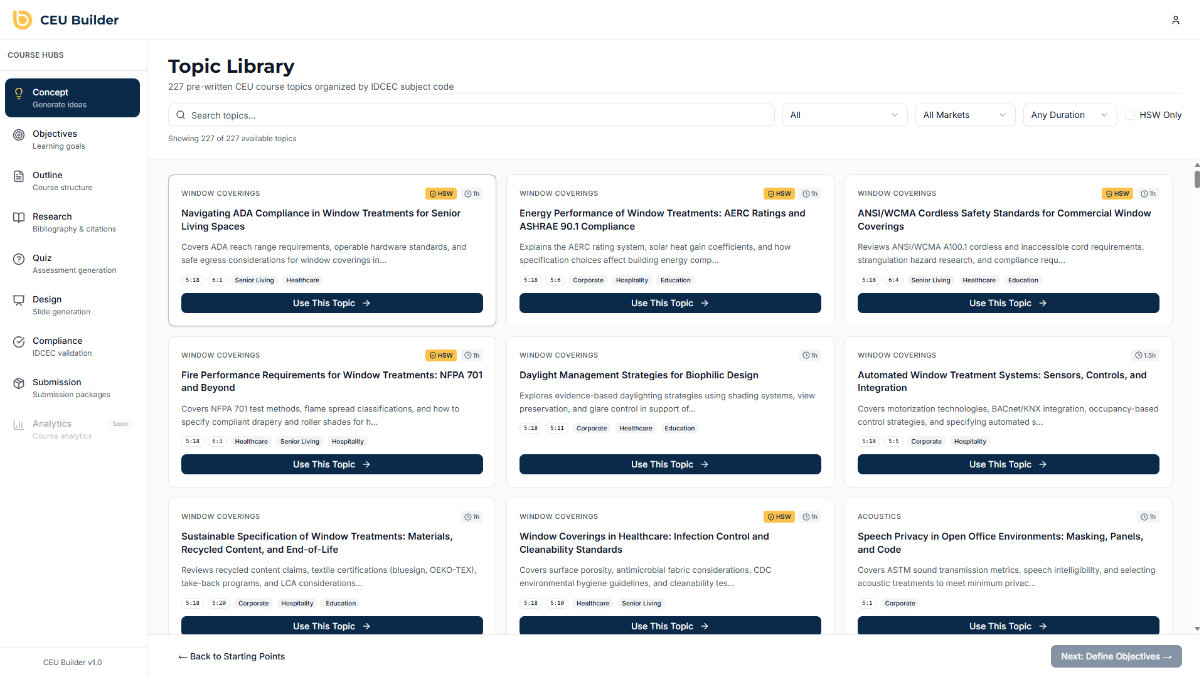
Take control of your continuing education success today. Visit CEU Builder to learn how we can fast-track your course approval or empower your team with our platform and AI tools. Don’t let the course approval process slow down your growth. Act now and turn accreditation into opportunity with proven expertise.
For broader strategies on growing revenue through education, see our insights at Pipeline & Revenue Growth – CEU Builder or explore foundational guidance in General – CEU Builder.
Frequently Asked Questions
What is the IDCEC Course Approval Process?
The IDCEC Course Approval Process is a structured pathway for providers to submit continuing education programs in interior design for evaluation to ensure they meet professional standards.
How long does the course approval review process typically take?
The review process generally takes about three weeks, during which IDCEC reviewers evaluate each submission for compliance and educational quality.
What are the key components required for IDCEC course submission?
Key components include initial provider registration, a comprehensive course content review, detailed learning objectives, and supporting materials that comply with educational quality standards.
What are some common reasons for course submission rejection?
Common reasons for rejection include insufficient supporting documentation, proprietary content violations, incomplete bibliographies, and the presence of excessive marketing language.
Recommended
