

7 Innovative Examples of CEU Course Topics for Manufacturers

Every American hospitality project hinges on design decisions that affect occupant health and safety. With over 80 percent of commercial interiors demanding HSW-compliant elements, understanding these specialized CEU topics is more than a regulatory box to check. For manufacturers, this insight unlocks the potential to shape continuing education programs that highlight how product choices transform interior environments, directly elevating your value in an increasingly competitive market.
Table of Contents
- 1. Understanding HSW-Eligible CEU Topics For Interior Design
- 2. Sustainable Materials In Hospitality And Commercial Spaces
- 3. Acoustics And Sound Control Solutions For Multi-Family Projects
- 4. Lighting Innovations For Energy Efficiency And Wellness
- 5. ADA Compliance And Universal Design Principles
- 6. Specifying Commercial Flooring For Performance And Safety
- 7. Advancing ROI With Data-Driven CEU Course Strategies
Quick Summary
| Key Message | Explanation |
|---|---|
| 1. Prioritize HSW Topics | Focusing on topics that enhance health, safety, and welfare is essential for meaningful design education. |
| 2. Leverage Sustainable Materials | Utilizing sustainable materials can significantly enhance environmental responsibility while offering aesthetic and functional benefits. |
| 3. Implement Effective Acoustic Strategies | Comprehensive sound control in multi-family projects is crucial for resident comfort and privacy. |
| 4. Emphasize Human-Centric Lighting | Modern lighting solutions should support wellness and energy efficiency through adaptive and natural light technology. |
| 5. Integrate Universal Design Principles | Adopting universal design fosters accessibility and enhances usability for individuals with diverse needs. |
1. Understanding HSW-Eligible CEU Topics for Interior Design
Health Safety and Welfare (HSW) continuing education credits represent the gold standard for professional interior design learning. These specialized credits go far beyond traditional educational requirements by focusing on design strategies that directly protect human well-being.
The American Institute of Architects defines HSW topics as those that fundamentally address how design decisions impact occupant safety, health, and overall welfare. HSW credit guidelines emphasize courses that explore critical themes like universal design, environmental sustainability, occupant protection, and evidence-based design practices.
HSW-eligible topics typically include core areas such as building codes, accessibility standards, material safety, ergonomic design principles, environmental psychology, and sustainable construction techniques. These courses provide interior designers with advanced knowledge that translates directly into creating spaces that protect human health and improve quality of life.
For manufacturers developing continuing education content, this means crafting learning experiences that demonstrate how product selections and design strategies can tangibly enhance occupant safety. Successful HSW courses move beyond product promotion to explore substantive design challenges and innovative solutions that prioritize human-centered approaches.
Some compelling HSW topic examples include exploring how acoustic materials reduce workplace stress, analyzing lighting design that supports circadian rhythms, examining material selections that improve indoor air quality, and investigating design strategies for enhanced mobility in aging populations.
Key HSW Course Development Principles:
• Focus on occupant protection and well-being
• Provide evidence-based design recommendations
• Connect theoretical concepts to practical applications
• Demonstrate measurable impacts on human health
• Integrate current research and industry standards
Pro tip: When developing HSW courses, prioritize scientific research and objective data over marketing language to create credible educational content that truly advances professional design knowledge.
2. Sustainable Materials in Hospitality and Commercial Spaces
Sustainable materials represent a transformative approach to design that goes beyond aesthetic considerations, directly addressing environmental responsibility in commercial and hospitality spaces. These innovative materials offer manufacturers a powerful opportunity to reduce carbon footprint while creating exceptional interior environments.
Modern hospitality design increasingly prioritizes circular economy principles that emphasize resource efficiency and waste reduction. Sustainable materials are not just an environmental choice but a strategic business decision that appeals to environmentally conscious clients and consumers.
Key Sustainable Material Categories:
• Recycled content materials
• Locally sourced products
• Low emission manufacturing components
• Renewable resource based materials
• Energy efficient production materials
The integration of sustainable materials involves careful selection of products that minimize environmental impact while maintaining exceptional performance standards. This means evaluating material lifecycle, production processes, transportation distances, and long term durability.
High performance sustainable materials can include recycled aluminum panels, bamboo flooring, low VOC paints, reclaimed wood surfaces, and textile products made from regenerated fibers. These materials not only reduce environmental strain but often provide superior aesthetic and functional qualities compared to traditional alternatives.
Manufacturers can leverage sustainable material selections as powerful marketing narratives, demonstrating commitment to environmental stewardship and meeting growing client demands for responsible design solutions.
Pro tip: When selecting sustainable materials, prioritize third party certifications and conduct comprehensive lifecycle assessments to ensure genuine environmental benefits beyond surface level marketing claims.
3. Acoustics and Sound Control Solutions for Multi-Family Projects
Acoustic design represents a critical yet often overlooked aspect of multi-family residential construction. Creating comfortable living environments requires sophisticated sound control strategies that protect resident privacy and enhance overall quality of life.
Multi-family projects demand comprehensive sound control strategies that address both airborne and impact noise transmission. Advanced acoustic solutions go beyond simple soundproofing to create holistic design approaches that integrate seamlessly with architectural aesthetics.
Key Acoustic Performance Metrics:
• STC (Sound Transmission Class)
• IIC (Impact Insulation Class)
• Noise Reduction Coefficient
• Decibel Absorption Ratings
• Vibration Isolation Performance
Successful acoustic design involves multiple strategic approaches including adding mass to building elements, decoupling surfaces to minimize vibration transfer, and implementing sophisticated absorption materials. This multilayered methodology ensures superior sound isolation and improved resident comfort.
Architectural solutions like perforated metal acoustic baffles can transform shared spaces such as lobbies and lounges. These innovative treatments reduce echo and enhance speech intelligibility while maintaining a sophisticated design aesthetic. Manufacturers can develop educational content exploring how specific material selections directly impact acoustic performance.
Advanced sound control solutions consider construction techniques like resilient channels, sound isolation clips, specialized insulation materials, and engineered flooring systems that dramatically reduce noise transmission between units.
Pro tip: When developing acoustic design solutions, prioritize comprehensive testing and measurement to validate real world performance beyond theoretical specifications.
4. Lighting Innovations for Energy Efficiency and Wellness
Lighting technology has evolved far beyond simple illumination into a sophisticated tool for enhancing human performance and environmental sustainability. Modern lighting solutions represent a critical intersection between energy conservation and occupant wellness.
Smart lighting systems integrate cutting edge technologies that transform how we experience interior environments. These advanced solutions combine high efficiency LEDs with intelligent sensors and adaptive controls to optimize both energy consumption and human comfort.
Key Lighting Innovation Components:
• Human centric lighting design
• IoT sensor integration
• Adaptive color temperature controls
• Daylight harvesting technologies
• Occupancy responsive illumination
Human centric lighting represents a groundbreaking approach that mimics natural light cycles to support human circadian rhythms. By dynamically adjusting color temperature and intensity throughout the day, these systems can improve mood, reduce eye strain, and enhance overall productivity in commercial and hospitality environments.
Advanced lighting control technologies now incorporate building information modeling and Internet of Things sensors to create intelligent illumination strategies. These systems can automatically adjust lighting based on occupancy levels, available natural light, and specific environmental conditions creating unprecedented levels of energy efficiency.
Manufacturers can develop compelling continuing education content exploring how these innovative lighting technologies represent a holistic approach to design that simultaneously addresses sustainability goals and human wellness requirements.
Pro tip: When designing lighting solutions, prioritize systems that offer granular control and data tracking to demonstrate measurable improvements in energy performance and occupant experience.
5. ADA Compliance and Universal Design Principles
Universal design represents a transformative approach to architectural and interior design that prioritizes accessibility and inclusivity for all individuals. This philosophy goes far beyond minimum legal requirements to create environments that are inherently usable by people with diverse abilities and needs.
Universal design principles challenge designers and manufacturers to think comprehensively about human diversity and functional requirements across different physical capabilities.
Core Universal Design Principles:
• Equitable use
• Flexibility in use
• Simple and intuitive design
• Perceptible information
• Tolerance for error
• Low physical effort
• Appropriate size and space
The Americans with Disabilities Act establishes critical baseline accessibility standards, but universal design represents a more holistic approach that anticipates and accommodates diverse human experiences. This approach considers variations in mobility, sensory perception, cognitive abilities, and individual preferences.
For manufacturers developing continuing education content, universal design offers a compelling narrative about creating spaces that are simultaneously functional, beautiful, and inclusive. These principles encourage designers to view accessibility not as a compliance requirement but as an opportunity for innovative problem solving.
Practical implementation involves strategies like incorporating adjustable height surfaces, designing clear and intuitive navigation paths, ensuring adequate lighting and color contrast, and creating flexible spaces that can be easily adapted to different user needs.
Pro tip: Approach universal design as a comprehensive strategy of inclusion rather than a checklist of legal requirements, focusing on creating environments that inherently work for everyone.
6. Specifying Commercial Flooring for Performance and Safety
Commercial flooring represents far more than a decorative surface it serves as a critical infrastructure component that directly impacts safety, operational efficiency, and long term facility performance. Intelligent flooring specification requires a comprehensive understanding of environmental demands and performance requirements.
Commercial flooring systems demand rigorous evaluation across multiple performance dimensions. Design professionals must consider traffic volumes, chemical exposure, moisture resistance, durability, maintenance requirements, and safety characteristics.
Critical Flooring Performance Factors:
• Slip resistance
• Chemical and impact durability
• Moisture management capabilities
• Compression strength
• Hygienic surface properties
• Maintenance complexity
• Aesthetic longevity
Successful commercial flooring specification involves understanding the unique demands of different environments. Healthcare facilities require antimicrobial surfaces with seamless installation. Manufacturing spaces need high compression strength and chemical resistance. Hospitality venues prioritize aesthetic appeal with robust performance characteristics.
Advanced flooring technologies now integrate multiple performance attributes. Engineered ceramic tiles with textured finishes provide superior traction. Resin and epoxy systems offer exceptional durability in high stress environments. Innovative materials can simultaneously address safety, hygiene, and aesthetic requirements.
Manufacturers developing continuing education content should explore the nuanced relationship between material science, safety engineering, and design aesthetics. This approach transforms flooring from a passive building element into an active contributor to occupant experience and facility performance.
Pro tip: Always specify flooring through a holistic lens that balances safety metrics, performance requirements, and long term maintenance considerations.
7. Advancing ROI with Data-Driven CEU Course Strategies
Data driven strategies represent the future of continuing education design for manufacturers seeking to transform learning programs from cost centers into strategic business assets. By leveraging advanced analytics and performance metrics, manufacturers can create targeted educational experiences that directly drive business outcomes.
Data driven manufacturing strategies enable organizations to move beyond traditional training approaches towards precision learning interventions that quantifiably impact operational performance.
Key Data Strategy Components:
• Performance baseline establishment
• Learning impact measurement
• Analytics driven course design
• Continuous improvement tracking
• Return on education calculation
Successful CEU course strategies require sophisticated data governance frameworks that align learning objectives with specific business goals. This means developing robust measurement systems that track not just course completion rates but tangible operational improvements resulting from educational investments.
Manufacturers can implement data driven approaches by establishing clear performance metrics before course development. These might include specification rates, product adoption metrics, sales team knowledge retention, or direct correlations between training and technical implementation success.
Advanced analytics allow manufacturers to design highly targeted continuing education experiences. By understanding precise knowledge gaps and performance challenges, course designers can create learning modules that address specific operational constraints and drive measurable business value.
Pro tip: Implement a comprehensive learning analytics framework that connects educational investments directly to quantifiable business performance improvements.
Below is a comprehensive table summarizing key topics and principles presented in the article related to interior design and professional development focus areas.
| Topic | Description | Key Considerations |
|---|---|---|
| HSW-Eligible CEU Topics | Focus on occupant safety, health, and welfare through design. | Includes universal design, sustainability, ergonomic principles, and evidence-based practices. |
| Sustainable Materials | Emphasis on environmentally responsible material choices in design. | Categories include recycled content, renewable resources, and locally sourced materials. |
| Acoustics and Sound Control | Strategies for sound management in multi-family residential projects. | Metrics like STC, IIC, and innovations such as sound isolation materials and designing for noise reduction. |
| Lighting Innovations | Utilization of advanced lighting systems to enhance energy efficiency and occupant wellness. | Integration of smart technologies, human-centric designs, and intelligent sensors. |
| ADA Compliance and Universal Design | Creating accessible environments that cater to diverse abilities and inclusivity. | Principles include equitable use, intuitive design, and adaptable spaces. |
| Commercial Flooring Specification | Selection of flooring materials based on safety and operational performance requirements. | Factors include slip resistance, moisture management, and long-term durability. |
| Data-Driven CEU Course Strategies | Utilizing analytics to tailor continuing education courses to achieve quantifiable business outcomes. | Establishment of metrics to measure learning impacts on operational performance. |
Take Control of Your CEU Course Development and Drive Specification Success
Designing innovative CEU courses on topics like HSW credit compliance, sustainable materials, acoustics, and universal design requires both deep expertise and efficient tools. The challenge many manufacturers face is the long 12 to 18 month timelines and costly legacy platforms offering little control over learning data or provider status. You want to deliver engaging, compliant education that drives measurable ROI without paying excessive fees or sacrificing ownership of your program.
CEU Builder empowers product manufacturers in hospitality and commercial interiors to become their own IDCEC and AIA accredited education providers with an AI-powered platform that accelerates course creation and delivers 100 percent data ownership. Our transparent pricing and quick 4 to 6 week development timelines put you in charge of your continuing education programs — from Health Safety Welfare course topics to commercial flooring safety and advanced lighting innovations. Learn how to create targeted CEU courses that connect education to specification directly at CEU Builder.
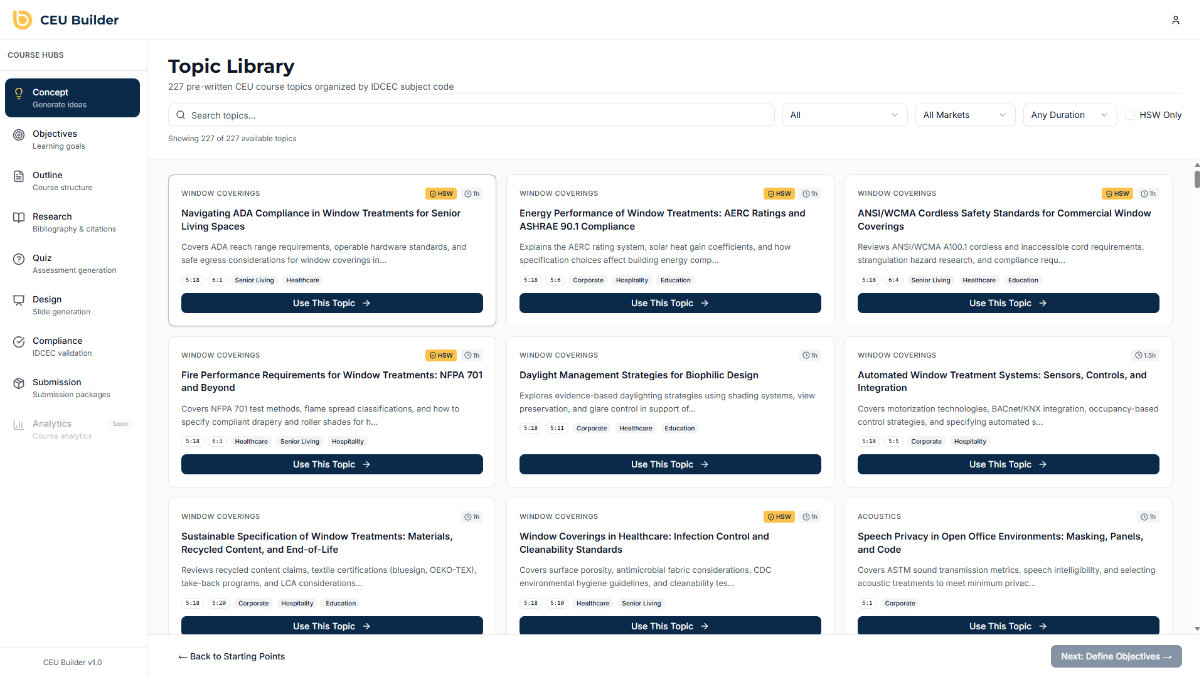
Ready to break free from outdated CEU directories and own your future? Explore how you can build or outsource your next accredited CEU course with guaranteed IDCEC approval by visiting CEU Builder. Take the first step toward transforming your education program, driving more spec wins, and reducing costs today.
Frequently Asked Questions
What are some examples of HSW-eligible CEU course topics for manufacturers?
These topics include material safety, environmental sustainability, and universal design principles. Manufacturers can develop courses that focus on how these elements protect occupant health and enhance design efficacy.
How can I develop sound control solutions as a CEU course topic?
Focus on integrating advanced sound control strategies that improve resident comfort in multi-family housing. Start by identifying specific acoustic performance metrics such as Sound Transmission Class (STC) and Noise Reduction Coefficient (NRC).
What role do sustainable materials play in CEU courses for manufacturers?
Sustainable materials are essential for teaching design solutions that minimize environmental impact. Manufacturers should highlight examples of recycled and locally sourced materials to illustrate their benefits and appeal in commercial design projects.
How can lighting innovations enhance CEU course offerings?
Incorporate human-centric lighting design and smart lighting systems into your courses. For example, teach how adjusting color temperatures can improve occupant wellness and productivity in various environments.
What is the difference between ADA compliance and universal design in CEU topics?
ADA compliance focuses on meeting legal accessibility standards, while universal design promotes inclusivity for all users. Equip your courses with comprehensive strategies that embrace flexibility and usability for diverse abilities, transcending mere compliance.
How can I measure the effectiveness of my CEU courses?
Measure course success through performance metrics like knowledge retention and course completion rates. Implement feedback mechanisms to continuously improve and achieve measurable outcomes, such as a 25% increase in learner satisfaction over time.
Recommended
