

How to Create CEU Courses for Hospitality Brands
Building genuine connections with architects often starts long before the first product sample arrives. For hospitality furniture manufacturers across the United States and Canada, the right CEU course can become a bridge to meaningful specification decisions. This guide reveals how to craft strategic, measurable learning objectives and engaging content that meet IDCEC requirements while positioning your brand as an indispensable resource for design professionals.
Table of Contents
- Step 1: Define Topics And Align Objectives
- Step 2: Build Compelling Educational Content
- Step 3: Design Assessments And Compliance Materials
- Step 4: Submit For IDCEC Accreditation And Review
- Step 5: Automate Delivery And Track Results
Quick Summary
| Key Point | Explanation |
|---|---|
| 1. Identify Relevant Topics | Focus on compelling subjects that address architects’ real challenges in hospitality design. Conduct market research for effective results. |
| 2. Craft Clear Learning Objectives | Use specific action verbs to describe measurable outcomes, ensuring alignment with course content and professional application. |
| 3. Develop Engaging Educational Content | Create informative, non-promotional materials that provide practical knowledge and real-world applications architects can use directly. |
| 4. Design Meaningful Assessments | Assess comprehension through critical thinking and application-based questions that validate true understanding of course content. |
| 5. Implement Tracking and Automation | Set up systems to monitor participant engagement and gather insights, assisting in leveraging educational content for future leads. |
Step 1: Define Topics and Align Objectives
In this crucial first step, you’ll learn how to strategically select compelling course topics and develop precise learning objectives that will capture architects’ and designers’ attention while meeting IDCEC accreditation requirements.
Successful CEU course development starts with identifying topics architects genuinely want to learn about. Begin by conducting market research that reveals the most pressing knowledge gaps in your specific hospitality design segment. Instead of creating content that sounds like a product brochure, focus on addressing real professional challenges. For instance, if you manufacture contract furniture, topics might include acoustic performance in hospitality spaces, ergonomic design for high-traffic environments, or sustainable material selection strategies.
When developing learning objectives, precision is key. Crafting measurable learning objectives requires using specific action verbs that describe exactly what participants will know or do after completing your course. Avoid vague verbs like “understand” or “know” – instead, use concrete terms from Bloom’s Taxonomy such as:
- Analyze material durability standards
- Compare different acoustic performance metrics
- Evaluate sustainable design strategies
- Apply ergonomic design principles
Learning objectives should transform abstract knowledge into actionable professional skills that architects can immediately implement in their design work.
Each objective needs to be tightly aligned with your course content and demonstrate clear value for design professionals. Consider how your learning objectives connect directly to specification decisions that architects make every day.
Professional Insight: Always draft your learning objectives before developing course content to ensure razor-sharp focus and maximum relevance for your target audience.
Step 2: Build Compelling Educational Content
This step focuses on transforming your course objectives into engaging, informative content that resonates with design professionals while maintaining strict IDCEC compliance standards.

Creating effective CEU content requires a strategic approach that goes beyond simple information delivery. Customized learning modules can dramatically enhance engagement by tailoring content to your audience’s specific needs. When developing your course material, concentrate on creating educational experiences that solve real design challenges. This means moving beyond product promotion and diving deep into technical insights, industry trends, and practical applications that architects genuinely care about.
Design your content around these key principles:
- Focus on practical knowledge that directly impacts design decision-making
- Use real-world case studies and professional scenarios
- Include technical specifications and performance metrics
- Integrate visual examples that demonstrate complex concepts
- Avoid overtly promotional language
Educational content should illuminate industry challenges, not just showcase your product features.
Each slide and section must provide clear, actionable insights that architects can immediately apply in their professional work. Consider using techniques like comparative analysis, performance data visualization, and detailed technical breakdowns that showcase your expertise without feeling like a sales pitch.
Professional Insight: Always approach your content as an educational resource first, treating your product as a natural solution to the professional challenges you’re discussing.
Step 3: Design Assessments and Compliance Materials
In this critical step, you’ll craft assessment materials that meet IDCEC requirements while providing meaningful knowledge verification for architects participating in your continuing education course.
Compliance training solutions demonstrate that effective assessments go far beyond simple multiple-choice questions. Your quiz design must rigorously validate that participants have genuinely understood the course material and can apply the knowledge in real-world design scenarios. Develop assessments with strategic intentionality that test both comprehension and practical application of the learned concepts.
When creating your assessment materials, focus on these key strategies:
- Create questions that require critical thinking
- Develop scenarios that mirror actual design challenges
- Include performance-based assessment elements
- Write distractors that are plausible but technically incorrect
- Ensure questions directly relate to your learning objectives
An effective assessment validates knowledge transfer, not just memorization.
Structure your quiz to include a mix of question types that comprehensively test different levels of understanding. This might involve scenario-based questions, technical specification matching, and comparative analysis problems that require deeper reflection on the course content.
Here’s a comparison of assessment question types for CEU courses:
| Question Type | Description | Best Used For |
|---|---|---|
| Scenario-Based | Applies knowledge to real situations | Testing real-world application |
| Technical Specification | Matches standards or requirements | Validating technical understanding |
| Comparative Analysis | Evaluates options side-by-side | Developing critical thinking |
| Multiple Choice with Distractors | Includes plausible but incorrect answers | Assessing depth of comprehension |
Professional Insight: Design your assessment questions to be more challenging than the course content itself, pushing participants to truly demonstrate mastery of the material.
Step 4: Submit for IDCEC Accreditation and Review
In this final critical phase, you’ll navigate the complex IDCEC submission process, transforming your carefully crafted course into an officially recognized continuing education offering for design professionals.
Course submission guidelines require meticulous preparation and attention to specific documentation requirements. Compile a comprehensive submission package that demonstrates your course meets all IDCEC standards, including non-proprietary content, clear learning objectives, and substantive educational value.
Prepare your submission materials with these essential components:
- Detailed course description outlining learning outcomes
- Complete bibliography with academic sources
- Non-promotional presentation materials
- Minimum 30-minute course duration documentation
- Precise learning objective statements
- Comprehensive quiz/assessment materials
- Proof of content neutrality
The quality of your submission determines your chances of first-pass accreditation.
Submit your materials through the IDCEC portal, understanding that the review process typically takes approximately three weeks. Be prepared to receive feedback and potentially make strategic revisions to align with their specific requirements.
Professional Insight: Review your submission materials as if an extremely critical expert will examine every single detail, leaving no room for ambiguity or promotional language.
Step 5: Automate Delivery and Track Results
In this final stage, you’ll set up systems that transform your CEU course from a one-time educational resource into a strategic lead generation and measurement tool for your hospitality brand.
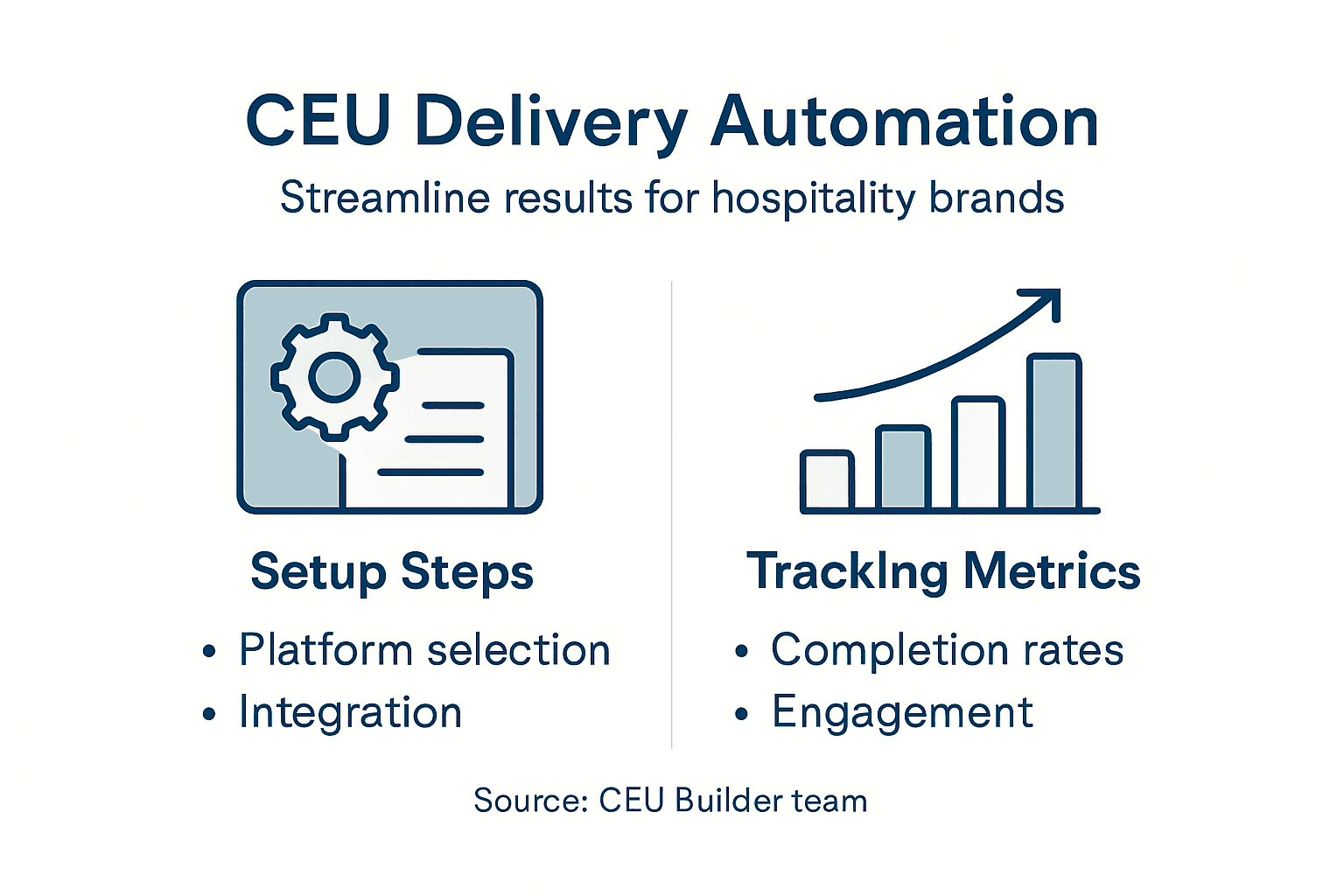
Measure what predicts revenue by implementing a robust tracking infrastructure that goes beyond simple completion metrics. Configure your learning management system to capture detailed insights about participant engagement, including time spent, quiz performance, and potential specification signals that indicate genuine interest in your products.
Set up your automation and tracking systems with these critical components:
- Automatic certificate generation
- Comprehensive participant tracking
- Integration with CRM systems
- Detailed engagement analytics
- Specification interest indicators
- Compliance documentation storage
- Automated follow-up email sequences
Tracking isn’t about numbers – it’s about understanding how your educational content drives actual business outcomes.
Ensure your system captures granular data that helps you understand not just who completed the course, but how that completion might translate into future specification opportunities. Look for patterns in participant behavior that signal genuine design professional interest.
Below is a summary of common tracking metrics and their value:
| Metric | What It Measures | Business Value |
|---|---|---|
| Time Spent per Module | Participant engagement depth | Gauges content effectiveness |
| Quiz Performance Scores | Knowledge transfer level | Indicates learning success |
| Specification Interest Signals | Product selection potential | Identifies hot leads |
| Automated Follow-Up Rate | Continued participant interaction | Enhances conversion opportunities |
Professional Insight: Design your tracking system to answer the critical question: “How does this course move potential customers closer to specifying our products?”
Accelerate Your Hospitality Brand’s CEU Course Success Today
Creating IDCEC-accredited continuing education courses for hospitality brands is a complex process full of challenges like topic selection, precise learning objectives, compliance with accreditation standards, and meaningful assessment design. You want courses that not only pass on knowledge but also drive real specification and revenue growth. Struggling with lengthy development times and the risk of submission rejection can leave your marketing efforts stalled and your internal resources stretched too thin.
CEU Builder offers a proven solution that transforms CEU development from compliance theater into a strategic demand generation engine. With a 100% first-pass IDCEC accreditation rate and accelerated 4-6 week turnaround on done-for-you courses, we help hospitality manufacturers create engaging, architect-focused education that links directly to specification criteria. Our process is built on deep industry insight and technology that ensures your content meets rigorous standards while resonating with design professionals. Learn how to select compelling topics that architects seek and build assessments that confirm mastery with support from experts who understand your unique needs.
Explore more about how our approach uses data-driven insights and compliance expertise in our Marketplaces & Distribution – CEU Builder and Data & Analytics in CEUs – CEU Builder sections. Feel empowered to turn continuing education into measurable business results with CEU Builder.
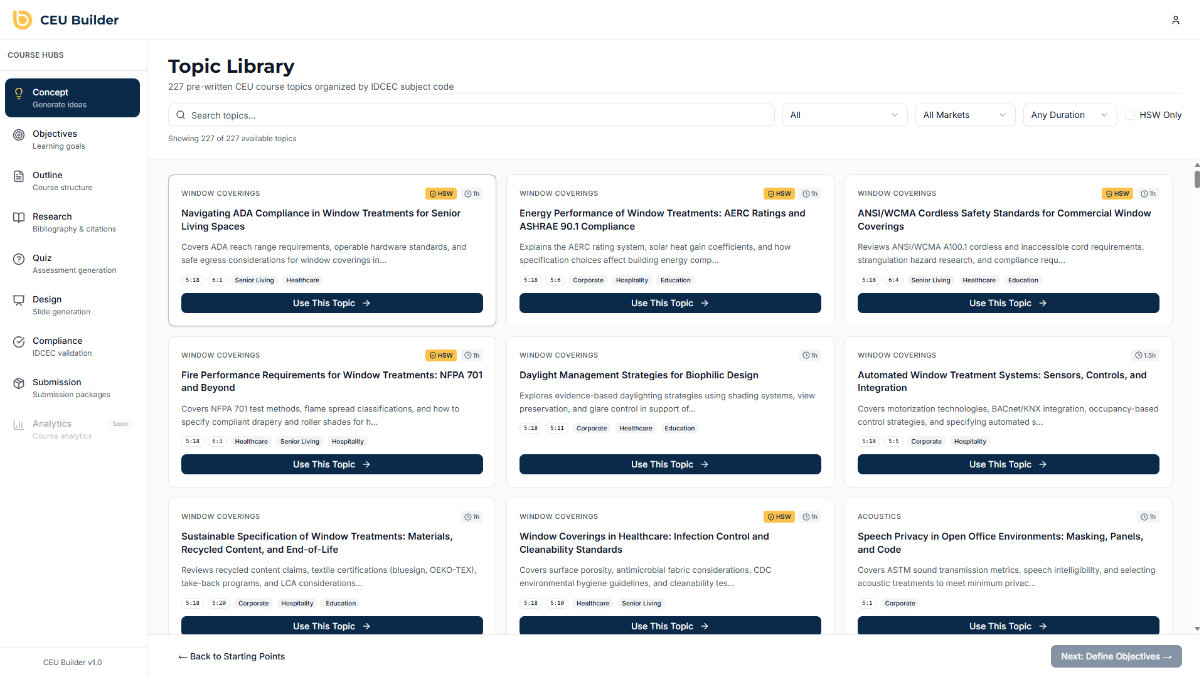
Ready to create CEU courses for your hospitality brand that get approved faster and deliver business impact? Visit CEU Builder now and discover our services, tools, and expert guidance tailored to your success.
Frequently Asked Questions
What are the key steps to create CEU courses for hospitality brands?
To create CEU courses for hospitality brands, start by defining relevant topics and aligning them with learning objectives. Next, build engaging educational content, design meaningful assessments, submit for IDCEC accreditation, and finally, automate course delivery and tracking.
How can I identify compelling topics for my CEU course?
You can identify compelling topics by conducting market research to uncover knowledge gaps in the hospitality design segment. Focus on real professional challenges architects face to ensure the course material is relevant and engaging.
What should I include in my learning objectives for the CEU course?
Your learning objectives should be specific, measurable, and aligned with the course content. Use action verbs from Bloom’s Taxonomy, such as “Analyze,” “Compare,” or “Evaluate,” to clearly state what participants will achieve after completing the course.
How do I design effective assessments for my CEU course?
Design assessments that require critical thinking and mirror real-world design challenges. Ensure your questions test comprehension and practical application by including scenario-based and technical specification questions that relate directly to your learning objectives.
What materials are required for IDCEC accreditation submission?
Your submission materials for IDCEC accreditation should include a detailed course description, a complete bibliography with academic sources, non-promotional presentation materials, learning objectives, assessment materials, and proof of content neutrality. Ensure all documentation meets IDCEC standards to increase your chances of approval.
How can I track the effectiveness of my CEU course after delivery?
Track the effectiveness of your CEU course by implementing a learning management system that captures detailed participant engagement metrics, such as time spent, quiz performance, and specification interest signals. Use this data to analyze how your educational content impacts business outcomes and adjust your strategy accordingly.
Recommended
- How to Offer CEU Courses for Hospitality Manufacturers
- CEU Builder builds accredited CEU courses in 45 days
- 7 Types of CEU Courses Every Manufacturer Should Know
- Course Development Process Explained: Driving CEU Results
- Conflict Management Training Courses: Skills for Real Life – Mastering Conflict
- Phishing Awareness Training for Employees: Key Benefits – Heights Consulting Group
