

Step by Step Accreditation Guide for IDCEC Providers

For many American building product manufacturers, taking back ownership of your continuing education offerings often begins with a close look at eligibility for IDCEC accreditation. Vendors must evaluate whether they qualify as individual or corporate providers before moving forward. Being clear on these distinctions helps avoid wasted effort and lets your team focus resources on the right documentation from the start. This guide highlights core provider criteria and practical steps to help you build a compliant, efficient CEU program for hospitality and commercial interiors markets.
Table of Contents
- Step 1: Assess Provider Eligibility And Gather Requirements
- Step 2: Complete IDCEC Provider Registration Process
- Step 3: Build Compliant CEU Courses Using Structured Workflows
- Step 4: Submit Courses For IDCEC Approval And Fix Feedback
- Step 5: Verify Final Course Approval And Set Up Tracking
Quick Summary
| Key Point | Explanation |
|---|---|
| 1. Assess Provider Eligibility First | Determine your qualification status and understand eligibility requirements before starting the IDCEC registration process. |
| 2. Complete Registration Thoroughly | Navigate the IDCEC online portal to create a detailed provider profile and submit required fees and documents. |
| 3. Develop Courses Following Guidelines | Create continuing education courses that align with IDCEC standards, ensuring content is educational and objective. |
| 4. Submit Courses for Feedback | Accurately submit all course materials and be prepared to address feedback during the review process for approval. |
| 5. Establish Tracking Systems | After course approval, implement a tracking system to monitor participant attendance and report continuing education credits accurately. |
Step 1: Assess provider eligibility and gather requirements
Navigating the IDCEC provider registration process starts with understanding your organization’s specific eligibility requirements. Checking your qualification status is crucial before investing time and resources into the accreditation journey. Manufacturers looking to become independent continuing education providers need to carefully evaluate whether they meet the core provider criteria.
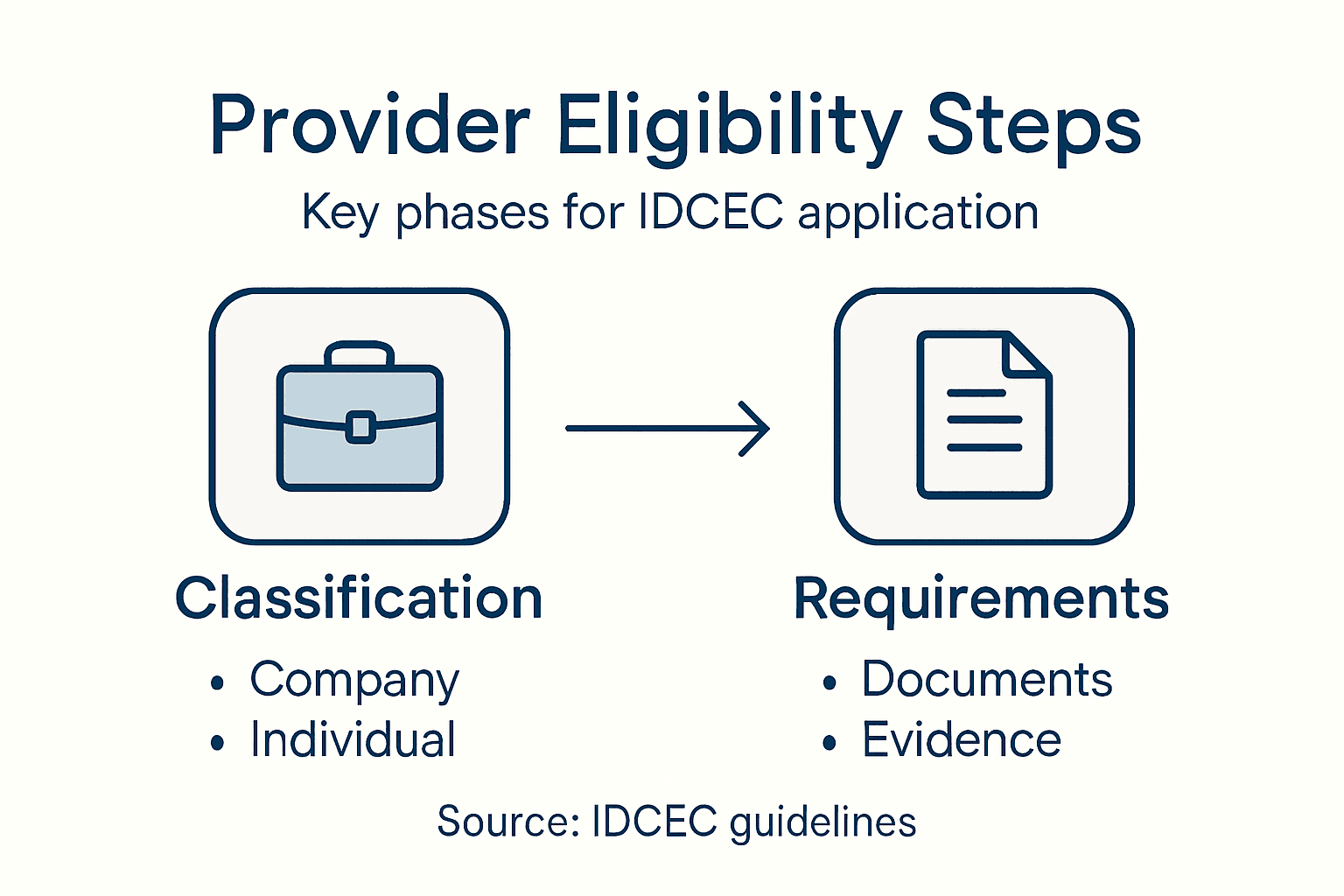
Eligibility assessment involves examining several key factors. First, determine your provider classification: Are you an individual provider delivering education yourself or a corporate provider representing your manufacturing organization? Corporate providers typically have broader scope and must demonstrate the capability to develop and deliver high quality continuing education programs. Specifically for manufacturer representatives, you will need to prepare documentation proving your organization’s ability to create professional learning experiences relevant to interior design professionals.
The documentation gathering phase requires meticulous preparation. You will need to compile evidence of your educational mission, course development capabilities, and commitment to delivering meaningful professional development. This includes preparing detailed course outlines, learning objectives, and demonstrating your technical expertise in creating curriculum that meets IDCEC standards. Understanding the specific documentation requirements upfront can streamline your application process and reduce potential delays.
Here’s a summary that contrasts individual and corporate IDCEC provider classifications:
| Classification Type | Key Characteristics | Documentation Focus |
|---|---|---|
| Individual Provider | Delivers own educational programs | Personal expertise, teaching details |
| Corporate Provider | Represents a manufacturing organization | Organizational capacity, curriculum |
| Manufacturer Representative | Corporate, with specialty focus | Professional learning experience |
Pro tip: Keep a digital folder with all required documents organized and easily accessible to simplify your IDCEC provider registration submission.
Step 2: Complete IDCEC provider registration process
Successfully registering as an IDCEC provider requires strategic navigation through the official online portal. Your goal is to create a comprehensive profile that demonstrates your organization’s capability to deliver high quality continuing education units for interior design professionals. Understanding the registration requirements will help streamline your application process.
The registration workflow involves several critical steps. Start by accessing the IDCEC online portal and creating an official account that matches your organizational classification. You will need to select the appropriate provider category that best represents your manufacturing organization. This typically involves providing detailed information about your company, including legal business name, contact details, primary educational focus, and professional credentials. Pay close attention to the documentation requirements, which may include proof of professional expertise, course development capabilities, and your organization’s commitment to delivering meaningful educational experiences for design professionals.
After completing your initial profile, you will need to submit the required registration fees and formally accept the IDCEC terms and conditions. Once approved, you will gain access to the provider dashboard where you can manage course submissions, track attendance, and monitor your continuing education activities. Each step of the process demands meticulous attention to detail to ensure a smooth and successful registration experience.
Pro tip: Prepare all organizational documentation in advance and double check each section of the online registration form to prevent unnecessary delays in your IDCEC provider approval.
Step 3: Build compliant CEU courses using structured workflows
Creating a successful continuing education course requires a methodical approach that meets the stringent standards of professional educational providers. Your primary objective is to develop content that not only educates but also meets the rigorous IDCEC course development guidelines. This means crafting an educational experience that is comprehensive, objective, and free from commercial bias.

The structured workflow begins with developing clear and measurable learning objectives that directly address specific professional knowledge gaps. Your course must be generic and non promotional, focusing on transferable skills and knowledge relevant to interior design professionals. This involves creating detailed presenter notes, designing a comprehensive course agenda, and ensuring the content meets minimum time requirements typically structured in one hour increments. Pay careful attention to developing learning materials that include active learning strategies, interactive elements, and assessment methods that validate participant comprehension.
As you progress through course development, focus on maintaining absolute objectivity and educational integrity. Each section of your course should connect logically, with learning objectives that are specific, measurable, and aligned with professional practice needs. Incorporate varied instructional techniques such as case studies, scenario based learning, and interactive elements that engage participants and reinforce key educational concepts. Remember that your ultimate goal is to provide meaningful professional development that supports continuous learning in the interior design industry.
Pro tip: Create a detailed content outline and have multiple subject matter experts review your course materials to ensure comprehensive coverage and eliminate potential commercial bias.
Step 4: Submit courses for IDCEC approval and fix feedback
Submitting your continuing education course for IDCEC approval requires precision and strategic preparation. Your goal is to navigate the course review process successfully by presenting a comprehensive and compliant educational package that meets all professional standards.
The submission workflow involves carefully uploading your complete educational materials into the IDCEC online portal. This includes presentation slides, detailed handouts, comprehensive speaking notes, and any supplementary learning resources. Each document must be meticulously reviewed to ensure it meets IDCEC guidelines such as being non promotional, generic in nature, and focused on transferable professional knowledge. Expect a review period of approximately three weeks during which IDCEC reviewers will examine your course materials for compliance and educational integrity.
When you receive feedback from reviewers, approach their comments strategically. Carefully analyze each point of critique and systematically address potential deficiencies such as incomplete bibliographies, insufficient learning objectives, or traces of product promotional content. Your objective is to demonstrate a commitment to educational excellence by making precise revisions that align with IDCEC standards. Prompt and thoughtful responses can significantly increase your chances of first round approval and establish your credibility as an educational provider.
Pro tip: Create a detailed revision tracking document that maps reviewer comments directly to specific changes in your course materials to ensure comprehensive and targeted improvements.
Step 5: Verify final course approval and set up tracking
Successfully obtaining IDCEC course approval marks a significant milestone in your professional development journey. After completing the submission and review process, you will need to verify course registration details meticulously to ensure all requirements are met and your course is ready for delivery.
Once approved, access your provider dashboard to confirm your course status and generate a unique class code for participant tracking. This code is critical for accurately recording and reporting continuing education credits. Prepare a comprehensive tracking system that allows you to monitor participant enrollment, attendance, and completion rates. Your tracking mechanism should capture essential information such as participant names, contact details, session dates, and individual learning outcomes to maintain precise educational records.
Establishing a robust tracking infrastructure involves more than just collecting data. You will need to develop a systematic approach to attendance reporting that meets IDCEC standards. This means submitting attendance records within specified timeframes and ensuring all participant information is entered accurately. Pay special attention to maintaining data integrity and creating a streamlined process that allows for easy verification and reporting of continuing education credits.
Pro tip: Develop an automated spreadsheet template in advance that includes all required participant tracking fields to simplify your reporting process and reduce manual data entry errors.
Use this table to track essential requirements at each step of the IDCEC provider process:
| Step | Main Requirement | Common Pitfall |
|---|---|---|
| Eligibility Assessment | Meet core criteria | Incomplete documentation |
| Provider Registration | Complete online profile | Missed fee submission |
| Course Development | Align with IDCEC guidelines | Commercial bias in content |
| Course Approval Submission | Submit all materials accurately | Missing learning objectives |
| Post-Approval Tracking | Maintain reporting infrastructure | Delayed attendance updates |
Take Control of Your IDCEC Provider Journey with CEU Builder
The article lays out the complex and often frustrating steps to become an accredited IDCEC provider, highlighting common challenges such as lengthy course development timelines, strict documentation requirements, and the need for precise compliance to avoid costly feedback delays. If your organization is struggling with these hurdles, such as navigating the IDCEC provider registration or ensuring courses meet strict IDCEC guidelines without commercial bias, CEU Builder offers a smarter, faster path forward.
With CEU Builder, manufacturers own their provider status and learner data rather than renting space from costly legacy platforms. Our AI-powered platform accelerates course creation, automates compliance checks, and simplifies tracking and attendance reporting — turning months of administrative work into weeks. If detailed course development or submission processes are holding you back, consider our Done-For-You course development service that guarantees first-pass IDCEC approval.
Ready to transform your continuing education strategy to save time and money while gaining full control over your education programs? Visit CEU Builder to learn how you can bypass the traditional barriers in the IDCEC provider registration process and confidently build accredited courses that elevate your brand.
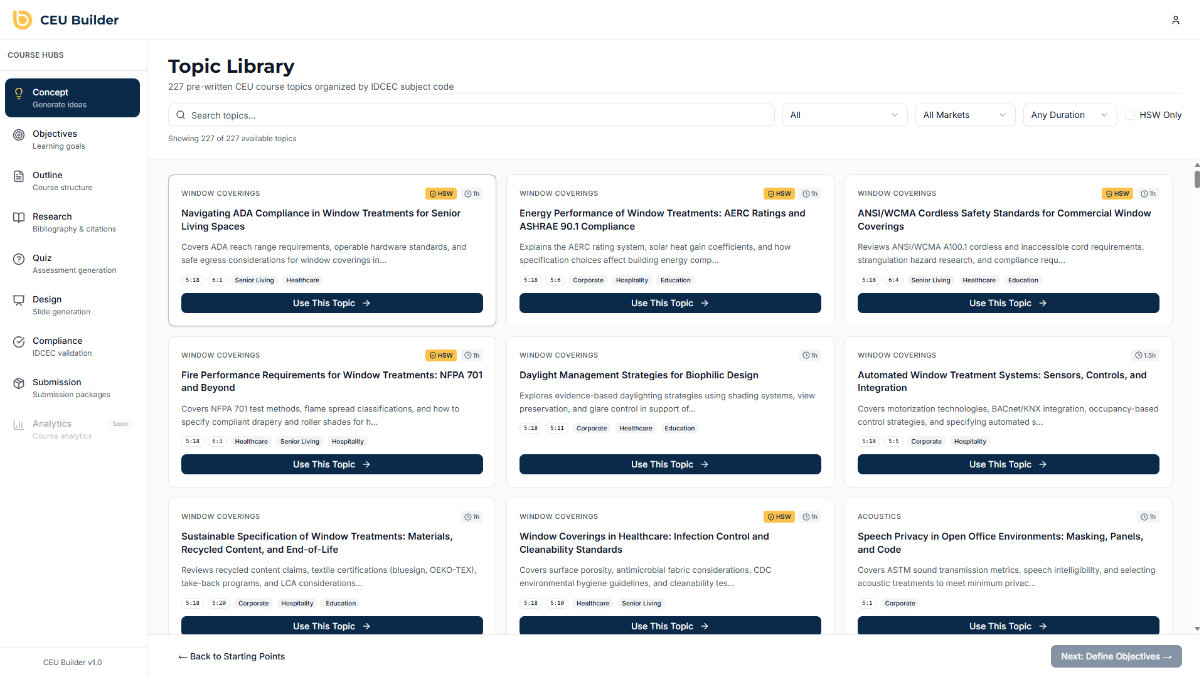
Take the first step toward ownership and efficiency — explore our platform today and start delivering accredited continuing education faster with full transparency and zero hidden fees. Discover why more manufacturers choose the provider ownership model to unlock cost savings and control in the competitive interior design industry.
Frequently Asked Questions
What are the core provider criteria for IDCEC accreditation?
To get IDCEC accreditation, your organization must meet specific core provider criteria, which include demonstrating the capacity to develop and deliver high-quality continuing education programs. Begin by assessing your educational mission and course development capabilities to ensure you align with these requirements.
How do I start the IDCEC provider registration process?
Start by accessing the IDCEC online portal and creating an account that matches your provider classification. Gather all necessary documentation about your organization, including the legal business name and contact details, to streamline the registration form completion.
What types of documents do I need to submit for course approval?
You must submit presentation slides, detailed handouts, and comprehensive notes as part of your course approval process. Ensure all materials are reviewed for compliance with IDCEC guidelines, focusing on educational integrity and avoiding promotional content.
How can I improve my chances of getting my course approved on the first submission?
Address feedback from IDCEC reviewers promptly and comprehensively by revising any deficiencies in your course materials. Create a revision tracking document that maps reviewers’ comments to specific changes in your content to demonstrate your commitment to educational excellence.
What steps should I take to track participant attendance after course approval?
Once your course is approved, set up a tracking system to monitor participant enrollment, attendance, and completion rates. Create an automated spreadsheet template that includes all necessary tracking fields, ensuring you submit attendance records within specified timeframes to maintain compliance.
How long does the IDCEC review process take after course submission?
Expect a review period of approximately three weeks after you submit your educational materials for IDCEC approval. Prepare your submissions carefully to avoid unnecessary delays and ensure a smoother approval experience.
Recommended
