

The three reasons IDCEC rejects courses (and how to eliminate all three)

You have spent weeks coordinating with your product team, your marketing department, and perhaps an outside consultant to build a brand new continuing education course. You have polished the slides, gathered the high-resolution project photography, and finally hit the submit button on the IDCEC website. Then you wait. Three weeks later, an email arrives. It is not an approval. It is a rejection notice citing "insufficient material" or "proprietary content."
For a VP of Marketing or a Sales Director at a hospitality furniture or flooring manufacturer, this is more than just a minor administrative hurdle. It is a direct blow to the quarterly sales strategy. A rejected course means your sales reps cannot book the lunch and learns they promised to their top architectural accounts. It means your competitors, who might have their accreditation already in place, are the ones getting into the library while you are stuck in a cycle of revisions.
The Interior Design Continuing Education Council (IDCEC) serves as a rigorous gatekeeper for the profession. Their job is to ensure that when a designer walks into a room to earn a credit, they are receiving an education, not a sales pitch. When a course is rejected, it is usually because the manufacturer failed to draw the line between brand promotion and industry education.
Understanding the specific mechanics of why these rejections happen is the only way to build a reliable, repeatable CEU program. If you want to move from "submission-pending" to "accredited" on the first pass, you need to eliminate these three common failure points.
The failure of documentation: why slides are not enough
The most frequent reason for a rejection is "insufficient material." Many manufacturers make the mistake of assuming that the PowerPoint deck is the course. To a reviewer at IDCEC, the slides are only half of the story. They need to see the "meat" of the presentation, which exists in the words spoken by the presenter.
When you submit a deck with beautiful imagery but very little text on the slides, the reviewer has no way of knowing what information is actually being conveyed to the designers. They cannot verify the educational value if the content is locked in the head of your sales rep. To eliminate this risk, you must provide comprehensive speaker notes for every single slide.
These notes should not be bullet points or rough outlines. They should be a near-transcript of the educational narrative. If a slide shows a diagram of a moisture barrier in a commercial flooring installation, the notes must detail the physics of moisture vapor transmission, the industry standards involved, and the specific mitigation techniques being taught.

Beyond the notes, IDCEC looks for a cohesive narrative that aligns with the stated learning objectives. If your course claims to teach about sustainable textile sourcing, but three out of the four learning objectives are barely mentioned in the slides, the course will be sent back. You need to treat the submission like an academic syllabus. Every slide should be mapped back to a specific learning objective to prove that you are delivering on the promise of the course title.
The proprietary content trap: stripping the brand to save the credit
The second reason for rejection is "proprietary content." This is often the hardest pill for marketing leaders to swallow. You are the one paying for the development of the course, you are paying the IDCEC fees, and your reps are the ones delivering the content. It feels natural to want your logo on every slide and your product names in every headline.
However, IDCEC rules are very clear: a CEU must be brand-neutral. If a reviewer sees a company logo on every page, or if the presentation focuses on why your specific brand of acoustic panel is better than the competition, they will reject it immediately. They view this as an advertisement, not education.
To eliminate this rejection reason, you must follow the "sandwich" rule. You are generally permitted to have your company name and logo on the very first slide (the introduction) and the very last slide (the Q&A or contact slide). Every slide in between must be completely devoid of brand markers. This includes:
- Product model numbers or trademarked names.
- Proprietary technology names that only exist within your company.
- Photos that prominently feature your logo on packaging or labels.
- Language that compares your brand to a competitor.
Instead of talking about your "Titan-Strong 5000 Locking System," you must talk about "mechanical locking mechanisms in luxury vinyl tile." You are teaching the category, not the product. The goal is to position your company as the subject matter expert on the category. When you provide the best education on a topic, the designers naturally look to you for the product solution, even if you did not mention your brand name for forty five minutes.
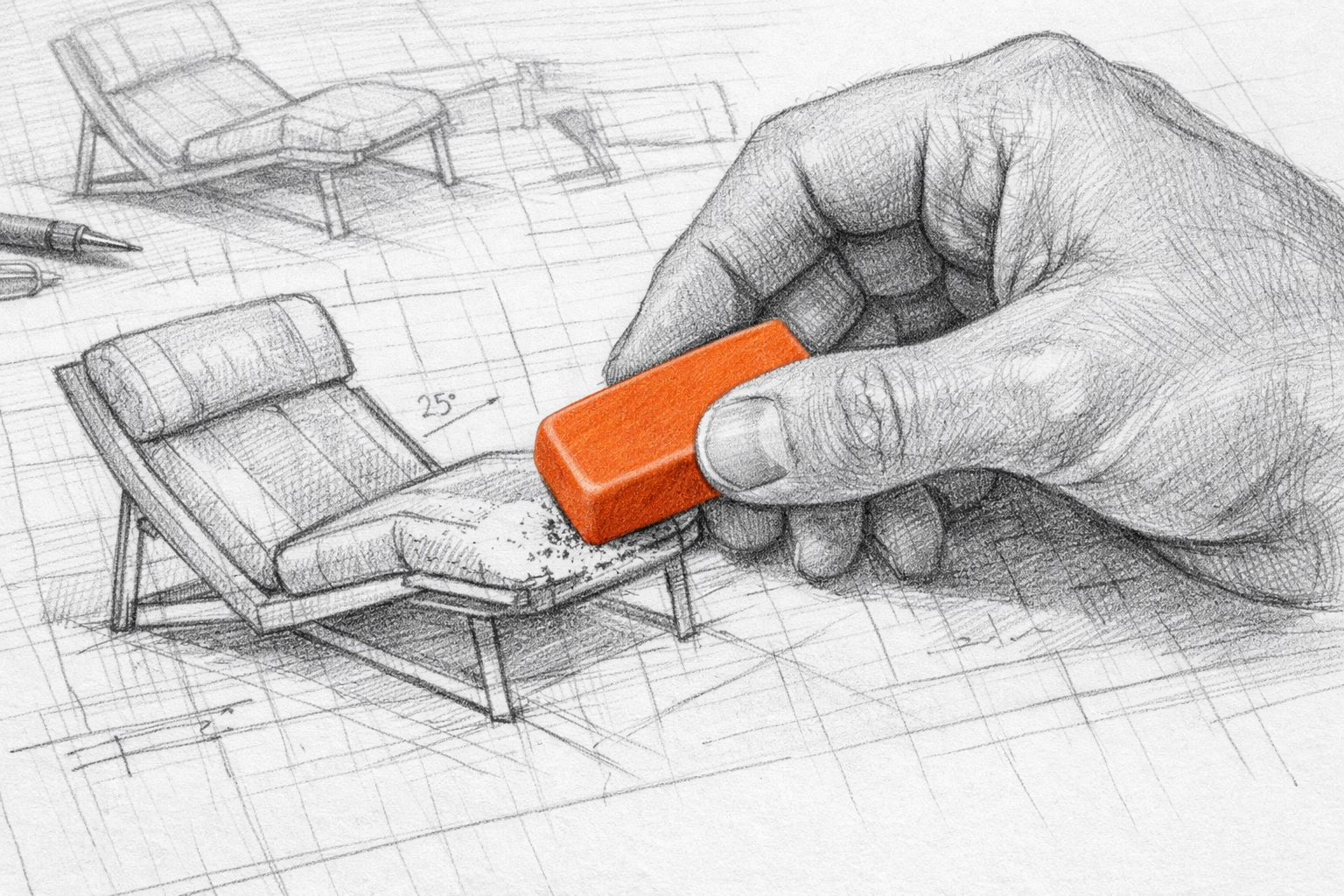
This neutrality extends to the imagery as well. While you can use your own project photography, the images should illustrate a concept rather than serve as a catalog showcase. If you are showing a chair, the discussion should be about ergonomic standards or fire safety ratings, not about the specific aesthetics of your new collection.
The missing foundation: bibliography and justification statements
The third reason for rejection involves a lack of academic or professional rigor. IDCEC requires a bibliography and a justification statement. Many manufacturers treat these as an afterthought, scribbling down a couple of website links or a brief sentence about why the topic matters. This is a mistake.
The justification statement is your opportunity to tell the reviewer why this course is essential for an interior designer's professional development. It needs to connect the topic to health, safety, and welfare (HSW) if you are seeking HSW credits, which are the most valuable credits in the industry. You need to explain the "so what." Why does a designer need to know about the molecular structure of high-performance coatings? If you cannot link that knowledge to the longevity of a project or the safety of the end-user, the reviewer will not see the value.
The bibliography is where you prove your facts. You cannot simply rely on internal company data. IDCEC wants to see that your educational content is backed by third-party, reputable sources. This could include:
- Industry standards (ANSI, BIFMA, ASTM).
- Government regulations (ADA, OSHA).
- Peer-reviewed journals or academic studies.
- Trade association white papers (IIDA, ASID, AIA).
If your course claims that a certain material reduces stress in healthcare environments, you must cite the environmental psychology study that proves it. If you claim a specific installation method is the industry standard, you must cite the relevant trade manual.

Providing a robust bibliography shows the IDCEC that you have done the work. It moves your submission from a "marketing presentation" to a "professional education module." When a reviewer sees five or six high-quality external references, their confidence in your content increases significantly.
How to systemize first-pass approval
Eliminating these three rejection reasons is not a matter of luck; it is a matter of process. Most manufacturers struggle because they view CEU creation as a one-off project that they outsource to an agency that might not understand the nuances of IDCEC's changing standards.
When you bring your CEU development in-house or use a dedicated system like CEU Builder, you can create templates that enforce these rules automatically. You can ensure that every course follows the correct slide-to-note ratio. You can set up a "brand scrub" phase where every logo is stripped from the core content. You can maintain a library of industry citations to pull into your bibliographies.
The cost of a rejection is high. Beyond the $100 to $500 re-submission fees, there is the opportunity cost of the weeks lost while your sales team waits for a valid IDCEC number. In the hospitality and commercial world, a three-week delay can be the difference between getting on a project's specification list and being left off entirely.

By focusing on high-quality speaker notes, strict brand neutrality, and evidence-based justifications, you can ensure that your courses sail through the accreditation process. This allows your marketing team to focus on strategy rather than revisions, and your sales team to focus on what they do best: building relationships with architects and designers.
Moving beyond the agency model
Many brands feel they have to pay an agency $15,000 for a single CEU course just to ensure it gets approved. These agencies often justify their high fees by claiming they have a "special relationship" with the accreditation bodies or a "secret formula" for approval. In reality, the "secret" is simply following the public guidelines that IDCEC provides.
You do not need to "rent" access to accreditation. You can own it. By understanding the three core reasons for rejection, your internal team can produce content that is more accurate, more timely, and more aligned with your product launches than any external agency could ever manage.
If you are tired of the back-and-forth with reviewers and the high costs of agency-led CEU development, it is time to look at a better way. You can build a program that generates accredited courses in days, not months. You can turn your technical product knowledge into a powerful sales tool that opens doors at the highest levels of the A&D community.

The goal is to stop being a "provider" on paper and start being an "educator" in practice. When you master the IDCEC submission process, you remove the friction between your marketing department and your sales targets. You provide your reps with a "door-opener" that is guaranteed to work, backed by the credibility of a national accreditation body.
If you are ready to take control of your CEU program and eliminate the headache of IDCEC rejections, we can help you navigate the process. Our approach is designed to get you from topic to submission-ready in a fraction of the time it takes the traditional agency route.
To learn more about how to streamline your accreditation process and build a library of high-performing CEU courses, visit ceubuilderhq.com or book a demo today. We will show you exactly how to structure your content for first-pass success every single time.
