

7 Types of CEU Courses Every Manufacturer Should Know

Over half of American building product manufacturers report increasing scrutiny over education program costs and limited access to learner data. For Marketing Directors aiming to position their brands as industry leaders, owning an IDCEC-accredited CEU program offers both cost efficiency and data control. This guide reveals how American manufacturers can take charge of their continuing education strategy by developing high-impact courses that meet professional standards and drive real influence within the architecture and design community.
Table of Contents
- 1. Introduction To CEU Courses For Manufacturers
- 2. HSW Courses: Ensuring Health, Safety, Welfare Compliance
- 3. Product-Specific CEU Courses For Interior Solutions
- 4. Design Trends And Regulatory Update Courses
- 5. Sustainability And Green Building CEU Courses
- 6. Technology Integration Courses For A&D Professionals
- 7. Sales Training Courses For Specification Success
Quick Summary
| Key Message | Explanation |
|---|---|
| 1. Develop CEU Courses to Build Brand Authority | Create Continuing Education Unit (CEU) courses to position your brand as a thought leader in the industry. |
| 2. Prioritize Health, Safety, and Welfare (HSW) Compliance | HSW courses are essential for design professionals, focusing on practices ensuring human wellbeing. |
| 3. Use Product-Specific Courses for Technical Insights | Tailor CEU courses to showcase the unique performance of specific interior products, aiding specification decisions. |
| 4. Stay Current with Design Trends and Regulations | Offer courses covering emerging design technologies and regulatory updates to keep professionals informed. |
| 5. Integrate Technology in Design Education | Incorporate digital tools and innovations into courses to enhance the design processes and decision-making. |
1. Introduction to CEU Courses for Manufacturers
Continuing Education Unit (CEU) courses represent a strategic opportunity for building product manufacturers to establish thought leadership and drive specification through targeted educational content. These specialized learning programs go far beyond simple marketing materials by providing architects and designers with valuable professional development credits while simultaneously positioning your brand as an industry expert.
At their core, CEU courses are structured learning experiences designed to help professionals maintain and enhance their professional credentials. For manufacturers in the hospitality and commercial interior design sectors, these courses serve as a powerful mechanism to demonstrate technical expertise and solve real world design challenges. Manufacturers should be their own IDCEC provider rather than relying on expensive third party platforms.
Successful CEU courses typically address critical industry needs such as material performance, sustainability practices, installation techniques, and emerging design trends. They transform product knowledge into actionable educational content that helps design professionals make more informed specification decisions. By creating high quality courses, manufacturers can directly influence specification processes while providing genuine value to their target audience.
Understanding the nuanced requirements of CEU development is crucial. Courses must meet strict Interior Design Continuing Education Council (IDCEC) standards including Health Safety and Welfare (HSW) compliance, precise learning objectives, and professional presentation standards. These requirements ensure that courses deliver meaningful educational experiences rather than serving as thinly disguised sales pitches.
Key Elements of Effective CEU Courses:
- Demonstrate clear learning objectives
- Provide technically accurate information
- Address real world design challenges
- Include interactive learning components
- Align with professional development requirements
Pro tip: Focus on solving actual design challenges instead of promoting specific product features to create truly valuable educational content.
2. HSW Courses: Ensuring Health, Safety, Welfare Compliance
Health Safety and Welfare (HSW) courses represent a critical category of continuing education that goes beyond standard product training by focusing on professional practices that directly impact human wellbeing. These specialized courses address fundamental design considerations that protect human health, ensure workplace safety, and promote overall welfare for building occupants.
HSW credits are mandatory for design professionals seeking to maintain their professional credentials and demonstrate commitment to responsible design practices. Understanding HSW versus general credits helps manufacturers create more targeted and compelling educational content for architects and designers.
Successful HSW courses must comprehensively explore topics that directly relate to human safety and environmental performance. These might include material toxicity, ergonomic design principles, accessibility standards, indoor air quality, sustainable building practices, and risk mitigation strategies. The primary goal is to equip design professionals with knowledge that enables them to make informed decisions that protect human health and improve built environments.
Key Components of Effective HSW Courses:
- Demonstrate clear connections to human safety
- Provide evidence based research and data
- Address current industry standards and regulations
- Include practical application strategies
- Offer verifiable learning outcomes
Compliance Considerations:
- Courses must be approved by IDCEC
- Learning objectives must explicitly address HSW topics
- Content must go beyond product specific information
- Include research from reputable sources
- Maintain objective educational approach
Pro tip: Design HSW courses that solve real world design challenges while maintaining strict educational objectivity to maximize professional credibility and learner engagement.
3. Product-Specific CEU Courses for Interior Solutions
Product-specific CEU courses represent a strategic opportunity for manufacturers to demonstrate technical expertise while providing valuable educational content to design professionals. These highly targeted courses focus on exploring the unique performance characteristics, applications, and innovative solutions associated with specific interior product categories.
Successful product-specific courses transcend simple sales presentations by offering deep technical insights that help architects and designers make more informed specification decisions. Winning course topics for hospitality manufacturers can transform technical information into compelling educational experiences that drive specification potential.
These specialized courses should comprehensively explore critical aspects of interior solutions including material performance, installation techniques, sustainability considerations, design flexibility, and long term environmental impact. The goal is to provide design professionals with nuanced understanding that goes far beyond basic product marketing narratives.
Key Elements of Effective Product-Specific Courses:
- Demonstrate technical performance capabilities
- Address real world design challenges
- Provide objective performance data
- Explore innovative application strategies
- Connect product features to design outcomes
Strategic Course Development Considerations:
- Maintain educational objectivity
- Use research backed performance data
- Include comparative analysis
- Address potential specification challenges
- Highlight unique product advantages
Pro tip: Transform technical specifications into narrative design solutions that illustrate how your product solves complex architectural challenges.
4. Design Trends and Regulatory Update Courses
Design trends and regulatory update courses represent a critical category of continuing education that helps architects and designers stay current with rapidly evolving industry standards and emerging design philosophies. These specialized courses bridge the gap between theoretical knowledge and practical implementation of cutting edge design strategies.
Regulatory update courses provide design professionals with essential insights into changing building codes, sustainability requirements, accessibility standards, and material performance specifications. Common IDCEC course rejection reasons highlight the importance of creating courses that meet stringent educational and compliance standards.
Successful design trend courses go beyond surface level aesthetic discussions by exploring deeper implications of technological innovations, material science advancements, and shifts in workplace and residential design paradigms. These courses help design professionals understand not just what is changing but why these changes matter and how they can be strategically implemented.
Key Components of Design Trend Courses:
- Explore emerging design technologies
- Analyze shifting workplace requirements
- Discuss sustainability innovations
- Examine material performance trends
- Provide forward looking perspectives
Regulatory Update Focus Areas:
- Building code modifications
- Accessibility standards
- Environmental performance requirements
- Material safety regulations
- Professional practice guidelines
Pro tip: Create courses that blend forward looking trend analysis with practical implementation strategies to maximize learner engagement and professional value.
5. Sustainability and Green Building CEU Courses
Sustainability and green building CEU courses represent a transformative approach to design education that goes beyond traditional architectural training. These specialized courses equip design professionals with critical knowledge about environmental performance, resource conservation, and holistic design strategies that minimize ecological impact.
Modern architects and interior designers increasingly recognize that sustainable design is not just an optional strategy but a fundamental requirement for responsible professional practice. Industry insights demonstrate that green building practices are rapidly becoming standard expectations across commercial and residential design sectors.
Comprehensive sustainability courses explore multifaceted approaches to environmental design including material selection, energy efficiency, waste reduction, indoor environmental quality, and lifecycle assessment methodologies. These educational experiences help design professionals understand how individual product choices and design decisions can create meaningful environmental impact.
Key Focus Areas for Sustainability Courses:
- Carbon footprint reduction strategies
- Renewable material technologies
- Energy efficient design principles
- Water conservation techniques
- Circular economy design approaches
Critical Sustainability Performance Metrics:
- Embodied carbon measurements
- Material sourcing transparency
- Waste stream minimization
- Indoor air quality standards
- Ecological regeneration potential
Pro tip: Design sustainability courses that transform abstract environmental concepts into actionable design strategies with clear measurable outcomes.
6. Technology Integration Courses for A&D Professionals
Technology integration courses represent a critical educational pathway for architecture and design professionals seeking to understand emerging digital tools and technological innovations transforming the built environment. These specialized courses bridge the gap between traditional design practices and cutting edge technological capabilities.
How to become an IDCEC provider requires understanding the evolving technological landscape that impacts design professionals. Successful technology integration courses explore digital modeling tools, computational design strategies, artificial intelligence applications, virtual reality visualization techniques, and advanced simulation technologies that enhance design decision making.
These courses help design professionals understand how technological innovations can streamline workflow processes, improve design accuracy, enhance collaboration, and create more sophisticated design solutions. By providing comprehensive insights into emerging technologies, manufacturers can position themselves as thought leaders in technological advancement.
Key Technology Integration Topics:
- Digital design modeling platforms
- Computational design strategies
- Building information modeling
- Virtual and augmented reality
- Artificial intelligence design tools
- Performance simulation technologies
Strategic Technology Learning Objectives:
- Understand emerging digital design tools
- Explore technological workflow integration
- Analyze performance simulation capabilities
- Evaluate artificial intelligence design applications
- Develop technological adoption strategies
Pro tip: Focus on practical technology demonstrations that show direct applications in design workflows rather than purely theoretical technological discussions.
7. Sales Training Courses for Specification Success
Sales training courses for specification success represent a strategic educational approach that transforms traditional product marketing into sophisticated design professional engagement. These specialized courses equip sales representatives with deep technical knowledge and communication strategies that drive meaningful architectural and design specification opportunities.
How to become an IDCEC provider requires understanding that effective sales training goes far beyond basic product presentations. Successful courses focus on developing nuanced communication skills that help sales teams understand design professional decision making processes and effectively articulate product value propositions.
These training programs bridge the critical gap between technical product knowledge and professional relationship building. By providing comprehensive insights into design professional needs, specification challenges, and communication strategies, manufacturers can create more meaningful and impactful sales interactions.
Key Sales Training Course Components:
- Design professional communication strategies
- Technical product knowledge depth
- Specification process understanding
- Relationship building techniques
- Solution oriented presentation skills
- Needs assessment methodologies
Strategic Sales Engagement Objectives:
- Develop consultative selling approaches
- Understand architectural specification workflows
- Translate technical features into design solutions
- Build trust through educational interactions
- Demonstrate genuine design problem solving capabilities
Pro tip: Create sales training courses that position your team as design problem solvers rather than traditional product pushers.
Below is a comprehensive table summarizing the main concepts, strategies, and best practices discussed in the article regarding CEU course development for manufacturers.
Take Control of Your CEU Course Strategy Today
The article “7 Types of CEU Courses Every Manufacturer Should Know” highlights the challenge many manufacturers face with long development timelines, limited control, and costly fees when relying on legacy CEU platforms. If you are ready to overcome these pain points and become your own accredited education provider, CEU Builder offers the solution you need. Our AI-powered platform simplifies creating IDCEC-approved courses in a fraction of the time and cost, empowering you with complete data ownership and transparent pricing.
Key benefits include:
- Becoming an independent IDCEC and AIA provider instead of renting space
- Reducing course development from 12-18 months to as little as 4-6 weeks
- Capturing 100% of learner data with seamless CRM integration
- Avoiding hidden fees and vendor lock-in with a price locked forever model
Stop paying six figures to legacy directories and start owning your education program on your terms. Learn how CEU Builder can turn the types of CEU courses covered in the article into specification-driving assets designed for your sales and marketing teams.
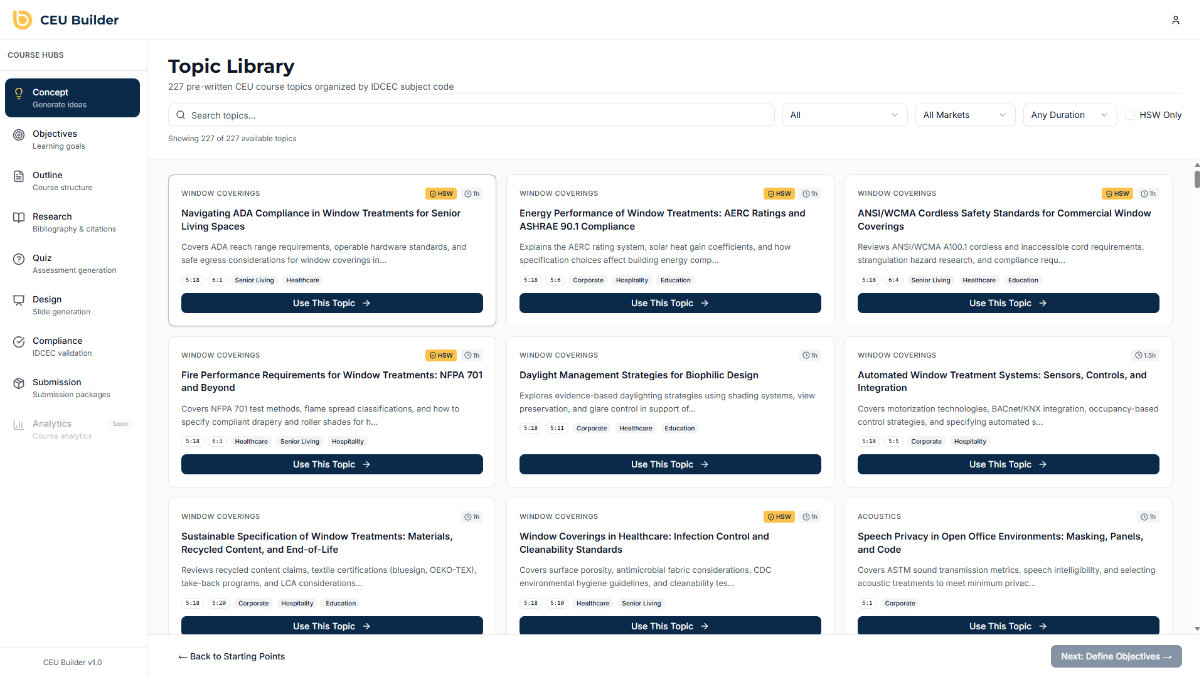
Explore the power of owning your provider status at CEU Builder and discover how to become an IDCEC provider without delay. Get started now to save time, reduce costs, and maximize your return on CEU investments.
Frequently Asked Questions
What are CEU courses for manufacturers?
CEU courses for manufacturers are structured learning programs that help industry professionals maintain their credentials and enhance their knowledge. Engage in these courses to establish your brand’s expertise and provide valuable learning opportunities for architects and designers.
How can manufacturers ensure their CEU courses meet IDCEC standards?
To ensure compliance with IDCEC standards, manufacturers must clearly define learning objectives and address topics related to Health Safety and Welfare (HSW). Regularly review and update course content to adhere to current industry regulations and best practices.
What topics should manufacturers cover in product-specific CEU courses?
Manufacturers should focus on critical aspects such as material performance, installation techniques, sustainability considerations, and design flexibility. Choose topics that not only showcase product features but also address real-world design challenges architects face.
How do sustainability CEU courses benefit manufacturers?
Sustainability CEU courses educate design professionals on environmentally friendly practices, positioning manufacturers as leaders in responsible design. Develop courses that cover topics like energy efficiency and renewable materials to appeal to modern architectural trends.
What is the importance of sales training courses for specification success?
Sales training courses help manufacturers equip their sales teams with the knowledge and skills needed to communicate effectively with design professionals. Implement training focused on relationship building and needs assessment to enhance sales interactions and drive specifications.
Recommended
