

Why Offer CEU Courses: Manufacturer Advantages

Frustration grows each time another invoice lands for continuing education, yet the cycle continues for many North American manufacturers. Managing CEU programs is not just expensive, it also limits your control over content and workforce development. For Marketing and Sales Directors aiming to maintain compliance while strengthening product expertise, understanding how to own and structure a continuing education program can provide meaningful cost savings and strategic flexibility.
Table of Contents
- CEU Courses Defined for Manufacturers
- Types of CEU Courses and Accreditation
- How CEU Courses Drive Specification Sales
- Financial Benefits of Owning CEU Programs
- Compliance, Data Control, and ROI Tracking
Key Takeaways
| Point | Details |
|---|---|
| Importance of CEUs | Continuing Education Units are essential for maintaining industry credentials and tracking professional development in manufacturing. |
| Types of Courses | Manufacturers have various CEU options, including technical skills, safety compliance, and leadership training to meet diverse workforce needs. |
| Financial Benefits | Developing in-house CEU programs can lead to cost savings, revenue generation, and improved workforce productivity. |
| Compliance and Tracking | Robust systems for tracking CEUs are crucial for regulatory compliance and measuring the ROI of educational investments. |
CEU Courses Defined for Manufacturers
Continuing Education Units (CEUs) represent structured professional development programs essential for manufacturers seeking to maintain industry credentials and workforce expertise. Nationally recognized measurement standards define CEUs as formal educational experiences that document ongoing professional learning and skill enhancement.
For manufacturers, CEUs provide a systematic approach to tracking workforce training and competency development. One CEU represents ten contact hours of participation in an approved educational program, offering a standardized method to certify professional growth. These units are critically important in regulated industries where ongoing learning demonstrates commitment to current best practices, technological advancements, and regulatory compliance.
Manufacturers can leverage CEU courses across multiple professional domains, including technical skills, safety protocols, industry standards, and specialized product knowledge. Internationally recognized educational frameworks enable companies to document employee development, validate training investments, and maintain competitive workforce capabilities. Key benefits include:
- Documenting employee skill progression
- Maintaining professional certifications
- Demonstrating commitment to continuous improvement
- Meeting industry-specific regulatory requirements
- Enhancing organizational knowledge infrastructure
Pro tip: Schedule regular internal reviews of your CEU program to ensure alignment with emerging industry standards and technological developments.
Types of CEU Courses and Accreditation
Manufacturers have diverse options for continuing education courses, ranging from technical skill development to regulatory compliance training. Worldwide accreditation standards ensure these programs maintain rigorous quality controls and provide meaningful professional development opportunities across various industry sectors.
CEU courses typically fall into several key categories that address different learning needs and professional requirements. These include live training events, self-paced online modules, interactive webinars, and blended learning programs that combine multiple instructional approaches. Professional accreditation bodies play a crucial role in validating these educational experiences, ensuring that the training meets established industry benchmarks and provides genuine skill enhancement.
The primary types of CEU courses for manufacturers include:
- Technical Skills Training: Focused on specific manufacturing technologies, equipment operation, and emerging industry techniques
- Safety and Compliance Courses: Addressing regulatory requirements, workplace safety protocols, and risk management
- Product Knowledge Programs: Detailed sessions about specialized equipment, materials, and advanced manufacturing processes
- Leadership and Management Development: Courses targeting professional skills, team management, and strategic thinking
- Industry Standards and Best Practices: Updates on current technological trends, standardization requirements, and innovative methodologies
Manufacturers should carefully evaluate accreditation sources to ensure their chosen CEU courses provide recognized and valuable professional development credentials that align with their specific industry needs and workforce requirements.
Here’s a summary of the main types of CEU courses and their ideal applications for manufacturers:
| CEU Course Type | Primary Focus | Typical Participants | Business Objective |
|---|---|---|---|
| Technical Skills | Equipment & technology training | Machine operators, engineers | Increase operational efficiency |
| Safety & Compliance | Regulatory and safety standards | Supervisors, safety managers | Reduce incidents and legal risks |
| Product Knowledge | In-depth product expertise | Sales teams, support staff | Support solution-oriented selling |
| Leadership & Management | Team skills and strategy | Supervisors, mid-level leaders | Improve organizational capability |
Pro tip: Develop a strategic CEU tracking system that documents individual employee learning progress and connects training outcomes to measurable performance improvements.
How CEU Courses Drive Specification Sales
CEU courses represent a powerful strategic tool for manufacturers to transform educational content into direct specification opportunities. Professional development strategies enable sales teams to build deep technical expertise that translates directly into increased client trust and product specification rates.

The critical connection between CEU courses and specification sales lies in their ability to position manufacturers as trusted industry experts. By delivering high-quality, technically sophisticated educational content, companies can demonstrate profound product knowledge, showcase innovative solutions, and create meaningful engagement with architects, designers, and specifying professionals. Continuing education supports professional growth that directly impacts sales performance and specification conversion rates.
Key mechanisms through which CEU courses drive specification sales include:
- Technical Credibility: Providing in-depth product and industry knowledge
- Relationship Building: Creating opportunities for meaningful professional interactions
- Problem-Solving Demonstration: Showcasing solutions to complex design challenges
- Differentiation Strategy: Highlighting unique product capabilities beyond standard marketing materials
- Consultative Selling Approach: Positioning sales representatives as trusted advisors
Successful manufacturers recognize that CEU courses are not just educational experiences, but strategic sales tools that create pathways to deeper client relationships and increased specification opportunities. By investing in high-quality, targeted continuing education programs, companies can transform traditional sales approaches into sophisticated, knowledge-driven engagement strategies.
Pro tip: Design CEU course content that directly addresses specifying professionals’ most pressing design challenges and technical requirements.
Financial Benefits of Owning CEU Programs
Manufacturers can unlock significant financial advantages by developing and owning their continuing education programs. Strategic CEU investments create multiple revenue streams and cost-saving opportunities that extend far beyond traditional training approaches, transforming education from an expense into a strategic asset.
The financial benefits of owning CEU programs are multifaceted, ranging from direct cost savings to indirect revenue generation. Tax credit opportunities enable manufacturers to offset educational investments while simultaneously improving workforce capabilities. These programs provide a sophisticated approach to talent development that directly impacts organizational performance and bottom-line results.
Key financial advantages include:
- Reduced Training Expenses: Eliminating external training vendor costs
- Potential Tax Credits: Leveraging educational investment deductions
- Revenue Generation: Monetizing proprietary course content
- Workforce Productivity: Increasing employee skill levels and performance
- Competitive Differentiation: Creating unique intellectual property
- Specification Driving: Using education as a sales and marketing tool
By strategically developing in-house CEU programs, manufacturers can transform traditional training expenditures into sophisticated investments that generate measurable financial returns. The ability to control content, delivery, and learning outcomes provides unprecedented strategic flexibility and potential for organizational growth.
Compare the financial benefits of developing in-house CEU programs versus using external training vendors:
| Criteria | In-House CEU Program | External Training Vendor |
|---|---|---|
| Cost Control | High (internal allocation) | Limited (fixed vendor fees) |
| Customization | Tailored to company needs | Standardized, less flexible |
| Intellectual Property | Proprietary materials retained | IP remains with vendor |
| Revenue Potential | Can monetize course content | No income generated |
Pro tip: Track and quantify the direct and indirect financial impacts of your CEU program to demonstrate its strategic value to leadership.
Compliance, Data Control, and ROI Tracking
Manufacturers must prioritize robust systems for tracking and managing continuing education programs to ensure regulatory compliance and strategic workforce development. Automated CEU tracking applications provide critical infrastructure for monitoring educational investments, reducing compliance risks, and generating actionable insights into workforce competency.
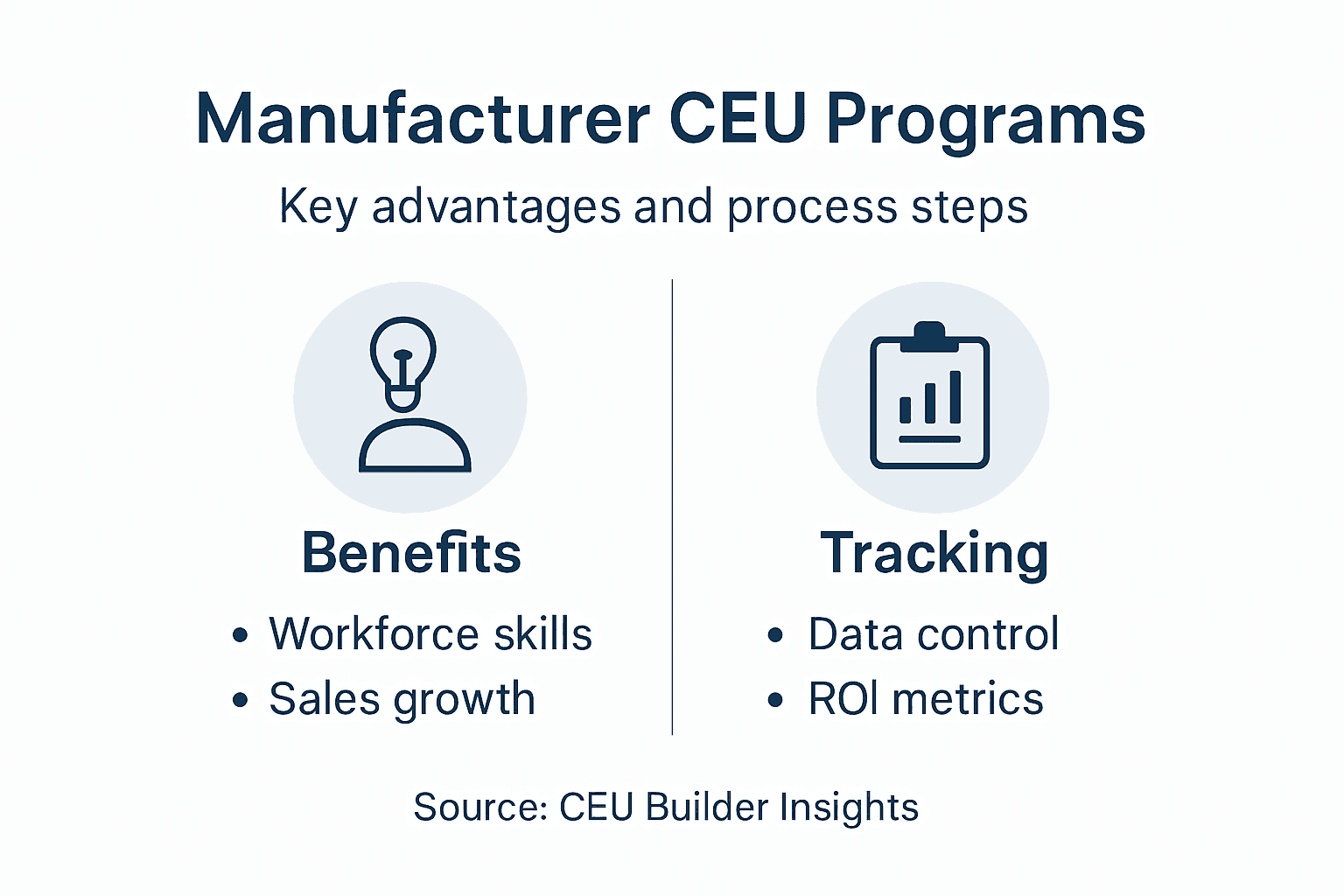
Effective compliance and ROI tracking requires a comprehensive approach that goes beyond simple record-keeping. Compliance monitoring frameworks enable manufacturers to transform educational data into strategic intelligence, identifying training effectiveness, workforce skill gaps, and potential regulatory vulnerabilities before they become significant issues.
Key elements of a comprehensive CEU tracking and compliance strategy include:
- Real-Time Data Capture: Immediate documentation of employee training activities
- Audit Trail Management: Comprehensive record-keeping for regulatory verification
- Performance Analytics: Measuring training impact on workforce capabilities
- Compliance Risk Assessment: Proactively identifying potential regulatory gaps
- Automated Reporting: Streamlined documentation for internal and external stakeholders
- Learning Outcome Tracking: Correlating training with performance improvements
By implementing sophisticated data control and ROI tracking mechanisms, manufacturers can elevate continuing education from a compliance requirement to a strategic organizational asset that drives innovation, reduces risks, and enhances overall workforce competitiveness.
Pro tip: Develop a standardized dashboard that provides leadership with clear, real-time visibility into the financial and performance impacts of your CEU programs.
Take Control of Your Manufacturer CEU Programs Today
The article highlights key challenges manufacturers face when offering CEU courses such as lack of provider ownership, limited control over learner data, costly and lengthy development timelines, and difficulty proving ROI. These pain points can leave manufacturers locked into expensive legacy platforms that treat CEU programs as administrative burdens rather than strategic assets. If you are seeking to own your education provider status, accelerate course development from 12-18 months down to weeks, and gain full control of your learner analytics and specification sales impact CEU Builder offers the solution.
Our AI-powered platform empowers manufacturers to become their own IDCEC and AIA accredited providers with transparent pricing starting at $99/month and no hidden fees. We handle compliance, course development, and data ownership so you can directly connect CEU courses to specification-driving sales strategies documented in the article. Enjoy dramatic cost savings while building a competitive advantage by controlling course content and student engagement in real time.
Unlock your CEU program’s full potential now. Discover how to own your provider status and reduce your CEU program costs by up to 95 percent. Learn more about our AI-driven course builder and explore our Done-For-You CEU course development services to get your first accredited course approved in 4-6 weeks. Stop renting your education future from legacy directory platforms and start owning it today.
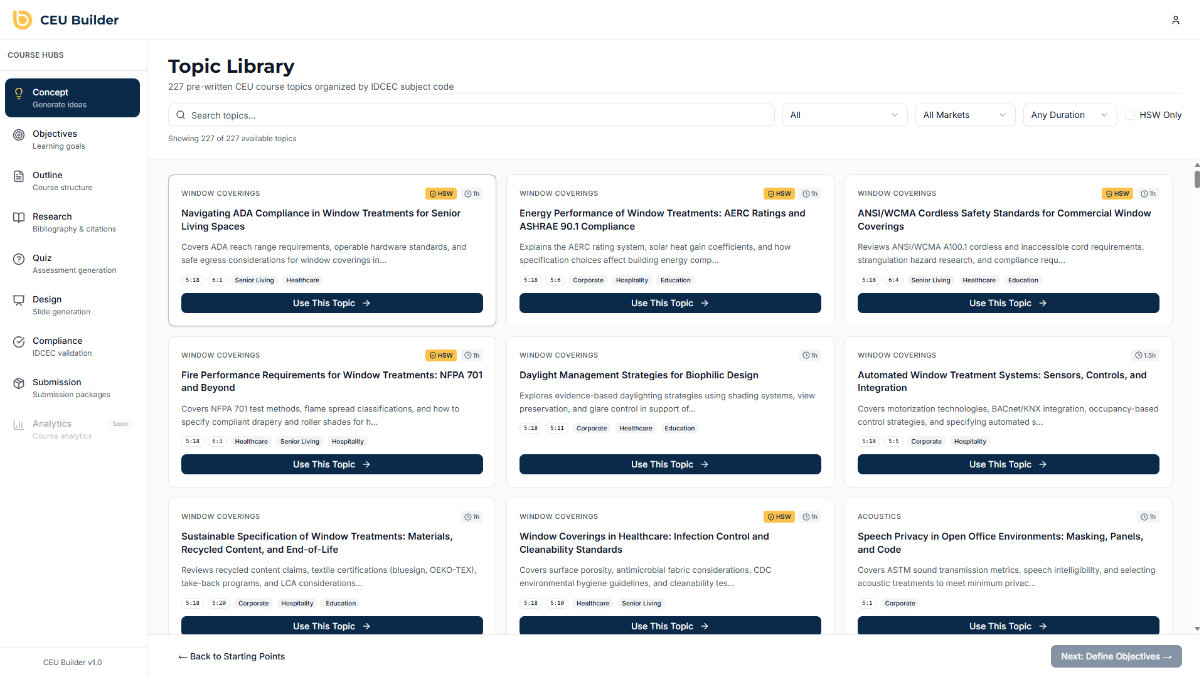
Ready to transform your continuing education strategy and sales pipeline? Visit CEU Builder and take the first step toward full provider ownership and data control now.
Frequently Asked Questions
What are CEU courses?
CEU courses, or Continuing Education Units, are structured professional development programs designed to document ongoing education and skill enhancement for professionals, including manufacturers.
Why should manufacturers offer CEU courses?
Manufacturers should offer CEU courses to enhance workforce skills, maintain industry certifications, ensure regulatory compliance, and positively impact specification sales by establishing themselves as trusted expert resources.
How do CEU courses impact workforce productivity?
CEU courses can significantly improve workforce productivity by enhancing employee skills, knowledge, and adherence to industry best practices, resulting in a more competent and efficient workforce.
What types of CEU courses are available for manufacturers?
Manufacturers can offer a variety of CEU courses, including technical skills training, safety and compliance courses, product knowledge programs, leadership development, and updates on industry standards and best practices.
Recommended
