

How a single CEU course opened 40 architect meetings in one quarter

Getting inside the room with an architect at a top tier firm is arguably the hardest task in the hospitality and commercial interiors industry. You can have the most sustainable flooring, the most innovative lighting, or the most durable textiles, but if you cannot get past the lobby, your product will never make it into the specification. For most sales teams, the standard operating procedure is a mix of cold emails, LinkedIn outreach, and the occasional drop off of samples. These methods are increasingly met with silence. Architects are busier than they have ever been, and their gatekeepers are more protective than ever.
The dynamic changes when you stop offering a product and start offering a solution to their mandatory requirements. Every licensed architect and interior designer in North America must complete a specific number of Continuing Education Units (CEUs) to maintain their professional standing. This is not a choice for them, it is a legal and professional necessity. When your sales representative calls an architect to talk about a new product line, they are a solicitor. When that same representative calls to offer an accredited IDCEC or AIA course that solves a technical challenge, they are an educator.
This shift in positioning is exactly how one manufacturer managed to book 40 high value architect meetings in a single quarter using just one new CEU course. It was not magic, and it was not a fluke. It was the result of moving away from agency dependency and taking control of their own educational content.
The friction of traditional architectural outreach
The traditional model of A&D sales relies heavily on the "lunch and learn." Historically, this was a simple transaction: the manufacturer provided food, and the architect provided 60 minutes of their time. However, the value of that 60 minutes has increased significantly while the value of a free lunch has stayed the same. Architects are no longer willing to trade an hour of billable time just for a sandwich, especially if the presentation is nothing more than a thinly veiled sales pitch.
When a marketing director at a commercial product manufacturer looks at their pipeline, they often see a bottleneck at the "initial meeting" stage. Sales reps report that they are making the calls, but they cannot get the firm to commit to a date. This is usually because the firm does not see the immediate benefit. They have projects to finish and deadlines to meet. Learning about your new color palette does not help them hit those deadlines.
The bottleneck exists because the value proposition is one sided. The manufacturer wants to sell, but the architect has no urgent reason to buy. By introducing a CEU course, you align your sales goals with their professional requirements. You are no longer asking for a favor, you are providing a service that they would otherwise have to seek out and potentially pay for themselves.
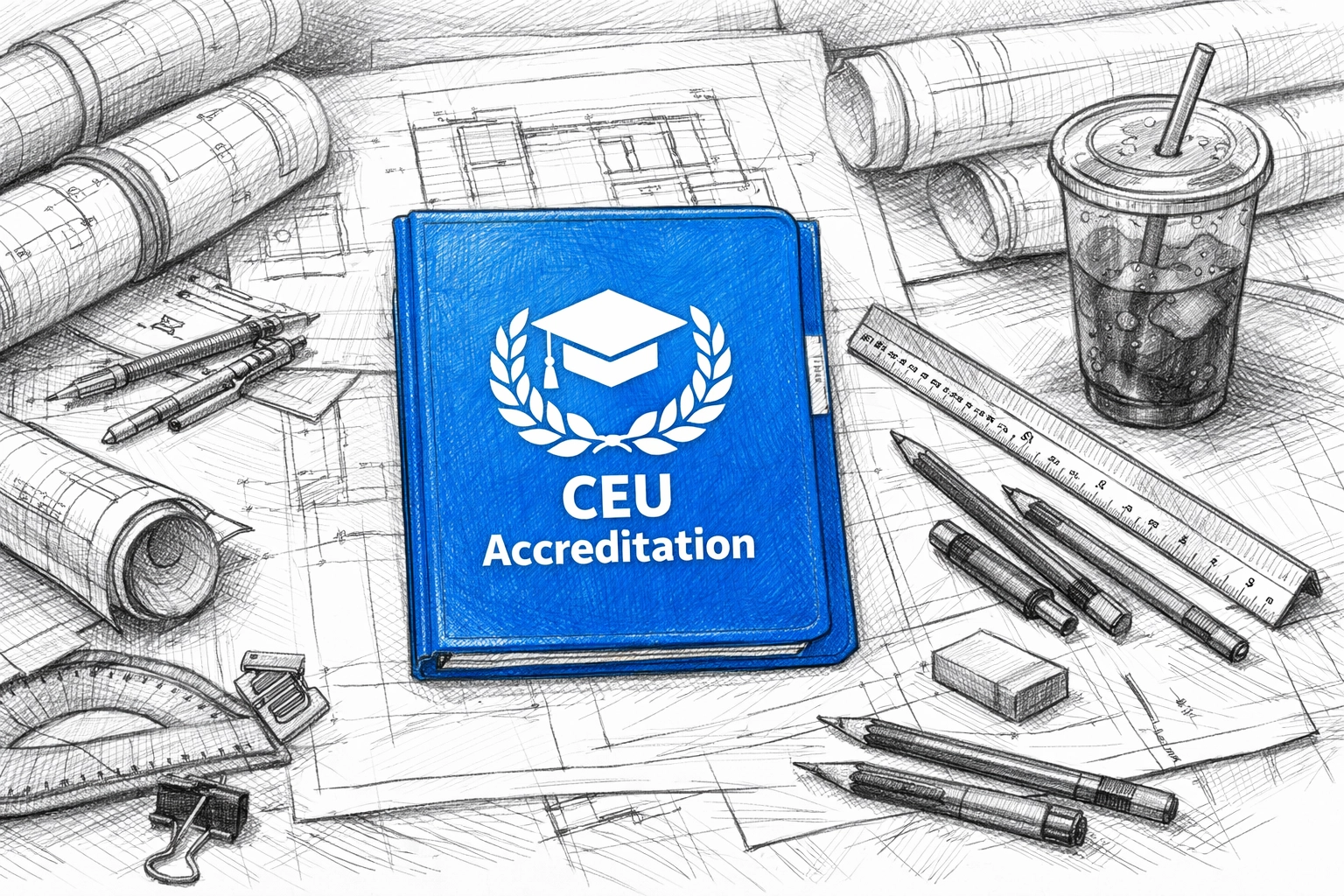
A pencil sketch in monochromatic graphite showing an architect’s desk cluttered with blueprints and a single, brightly colored CEU certificate highlighted in blue, emphasizing its importance among the workload.
The mechanics of the 40 meeting quarter
To understand how a single course generated 40 meetings, we have to look at the math and the strategy behind the rollout. In this specific case, the manufacturer had a sales team of five representatives covering different territories. Before the launch of their new CEU, these reps averaged about two firm meetings per month. Their outreach was focused on product updates and new catalog launches.
Once the new course was accredited by IDCEC and AIA, the strategy shifted. The reps stopped asking for "product presentations" and started offering a "technical briefing on moisture mitigation in hospitality environments." The shift in language was subtle but powerful.
In the first month, the outreach success rate tripled. Instead of a 5 percent response rate on emails, they saw 15 percent. Architects who had ignored the reps for over a year finally responded because they specifically needed Health, Safety, and Welfare (HSW) credits before the end of their reporting cycle. By the end of the quarter, the five reps had collectively booked 40 meetings. This averaged out to nearly three meetings per rep, per month, which was a significant increase from their previous baseline.
The beauty of this approach is that the meeting itself is the goal. Once the rep is in the room for the CEU presentation, they have the undivided attention of the design team for 60 minutes. They have established themselves as a technical expert. The product specification happens naturally as a follow up to the educational content.
Why the topic matters more than the brand
A common mistake manufacturers make is naming their CEU after their company or their product. If your course is titled "An Introduction to [Brand Name] Flooring," you have already lost. Architects see right through this. They know it is a sales pitch, and more importantly, accrediting bodies like IDCEC are likely to reject it for being too promotional.
The 40 meeting success story was built on a course that focused on a industry wide pain point. They chose a topic that was relevant to current building codes and common project failures. By focusing on "why things break" rather than "why our product is great," they gained instant credibility.
The content followed the CEU Ready Content guidelines, ensuring that the educational objectives were clear and that the material was strictly non-proprietary. This is the secret to high specification rates. When you teach an architect how to solve a problem, and your product happens to be the best tool for that solution, you do not have to "sell" them at all. They will specify your product because you have proven that you understand the technical requirements of their project.
The problem with the agency model
Most manufacturers recognize the need for CEU courses, but they believe the only way to get them is to hire an outside agency. They pay $15,000 to $40,000 per course and wait months for the final product. This creates a high barrier to entry and a slow "time to market." If you have to pay $40,000 every time you want a new door opener, you are going to be very hesitant to refresh your library.
This dependency on agencies is what keeps many sales teams stuck with outdated materials. We often see manufacturers using courses from 2021 or 2022 because they do not want to incur the expense of a new one. The problem is that architects have already seen those courses. If you call a firm and offer a course they took two years ago, the door stays shut.
To hit a goal of 40 meetings in a quarter, you need fresh, relevant content. You need to be able to react to industry trends in real time. If a new sustainability standard is released, you should be able to have a CEU course ready in weeks, not months. This is why the manufacturer in our case study moved away from the agency model and adopted a more agile approach to content creation.

A monochromatic graphite illustration of a ticking clock integrated into an architectural floor plan, with a small green accent on the "ready" phase, symbolizing the speed of in-house CEU production.
Owning the provider status
One of the biggest shifts for this manufacturer was moving from "renting" access to "owning" it. Many manufacturers use third party providers to host their courses. While this seems easy, it means you do not own the relationship with the accrediting body, and you are often paying a premium for every credit reported.
When you own your provider status, you control the narrative. You can submit as many courses as you want without paying an agency fee for every single one. This manufacturer utilized CEU Builder to streamline their internal process. They were able to take their existing product knowledge and translate it into IDCEC compliant content in a fraction of the time it would have taken an agency.
By bringing the process in-house, they reduced the cost of course creation by over 70 percent. This allowed them to create multiple "micro-courses" targeted at different design niches, further increasing their opportunities for meetings. Instead of one broad course, they had four specialized ones. This gave their sales reps four different reasons to call every firm in their territory.
How to structure a door opening CEU
If you want to replicate these results, you need to structure your course with the "Educational First" mindset. This does not mean you ignore your product, but it means you position your product as the logical conclusion to a technical argument.
The course should follow a standard logic:
- Identify a common challenge or regulation in the industry.
- Explain the technical requirements and the "why" behind them.
- Discuss various solutions and their pros and cons.
- Provide a framework for how to specify the right solution for a project.
By the time you reach step four, the design team is already looking at you as a consultant. This is the moment where the "meeting" happens. Even if the presentation is over Zoom or in a formal lunch and learn setting, the conversation that happens after the presentation is where the specifications are won.
An architectural linework sketch of a doorway opening into a bright, collaborative studio space, with a selective yellow accent on the door handle to represent the CEU as the key.
The ROI of 40 meetings
Let's look at the business case for this effort. In the commercial and hospitality interior space, a single specification can range from $50,000 to over $1,000,000 depending on the project size. If 40 meetings lead to just four new specifications (a conservative 10 percent conversion rate), the return on investment is astronomical.
The cost of developing that single CEU course using an in-house tool like CEU Builder is minimal compared to the potential revenue. Even if you factor in the time spent by the sales team and the marketing department, the "cost per meeting" is significantly lower than any other form of lead generation.
Furthermore, these 40 meetings are not just one-off events. They represent 40 new or strengthened relationships with key decision makers. Once a rep has successfully delivered a high value CEU, they are no longer a stranger. They are a trusted resource. The next time that architect has a question about a project, they are going to call the person who taught them something, not the person who sent them a cold LinkedIn message.
Speed as a competitive advantage
In the A&D world, timing is everything. If a competitor releases a new product and follows it up with a CEU course, they are going to capture the attention of the market. If you wait six months to hire an agency and get your own course approved, you have already lost the first mover advantage.
The manufacturer in our example was able to get their course from concept to "submission ready" in under a week. They did not have to wait for an agency's creative director to get back to them. They used their own internal expertise, organized it using a structured framework, and hit the market while the topic was still trending.
This speed is what allows a sales team to stay aggressive. When a rep knows they have a brand new, highly relevant course to offer, their confidence increases. They are more likely to make that extra phone call because they know they have something of genuine value to offer.

A pencil sketch of a hand holding a graphite pencil, drafting a roadmap that leads from "Product Knowledge" to "Architect Meeting," with selective red accents on the milestones.
Moving beyond the lunch and learn
While 40 meetings in a quarter is an impressive stat, the long term goal is to build a library of content that works for you 24/7. This manufacturer didn't stop at in-person presentations. They utilized their accredited content for on-demand learning as well.
By having a suite of courses, they could cater to different learning styles and schedules. Some firms preferred the traditional lunch and learn, while individual designers preferred to take the course online on their own time. In both scenarios, the manufacturer captured the lead data and the "intent" of the designer.
When someone takes your CEU course online, they are raising their hand and saying, "I am interested in this specific technical challenge." That is a much warmer lead than a random name on a mailing list. Your sales team can then follow up with a targeted message: "I saw you completed our course on acoustic design in open offices. Do you have a project right now where we can help with the calculations?"
The role of CEU Builder in your strategy
At CEU Builder, we believe that manufacturers should own their education strategy. We provide the tools and the framework to help you move away from expensive agency contracts and take control of your A&D outreach. Our platform is designed to make the accreditation process transparent and manageable, even if you have never submitted a course to IDCEC or AIA before.
We help you turn your product experts into accredited educators. This doesn't just open doors, it changes the way your entire sales organization is perceived by the market. You stop being a vendor and start being a partner in the design process.
If your sales team is struggling to get meetings, the problem probably isn't your product. It is your invitation. Stop asking for a slice of their time and start offering them the credits they need to keep their license. The results, as we have seen, can be transformative for your pipeline.
A monochromatic sketch of a modern office building with a single window illuminated in a warm orange glow, symbolizing the one firm that just booked a meeting through a CEU course.
Taking the first step toward 40 meetings
If you are ready to stop renting your access to architects and start owning it, the first step is to evaluate your current educational library. Is it up to date? Is it solving a technical problem? Is it easy for your sales reps to pitch?
You do not need a massive marketing budget or a team of 50 to see these kinds of results. You need one good course, a solid accreditation, and a sales team that understands how to lead with education. The transition from "sales rep" to "subject matter expert" is the most effective way to increase your specification rate and build long term brand loyalty in the hospitality and commercial sectors.
The data is clear. Architects need CEUs, and they prefer to get them from the manufacturers who provide the most value. By taking the process in-house, you can ensure that your content is always fresh, always relevant, and always ready to open the next door.
To see how you can start building your own door-opening CEU courses without the agency price tag, visit ceubuilderhq.com or book a demo to see our platform in action. Let’s get your sales team into the rooms where the decisions are made.
