

What is CEU Ready Content? A Guide for Hospitality Brands

A 45-minute accredited CEU course can hold an architect’s attention 9 times longer than a typical sales call. For hospitality manufacturers selling through specification, this attention advantage transforms how you engage design professionals. CEU Ready Content isn’t promotional material. It’s IDCEC-accredited education that positions your brand as expert while architects earn required licensing credits. This guide explains what makes content CEU-ready, how accreditation works, and why strategic manufacturers invest in education that drives specifications.
Table of Contents
- Introduction To CEU Ready Content
- Understanding IDCEC Accreditation And Requirements
- The Specification Problem And Opportunity In Hospitality
- The CEU Builder Difference: Methodology And Outcomes
- Business Case: ROI And Strategic Benefits Of CEU Ready Content
- Common Misconceptions And Pitfalls In CEU Content Development
- Implementation Models And Strategic Timing
- Conclusion And Next Steps For Hospitality Manufacturers
- Explore CEU Builder’s Accredited Course Development Solutions
- Frequently Asked Questions
Key takeaways
| Point | Details |
|---|---|
| CEU Ready Content is IDCEC-accredited, non-promotional education | Strictly educational material that meets IDCEC standards, not product brochures or sales pitches. |
| IDCEC accreditation requires generic content and strict compliance | Proprietary or promotional material causes instant rejection, demanding careful content strategy. |
| CEU courses uniquely engage architects for extended periods | 45-60 minute educational sessions replace brief sales interactions with sustained attention. |
| CEU Builder guarantees 100% first-pass accreditation success | Proven methodology achieves approval on first submission within 4-6 weeks. |
| Strategic CEU content delivers measurable specification ROI | Courses generate direct specification requests and architect relationships worth 10x investment. |
Introduction to CEU ready content
CEU Ready Content refers to IDCEC-accredited educational material specifically designed to fulfill continuing education requirements for architects and interior designers. Unlike promotional content that manufacturers typically produce, CEU Ready Content serves a dual purpose: satisfying mandatory licensing credits while strategically positioning your products within educational frameworks.
Architects must complete continuing education credits annually to maintain professional licensing. They actively seek quality courses that teach relevant design knowledge while fulfilling this requirement. When your manufacturing brand provides this education, you create a unique value exchange that traditional marketing cannot match.
The distinction between promotional and educational content is critical. IDCEC requires CEU course content to be generic and non-proprietary. Any promotional material results in accreditation denial. This requirement isn’t a limitation. It’s an opportunity to establish expertise through teaching rather than selling.
For hospitality manufacturers, CEU Ready Content transforms architect relationships from transactional vendor interactions into educational partnerships. You’re not pitching products. You’re teaching design principles, specification criteria, and application knowledge that architects need for their projects. Your products become the natural solution within this educational context.
CEU Ready Content characteristics include:
- Educational objectives that teach transferable knowledge
- Generic terminology avoiding brand-specific promotion
- Technical information applicable across product categories
- Assessment questions testing comprehension and application
- Bibliography supporting claims with credible sources
- Compliance with IDCEC submission standards
The content acts as both compliance tool and demand generation engine. Architects get required credits. You get 45-60 minutes of focused attention from specification decision-makers. This attention happens in a context where you’re positioned as expert rather than vendor, fundamentally shifting how architects perceive your brand when they’re selecting products months later.
Understanding IDCEC accreditation and requirements
IDCEC accreditation validates that your educational content meets professional standards for architect continuing education. The process involves submitting course materials for review against strict criteria. Understanding these requirements determines whether your investment succeeds or fails.
IDCEC requires non-proprietary content. Proprietary or promotional material causes 100% rejection. This means:
- You cannot name your specific products or brands in course content
- All terminology must use generic industry language
- Examples must be applicable beyond your product line
- Learning objectives must teach transferable skills
- Assessment questions must test knowledge, not brand recall
The accreditation submission process follows distinct stages. First, you register as an IDCEC provider, establishing your organization’s credentials. Second, you develop course content meeting all compliance requirements. Third, you submit materials including learning objectives, course outline, slide deck, exam questions, and bibliography. Fourth, IDCEC reviewers evaluate your submission against their standards.
Typical accreditation timelines span 90-180 days for traditional providers. Delays occur when submissions fail to meet requirements, forcing complete rebuilds. Each revision cycle adds 4-8 weeks. Failed accreditations waste tens of thousands in internal resource costs and delay market entry by a year or more.
Achieving first-pass approval eliminates these bottlenecks. CEU Builder maintains a 100% first-pass accreditation rate, meaning every course submitted gets approved on the first attempt. This perfect record comes from reverse-engineering IDCEC requirements and building compliance into every development stage.
Common accreditation failures include:
- Promotional language referencing specific brands
- Learning objectives that are too narrow or product-specific
- Insufficient bibliography supporting factual claims
- Exam questions testing brand recall rather than knowledge
- Content lacking educational value for practicing professionals
- Missing required documentation or incomplete submissions
Pro Tip: Before investing in course development, audit your existing content against IDCEC standards. Most manufacturer materials are too promotional for direct conversion. Plan to create genuinely educational content from scratch rather than adapting sales collateral.
The accreditation guarantee matters because it eliminates financial risk. When working with providers who ensure IDCEC approval, you know your investment will reach market. Failed accreditations don’t just delay launch. They require complete rebuilds at additional cost, making the total investment 2-3x the original budget.
The specification problem and opportunity in hospitality
Hospitality manufacturers face a fundamental challenge: architects and designers control product specifications worth billions annually, but traditional marketing approaches fail to influence their decisions effectively. CEU Ready Content addresses this problem by creating educational touchpoints that shape specification preferences before projects begin.
Architects must complete IDCEC-accredited CEU credits annually for licensing, creating steady demand for quality educational content. They actively seek courses that fulfill this requirement while teaching them about products, materials, and design approaches relevant to their work. This mandatory education creates a captive audience for manufacturers who provide valuable learning experiences.
CEU courses yield substantially longer engagement times than typical sales interactions. A 45-60 minute educational session replaces a 5-minute product pitch or brief trade show conversation. During this extended engagement, you’re teaching specification criteria, application knowledge, and design considerations that architects will reference when selecting products for future projects.

Architects prefer educational content over promotional sales pitches. They’re trained to evaluate information critically and dismiss obvious marketing. When you position yourself as educator rather than vendor, you bypass their natural skepticism. The educational context creates permission to share detailed technical information they would ignore in a sales setting.
Key specification advantages from CEU content:
- Early positioning before project specifications are determined
- Extended attention windows allowing thorough product education
- Authority positioning as industry expert rather than vendor
- Specification criteria teaching that favors your products
- Relationship depth impossible through brief sales interactions
“When an architect takes a course about acoustic performance in hospitality environments six months before starting a hotel project, that manufacturer becomes the reference point when acoustic solutions are needed.”
This timing advantage is impossible to achieve through reactive sales approaches. By the time sales reps learn about projects, specifications are often already determined. CEU courses position manufacturers before projects begin, when architects are building their knowledge base and preference structures.
The strategic opportunity lies in transforming continuing education from compliance theater into demand generation. Most architects view CEU requirements as bureaucratic obligation. When you provide genuinely valuable education that teaches them skills they can apply immediately, you create gratitude and preference that translates into specifications.
Offering CEU courses differentiates your brand in competitive markets. While competitors rely on product literature and sales calls, you’re teaching architects how to specify correctly, solve design challenges, and evaluate performance criteria. This educational positioning creates competitive moats that are difficult to replicate.
The CEU Builder difference: methodology and outcomes
CEU Builder’s approach combines reverse-engineered accreditation processes, custom GPT-powered content creation, and strategic topic selection to deliver guaranteed approval within compressed timelines. This methodology eliminates the typical challenges that make CEU development difficult for manufacturers.
The reverse-engineering approach treats IDCEC accreditation as a system to decode and operationalize rather than a bureaucratic hurdle. Analyzing successful accreditations reveals pattern requirements. Building process guardrails ensures compliance at every development stage. The result is a development process that is both faster than competitors and more reliable.
Custom GPT tools handle repeatable tasks like bibliography formatting, exam question generation, and compliance auditing. This automation eliminates human error on routine requirements while preserving strategic thinking for content that differentiates manufacturers. Seventy percent of the process is systematized. The remaining thirty percent receives focused human expertise.
Strategic topic research aligns with architect search behavior. Rather than teaching what manufacturers want to promote, CEU Builder identifies what architects actually need to learn. This research reveals content opportunities that generate high completion rates and specification results. Topics are selected based on search data, competitive gaps, and alignment with manufacturer capabilities.
Design principles engage architects while subtly positioning manufacturer specifications. Course structure follows instructional design best practices. Visual elements support learning retention. Exam questions reinforce key differentiators and application knowledge. The educational experience positions the manufacturer as industry expert and trusted resource.
CEU Builder guarantees 100% first-pass accreditation success with an average 4-6 week timeline. This compresses the traditional 90-180 day development cycle by 80-95%. Speed comes from systematized processes and technology leverage, not rushed work or quality shortcuts.
| Approach | Timeline | Approval Rate | Cost |
|---|---|---|---|
| Internal Development | 6-12 months | 30-40% first-pass | $25,000-$50,000 loaded cost |
| Generic CEU Providers | 3-6 months | 60-70% first-pass | $15,000-$25,000 per course |
| CEU Builder Done-For-You | 4-6 weeks | 100% first-pass | $10,000 per course |
| CEU Builder Platform | 8-12 weeks | 100% with support | $99/month subscription |
Pro Tip: The guaranteed accreditation process eliminates the single biggest risk in CEU development. Failed accreditations waste months and require complete rebuilds. Guaranteed approval means your investment reaches market on schedule.
The methodology difference extends beyond speed. Specification-driven course development means content is designed to drive business outcomes, not just fulfill credit requirements. Learning objectives teach specification criteria that favor your products. Exam questions reinforce key differentiators. The entire educational experience positions you strategically for future specifications.
Business case: ROI and strategic benefits of CEU ready content
The financial justification for CEU Ready Content is straightforward: courses generate measurable specification outcomes that return multiples of the initial investment. Understanding this ROI helps manufacturers make informed decisions about educational content development.
A single $10,000 course generating 200 architect completions in year one creates 200 touchpoints with specification-capable decision-makers. If just 2% of those architects specify your products into projects, that’s 4 specifications. In hospitality projects where product packages often exceed $100,000, a single specification often returns 10x the course investment.
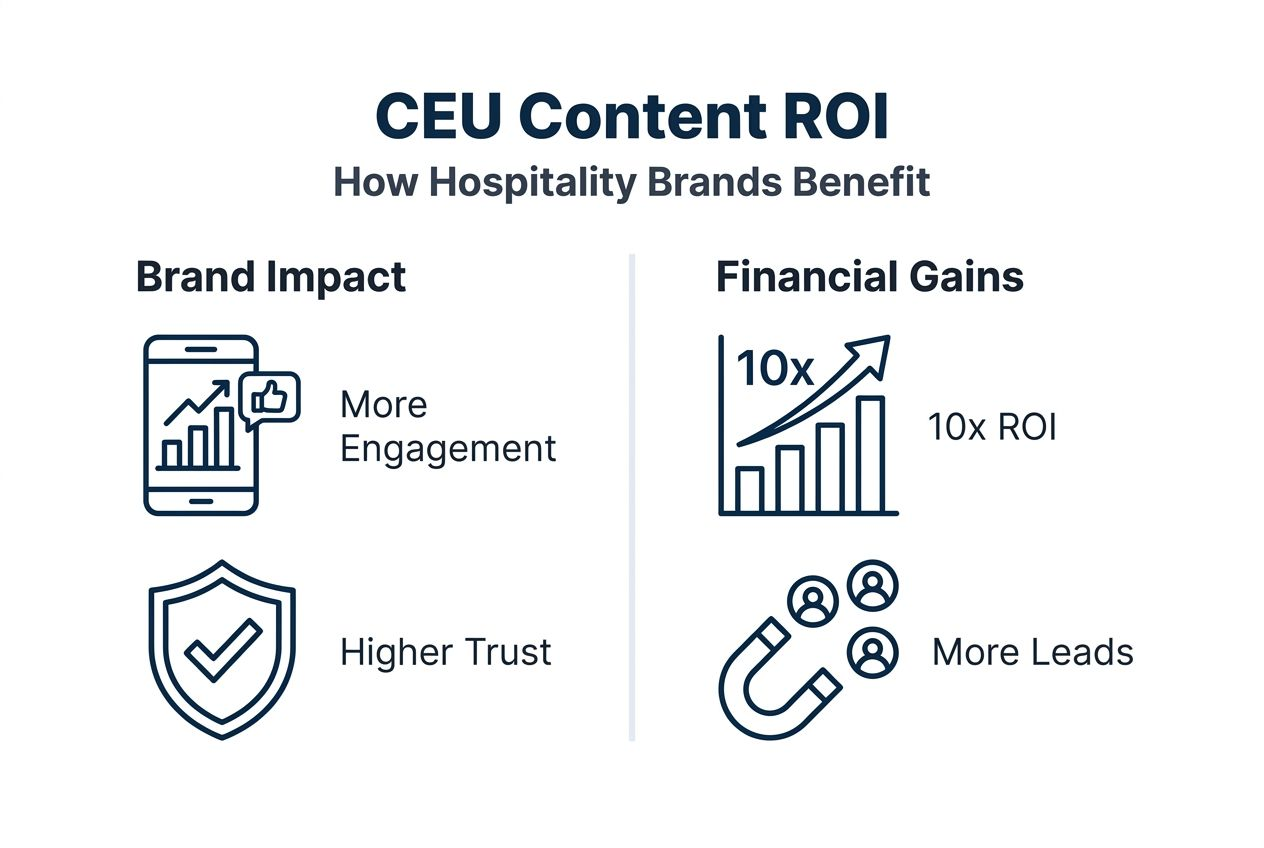
IDCEC CEU courses yield a 10x return on investment for hospitality brands through specification influence. This ROI comes from direct specification requests, sales conversations referencing course content, and lead quality improvements because architects self-identify interest through course selection.
The math improves over time because courses have indefinite shelf lives. A course built in 2026 continues generating completions and specifications in 2027, 2028, and beyond with no additional development cost. Platform access is lifetime. The initial investment creates perpetual lead generation infrastructure.
Compare CEU content investment to traditional marketing:
- Trade show booths: $30,000-$50,000 annually for premium positioning
- Print advertising: $5,000-$15,000 per placement with no tracking
- Field sales calls: $200-$500 per meeting in loaded cost
- Digital advertising: $3-$8 per click with 2-3% conversion rates
These approaches generate brief attention moments rather than extended educational engagement. CEU courses create 45-60 minute interactions where you’re positioned as expert, not vendor. This fundamental difference drives superior specification outcomes.
Strategic benefits beyond immediate ROI:
- Educational authority that’s difficult for competitors to overcome
- Specification preference from architects who learned from your courses
- Sales efficiency when prospects already understand your value proposition
- Data advantage revealing which architects are interested in which topics
- Market positioning as the manufacturer with comprehensive education portfolio
Manufacturers who build comprehensive CEU libraries create competitive advantages that compound over time. Each course adds to your educational footprint. Multiple courses covering different topics create multiple specification touchpoints. A portfolio of 3-5 courses positions you as the go-to educational resource in your category.
The evergreen nature of educational content means ROI from CEU content improves annually. Year one generates initial completions and specifications. Year two adds new completions without new development cost. By year three, the cumulative specification impact far exceeds the original investment.
Common misconceptions and pitfalls in CEU content development
Hospitality manufacturers often hold false beliefs about CEU content that lead to failed accreditations or limited business impact. Understanding these misconceptions helps you avoid costly mistakes and maximize your educational content investment.
The most dangerous misconception is believing any CEU content will generate specification leads. Generic courses that meet IDCEC requirements but fail to address actual architect needs generate minimal business impact. The content gets accredited but doesn’t engage architects or position your products effectively.
Another common pitfall involves including proprietary or promotional content. Manufacturers naturally want to showcase their products. IDCEC standards prohibit this. Any brand names, product-specific features, or promotional language causes accreditation denial. The entire course must be rebuilt with generic terminology, wasting months of development time.
Underestimating complexity and timeline involved in internal course development leads to budget overruns and missed deadlines. Marketing teams lacking instructional design expertise spend 6-12 months developing content that IDCEC rejects during review. The failed attempt wastes tens of thousands in internal resource costs.
Financial and opportunity costs of delayed or failed accreditations compound over time:
- 6-month delay means 6 months of lost specification opportunities
- Failed submission requires complete rebuild, doubling development cost
- Competitors who launch first establish educational authority
- Internal resources remain tied to project instead of other priorities
- Market timing advantages disappear as industry conditions change
“The difference between a course that gets approved and one that gets rejected often comes down to subtle language choices and structural decisions that non-experts miss. Specialized expertise matters.”
Why specialized expertise and strategic content design are critical for success: IDCEC reviewers evaluate hundreds of submissions. They recognize patterns indicating promotional intent even when manufacturers believe their content is educational. Professional instructional designers understand how to structure content that teaches effectively while positioning products subtly within educational frameworks.
The pitfall of treating CEU development as a marketing project rather than an educational product creates fundamental misalignment. Marketing teams optimize for brand visibility and product promotion. Educational content requires optimizing for learning outcomes and knowledge transfer. These goals often conflict. CEU content quality and accreditation depends on prioritizing education over promotion.
Another misconception involves believing one course is sufficient. A single course provides limited specification touchpoints and minimal competitive differentiation. Comprehensive educational portfolios with 3-5 courses covering different topics create multiple engagement opportunities and establish genuine educational authority.
Implementation models and strategic timing
Hospitality manufacturers can choose between done-for-you service or platform-based DIY development depending on internal resources, timeline requirements, and strategic priorities. Understanding both models helps you select the approach that maximizes results for your situation.
Done-for-you CEU Builder service delivers complete course development from strategy through IDCEC approval. Timeline is 4-6 weeks from kickoff to accreditation. Cost is $10,000 per course with 100% approval guarantee. This model works for manufacturers wanting immediate results without internal resource allocation. Your only role is reviewing content before launch.
Platform plus AI plus training subscription provides tools and guidance for internal teams to build courses themselves. Timeline is 8-12 weeks for course completion. Cost is $99 per month with unlimited course creation capacity. This model serves manufacturers with dedicated marketing teams who understand their products deeply and want to maintain creative control.
| Factor | Done-For-You | Platform + Training |
|---|---|---|
| Timeline | 4-6 weeks | 8-12 weeks |
| Investment | $10,000 per course | $99/month |
| Internal Resources | Minimal (review only) | Significant (content creation) |
| Creative Control | Collaborative | Complete |
| Best For | Fast market entry | Multiple course programs |
Aligning educational intervention timing with hospitality design project phases maximizes impact. Architects research and learn continuously, not just when active on projects. CEU courses taken 3-6 months before project kickoff position your brand as the reference point when specifications are determined. This timing advantage is impossible to achieve through reactive sales.
Benefits of multi-course strategies:
- Create comprehensive educational presence across product categories
- Multiple touchpoints with architect audiences increase specification probability
- Portfolio depth signals market leadership and educational commitment
- Different courses appeal to different architect interests and project types
- Competitive moat becomes harder to replicate as course library grows
Strategic timing considerations for course launches:
- Align with industry trade shows to maximize promotional opportunities
- Launch before peak specification season in your product category
- Coordinate with product launches to educate market on new applications
- Schedule releases quarterly to maintain consistent architect engagement
Pro Tip: Start with one course focused on your strongest product category or most common architect challenge. Use completion data and specification results to validate ROI. Then expand into multi-course series covering adjacent topics. This phased approach minimizes initial risk while building toward comprehensive educational portfolio.
The platform model becomes increasingly economical as you build multiple courses. A manufacturer creating 5 courses over 12 months through the platform invests roughly $1,200 in subscription costs versus $50,000 for five done-for-you courses. The tradeoff is internal resource commitment and longer timelines.
Creating CEU courses through either model requires understanding your architect audience deeply. Topic selection based on search data and educational needs drives completion rates. Content that teaches genuinely valuable skills drives specification outcomes. The implementation model matters less than strategic content alignment with architect priorities.
Conclusion and next steps for hospitality manufacturers
CEU Ready Content transforms architect engagement from transactional selling into educational partnership. The strategic advantage comes from positioning your brand as expert before specifications are determined, creating preference through teaching rather than promotion.
Successful CEU programs follow these principles:
- Align CEU strategy with architect search behavior and educational needs rather than manufacturer promotional goals
- Choose development models fitting internal resources and timeline requirements without compromising content quality
- Leverage IDCEC accreditation to transform CEU from compliance into demand generation channel
- Start with strategic topic research identifying what architects actually need to learn
- Use data-driven engagement metrics to optimize content and justify ongoing investments
The manufacturers who win specification battles in 2026 and beyond are those who educate architects rather than pitch them. CEU Ready Content provides the framework, accreditation, and strategic positioning to make this shift. Your next step is determining whether done-for-you service or platform development fits your organization’s capabilities and goals.
Begin by auditing your current architect engagement strategy. Calculate how much you invest in traditional marketing generating brief attention moments. Compare this to educational content investment generating 45-60 minute expert positioning. The math favors CEU development for manufacturers selling through specification.
Explore continuing education importance and compliance requirements to understand the full landscape. Then commit to strategic educational content that positions your brand as the authority architects trust when specifying products for hospitality projects.
Explore CEU Builder’s accredited course development solutions
Ready to transform architect engagement through strategic CEU content? CEU Builder offers done-for-you service and platform options ensuring guaranteed 100% first-pass IDCEC accreditation within 4-6 weeks. Our reverse-engineered methodology eliminates the typical failures and delays that waste manufacturer resources.
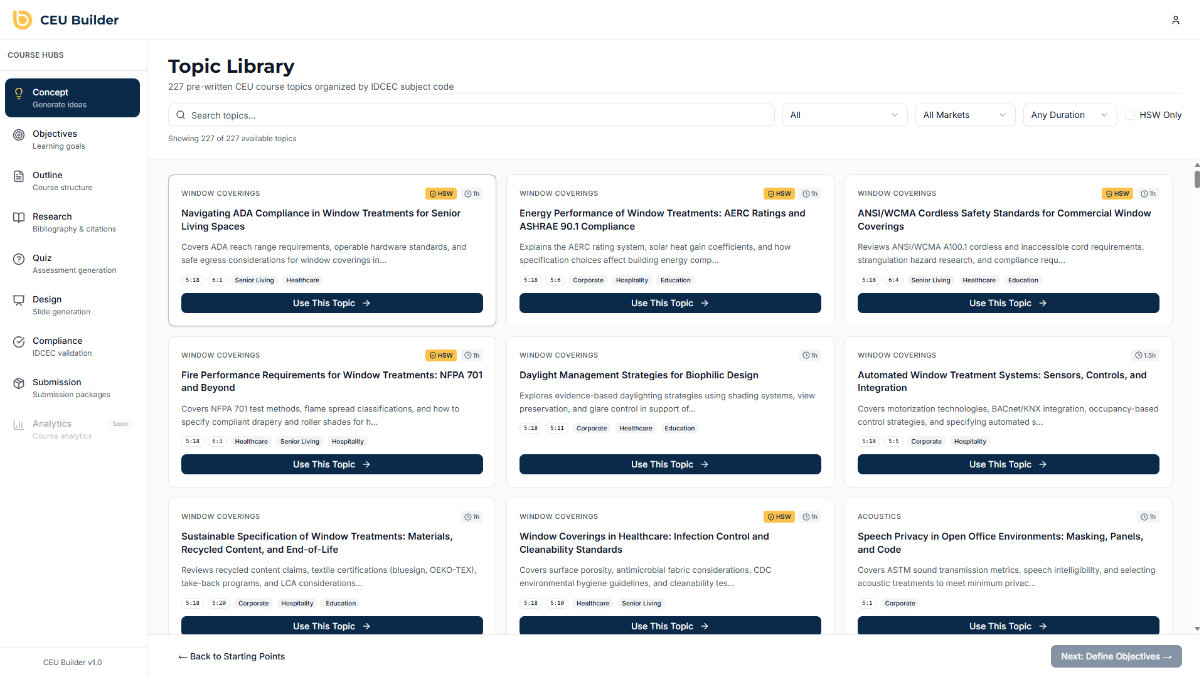
We specialize exclusively in hospitality manufacturers, understanding your products, markets, and architect audiences deeply. Our courses are designed to drive specifications, not just fulfill credit requirements. From strategic topic research through final approval, we handle complexity so you can focus on business outcomes. IDCEC CEU courses deliver 10x ROI through measurable specification growth. Visit CEU Builder to explore how creating CEU courses positions your brand as the educational authority architects trust.
Frequently asked questions
What exactly is CEU Ready Content for hospitality manufacturers?
CEU Ready Content is IDCEC-accredited educational material designed to fulfill architect continuing education requirements while strategically positioning your products. It must be generic, non-promotional, and genuinely educational to achieve accreditation.
How does non-proprietary content influence accreditation success?
IDCEC requires all content to use generic industry terminology without brand names or product-specific promotion. Proprietary language causes instant rejection. Non-proprietary content that teaches transferable skills while subtly positioning specification criteria achieves approval.
What are realistic timelines and costs for developing CEU courses?
Done-for-you service takes 4-6 weeks at $10,000 per course with guaranteed approval. Platform development takes 8-12 weeks at $99 monthly with internal resource commitment. Traditional in-house development often takes 6-12 months and costs $25,000-$50,000 in loaded costs.
How does CEU content drive specifications beyond compliance?
CEU courses create 45-60 minute educational interactions where you’re positioned as expert, not vendor. Architects who learn specification criteria from your courses naturally prefer your products when selecting materials for future projects months later.
What’s the difference between done-for-you and platform CEU development?
Done-for-you service handles everything from strategy through IDCEC approval with minimal client involvement in 4-6 weeks. Platform model provides tools and training for internal teams to build courses themselves over 8-12 weeks with complete creative control.
Recommended
- How to Create CEU Courses for Hospitality Brands
- How to Offer CEU Courses for Hospitality Manufacturers
- Continuing Education Compliance Workflow for Hospitality Brands
- Own CE Content: 100% IDCEC Approval & 10x ROI Boost
- A Travel Pillow for Business Owners – Rest Well, Look Sharp, Win More.– BOLSTIE TRAVEL PILLOW
