

What is a CEU provider? IDCEC accreditation guide 2026

Most hospitality manufacturers assume CEU providers are generic education vendors who rubber stamp courses for compliance. This misunderstanding costs companies millions in lost specifications. A CEU provider under IDCEC is actually a strategic registration that authorizes your company to develop, submit, and deliver accredited courses that position your products as the preferred specification choice. Understanding provider mechanics, registration types, and operational requirements determines whether your educational content drives revenue or sits unused. This guide clarifies what CEU providers are, how they function within IDCEC’s system, and why this designation matters for product managers developing courses that influence architect and designer decisions.
Table of Contents
- Key takeaways
- What is an IDCEC CEU provider?
- Types of IDCEC CEU providers and registration details
- How CEU providers manage continuing education courses and credits
- Why hospitality manufacturers benefit from becoming IDCEC CEU providers
- How CEU Builder supports your IDCEC provider journey
- Frequently asked questions
Key Takeaways
| Point | Details |
|---|---|
| CEU provider definition | A CEU provider is an organization or individual registered with IDCEC to develop, submit, and deliver accredited courses that award CEUs to interior designers. |
| Provider types and fees | IDCEC offers three categories including individual corporate and preferred with varying annual fees and submission benefits with corporate at 420 annually and preferred at 6000 annually with unlimited submissions and ASID partners receiving discounts. |
| Course approval process | IDCEC evaluators review content for clear learning objectives appropriate depth and accuracy to determine approval and CEU issuance. |
| Strategic value of registration | Registration creates the infrastructure for perpetual lead generation through educational content and aligns product teams with designer decision makers. |
What is an IDCEC CEU provider?
A CEU provider is an organization or individual registered with IDCEC to develop, submit, and have approved continuing education courses that award CEUs to interior designers. IDCEC operates as the central registry managing provider credentials and course approvals for the interior design profession. Without provider registration, you cannot submit courses for accreditation or issue recognized continuing education credits.
Three distinct provider categories exist within IDCEC’s system. Individual providers suit single educators or consultants offering limited course catalogs. Corporate providers accommodate companies developing multiple courses across product lines or application categories. Preferred providers pay premium fees for unlimited course submissions and enhanced benefits. Each category carries different annual fees, submission costs, and administrative requirements.
The provider registration authorizes specific actions within IDCEC’s framework:
- Submitting course content for accreditation review
- Receiving approval to award CEUs upon successful evaluation
- Reporting learner attendance and completion data
- Maintaining transcripts and compliance records
- Accessing IDCEC’s provider portal and tracking systems
Once registered, providers develop courses meeting IDCEC’s educational standards. Content must demonstrate clear learning objectives, appropriate depth for professional audiences, and accurate technical information. Courses undergo review by IDCEC evaluators who assess instructional quality, content accuracy, and compliance with continuing education standards. Approval grants authority to issue CEUs that count toward designers’ annual requirements.
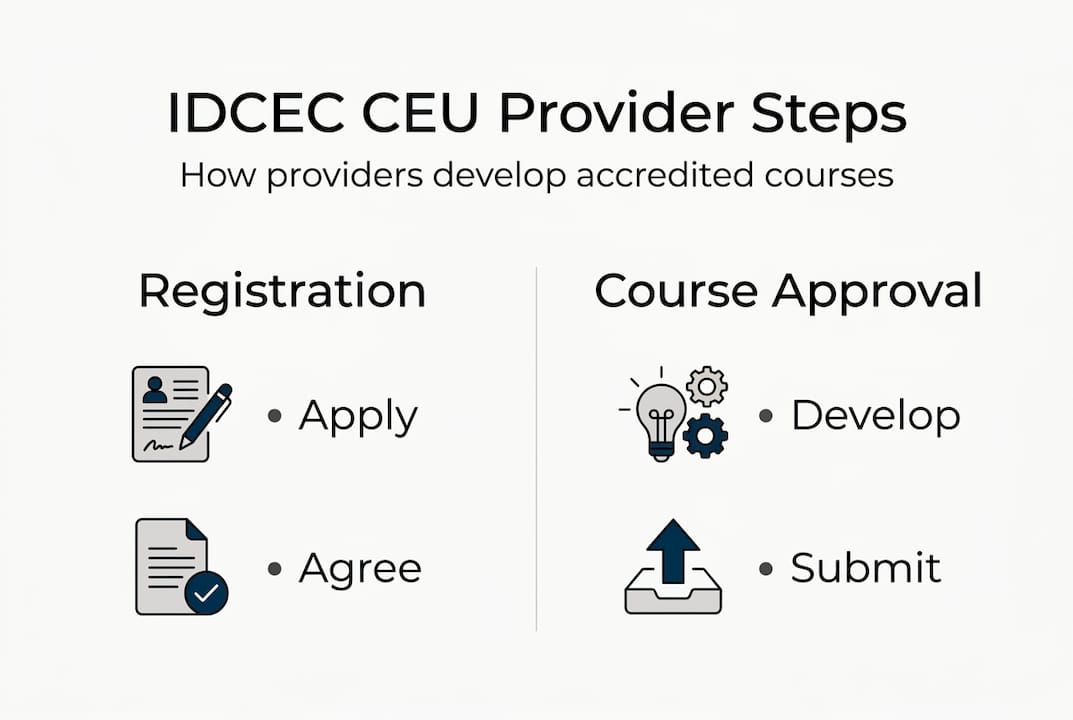
Provider status creates the legal and operational foundation for educational programs. Manufacturers cannot simply create content and claim it offers continuing education credits. The provider registration establishes accountability, ensures quality standards, and maintains the integrity of credits earned by design professionals. This structure protects both learners and the profession from substandard educational offerings.
For hospitality manufacturers, provider registration represents the first step toward getting IDCEC approval for your CEU course. The registration itself costs less than a single trade show booth, yet creates infrastructure for perpetual lead generation through educational content. Understanding provider mechanics helps marketing teams budget accurately and set realistic timelines for course launches.
Types of IDCEC CEU providers and registration details
IDCEC provider types include individual, corporate, and preferred with distinct fee structures and operational benefits. Corporate providers pay $420 annually, suitable for most manufacturing companies developing strategic course libraries. Preferred providers pay $6,000 yearly but eliminate per-course submission fees, making this tier economical for organizations planning comprehensive educational portfolios. ASID partners receive fee discounts at corporate and preferred levels, reducing costs for companies already engaged with design professional associations.
The fee structure includes two components: annual provider registration and per-course submission fees. Individual providers pay lower annual fees but face per-course charges that accumulate quickly with multiple submissions. Corporate providers balance moderate annual costs with reasonable per-course fees. Preferred providers pay high upfront fees but submit unlimited courses without additional charges. This creates a breakeven calculation based on anticipated course volume.
| Provider Type | Annual Fee | Per-Course Fee | Best For |
|---|---|---|---|
| Individual | Lower | Per submission | Single educators, consultants |
| Corporate | $420 | Per submission | Most manufacturers, 1-5 courses/year |
| Preferred | $6,000 | $0 | High-volume programs, 6+ courses/year |
| ASID Partner | Discounted | Discounted | Companies with existing ASID relationships |
Corporate provider status suits hospitality manufacturers launching initial CEU programs. The $420 annual fee plus submission costs for 2-3 courses totals less than $2,000 in registration expenses. This investment creates the infrastructure to deliver accredited education while testing course topics and measuring specification impact. Companies can upgrade to preferred status once they validate ROI and commit to larger course libraries.

Preferred provider designation makes financial sense when course volume exceeds six submissions annually. At that threshold, the elimination of per-course fees offsets the higher annual cost. Manufacturers building comprehensive educational portfolios across multiple product categories benefit from preferred status. The unlimited submission structure encourages experimentation with diverse topics without incremental cost penalties.
ASID partnership discounts reduce barriers for companies already engaged with design professional communities. These relationships often exist through trade show participation, sponsorships, or industry involvement. Leveraging existing partnerships for provider fee reductions improves program economics while strengthening connections with design professional organizations.
Registration requirements include basic organizational information, contact details for course administrators, and agreement to IDCEC’s provider standards. The application process takes 2-4 weeks for approval. Once registered, providers access the submission portal, compliance resources, and reporting systems. This infrastructure supports the step by step accreditation guide for IDCEC providers that streamlines course development.
Pro Tip: Calculate your breakeven point by dividing the preferred provider annual fee by your per-course submission cost under corporate status. If you plan more courses than this breakeven number, preferred status saves money while enabling aggressive educational content strategies.
Provider type selection impacts speed to market and program scalability. Corporate status enables rapid launch with minimal upfront investment. Preferred status supports ambitious multi-course strategies without cost constraints limiting topic exploration. Understanding these distinctions helps product managers align provider registration with business objectives and continuing education compliance requirements.
How CEU providers manage continuing education courses and credits
Providers develop course content addressing specific learning objectives aligned with design professional needs. Content creation involves instructional design, technical accuracy verification, and compliance with IDCEC standards. Once developed, courses undergo submission through IDCEC’s portal where evaluators assess educational quality, content depth, and appropriateness for continuing education credit.
Approved courses enter the provider’s active catalog, available for delivery to design professionals seeking required credits. Course formats include live presentations, webinars, self-paced online modules, and on-demand video content. Each format requires different delivery infrastructure but awards identical CEU credits upon completion. Providers choose formats based on audience preferences, content complexity, and operational capacity.
Attendance reporting validates credit awards and maintains system integrity. Providers report attendance data to IDCEC after each course delivery. This reporting confirms which learners completed requirements and earned credits. Learners can self-report attendance through IDCEC’s systems or use mobile apps with QR code scanning for automated tracking. The dual reporting approach creates redundancy ensuring accurate credit records.
Credit tracking happens at three levels:
- Provider Level: Course completion records, attendance rosters, certificate issuance
- IDCEC Level: Central transcript maintenance, credit validation, compliance monitoring
- Learner Level: Personal transcript access, credit verification for licensing boards
This three-tier system ensures accountability while giving learners control over their continuing education records. Design professionals access transcripts proving credit completion when renewing licenses or demonstrating professional development. The centralized tracking eliminates disputes about credit validity or completion status.
Providers maintain detailed records supporting reported attendance. Documentation includes sign-in sheets for live events, completion data from learning management systems, and exam results for courses requiring knowledge assessment. These records must be available for audit if IDCEC or licensing boards question credit validity. Proper record-keeping protects both providers and learners from compliance issues.
Certificate generation represents the final operational step. Upon completion, providers issue certificates documenting course title, credit hours, completion date, and provider information. Certificates serve as immediate proof of completion while official transcripts update in IDCEC’s central system. Professional-quality certificates enhance perceived value and encourage course completion.
The operational workflow creates a continuous cycle: course development, IDCEC approval, learner enrollment, delivery, attendance reporting, certificate issuance, and transcript updating. Efficient providers systematize this workflow using learning management systems, automated reporting tools, and templated certificates. These systems reduce administrative burden while maintaining compliance with IDCEC requirements.
Pro Tip: Implement automated attendance reporting integrated with your learning management system. Manual reporting creates errors and delays that frustrate learners waiting for credit confirmation. Automation ensures immediate transcript updates, improving learner satisfaction and program reputation.
Operational excellence in credit management builds provider credibility. Design professionals remember providers whose courses appear quickly in transcripts and whose certificates arrive promptly. This operational reliability encourages repeat enrollment and word-of-mouth recommendations. The continuing education checklist for IDCEC courses helps providers maintain consistent operational standards across all course deliveries.
Why hospitality manufacturers benefit from becoming IDCEC CEU providers
CEU courses educate designers on products, codes, and application benefits, directly influencing specification decisions worth millions in project value. When architects and designers take manufacturer-developed courses, they learn specification criteria, performance characteristics, and installation requirements in an educational context rather than a sales pitch. This positioning creates preference structures that favor the educating manufacturer when projects require those product categories.
Health, Safety, and Welfare courses carry additional weight in the specification process. HSW-eligible content addresses code compliance, occupant safety, and regulatory requirements that architects must satisfy in every project. Manufacturers developing HSW courses on topics like fire safety, acoustic performance, or accessibility standards position their products as the compliant solution architects need. The HSW designation attracts higher enrollment because designers prioritize courses fulfilling this specific credit requirement.
Empirical data demonstrates continuing education’s business impact. CE programs drive 250% revenue growth and 374% enrollment increases according to industry benchmarks. Organizations implementing strategic educational programs report higher Net Promoter Scores and fewer post-sale support issues. These outcomes stem from better-educated customers who understand product capabilities and specify appropriately.
Key business benefits for hospitality manufacturers:
- Extended engagement windows replacing brief sales calls with 45-60 minute educational sessions
- Specification preference from architects who learned selection criteria from your courses
- Lead quality improvements as course selection reveals topic interest and project relevance
- Sales efficiency gains when prospects already understand product categories and value propositions
- Competitive differentiation through educational authority competitors cannot quickly replicate
| Metric | Traditional Marketing | CEU-Based Education |
|---|---|---|
| Engagement Duration | 5-10 minutes | 45-60 minutes |
| Positioning | Vendor/seller | Expert/educator |
| Lead Quality | Mixed | Self-qualified by topic |
| Specification Influence | Low | High |
| Competitive Moat | Weak | Strong |
“Educational content transforms transactional vendor relationships into trusted advisor partnerships. Architects remember manufacturers who taught them valuable skills when specification decisions arrive months later.”
The ROI calculation for CEU programs shows compelling returns. A single $10,000 course generating 200 completions creates 200 touchpoints with specification-capable decision-makers. If 2% specify products into projects, that’s four specifications. In hospitality projects where product packages often exceed $100,000, one specification returns 10x the course investment. The math improves annually as courses continue generating completions without additional development costs.
Strategic course development focuses on topics architects actively search for rather than product features manufacturers want to promote. This audience-first approach ensures high enrollment and genuine value delivery. Courses addressing acoustic performance in hospitality environments, fire safety in senior living facilities, or accessibility compliance in multifamily projects attract designers facing these challenges on current projects.
Pro Tip: Develop HSW-eligible courses first to maximize enrollment and specification impact. Designers prioritize HSW credits, giving these courses higher completion rates and better positioning in IDCEC’s course directory. The HSW designation signals importance and relevance that generic product education cannot match.
Manufacturers building comprehensive CEU libraries create competitive advantages difficult to overcome. Educational authority, specification preference, and market position compound over time as course catalogs grow. The IDCEC CEU courses ROI for hospitality brands demonstrates how strategic programs generate measurable business outcomes while course development for manufacturers provides frameworks for building effective educational content.
How CEU Builder supports your IDCEC provider journey
Navigating IDCEC provider registration and course accreditation requires specialized expertise most manufacturers lack internally. CEU Builder streamlines this process through comprehensive guides, done-for-you services, and proven systems that compress traditional 90-180 day timelines into 4-6 weeks. Our step by step accreditation guide walks you through provider registration, course development, and submission management.
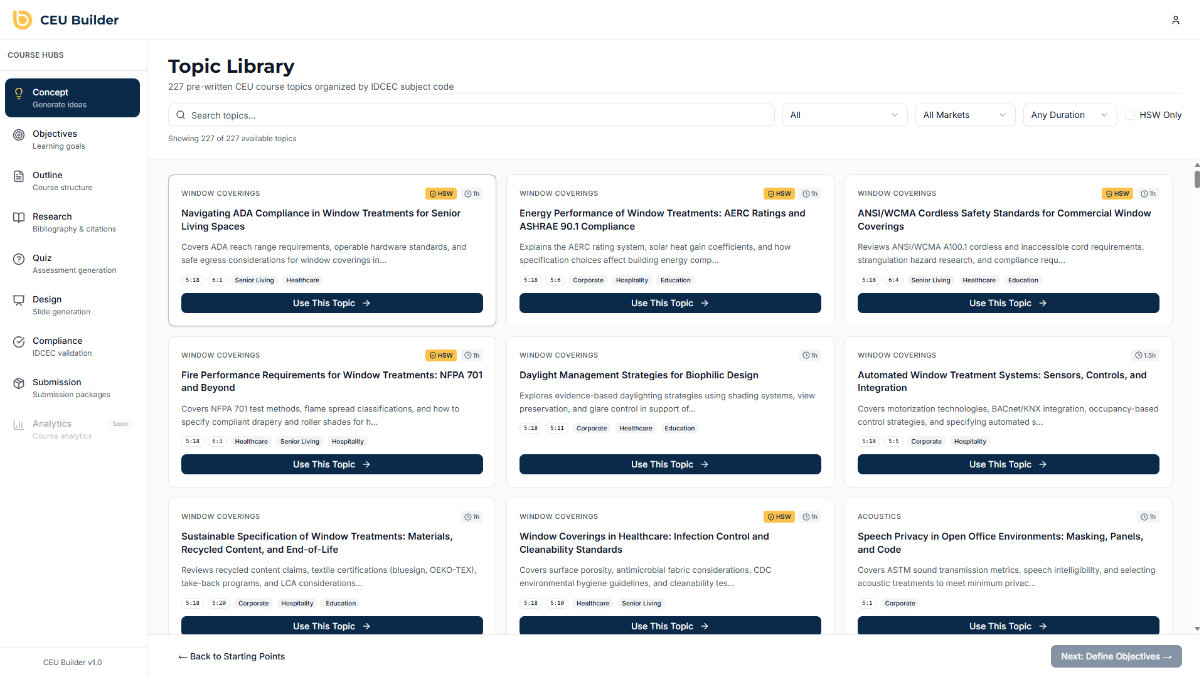
We maintain a 100% first-pass IDCEC accreditation rate, meaning every course submitted gets approved on the first attempt. This perfect track record eliminates the costly failures that waste months and require complete rebuilds. Our process handles everything from initial strategy through final approval, with your only role being content review before launch. Hospitality manufacturers trust CEU Builder to transform continuing education from compliance theater into demand generation engines that drive specifications and revenue. Learn how to get IDCEC approval for your CEU course and discover the IDCEC CEU courses ROI manufacturers achieve through strategic educational programs.
Frequently asked questions
What is a CEU provider in interior design?
A CEU provider is a registered entity authorized by IDCEC to develop courses awarding continuing education credits to interior designers. Providers ensure course compliance with educational standards and maintain the qualifications necessary to issue recognized credits. Registration establishes accountability and quality control within the continuing education system.
How do IDCEC CEU providers report learner attendance?
Providers report attendance data to IDCEC after course delivery to validate credit awards. This reporting confirms which learners completed requirements and earned credits. Learners can self-report attendance through IDCEC’s portal or use mobile apps with QR code scanning for automated tracking, creating redundancy that ensures accurate records.
What benefits do hospitality manufacturers get from offering IDCEC CEUs?
CEU courses educate designers on product features, codes, and applications, driving greater specification rates and sales. Educational positioning builds brand trust and reduces post-sale support issues because designers understand proper product selection and installation. Empirical data shows CE programs generate 250% revenue growth and 374% enrollment increases, demonstrating strong ROI from strategic educational initiatives.
How long does IDCEC provider registration take?
Provider registration typically requires 2-4 weeks for approval after submitting required organizational information and agreeing to IDCEC standards. Once approved, providers access submission portals, compliance resources, and reporting systems needed for course development and delivery. The registration timeline is separate from course approval, which adds 4-6 weeks for review and accreditation.
What is the difference between corporate and preferred IDCEC providers?
Corporate providers pay $420 annually plus per-course submission fees, suitable for manufacturers developing 1-5 courses yearly. Preferred providers pay $6,000 annually but submit unlimited courses without additional fees, making this tier economical for organizations planning 6+ courses. The breakeven point depends on submission volume, with preferred status benefiting high-volume educational programs.
Recommended
