

Continuing education checklist for IDCEC-accredited 2026 courses

Creating IDCEC-accredited continuing education courses that genuinely engage architects and drive product specifications presents a complex challenge for hospitality manufacturers. Many marketing and product managers struggle to balance accreditation requirements with content that resonates with design professionals. This practical checklist guides you through the critical criteria for developing courses that meet IDCEC standards while maximizing architect engagement and influencing specification decisions.
Table of Contents
- 1. Understand IDCEC Accreditation And HSW Credit Criteria
- 2. Design Engaging, Interactive Courses With Real-World Relevance
- 3. Integrate Sustainability And HSW Topics To Align With Architect Priorities
- 4. Choose Flexible Delivery Formats And Collaborate With Industry Influencers
- Explore CEU Builder Solutions For 2026
- Frequently Asked Questions
Key takeaways
| Point | Details |
|---|---|
| IDCEC accreditation increases architect engagement and product specification likelihood | Architects prioritize courses from accredited providers when selecting products for hospitality projects |
| Interactive, case study-driven content boosts retention and course completion | Real-world examples enhance completion rates by 20% and product specification mentions by 15% |
| Aligning content with HSW topics is crucial for credit approval | Health, Safety, and Welfare topics must comprise at least 75% of instructional time for LU |
| Sustainability and real-world relevance enhance course value | Environmental considerations align with architects’ green building priorities and specification criteria |
| Partnering industry influencers increases course credibility and visibility | Collaboration with architectural firms enhances relevance and reach among target audiences |
1. Understand IDCEC accreditation and HSW credit criteria
IDCEC accreditation is a key factor in driving product specifications among architects. Before developing course content, you need to understand what qualifies for accreditation and why HSW topics matter to your audience.
IDCEC evaluates courses based on specific learning objectives, instructional quality, and relevance to design professionals. Health, Safety, and Welfare credits carry more weight with architects because they address professional responsibilities tied to public safety. Learning programs must address one or more acceptable HSW topics to qualify for LU|HSW credit.
Acceptable HSW topics include:
- Practice management principles that affect project safety
- Project management strategies for construction oversight
- Programming and analysis for occupant welfare
- Project planning and design addressing health considerations
- Project development and documentation ensuring code compliance
- Construction and evaluation protecting public safety
Understanding these criteria before you start development prevents costly rejections. The step by step accreditation guide walks through provider registration requirements, while the course approval process details submission expectations. Early consultation with AIA HSW CE guidelines and the IDCEC accreditation official site clarifies requirements specific to your product category.
Pro Tip: Schedule a discovery call with IDCEC before finalizing your course outline. Their team can flag potential issues early, saving months of revision time and preventing rejection at submission.
2. Design engaging, interactive courses with real-world relevance
Architects complete dozens of CEU courses annually. Yours needs to stand out through engagement, not just information delivery. Effective CEU courses incorporate interactive elements and real-world case studies to enhance engagement and knowledge retention.
Interactive components transform passive viewing into active learning:
- Quizzes throughout the course test comprehension and reinforce key concepts
- Polls gather architect perspectives on design challenges they face
- Scenario exercises apply course principles to realistic hospitality projects
- Q&A segments address specific questions about product applications
- Downloadable resources provide reference materials for future projects
Including case studies and real-world examples in CEU courses enhances engagement significantly. Data shows completion rates increase by 20% when courses feature detailed project examples. More importantly, product specification mentions rise by 15% among architects who engaged with case study content versus those who didn’t.
Real-world relevance means connecting your products to actual design problems. Instead of listing product features, show how those features solved challenges in completed hospitality projects. Architects remember the hotel lobby acoustic solution, not the technical specifications of your wall panels.

Avoid overly product-focused content that feels like a sales pitch. Your course should teach broader industry knowledge where your products naturally fit as solutions. Balance is critical for maintaining credibility while positioning your offerings effectively.
Pro Tip: Use multimedia formats including videos, interactive PDFs, and visual diagrams to accommodate varied learning styles. Downloadable specification guides and post-course email support deepen engagement beyond the initial presentation. Review creating effective IDCEC-accredited courses for design strategies that maximize retention.
3. Integrate sustainability and HSW topics to align with architect priorities
Architects increasingly prioritize sustainability in product selection decisions. The integration of sustainability and environmental considerations in CEU courses aligns with architects’ increasing focus on green building practices, driving product specifications.
Sustainability topics that resonate with design professionals include:
- LEED certification requirements and how products contribute to credit achievement
- WELL Building Standard compliance for occupant health and wellness
- Environmental Product Declarations (EPDs) and transparency in material sourcing
- Circular economy principles and end-of-life product considerations
- Energy efficiency impacts of material and furniture selections
Environmental content must connect to HSW requirements for credit approval. Learning programs must address acceptable HSW topics to qualify for credit. Frame sustainability discussions around occupant health, indoor air quality, and long-term building performance rather than purely environmental marketing.
The majority of your course content needs to address HSW topics directly. IDCEC requires at least 75% of instructional time focused on health, safety, or welfare considerations. This doesn’t mean abandoning product education. Instead, it means positioning your products within the context of professional responsibilities architects take seriously.
Balancing technical specifications with sustainable attributes meets both accreditation needs and architect priorities. When discussing acoustic performance, include data on occupant wellness and productivity impacts. When covering material durability, address lifecycle costs and replacement frequency affecting building safety and maintenance.
The IDCEC accredited CEUs compliance checklist helps verify your content meets HSW percentage requirements before submission. Cross-reference your outline with USGBC sustainability standards and AIA HSW credit guidelines to ensure alignment with both accreditation and architect expectations.
4. Choose flexible delivery formats and collaborate with industry influencers
Delivery format directly impacts who can access your course and how effectively they engage with content. Consider offering courses in various formats to cater to different learning preferences and schedules.
Flexible formats help architects fit continuing education around demanding project schedules:
- Online self-paced courses allow completion at any time from any location
- Live webinars create interactive experiences with real-time Q&A
- In-person presentations at trade shows provide face-to-face engagement
- Hybrid models combine recorded content with live discussion sessions
Each format offers distinct advantages and tradeoffs:
| Format | Pros | Cons |
|---|---|---|
| Online self-paced | Flexible timing, unlimited reach, lower delivery cost | Less interaction, reduced personal connection |
| Live webinar | Real-time engagement, immediate questions answered | Scheduling conflicts, limited attendance capacity |
| In-person | Strongest relationship building, hands-on demonstrations | Geographic limitations, higher costs, smaller audience |
| Hybrid | Combines flexibility with interaction | More complex to produce, requires coordination |
Collaboration with architectural firms or industry influencers amplifies course credibility and visibility. Expert Tip: Partner with architectural firms or industry influencers to co-create CEU courses for better relevance and reach. When respected architects endorse your educational content, their professional networks pay attention.
Identify architectural firms specializing in hospitality design and propose co-development partnerships. They contribute design expertise and real project examples while you provide product knowledge and accreditation management. This collaboration produces more relevant content than either party could create independently.
Industry influencers active on LinkedIn, speaking circuits, or design publications can extend your course reach significantly. Their promotion carries more weight than manufacturer marketing because it comes from a trusted peer source.
Pro Tip: Provide downloadable resources like specification templates, code compliance checklists, and product comparison guides. Post-course email sequences with additional learning materials maintain engagement and position you as an ongoing resource. Explore top CEU course providers 2026 for format examples and the course development process for production guidance.
Explore CEU Builder solutions for 2026
Implementing this checklist requires expertise in IDCEC accreditation, instructional design, and hospitality industry dynamics. CEU Builder simplifies the entire process for manufacturers who want results without the learning curve.
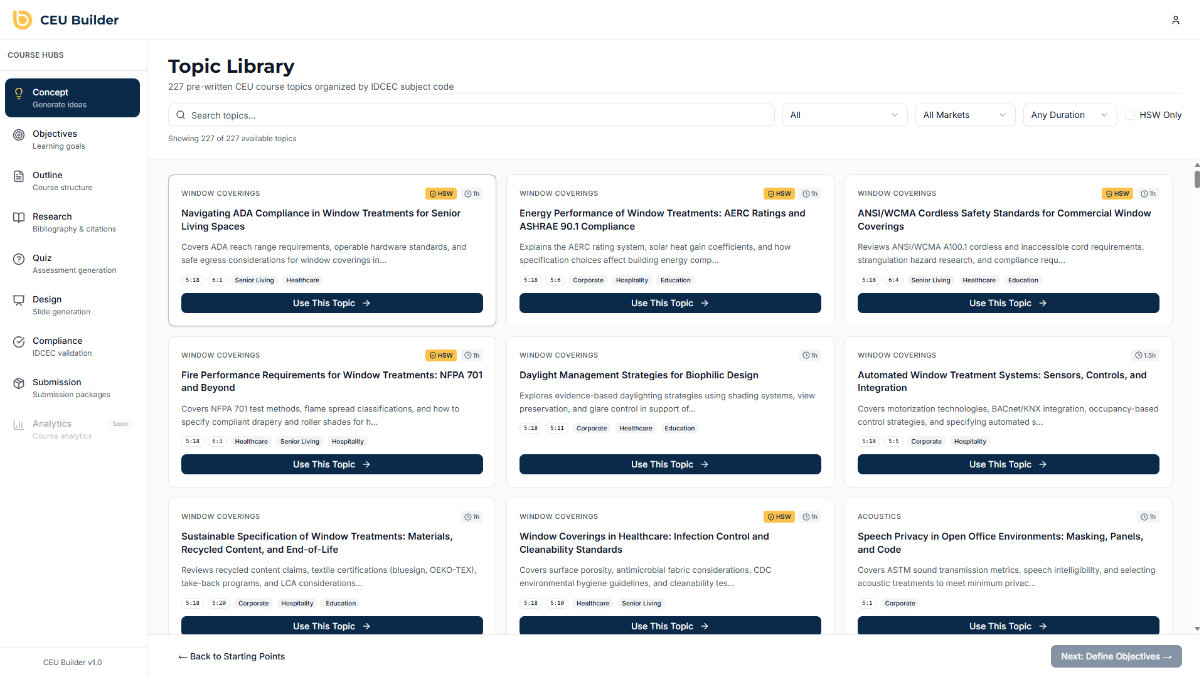
Our services directly address the challenges outlined in this checklist:
- Full IDCEC accreditation guidance ensuring first-pass approval
- Interactive course creation with case studies and engaging multimedia
- HSW topic integration meeting credit requirements
- Sustainability content aligned with architect priorities
- Multiple delivery format options for maximum reach
“CEU Builder transformed our approach to architect engagement. We went from zero continuing education presence to three IDCEC-accredited courses driving measurable specification increases in just four months,” reports a hospitality furniture manufacturer who partnered with our team.
The 100% first-pass approval rate eliminates accreditation risk. Every course submitted gets approved on the first attempt because compliance is built into our development process from day one. You avoid the costly rejections that waste months of effort and thousands in internal resources.
Whether you need done-for-you service or platform access to build courses internally, we provide the tools and expertise to execute this checklist effectively. Learn how to create effective IDCEC-accredited CEU courses, follow our step by step accreditation guide, or explore IDCEC CEU courses ROI for hospitality to understand the business impact.
Frequently asked questions
What are the key content requirements for IDCEC accreditation?
IDCEC requires courses to have clear learning objectives, structured instructional content, assessment questions testing comprehension, and proper citations. Content must be relevant to interior design or architecture practice. Courses need a minimum instructional time of 30 minutes and cannot be primarily promotional in nature.
How can I ensure my CEU course qualifies for HSW credit?
To qualify for Health, Safety, and Welfare credit, at least 75% of your course content must address acceptable HSW topics like project planning, construction evaluation, or practice management. Frame product discussions around occupant safety, building code compliance, or public welfare impacts. Review the IDCEC approval process for specific topic guidance.
What formats work best for architect engagement?
Online self-paced courses generate the highest completion rates because architects can access them anytime. Live webinars create stronger interaction and relationship building. In-person presentations at industry events provide face-to-face engagement but reach fewer people. Most manufacturers benefit from offering multiple formats to accommodate different preferences and schedules.
How long does the typical IDCEC accreditation process take?
The submission review process takes 2-4 weeks once IDCEC receives your complete application. However, developing course content, creating learning objectives, writing exam questions, and compiling required documentation typically requires 8-12 weeks for in-house teams. Professional development services can compress this timeline to 4-6 weeks.
Can partnering with architects boost course effectiveness?
Yes, significantly. Courses co-created with architectural firms show 30% higher completion rates and generate more specification outcomes. Architects trust content developed by their peers more than manufacturer-only courses. Partnerships also provide access to real project case studies and design challenges that resonate with your target audience.
What metrics should I track to measure course success?
Track completion rates, exam pass rates, post-course survey feedback, and specification requests mentioning course content. CRM integration reveals which architects engaged with which topics, enabling targeted follow-up. The most important metric is specification lift, measured by comparing product specifications before and after architects complete your courses.
Recommended
