

AIA accreditation explained: how to influence architect specs

Most hospitality furniture and lighting manufacturers treat AIA accreditation as a simple stamp of approval, something to check off before handing a course to a sales rep. That framing costs you real specification opportunities. AIA accreditation refers to approval by the AIA Continuing Education System (CES) for learning programs that qualify for AIA Learning Units (LUs), particularly Health, Safety, and Welfare (HSW) credits required for licensed architects. When you understand what that actually means for how architects make product decisions, the entire strategy shifts from compliance to influence.
Table of Contents
- What is AIA accreditation and why does it matter?
- How manufacturers become AIA CES providers
- What qualifies as HSW content? Topics and benchmarks
- Designing and delivering AIA-accredited education for architects
- AIA vs IDCEC accreditation: Cross-compliance and dual-approval
- Build a CE strategy that influences specs
- Frequently asked questions
Key Takeaways
| Point | Details |
|---|---|
| AIA accreditation defined | AIA accreditation validates that a course qualifies for architect learning units and HSW credit. |
| Manufacturer pathway | Register as a CES provider, design neutral courses, and undergo AIA review to offer accredited programs. |
| HSW content is key | At least 75 percent of course time must cover health, safety, and welfare topics for HSW eligibility. |
| AIA vs. IDCEC | AIA serves architects, IDCEC interior designers, with dual CEU approval expanding influence for hospitality manufacturers. |
| Strategic education impact | Well-designed AIA-accredited programs boost specification opportunities and market credibility. |
What is AIA accreditation and why does it matter?
AIA stands for the American Institute of Architects. Its Continuing Education System, known as AIA CES, approves learning programs that award LUs, or Learning Units, to licensed architects who complete them. Not all LUs are equal. The most valuable are HSW credits, which cover Health, Safety, and Welfare topics that directly relate to how buildings protect the people inside them.
AIA members must complete 18 LUs annually to maintain membership, with at least 12 of those being HSW credits. That requirement creates a predictable, recurring demand for accredited education. Architects are not browsing your course catalog out of curiosity. They need those credits to keep their licenses active.
Here is what that means for you as a manufacturer. When your course fills that requirement, you earn 45 to 60 minutes of focused attention from a specification-capable decision-maker. That is not a trade show conversation. That is structured learning time where your brand is positioned as the expert, not the vendor.
| Credit type | Annual requirement | Who needs it |
|---|---|---|
| Total LUs | 18 per year | All AIA members |
| HSW LUs | 12 minimum | All AIA members |
| Elective LUs | Up to 6 | All AIA members |
The compliance guide for manufacturers breaks down how these requirements translate into course design decisions. Understanding the credit structure before you build saves significant revision time later.
“AIA-accredited education is not just a credential. It is a direct channel into the architect’s decision-making process at the moment they are most receptive to learning.”
Key reasons AIA accreditation matters to hospitality manufacturers:
- Architects actively seek accredited courses to fulfill annual requirements
- HSW-focused content positions your brand around safety and performance, not just aesthetics
- Course completions create documented touchpoints with specification-capable professionals
- Educational credibility transfers to product credibility during the specification process
With that baseline in place, let’s break down the specific steps and requirements for manufacturers.
How manufacturers become AIA CES providers
Becoming an AIA CES provider is a structured process, but it is manageable when you know what to expect. To offer AIA-accredited CE, manufacturers register as CES providers via annual subscription, then submit courses for review ensuring 75% HSW content, measurable learning objectives, and no promotional bias.
Here is the step-by-step path:
- Register as a CES provider. Complete the AIA provider application and pay the annual subscription fee. This gives you access to the submission portal and provider resources.
- Develop your course content. Build your slide deck, speaker script, and exam questions with HSW compliance built in from the start. Do not retrofit compliance after the fact.
- Submit for course review. Upload your course materials through the AIA CES portal. Reviewers check for HSW content percentage, measurable objectives, and absence of promotional language.
- Receive approval and launch. Once approved, you can deliver the course and report completions through the CES system.
- Renew annually. Provider status and individual courses require annual renewal. Audits can occur, so maintain clean records.
The CEU course development steps guide walks through each phase in detail, including how to write learning objectives that satisfy AIA reviewers without sounding like a compliance checklist.

Pro Tip: Write your learning objectives before you write a single slide. Objectives drive content structure, and AIA reviewers evaluate them first. If your objectives are weak, the rest of the course will not save you.
The anti-promotion requirement trips up more manufacturers than any other rule. You cannot mention your brand name in a way that functions as a sales pitch. You can reference your products as examples within an educational context, but the course must teach a concept, not sell a product. That distinction is the difference between approval and rejection.
Knowing the process is just the start. Let’s unpack what makes a course eligible and valuable.
What qualifies as HSW content? Topics and benchmarks
HSW eligibility requires content protecting public health, safety, and welfare in topics like project planning and design, materials, and construction methods. At least 75% of instructional time must cover approved HSW topics.
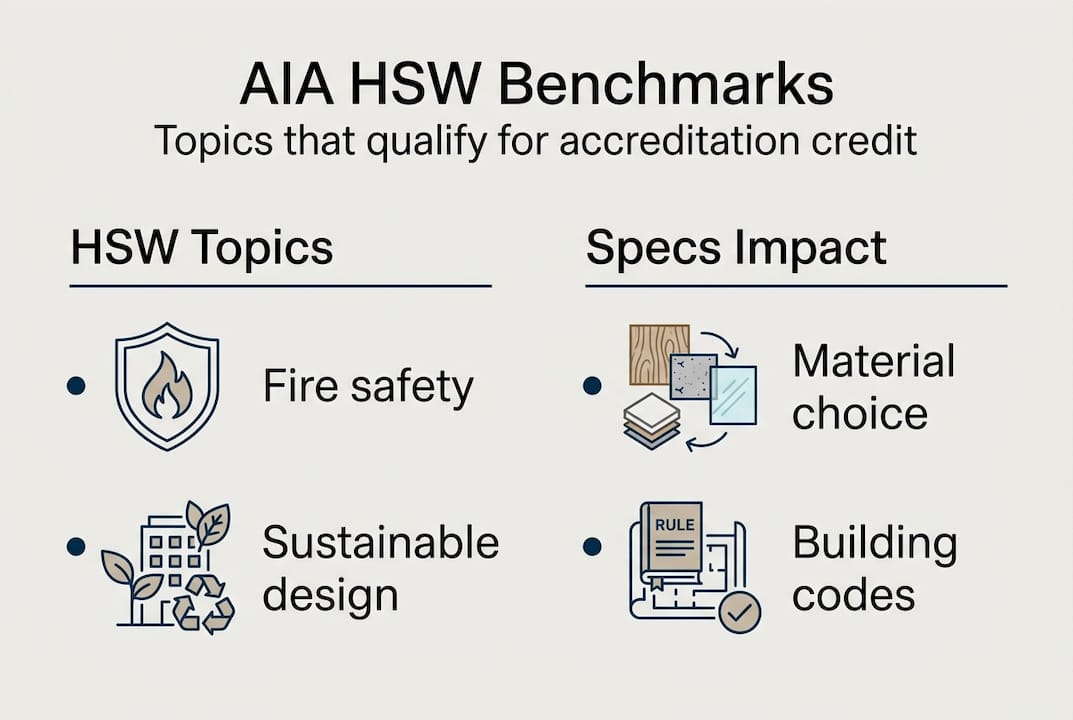
For hospitality manufacturers, this is actually good news. Many of your most technically differentiated product features map directly to HSW categories.
| HSW topic area | Hospitality application examples |
|---|---|
| Fire safety and egress | Flame-retardant upholstery, fire-rated partition systems |
| Acoustic performance | Sound-absorbing panels, noise-reducing furniture layouts |
| Sustainable materials | Low-VOC finishes, recycled content certifications |
| Indoor air quality | Off-gassing standards, material transparency reports |
| Accessibility and safety | ADA-compliant furniture dimensions, slip-resistant surfaces |
The 75% threshold is not as restrictive as it sounds. A course on acoustic performance in hotel lobbies can spend the majority of its time on sound transmission coefficients, building code requirements, and occupant wellness research. Your product appears as the solution to a documented problem, not as the subject of a sales pitch.
Relevant HSW topics for hospitality furniture and lighting manufacturers include:
- Building codes and fire safety standards for commercial interiors
- Sustainable material selection and environmental certifications
- Acoustic design principles for hospitality environments
- Lighting and its impact on occupant health and circadian rhythms
- Accessibility requirements under ADA for commercial furniture
You can also review AIA and IDCEC-approved topics to see how other manufacturers in adjacent categories have structured their HSW content. Real-world hospitality case studies show how product-specific education gets structured within HSW frameworks without crossing into promotion.
Once you know the qualifying topics, the next step is course design and delivery.
Designing and delivering AIA-accredited education for architects
The format of your course matters as much as the content. Manufacturers offer AIA LU/HSW courses via lunch-and-learns or webinars to educate on HSW-relevant applications, directly influencing architect specifications.
Here is how to build a delivery program that actually moves the needle:
- Choose your primary format. Lunch-and-learns work well for regional sales teams building relationships with local architecture firms. Webinars scale nationally without travel costs. Both formats qualify for AIA credit.
- Design for engagement, not endurance. A 60-minute course should include knowledge checks, visual case studies, and practical application examples. Passive slide reading loses architects fast.
- Train your presenters. Your sales reps need a speaker script and clear boundaries around what they can and cannot say. One off-script promotional comment can invalidate the credit for attendees.
- Track and report completions. AIA CES providers are responsible for recording attendance and reporting credit hours electronically. Build this into your delivery workflow from day one.
- Connect completions to your CRM. Every architect who completes your course is a warm lead. Tag them, track their engagement, and equip your sales team with context for follow-up.
“The architect who just completed your HSW course on acoustic performance is not a cold prospect. They are a pre-educated buyer who already understands the problem your product solves.”
Pro Tip: Use post-course surveys to capture which topics resonated most. That data tells you what architects actually care about, which informs your next course topic and your sales team’s talking points.
Exploring continuing education platforms helps you identify the right delivery infrastructure before you commit to a format. Understanding the broader architectural plans process also clarifies where your course fits in the architect’s project timeline.
As you design your program, it’s key to recognize the IDCEC connection and how the two systems compare.
AIA vs IDCEC accreditation: Cross-compliance and dual-approval
AIA and IDCEC (Interior Design Continuing Education Council) are separate accreditation systems serving different professional audiences. AIA LUs are not automatically IDCEC CEUs, but dual approval is common for hospitality manufacturers targeting both architects and interior designers.
| Factor | AIA CES | IDCEC |
|---|---|---|
| Primary audience | Licensed architects | Interior designers |
| Annual credit requirement | 18 LUs (12 HSW) | Varies by state license |
| HSW content threshold | 75% minimum | Separate HSW designation |
| Anti-promotion rules | Strict | Strict |
| Dual approval possible | Yes | Yes |
For hospitality manufacturers, this distinction is critical. Hotel projects typically involve both architects and interior designers. If your course only carries AIA credit, you are missing the interior design audience entirely. If it only carries IDCEC credit, architects cannot count it toward their AIA membership requirements.
Benefits of pursuing dual AIA and IDCEC approval:
- One course reaches two distinct professional audiences
- Doubles your potential completion volume without doubling development cost
- Positions your brand as the educational resource for the full project team
- Strengthens specification influence at multiple decision points in the design process
The content requirements for both systems overlap significantly, especially around HSW topics and anti-promotion rules. Building for dual approval from the start is more efficient than retrofitting a single-system course later. Review the IDCEC vs AIA comparison to see exactly where the requirements diverge, and explore the guide on building IDCEC-accredited courses to understand the submission process for each system.
Understanding this dual pathway sets you up to act. Let’s recap the essential strategies and offer a next-step solution.
Build a CE strategy that influences specs
You now have a clear picture of how AIA accreditation works, what qualifies as HSW content, and how dual approval with IDCEC expands your reach across the full design team. The manufacturers who act on this knowledge build specification influence that compounds over time. Those who wait cede that ground to competitors who are already in front of architects every quarter.
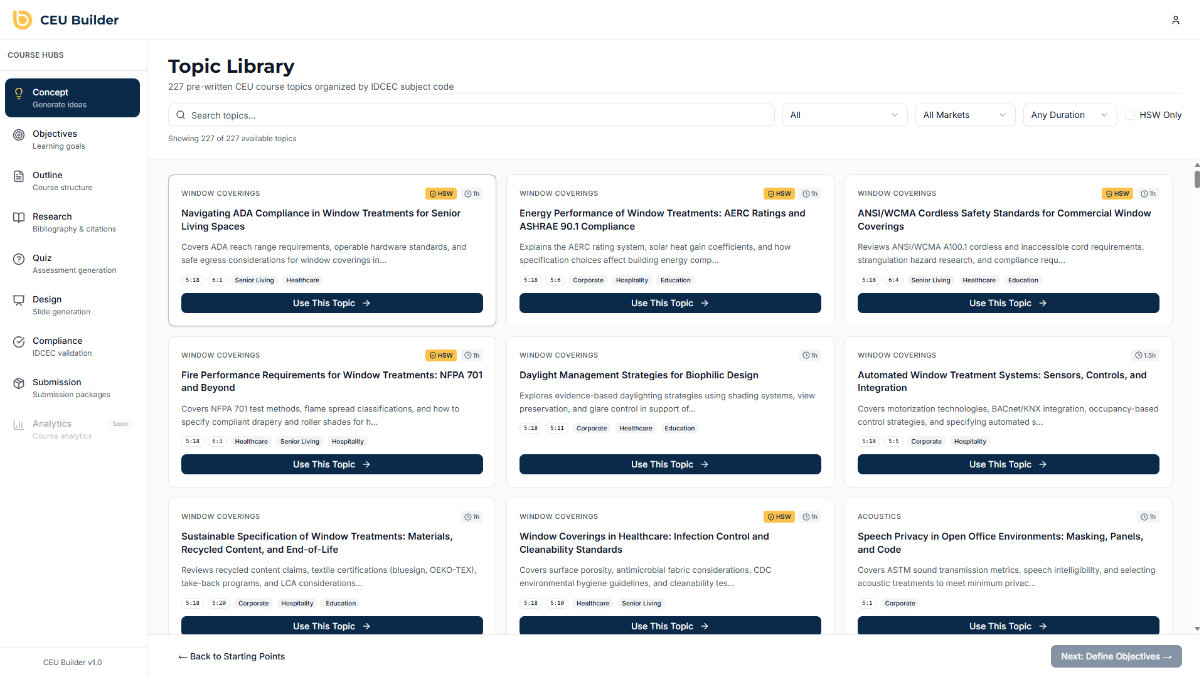
CEU Builder helps hospitality furniture and lighting manufacturers move from strategy to approved course in four to six weeks. Whether you need a step-by-step IDCEC accreditation walkthrough or a fully built course ready for delivery, the resources are ready. Visit CEU Builder to see how manufacturers are turning continuing education into a repeatable specification engine, without the months of trial and error that derail most in-house attempts.
Frequently asked questions
How long does it take to get a course AIA accredited?
AIA CES course review and approval typically takes two to four weeks once your materials are submitted through the provider portal.
What topics are always eligible as HSW content?
Building codes, fire safety, sustainable materials, and construction methods consistently qualify for HSW credit as long as 75% of the course covers approved topic areas.
Can one course offer both AIA LUs and IDCEC CEUs?
Yes. With dual approval, a single course can qualify for both AIA Learning Units and IDCEC CEUs when it meets the distinct requirements of each accreditation system.
What happens if a course contains promotional content?
AIA will reject the course outright. Strict anti-promotion rules prohibit branded sales pitches, and content must remain neutral and educational throughout.
How are attendance and credits tracked?
AIA CES providers are responsible for recording attendance and reporting credit hours for participants electronically through the CES system after each course delivery.
Recommended
- AIA accreditation examples: IDCEC CEU strategies 2026
- IDCEC Accreditation 2026: 50% Faster Specs & 40% Trust
- IDCEC vs AIA Credits: Which CEU Path Drives More Specs for Manufacturers? – CEU Builder
- Multi-provider accreditation explained: boost specs with CEUs
- Architectural Plans Step by Step for Any Project – Florida Licensed Engineers
