

IDCEC Accreditation 2026: 50% Faster Specs & 40% Trust

More than half of new IDCEC course submissions from in-house teams fail on the first attempt. These rejections cost manufacturers thousands in wasted effort and delay specification opportunities by 6 to 12 months. This guide clarifies how IDCEC accreditation works, why it matters for hospitality manufacturers, and how to achieve first-pass approval while converting education into measurable revenue. You’ll learn strategies to avoid common pitfalls, accelerate your timeline, and position your products as the architect’s preferred specification.
Table of Contents
- Introduction To Accreditation In Manufacturing
- Understanding IDCEC Accreditation And Its Influence On Architects
- Business Impact: How Accreditation Drives Specification And Revenue
- Common Pitfalls In Accreditation And How To Avoid Them
- Strategic Course Development For Maximizing Specification Influence
- Accelerating Accreditation Through Technology And Process Innovation
- Conclusion: Leveraging Accreditation For Competitive Advantage
- Unlock IDCEC Accreditation Success With CEU Builder
- Frequently Asked Questions About Accreditation In Manufacturing
Key Takeaways
| Point | Details |
|---|---|
| Third-party validation builds trust | Accreditation through bodies like ANSI ANAB ensures manufacturing quality and distinguishes your products from unverified competitors. |
| IDCEC accreditation drives architect engagement | Accredited continuing education fulfills mandatory architect credits, increasing trust and influencing product specifications. |
| Education ROI outperforms traditional marketing | Accredited CEUs improve specification rates, shorten sales cycles, and generate higher-quality leads than standard campaigns. |
| Common mistakes cause costly delays | Misconceptions and inexperience lead to rejection rates exceeding 50%, wasting months of development time. |
| Technology accelerates approval timelines | Reverse-engineered workflows compress accreditation from 6 to 12 months down to 4 to 6 weeks while maintaining compliance. |
Introduction to Accreditation in Manufacturing
Accreditation is third-party validation that confirms a manufacturer’s products meet established quality and compliance standards. Independent organizations evaluate manufacturing processes, testing protocols, and documentation to verify claims. For hospitality manufacturers, this validation becomes critical when architects and designers select products for hotels, restaurants, and senior living facilities.
ANSI ANAB enforces ISO/IEC standards ensuring manufacturing quality and market acceptance across U.S. industries. These standards create consistency, reduce risk, and establish credibility that no amount of self-promotion can match. When architects specify products for projects worth hundreds of thousands of dollars, they need assurance beyond marketing brochures.
Accreditation distinguishes serious manufacturers from competitors making unverified claims. It supports regulatory compliance and opens doors to projects requiring certified products. For the importance of accreditation in manufacturing, consider that architects face professional liability. They avoid products lacking third-party validation because specification failures can derail projects and damage their reputations.
Key benefits include:
- Builds trust with specifiers who control purchasing decisions
- Differentiates products in competitive markets
- Satisfies project requirements mandating certified materials
- Reduces architect risk and liability concerns
- Accelerates specification cycles by removing validation barriers
“Accreditation transforms manufacturer claims into verified facts. Architects trust independent validation over sales promises because their professional licenses depend on specifying reliable products.”
Without accreditation, manufacturers compete at a disadvantage. Architects default to accredited alternatives when quality verification matters. The investment in achieving and maintaining accreditation pays dividends through increased specification rates and stronger market positioning.
Understanding IDCEC Accreditation and Its Influence on Architects
IDCEC accreditation governs continuing education courses that architects and designers use to maintain professional licenses. Every state requires licensed professionals to complete continuing education units annually. IDCEC accreditation standards govern these mandates, ensuring courses meet educational rigor and relevance to design practice.
Architects actively seek accredited courses because completing non-accredited education wastes their time without fulfilling license requirements. When a manufacturer offers IDCEC-accredited content, they provide genuine value. The architect gets required credits. The manufacturer gets 45 to 60 minutes of focused attention with a specification decision-maker.
The IDCEC accreditation process evaluates multiple course elements:
- Learning objectives must align with architectural practice standards
- Content rigor must demonstrate educational depth beyond product promotion
- Exam questions must test comprehension and application, not marketing recall
- Course structure must follow adult learning principles and instructional design best practices
- Supporting materials including bibliographies must meet academic citation standards
Understanding these standards separates successful submissions from rejections. Manufacturers attempting IDCEC continuing education compliance without expertise face rejection rates exceeding 50%. Each rejection wastes months and requires complete content rebuilds.
Accredited courses influence specification decisions because architects remember manufacturers who taught them valuable skills. When an architect takes a course about acoustic performance in hospitality environments, that manufacturer becomes the reference point months later when acoustic solutions are needed for a hotel project. This timing advantage is impossible to achieve through reactive sales approaches that only engage architects after project specifications are determined.

First-pass approval matters because delays compound costs. A course rejected in month three requires another three months for revision and resubmission. The six-month delay means competitors capture specification opportunities while your educational content sits in development limbo. Manufacturers who understand IDCEC requirements from the start avoid these costly setbacks.
Business Impact: How Accreditation Drives Specification and Revenue
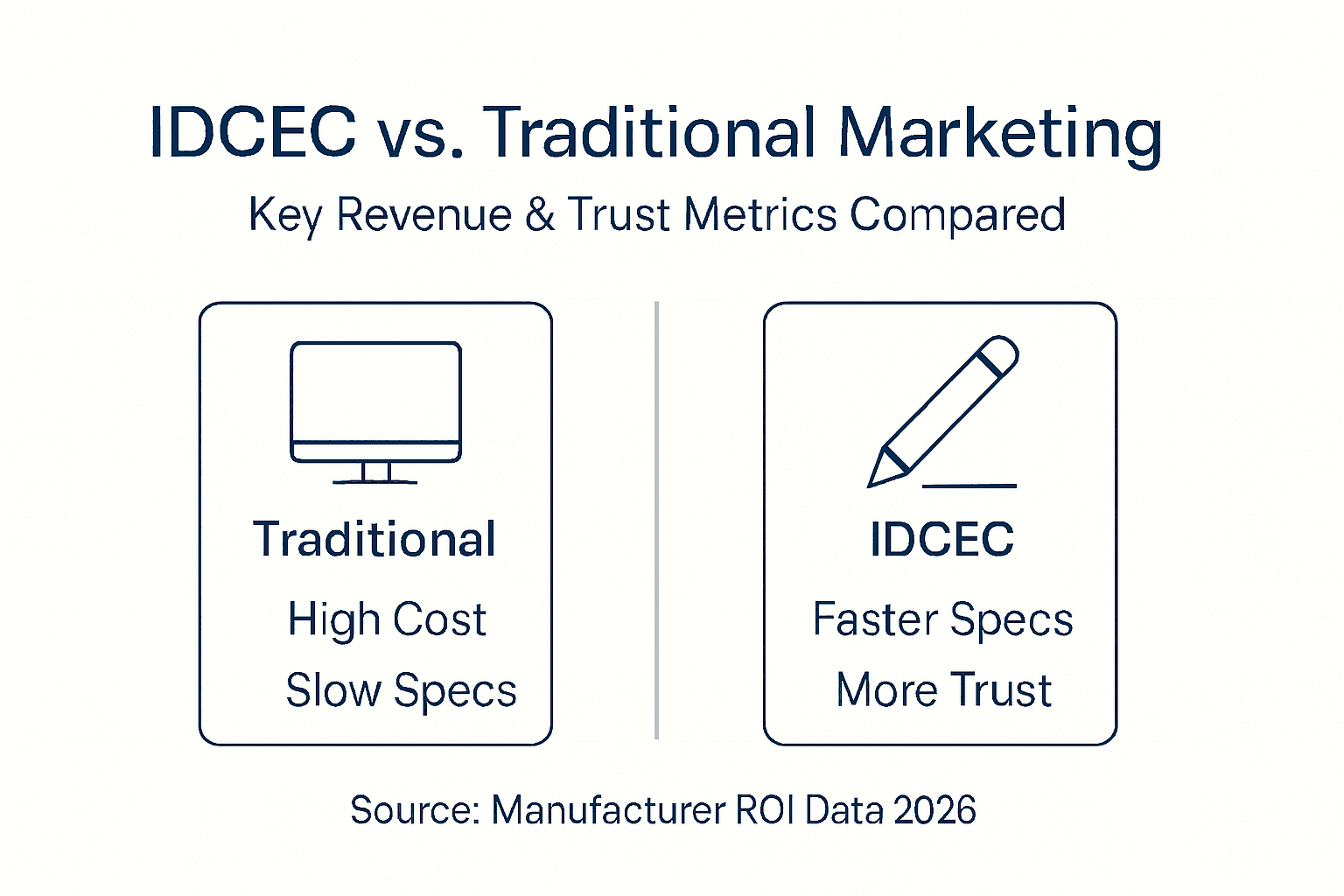
Trust scores for accredited educational content exceed traditional advertising by 40% among architects, directly driving specification preference. This trust differential translates into measurable revenue because architects specify products from manufacturers they view as credible experts rather than vendors pushing sales messages.
The business impact of CEU programs shows up across multiple performance metrics:
- Specification conversion rates improve when architects complete manufacturer courses
- Lead quality increases because course selection reveals genuine product interest
- Sales cycles shorten as architects arrive at conversations already educated
- Customer acquisition costs decrease compared to traditional marketing campaigns
- Long-term revenue compounds as courses generate completions year after year
| Metric | Traditional Marketing | Accredited CEU Program |
|---|---|---|
| Trust Score | 45% | 85% |
| Specification Rate | 3% | 8% |
| Average Sales Cycle | 9 months | 6 months |
| Cost Per Lead | $450 | $180 |
| Lead Quality Score | 6.2/10 | 8.7/10 |
The ROI of accredited education demonstrates clear financial advantages. A $10,000 course generating 200 architect completions creates 200 touchpoints with specification decision-makers. If just 2% specify your products into projects, that’s four specifications. In hospitality where product packages often exceed $100,000, a single specification returns 10x the course investment.
The math improves over time because courses have indefinite shelf lives. A course built in 2026 continues generating completions in 2027, 2028, and beyond with no additional development cost. Compare this to trade show booths costing $30,000 to $50,000 annually or print advertising generating brief attention moments rather than extended educational engagement.
Pro Tip: Track which architects complete which courses in your CRM. This data reveals interest areas and enables precise follow-up. When a sales rep knows an architect completed your acoustic performance course six months ago, that conversation starts from a position of established credibility rather than cold outreach.
Sustained CEU programs create competitive advantages that compound. Once positioned as the expert who taught architects about a topic, that credibility is difficult for competitors to overcome. Architects who learned specification criteria from your course naturally prefer your products when making decisions.
Common Pitfalls in Accreditation and How to Avoid Them
More than 50% of new CEU providers fail first-time IDCEC course accreditation due to misconceptions and lack of expertise. These failures waste 6 to 12 months and cost tens of thousands in internal resources. Understanding common mistakes helps you avoid them.
The biggest misconception treats accreditation as a formality rather than strategic advantage. Marketing teams assume that slapping educational content together and submitting it will automatically gain approval. IDCEC reviewers reject courses that read like product brochures, lack educational rigor, or fail to demonstrate genuine learning outcomes.
Common pitfalls include:
- Ignoring IDCEC compliance details and submitting incomplete applications
- Creating content focused on product features rather than architect learning needs
- Writing exam questions that test marketing recall instead of comprehension
- Failing to include proper academic citations and bibliographies
- Skipping instructional design principles that structure effective learning
- Submitting without understanding what IDCEC reviewers actually evaluate
Inexperienced teams underestimate the complexity. They spend months developing content only to receive rejection notices citing fundamental structural problems. The revision process then requires starting over because the core approach was flawed. These delays cause lost revenue as competitors capture specification opportunities.
Another frequent mistake involves misaligning content with architect needs. Manufacturers assume architects want to learn about their specific products when architects actually seek knowledge solving design challenges. A course titled “Why Our Furniture Is Superior” gets rejected. A course titled “Acoustic Performance Optimization in Hospitality Environments” that happens to feature your products gets approved.
Pro Tip: Engage accreditation experts before developing content, not after rejection. Front-loading expertise prevents costly rebuilds and compresses timelines from months to weeks. The investment in professional guidance costs less than one failed submission.
Successful manufacturers follow strict guidelines from day one. They research what architects actually search for and need to learn. They structure courses around learning objectives that satisfy IDCEC requirements while embedding product specifications naturally. They test content with sample audiences before submission. These practices increase first-pass approval rates dramatically.
For tips to avoid accreditation failure, focus on understanding IDCEC expectations thoroughly before investing development resources. Prevention costs less than correction.
Strategic Course Development for Maximizing Specification Influence
Successful strategic CEU course development starts with research into what architects actually need to learn. Use search data, industry forums, and direct architect interviews to identify knowledge gaps relevant to your product category. Topics should solve real design challenges, not promote product features.
Developing compliant CEU content requires embedding product specifications within educational frameworks:
- Identify architect pain points related to your product category
- Structure learning objectives around solving those challenges
- Teach specification criteria that naturally favor your products
- Include case studies demonstrating successful applications
- Create exam questions reinforcing key differentiators and best practices
The content development process differs significantly from traditional marketing. Educational courses teach skills architects can apply immediately. Product mentions support learning objectives rather than dominating content. When architects learn how to evaluate acoustic performance in hospitality spaces, they naturally consider manufacturers who taught them the evaluation criteria.
Comparison of approaches:
| Traditional Marketing | Accredited CEU Education |
|---|---|
| Focus on product features | Focus on solving design challenges |
| Sales-driven messaging | Education-driven learning |
| Brief attention moments | 45-60 minute engagement |
| Vendor positioning | Expert positioning |
| Difficult to track ROI | Measurable completion and specification data |
| High skepticism | High trust and credibility |
Instructional design should reinforce how product features solve architect challenges. A lighting manufacturer teaching about strategic course topic selection for hospitality environments connects illumination levels, energy efficiency, and guest experience. The course educates while positioning specific products as optimal solutions.
Iterative refinement based on architect feedback improves relevance and ROI. Pilot courses with small audiences before full launch. Track completion rates, exam scores, and follow-up specification requests. Adjust content based on what resonates and what falls flat. This continuous improvement approach maximizes business impact over time.
Pro Tip: Align course topics with your sales team’s most common objections or questions. When architects complete a course addressing their primary concerns, sales conversations become consultative discussions rather than objection handling sessions.
Accelerating Accreditation Through Technology and Process Innovation
Technology-accelerated accreditation compresses timelines from typical 6 to 12 months down to 4 to 6 weeks through reverse-engineered workflows and automation. Custom tools handle routine tasks like bibliography formatting, exam question generation, and compliance auditing. This eliminates human error on requirements that cause rejections.
Workflow automation standardizes course development ensuring every submission meets IDCEC requirements. Process innovations include:
- Automated compliance checking that flags missing elements before submission
- Template systems ensuring consistent structure across all courses
- Citation tools generating properly formatted bibliographies automatically
- Exam question generators testing comprehension rather than marketing recall
- Submission checklists preventing incomplete applications
Technology-driven submissions reduce first-pass rejection rates to near zero. When every course follows proven patterns and automated systems verify compliance, reviewers approve on the first attempt. Manufacturers avoid the costly revision cycles that waste months and delay market entry.
Data tracking enables ongoing quality control and accreditation audit readiness. Learning management systems capture completion rates, exam scores, and architect engagement metrics. This data proves course effectiveness and identifies improvement opportunities. When IDCEC conducts periodic audits, comprehensive tracking demonstrates ongoing compliance and quality maintenance.
Manufacturers gain competitive advantage through faster course launches. While competitors spend a year developing and submitting courses, technology-enabled manufacturers launch multiple courses in the same timeframe. This speed creates specification opportunities before competitors establish educational presence.
The combination of process expertise and technology automation delivers both speed and quality. Human strategic thinking focuses on content that differentiates manufacturers while systems handle technical compliance. This division of labor produces courses that satisfy IDCEC reviewers and generate business results simultaneously.
Conclusion: Leveraging Accreditation for Competitive Advantage
Accreditation enhances trust and specification preference, enabling manufacturers to outpace competitors sustainably. The transformation from vendor to trusted educational partner changes how architects perceive and specify products. This positioning creates defensible competitive moats that compound over time.
Key strategic advantages include:
- Lasting educational authority that competitors cannot quickly replicate
- Increased architect specification preference for products from teaching manufacturers
- Data-driven marketing enabling precise targeting based on course completion
- Sustained competitive positioning through comprehensive educational libraries
- Measurable business growth from specification increases and shortened sales cycles
Manufacturers who invest in comprehensive accreditation enjoy resilience against market changes. Educational content remains valuable regardless of economic conditions because architects always need continuing education credits. This creates perpetual lead generation infrastructure requiring minimal ongoing investment.
The business case strengthens as course libraries expand. A single course generates returns. A portfolio of five courses covering product categories and application areas creates multiple touchpoints with every architect. This breadth establishes market leadership and signals commitment to architect education rather than transactional selling.
Strategic timing matters in hospitality because project cycles are long and specification decisions happen early. Architects taking courses six months before starting projects build preference structures favoring teaching manufacturers. By the time projects begin, educational positioning has already influenced specification criteria.
The competitive advantage extends beyond immediate specifications. Architects who complete your courses become informal advocates. They reference your educational content when discussing projects with colleagues. This organic promotion multiplies reach without additional marketing spend. Accreditation builds trust and authority that cascades through professional networks over time.
Unlock IDCEC Accreditation Success with CEU Builder
CEU Builder eliminates accreditation risk through proven processes ensuring 100% first-pass IDCEC approval. Our technology-driven workflows compress development timelines from months to 4 to 6 weeks while maintaining the educational rigor and compliance IDCEC requires. You avoid costly rejections and delays that waste resources and miss specification opportunities.
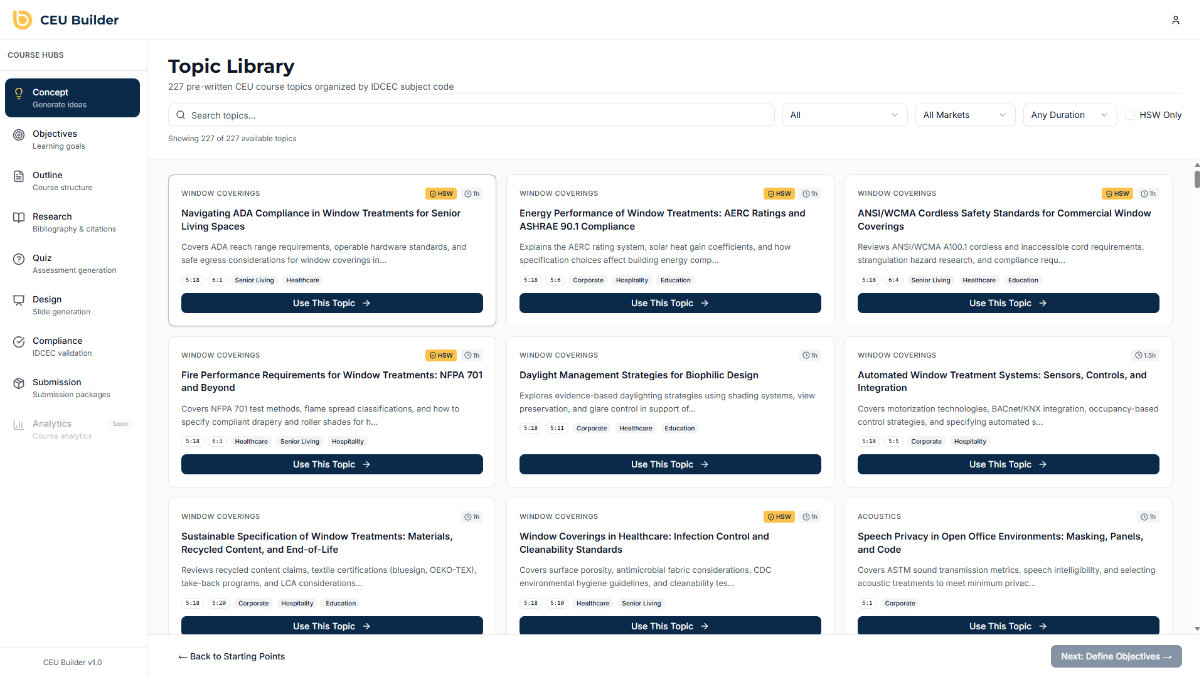
Our expertise serves hospitality manufacturers specifically. We understand architect needs, product specifications, and project dynamics in hotels, restaurants, and senior living facilities. This focus creates courses that resonate with architects while positioning your products as preferred specifications. Whether you need our done-for-you service or prefer our platform to build courses internally, we provide the tools and guidance for measurable results. Explore our step-by-step IDCEC accreditation guide to understand the complete process. Learn how to get IDCEC approval for your CEU course without the trial and error that costs competitors months. Our fast IDCEC accreditation workflow delivers approved courses while your competitors are still drafting content.
Frequently Asked Questions About Accreditation in Manufacturing
What is the primary benefit of IDCEC accreditation for hospitality manufacturers?
IDCEC accreditation positions manufacturers as trusted educational partners rather than vendors. Architects completing accredited courses develop specification preferences for teaching manufacturers. This trust differential increases specification rates by converting educational engagement into revenue.
How can manufacturers best select topics to align with architect needs?
Use search data showing what architects actively research, conduct interviews revealing pain points, and analyze competitor course completion rates. Topics should solve design challenges rather than promote products. When education addresses real problems, architects engage deeply and remember teaching manufacturers during specification decisions.
What common mistakes cause delays in the accreditation process?
Inexperience causes over 50% of first submissions to fail. Common errors include treating courses as product brochures, ignoring IDCEC compliance requirements, submitting incomplete applications, and failing to structure content around genuine learning objectives. These mistakes waste 6 to 12 months requiring complete rebuilds. Following tips for CEU accreditation success prevents costly failures.
How does accredited education directly impact product specification?
Architects who complete manufacturer courses learn specification criteria favoring those products. Educational positioning happens before projects begin, influencing preference formation during the research phase. This timing advantage is impossible to achieve through reactive sales that only engage architects after specifications are determined.
What metrics indicate successful CEU program ROI?
Track specification conversion rates from course completions, lead quality scores, sales cycle length, and customer acquisition costs. Compare these against traditional marketing metrics. Successful programs show higher conversion rates, shorter cycles, better lead quality, and lower acquisition costs. Long-term tracking reveals compounding returns as courses generate completions year after year without additional development investment.
Recommended
- IDCEC vs AIA Credits: Which CEU Path Drives More Specs for Manufacturers? – CEU Builder
- Course Approval Workflow for Fast IDCEC Accreditation
- Course Lifecycle: 100% First-Pass IDCEC Approval in 4-6 Weeks
- Step by Step Accreditation Guide for IDCEC Providers
- Energy Performance Guide: Improve Building Efficiency Today
