

Continuing education for manufacturers: engaging architects

Architects face a mandatory requirement to earn 18 learning units annually, creating 1.8 million hours of continuing education demand yearly. This massive education market represents an untapped opportunity for hospitality manufacturers to influence product specifications through strategic course development. Rather than relying solely on traditional sales approaches, manufacturers can position themselves as trusted educational resources that architects actively seek out. This article explains how to create compelling continuing education courses that engage design professionals and drive specification decisions.
Table of Contents
- Understanding Continuing Education Demand And Architect Requirements
- Creating Impactful Continuing Education Courses: Methodology And Compliance
- Innovative Delivery: Leveraging Digital And Immersive Learning To Boost Engagement
- Real World Manufacturer Examples And Common Pitfalls To Avoid
- Boost Your Hospitality Brand With Accredited CE Courses
- Frequently Asked Questions
Key takeaways
| Point | Details |
|---|---|
| Annual CE requirements | Architects need 18 learning units yearly with at least 12 focused on health, safety, and welfare topics. |
| Education over promotion | Successful courses balance valuable learning content with subtle product integration to build trust and pass accreditation. |
| Accreditation essentials | Proper AIA or IDCEC compliance ensures courses count toward architect requirements and reach target audiences effectively. |
| Innovative delivery formats | Interactive digital experiences and immersive technology increase engagement and retention compared to traditional slides. |
| Proven manufacturer impact | Real hospitality brands demonstrate measurable specification increases through strategic continuing education programs. |
Understanding continuing education demand and architect requirements
The architecture profession operates under strict continuing education mandates that create predictable, recurring demand for quality learning content. Architects require 18 learning units per year, with at least 12 focused on health, safety, and welfare topics. This requirement generates a substantial education market where design professionals actively search for courses that fulfill their licensing obligations while teaching practical, applicable knowledge.
For hospitality manufacturers, this demand represents a strategic opportunity to influence specification decisions at the earliest stages of project development. When architects take courses about fire safety systems in guest areas, acoustic performance in restaurants, or sustainable material selection for hotels, they build knowledge frameworks that shape future product choices. The manufacturer providing that education becomes the reference point when similar challenges arise on actual projects.
Health, safety, and welfare topics particularly relevant to hospitality include:
- Fire resistance and egress planning in high occupancy environments
- Acoustic isolation between guest rooms and public spaces
- Indoor air quality and material emissions in enclosed areas
- Accessibility compliance in hotels and senior living facilities
- Sustainable material selection for long term durability
These subjects directly connect to product specifications while addressing HSW credit requirements that architects prioritize when selecting courses. Manufacturers addressing these needs position themselves as problem solvers rather than vendors, fundamentally changing the relationship dynamic.
“Education creates trust. Architects remember manufacturers who taught them something valuable when they’re selecting products months later.”
The timing advantage cannot be overstated. Traditional sales approaches react to projects already in progress, when specifications may be locked. Continuing education positions manufacturers before projects begin, during the knowledge building phase when architects form preferences and identify preferred solutions. This proactive positioning influences specification decisions that happen six to twelve months after course completion.
Manufacturers who ignore this opportunity cede educational authority to competitors. Those who engage strategically create lasting competitive advantages through trusted advisor relationships that transcend transactional selling.
Creating impactful continuing education courses: methodology and compliance
Developing effective continuing education requires systematic methodology that balances educational value with accreditation compliance. The process begins by identifying genuine knowledge gaps that architects face in their daily practice. What challenges do they encounter when specifying products for hospitality projects? Which code requirements create confusion? Where do material performance questions arise most frequently?
Once you identify the knowledge gap, select the delivery format that best serves your content and audience:
- Lunch and learn presentations for in person engagement at architectural firms
- Live webinars enabling real time interaction with remote audiences
- On demand video courses providing flexible learning on architect schedules
- Immersive digital experiences using interactive technology for enhanced retention
The next critical step involves developing four clear, measurable learning objectives that emphasize health, safety, and welfare content. These objectives must specify exactly what knowledge or skills architects will gain. Vague objectives like “understand product benefits” fail accreditation review. Specific objectives like “identify three acoustic performance criteria for hotel guest room assemblies” demonstrate concrete learning outcomes.
Content development follows a structured formula. Plan approximately 7,000 to 8,000 words or 60 minutes of presentation material per learning unit. This ensures sufficient depth to meet accreditation standards while maintaining engagement. The content must balance educational substance with product integration, a nuanced requirement that trips up many first time course creators.

Pro Tip: Structure courses with 80% objective education and 20% subtle product positioning. Lead with code requirements, performance standards, and design principles. Introduce your products as solutions to the challenges you’ve taught architects to recognize.
Course submission for AIA review typically takes two to four weeks and includes strict scrutiny of promotional content. Reviewers reject courses that prioritize sales messaging over education. The key is demonstrating how your products meet the performance criteria and code requirements you’ve objectively explained, not simply listing product features.
Common pitfalls that cause rejection include:
- Excessive promotional language focused on brand benefits rather than technical performance
- Ignoring relevant building codes and industry standards in favor of product specifications
- Failing to provide objective comparisons or alternative solutions
- Lacking proper citations and technical references
After approval, promote courses strategically through AIA chapters, architectural firms, and industry associations. Direct outreach to design professionals yields higher enrollment than passive listing in course directories. Personal invitations referencing specific project types or challenges generate the strongest response rates.
Following continuing education best practices throughout development ensures courses meet both accreditation standards and business objectives. The investment in proper methodology pays dividends through higher approval rates, better architect engagement, and measurable specification impact.
Innovative delivery: leveraging digital and immersive learning to boost engagement
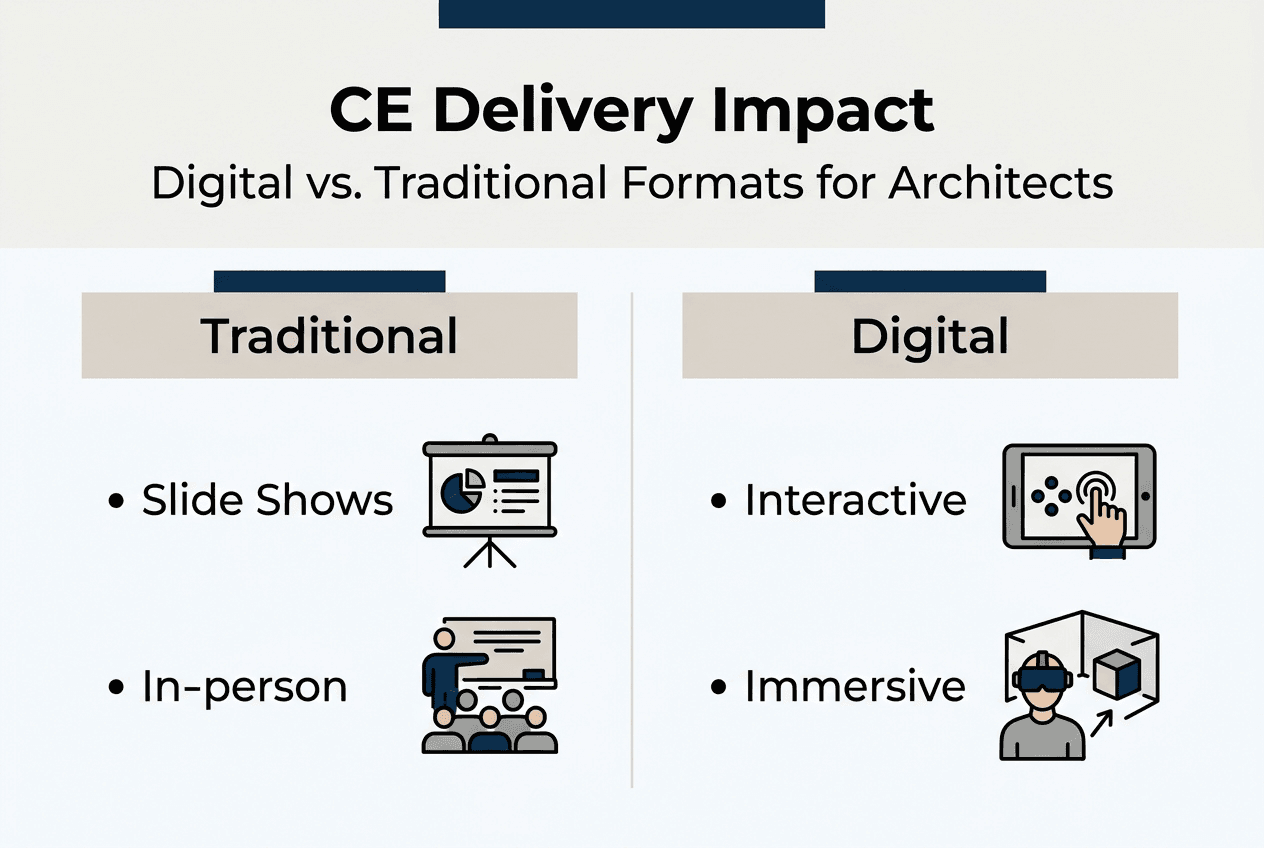
Traditional continuing education courses rely heavily on slide presentations that struggle to maintain attention and often result in poor knowledge retention. Architects sit through dozens of similar presentations annually, creating fatigue with conventional formats. The challenge for manufacturers is breaking through this monotony with delivery methods that genuinely engage and educate.
Immersive digital continuing education represents a significant evolution in course delivery. These experiences use interactive 3D models, product simulations, and scenario based learning to create active participation rather than passive consumption. When architects manipulate virtual building assemblies, test different material configurations, or solve design challenges through interactive exercises, they retain information at dramatically higher rates than slide based learning.
The retention difference stems from fundamental adult learning principles. Active participation enhances retention because learners construct knowledge through experience rather than memorizing presented information. An architect who virtually installs acoustic panels in a simulated hotel corridor understands installation requirements and performance implications far better than one who viewed static images.
Interactive elements that boost engagement include:
- Clickable 3D models showing product assembly and installation sequences
- Performance calculators demonstrating how specification choices affect outcomes
- Virtual site visits exploring real world applications in completed projects
- Scenario based quizzes requiring architects to solve authentic design challenges
- Comparison tools enabling side by side evaluation of different solutions
Data clearly demonstrates the engagement advantage of interactive formats:
| Delivery Format | Average Completion Rate | Knowledge Retention After 30 Days | Specification Influence |
|---|---|---|---|
| Traditional slides | 62% | 28% | Low |
| Video with quizzes | 74% | 41% | Moderate |
| Immersive interactive | 89% | 67% | High |
The specification influence metric measures how frequently architects reference course content when making product selections. Immersive formats create memorable experiences that architects recall months later during actual project work. The visual and interactive nature of the learning creates stronger mental associations between design challenges and manufacturer solutions.
Digital delivery also enables data collection that improves targeting and follow up. You can track which course sections architects spend the most time on, which interactive elements they engage with repeatedly, and where they struggle with quiz questions. This behavioral data reveals genuine interests and knowledge gaps that inform sales conversations and future content development.
Pro Tip: Incorporate brief polls throughout courses asking architects about their current projects, common challenges, or preferred solutions. The responses provide valuable market intelligence while maintaining engagement through active participation.
The investment in optimized continuing education delivery pays returns through higher completion rates, better retention, and stronger specification influence. As the education market becomes increasingly competitive, delivery innovation differentiates manufacturer courses from generic alternatives.
Real world manufacturer examples and common pitfalls to avoid
Examining successful manufacturer continuing education programs reveals patterns worth replicating while highlighting mistakes that undermine course effectiveness. Leading hospitality manufacturers demonstrate how strategic course development translates educational engagement into measurable specification increases.
Armstrong Ceilings created a course focused on ceiling and wall solutions for transportation venues, earning one learning unit with HSW credit. The content addressed acoustic performance and sustainability in high traffic environments like airports and train stations, applications directly relevant to hotel lobbies and conference centers. By teaching objective performance criteria first, then demonstrating how their products meet those standards, Armstrong positioned their solutions as the logical choice for architects facing similar challenges.
AZEK developed continuing education around fire resistant PVC applications in commercial settings. Rather than promoting product features, the course educated architects about fire code requirements, testing standards, and performance benchmarks for exterior trim and millwork. The educational approach built credibility that pure product promotion never achieves, resulting in specification preference when architects encountered projects requiring fire resistant materials.
National Gypsum focused their course on creating stronger, safer walls in hospitality guest areas. The content covered impact resistance requirements, sound transmission class ratings, and assembly details for high performance wall systems. By grounding product recommendations in objective performance data and code compliance, National Gypsum earned trust that translated to specifications.
| Manufacturer | Course Focus | Format | HSW Credit | Specification Impact |
|---|---|---|---|---|
| Armstrong Ceilings | Acoustics in transport venues | Live presentation | Yes | High in hotel lobbies |
| AZEK | Fire resistant PVC applications | On demand video | Yes | Increased exterior specs |
| National Gypsum | Guest room wall assemblies | Webinar series | Yes | Preferred wall systems |
These successful accreditation examples share common characteristics. Each course prioritizes education over promotion, addresses genuine architect challenges, includes robust technical content with code references, and positions products as solutions to objectively defined problems.
Conversely, common pitfalls that doom courses include:
- Leading with product features instead of design challenges
- Ignoring building codes and performance standards
- Focusing narrowly on one product rather than broader application knowledge
- Using promotional language that triggers accreditation rejection
- Failing to provide objective performance data and comparisons
The most frequent mistake is excessive promotional content that prioritizes sales messaging over education. Architects immediately recognize when a course exists primarily to promote products rather than teach valuable knowledge. This recognition destroys credibility and ensures the course generates minimal specification impact even if it achieves accreditation.
Another critical error involves neglecting codes and standards. Architects need practical guidance on meeting regulatory requirements. Courses that skip code discussion in favor of product specifications miss the opportunity to demonstrate how manufacturers help architects solve compliance challenges. The most effective courses teach the code requirements thoroughly, then show how specific products simplify compliance.
Pro Tip: Include real project case studies showing how other architects successfully applied the principles you’re teaching. Concrete examples make abstract concepts tangible while demonstrating your products in authentic contexts.
Manufacturers who study continuing education best practices and learn from both successful examples and common failures position themselves for course development success. The difference between courses that drive specifications and those that waste resources often comes down to understanding these proven patterns.
Boost your hospitality brand with accredited CE courses
Creating continuing education courses that genuinely engage architects and drive specifications requires specialized expertise in both hospitality manufacturing and accreditation compliance. The process involves strategic topic selection, rigorous content development, careful accreditation navigation, and ongoing promotional optimization.
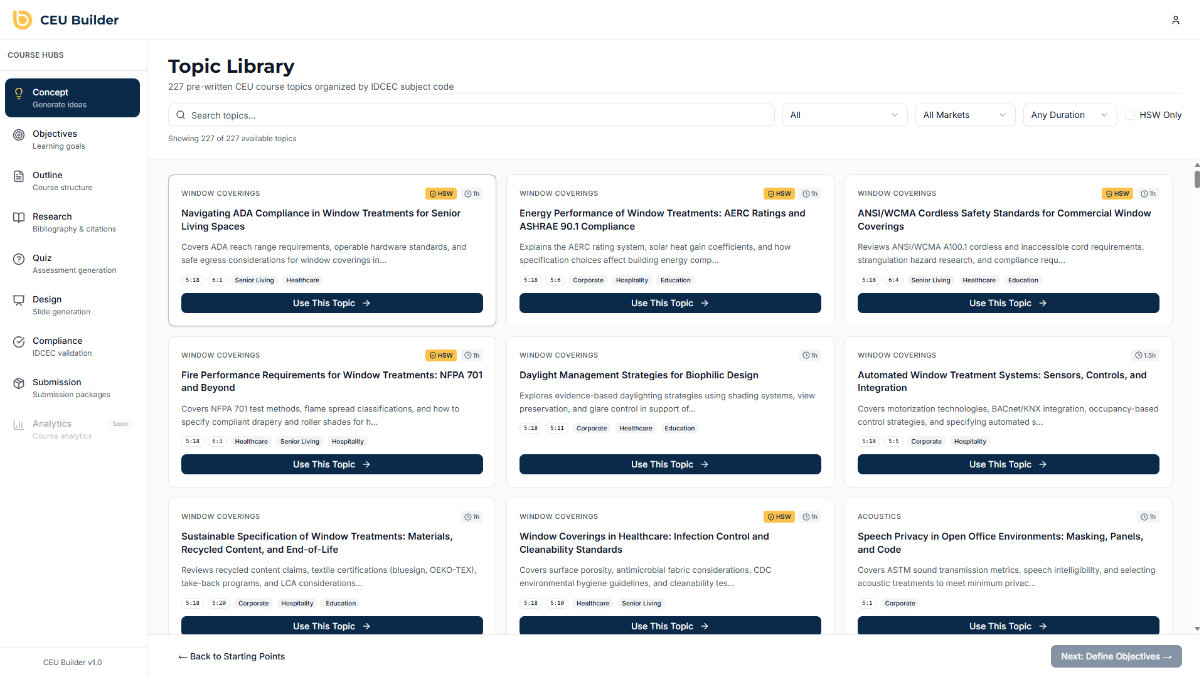
CEU Builder partners with hospitality manufacturers to transform continuing education from compliance exercise into demand generation engine. Our proven methodology compresses traditional six month development timelines into four to six weeks while maintaining a perfect first pass accreditation rate. We handle the complete process from initial strategy through final approval, ensuring your courses meet both IDCEC standards and business objectives.
Our course development services include comprehensive topic research aligned with architect search behavior, full instructional design and content creation, slide deck development optimized for engagement, and complete accreditation submission management. We build courses that architects want to take and that measurably influence their specification decisions.
For manufacturers seeking guidance on the accreditation process, our compliance resources explain exactly what IDCEC requires and how to structure content for approval. We also offer optimization strategies that maximize course impact through strategic promotion, data analysis, and continuous improvement.
Frequently asked questions
What are learning units and HSW credits?
Learning units quantify the educational credit architects earn through continuing education courses. One learning unit typically represents one hour of structured learning focused on professional practice topics. HSW credits specifically address health, safety, and welfare subjects directly related to protecting public wellbeing through sound architectural design. Architects must earn a minimum number of HSW credits within their total annual learning unit requirement, making HSW eligible courses particularly valuable.
How can hospitality manufacturers choose the right CE course format?
Lunch and learn presentations work well for direct engagement with architectural firms, enabling personal relationship building and immediate feedback. Webinars provide broader reach to remote audiences while maintaining live interaction through polls and Q&A sessions. On demand video courses offer maximum flexibility, allowing architects to complete education on their own schedules without coordinating live attendance. Immersive digital experiences using interactive technology deliver the highest engagement and retention but require greater development investment. Consider your content complexity, target audience preferences, and available resources when selecting format.
What mistakes should manufacturers avoid when creating CE courses?
Avoid excessive promotional content that prioritizes product features over educational value, as this triggers accreditation rejection and destroys credibility with architects. Include thorough coverage of relevant building codes, performance standards, and industry best practices rather than focusing narrowly on product specifications. Ensure content meets HSW criteria by addressing health, safety, and welfare topics directly relevant to protecting building occupants. Provide objective performance data and acknowledge alternative solutions rather than presenting only your products as viable options. Following these guidelines dramatically improves both accreditation success and specification impact.
Recommended
