

How to launch a CEU program that drives architect engagement

Hospitality product manufacturers face a persistent challenge: architects and designers control specifications worth billions annually, yet traditional marketing approaches fail to influence their decisions effectively. Continuing Education Units (CEUs) solve this problem by positioning manufacturers as educators rather than vendors, creating 45-60 minutes of focused attention from specification decision-makers who need these credits for professional licensing. This guide walks you through launching a CEU program designed specifically to drive architect engagement and increase specifications in hospitality projects.
Table of Contents
- Key takeaways
- Preparing to launch your CEU program: registration and defining purpose
- Developing CEU content: crafting engaging and compliant materials
- Submitting, promoting, and delivering your CEU program effectively
- Measuring success and optimizing your CEU program for specifications
- How CEU Builder helps hospitality manufacturers create effective courses
- How long does it take to get CEU course approval?
- What are the common pitfalls when launching CEU programs?
- How can hospitality manufacturers measure CEU program success?
Key Takeaways
| Point | Details |
|---|---|
| Provider registration required | Become a registered provider with accrediting bodies such as AIA CES or IDCEC to issue credits and be recognized as an educational source. |
| Define learning purpose | Before content, identify genuine knowledge gaps architects face in hospitality projects and frame objectives around solving these problems. |
| Set clear objectives | Create specific objectives that describe what participants will know or do after completing the course and align with licensure requirements. |
| Choose effective formats | Select formats like in person, live webinars, or self paced courses to balance engagement, reach, and production effort. |
| Maintain rigorous records | Keep attendance, materials, certificates, and feedback for at least seven years to satisfy AIA and IDCEC auditing standards. |
Preparing to launch your CEU program: registration and defining purpose
Before creating any course content, you must become a registered provider with accrediting bodies like AIA CES or IDCEC. This involves submitting an application, paying annual subscription fees, and agreeing to maintain standards for record retention and course quality. Registration establishes your organization as a legitimate education provider and enables you to issue credits that architects can report to licensing boards. The process typically takes 2-4 weeks and requires documentation proving your organization’s stability and commitment to educational standards.
Once registered, define educational purpose by identifying genuine knowledge gaps architects face in hospitality projects. Effective topics address technical challenges like waterproofing in wet hospitality environments, acoustic performance in open-plan restaurants, or material durability in high-traffic hotel lobbies. Avoid topics that simply showcase product features. Instead, frame learning objectives around problems architects need to solve, with your products positioned as solutions within broader educational context.
Set specific learning objectives that align with continuing education requirements. Objectives should describe what participants will know or be able to do after completing the course. For example: “Identify three code-compliant acoustic treatments for hospitality dining spaces” or “Evaluate material performance criteria for senior living facility furnishings.” These objectives guide content development and provide the framework accreditors use to evaluate your course.
Choose your course format based on audience preferences and internal capabilities. Options include in-person presentations at AIA chapters, live webinars, or self-paced online courses. In-person formats create direct engagement but limit geographic reach. Webinars scale better but require scheduling coordination. Self-paced courses offer maximum flexibility but need more sophisticated content production. Most manufacturers start with live formats to test content before investing in self-paced production.
Pro Tip: Anticipate AIA auditing standards by maintaining detailed records from day one. Keep attendance logs, presentation materials, certificates issued, and participant feedback for at least seven years. Accreditors randomly audit providers, and incomplete records can result in losing your provider status.
This comparison helps you evaluate registration requirements and format trade-offs:
| Provider Type | Annual Fee | Approval Timeline | Course Format Options | Primary Audience |
|---|---|---|---|---|
| AIA CES | $500-$1,200 | 2-4 weeks | In-person, webinar, self-paced | Architects (all sectors) |
| IDCEC | $750-$1,500 | 2-4 weeks | In-person, webinar, self-paced | Interior designers (commercial focus) |
| Format | Pros | Cons | Best For |
|---|---|---|---|
| In-Person | High engagement, relationship building | Limited reach, travel costs | Local market penetration |
| Live Webinar | Scalable, lower cost per attendee | Scheduling challenges, tech issues | National audience development |
| Self-Paced | 24/7 availability, maximum flexibility | Higher production cost, less interaction | Established programs with proven content |
Developing CEU content: crafting engaging and compliant materials
Effective CEU content balances educational value with accreditation compliance. Develop 60-minute material that provides one Learning Unit, including detailed speaker notes, case studies demonstrating real-world applications, and minimal branding. Accreditors reject courses that read like product brochures. Your content must teach specification criteria, code requirements, and performance evaluation methods that happen to favor your products through objective technical superiority rather than promotional claims.
Follow this six-step process for compliant content development:
-
Research architect search behavior to identify topics they actively seek rather than topics you want to teach. Use tools like Google Trends, architect forums, and AIA chapter feedback to validate demand.
-
Structure content around learning objectives established during planning. Each section should directly support one or more objectives, with clear connections between content and stated learning outcomes.
-
Incorporate case studies from completed hospitality projects showing how specification decisions impacted project success. Use before/after comparisons, cost-benefit analyses, and performance data to illustrate key points.
-
Include code references and technical standards relevant to hospitality applications. Cite IBC requirements, ADA guidelines, and industry standards that architects must navigate when specifying products.
-
Add interactive elements like polls, Q&A opportunities, or scenario-based problem-solving exercises that keep participants engaged beyond passive listening.
-
Minimize promotional content to less than 10% of total course time. Brief mentions of how your products meet discussed criteria are acceptable; extended product demonstrations are not.
Pro Tip: Use AI tools like CEU Builder to accelerate outline creation and compliance checks, reducing development time from weeks to 6-12 hours. Custom GPT tools handle routine tasks like bibliography formatting and exam question generation while you focus on strategic content that differentiates your expertise.
Consider incorporating immersive technologies like VR or AR to boost retention. Architects who experience products in simulated hospitality environments retain specification criteria better than those who view static slides. While more expensive to produce, immersive formats generate significantly higher engagement and specification conversion rates, particularly for complex products requiring spatial understanding.

Submitting, promoting, and delivering your CEU program effectively
After content development, submit course materials online for accreditation review. Upload your presentation deck, speaker notes, learning objectives, exam questions, and bibliography. Review timelines typically run 2-4 weeks, though Health, Safety, and Welfare (HSW) courses face more stringent scrutiny and may take longer. HSW designation increases course value to architects because these credits fulfill specific licensing requirements, but accreditors evaluate these courses more carefully for accuracy and depth.
Once approved, promote your course through multiple channels to maximize architect reach. Partner with AIA chapters to present at monthly meetings, gaining access to local architect communities actively seeking CEU opportunities. List courses in provider catalogs where architects search for relevant education. Leverage social media, particularly LinkedIn, to reach design professionals in your target markets. Promote courses at trade shows like HD Expo and NeoCon, where hospitality architects gather and expect educational programming.
Track attendance meticulously for both accreditation compliance and business intelligence. Issue certificates immediately after course completion, capturing participant data for CRM integration. Use platforms like HubSpot to attribute leads to specific courses, tracking which topics generate the most engagement and which participants later request specifications or quotes.
This table compares promotional channels by effectiveness:
| Channel | Reach | Cost | Lead Quality | Best Use Case |
|---|---|---|---|---|
| AIA Chapters | Local (50-200) | Low ($0-$500) | High | Geographic market penetration |
| Provider Catalogs | National (500-2,000) | Medium ($1,000-$3,000/year) | Medium | Broad awareness building |
| Trade Shows | Targeted (200-1,000) | High ($5,000-$15,000) | Very High | Face-to-face relationship development |
| Social Media | Variable (100-10,000+) | Low ($0-$2,000) | Medium | Ongoing engagement and remarketing |
| Email to House List | Existing contacts | Low ($0-$500) | High | Nurturing current relationships |
Top strategies to maximize delivery impact:
- Schedule courses during architect work hours (10am-2pm) rather than evenings to reduce no-show rates
- Offer courses quarterly rather than annually to create multiple engagement opportunities throughout the year
- Record live sessions for on-demand access, extending content lifespan and accommodating different learning preferences
- Create course series that build on each other, encouraging architects to complete multiple courses and deepen engagement
- Integrate CEU course delivery into existing sales processes so reps can offer education as part of specification conversations
Measuring success and optimizing your CEU program for specifications
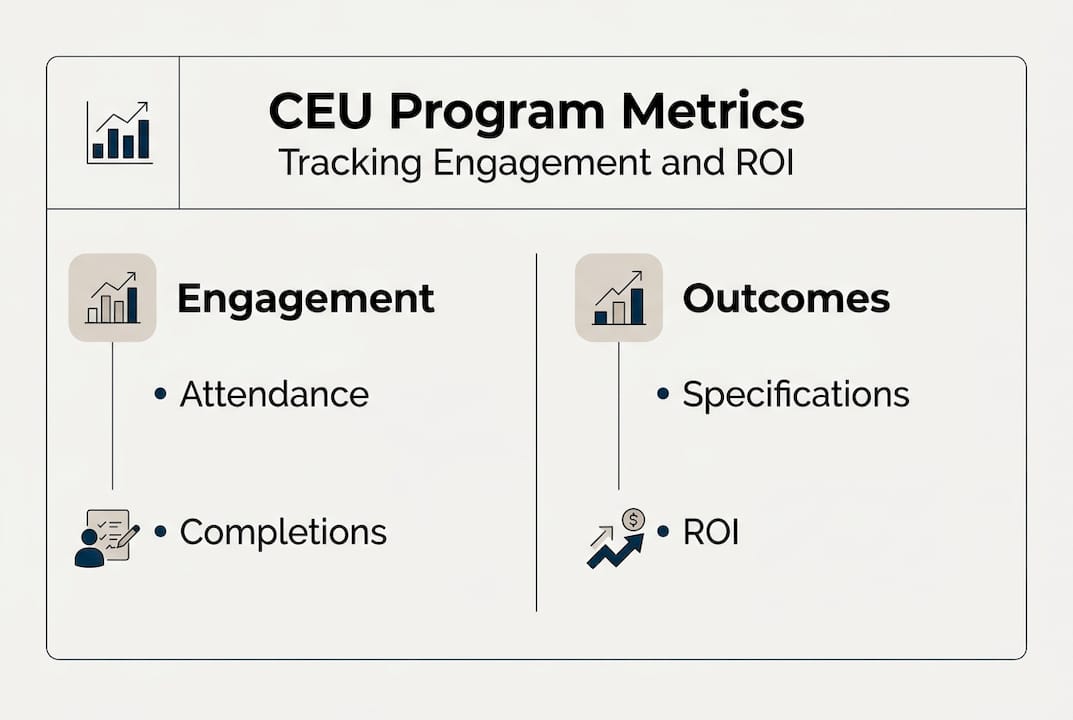
Effective measurement connects CEU participation to business outcomes. Track three primary metrics: specifications written by course participants, project dollar values influenced by those specifications, and attendee-to-contract conversion rates. CEU programs have generated $120M in attributed revenue for building product manufacturers who implement rigorous tracking systems connecting education to pipeline outcomes.
Compare traditional slide-based courses with immersive VR/AR formats on retention and specification impact. Immersive programs cost 3-5x more to produce but generate 40-60% higher specification conversion because participants remember spatial relationships and product applications better than abstract information from slides. For complex products like modular furniture systems or lighting installations, the ROI justifies the higher production investment.
Integrate CRM platforms to attribute leads and pipeline value to specific courses. Tag contacts who complete courses, track their progression through sales stages, and calculate average deal size from CEU-sourced leads versus other channels. This data proves program value to executives and guides content investment decisions. Manufacturers typically see CEU-sourced leads convert 2-3x faster than cold outreach because education pre-qualifies interest and builds credibility.
Common pitfalls to avoid:
- Creating product-focused content that gets rejected during accreditation review
- Failing to promote approved courses, leaving valuable educational assets unused
- Neglecting attendance tracking, making ROI measurement impossible
- Treating CEU as one-time project rather than ongoing program requiring iteration
- Ignoring participant feedback that reveals content gaps or topic opportunities
Pro Tip: Integrate data collection early by building tracking into course registration and certificate issuance. Capture participant contact information, firm name, project types, and geographic location. Survey participants immediately after completion about specification intent and current project needs. This intelligence enables targeted follow-up and reveals which content drives the most specification interest.
Expert optimization tips:
- Refresh course content annually to maintain accuracy and relevance as codes and standards evolve
- A/B test different course titles and descriptions to identify messaging that maximizes registration
- Create topic clusters where multiple courses address related aspects of hospitality design challenges
- Develop advanced courses for architects who completed introductory material, deepening engagement over time
- Partner with complementary manufacturers for co-branded courses that provide comprehensive solutions
This comparison shows ROI differences between formats:
| Format Type | Development Cost | Annual Reach | Specification Conversion | 3-Year ROI |
|---|---|---|---|---|
| Traditional Slides | $8,000-$12,000 | 150-300 architects | 2-3% | 3-5x |
| Immersive VR/AR | $25,000-$40,000 | 100-200 architects | 5-8% | 8-12x |
| Hybrid (Slides + Video) | $15,000-$20,000 | 200-400 architects | 3-5% | 5-8x |
How CEU Builder helps hospitality manufacturers create effective courses
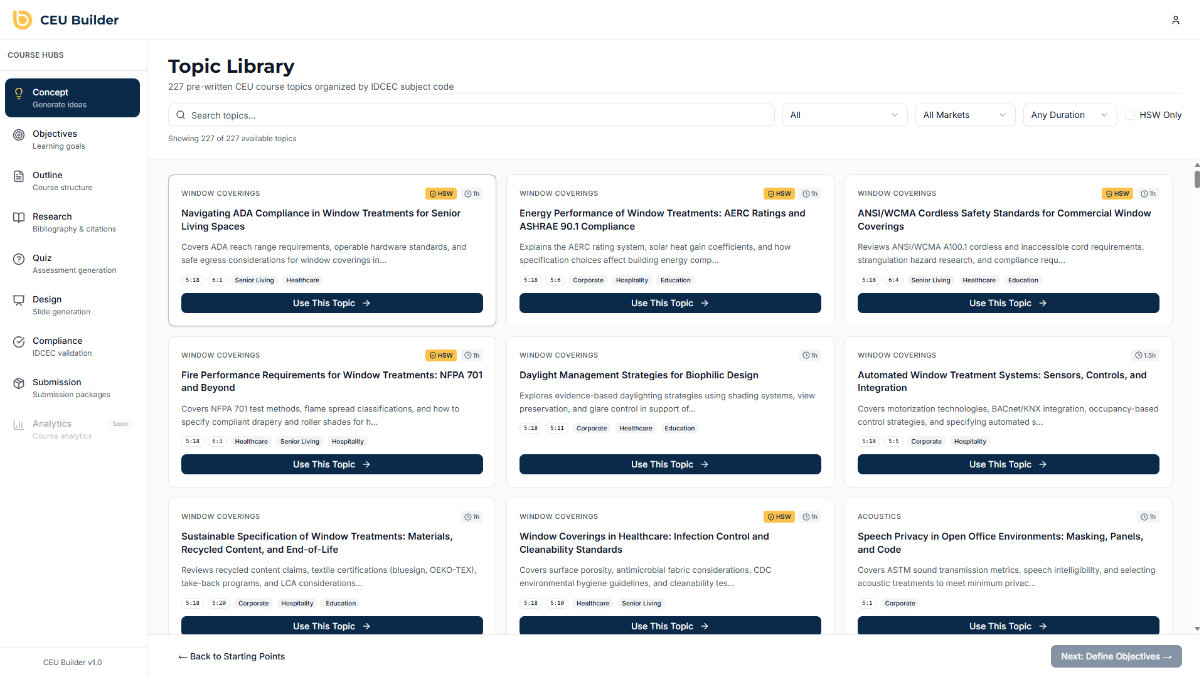
CEU Builder accelerates course development through AI-powered tools and expert guidance specifically designed for hospitality manufacturers targeting architects and interior designers. The platform handles complex IDCEC accreditation requirements that typically delay programs by months, compressing development timelines from 90-180 days to 4-6 weeks through reverse-engineered processes and custom GPT automation.
Key platform benefits:
- First-pass IDCEC approval guaranteed through systematic compliance built into every development stage
- Expert instructional design that balances educational value with specification-driving content
- Complete submission management handling technical filing requirements and reviewer communications
- Immersive course design capabilities incorporating VR/AR elements for maximum retention
- Lifetime platform access for ongoing course delivery and certificate management
Manufacturers using CEU Builder have achieved 10x ROI by connecting course completions directly to specification requests and project wins. The platform’s tracking infrastructure reveals which architects engage with which topics, enabling precise targeting and personalized follow-up that traditional marketing cannot match.
How long does it take to get CEU course approval?
Typical accreditation review takes 2-4 weeks after you submit complete materials to AIA CES or IDCEC. HSW courses requiring Health, Safety, and Welfare designation face stricter evaluation and may extend to 4-6 weeks as reviewers verify technical accuracy and code compliance. Timeline depends on submission completeness, with missing documentation or unclear learning objectives triggering revision requests that add weeks to the process.
What are the common pitfalls when launching CEU programs?
Overpromoting products rather than educating leads to accreditation rejection and wasted development investment. Courses reading like sales presentations fail to meet educational standards and damage manufacturer credibility with architects who expect genuine learning value. Ignoring attendee tracking and CRM integration limits ROI measurement, making it impossible to prove program value or optimize content based on specification outcomes. Underestimating content depth requirements results in rejected submissions requiring complete rebuilds.
How can hospitality manufacturers measure CEU program success?
Track specifications written by course participants, project dollar values those specifications represent, and lead-to-contract conversion rates compared to other marketing channels. Use CRM tools like HubSpot for attendance tracking and pipeline attribution, tagging contacts who complete courses and monitoring their progression through sales stages. Benchmark performance against industry data showing successful programs generate 2-3x faster conversion than cold outreach and produce average deal sizes 40-60% higher due to pre-qualified interest and established credibility through education.
Recommended
