

Step-by-step CEU compliance guide for IDCEC accreditation

Hospitality manufacturers face a persistent challenge: architects and designers control billions in product specifications, but traditional marketing struggles to influence their decisions. IDCEC-accredited CEU courses offer a strategic solution, positioning your brand as an educational authority while fulfilling the continuing education requirements design professionals need anyway. This guide walks you through the complete compliance process, from provider registration through course delivery, ensuring your CEU courses meet every IDCEC requirement while maximizing your influence on specifications.
Table of Contents
- Key takeaways
- Understanding the CEU compliance requirements for IDCEC accreditation
- Preparing your CEU course: development essentials and best practices
- Submitting your course and managing approvals step by step
- Troubleshooting common CEU compliance challenges and ensuring ongoing success
- Streamline your CEU compliance with CEU Builder
- Frequently asked questions
Key Takeaways
| Point | Details |
|---|---|
| Provider registration | Manufacturers must register as an IDCEC provider before submitting any courses, and the registration typically takes one to two weeks. |
| Course development requirements | IDCEC compliant courses must include clear learning objectives of three to five measurable outcomes, comprehensive assessments of ten to fifteen questions for a one hour course with a passing threshold of seventy to eighty percent, accurate citations using academic style references, and a structured content flow from introduction to application that engages designers while avoiding overt product promotion and aligns with Health Safety and Welfare topics. |
| Provider types and costs | Provider options include Individual Corporate and Preferred with varying economics and benefits: Individual offers lower annual fees but limited scalability, Corporate charges four hundred twenty dollars per year and may be waived the first year if you are an ASID partner, and Preferred costs six thousand dollars per year with a five hundred dollar first year discount and is suited for high volume programs. |
| Strategic CEU value | IDCEC CEUs help hospitality manufacturers position their brand as an educational authority and improve influence on product specifications among architects and designers. |
Understanding the CEU compliance requirements for IDCEC accreditation
Before developing any course content, you must understand what IDCEC accreditation requires and how provider types affect your compliance obligations. CEU stands for Continuing Education Unit, representing 10 contact hours of instruction. IDCEC (Interior Design Continuing Education Council) is the primary accrediting body for continuing education courses targeting interior designers and architects in commercial spaces.
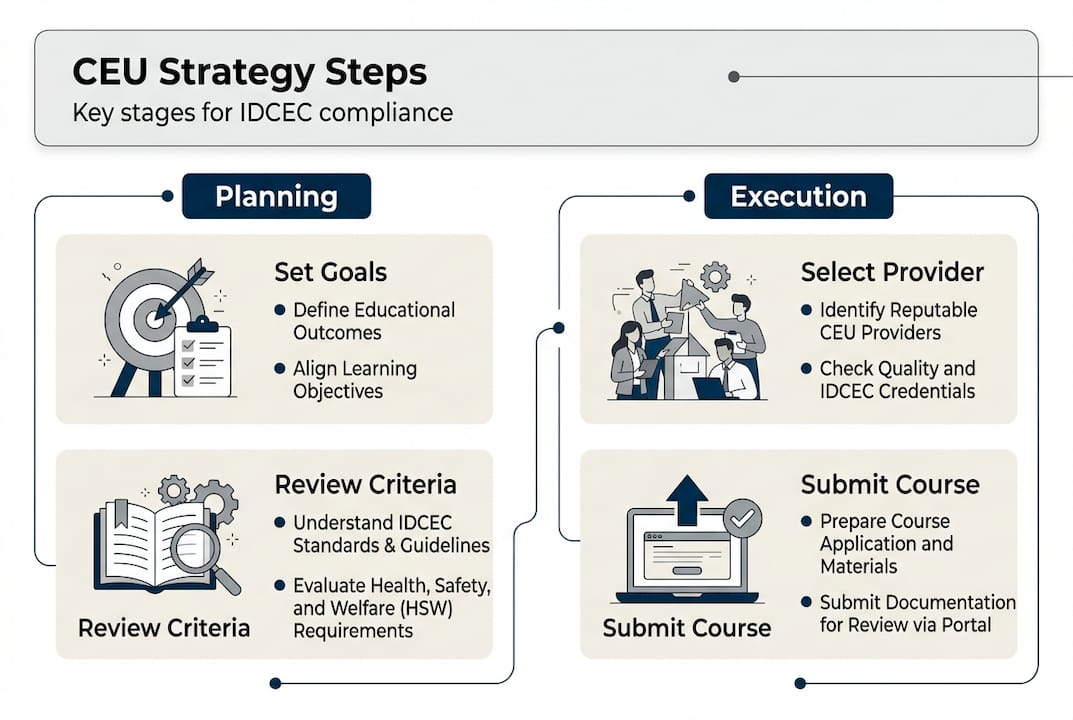
To develop IDCEC-accredited CEU courses, manufacturers must first register as an IDCEC provider (Individual, Corporate, or Preferred). This registration is mandatory before any course submission can proceed. Each provider type carries different fee structures and benefits:
- Individual Provider: Best for independent consultants or single-course creators. Lower annual fees but limited scalability for manufacturers planning multiple courses.
- Corporate Provider: Standard option for manufacturers. Annual registration fee of $420, waived for the first year if you’re an ASID partner. Suitable for brands developing 1-5 courses annually.
- Preferred Provider: Premium tier at $6,000 annually with a $500 first-year discount. Designed for organizations planning high-volume course development (6+ courses per year) with enhanced support and visibility.
The provider registration process requires completing detailed paperwork, establishing your organization’s credentials, and demonstrating commitment to educational quality. This step typically takes 1-2 weeks and must be completed before any course development work translates into accredited credits. Understanding the IDCEC approval process early prevents costly missteps during course creation.
Manufacturers should evaluate their multi-year CEU strategy before selecting a provider type. If you plan to build a comprehensive educational library across product lines, Preferred Provider status delivers better economics and positioning despite the higher upfront cost.
Preparing your CEU course: development essentials and best practices
Once provider registration is complete, focus shifts to course development. IDCEC has specific requirements that every course must meet for accreditation approval. Missing even one element typically results in rejection and restart delays.
Every compliant course must include:
- Clear learning objectives: 3-5 measurable outcomes specifying exactly what participants will know or be able to do after completion. These must align with Health, Safety, Welfare (HSW) topics whenever possible, as architects prioritize these subjects for professional development.
- Comprehensive assessments: Quiz or exam questions testing retention and application of course content. Typically 10-15 questions for a one-hour course, with passing threshold of 70-80%.
- Accurate citations: Bibliography documenting all factual claims, statistics, and technical information. IDCEC requires academic-standard referencing to ensure content credibility.
- Structured content flow: Logical progression from introduction through main concepts to practical application. Content must engage design professionals while avoiding overt product promotion.
The most successful courses emphasize HSW topics because these subjects directly address the specification criteria architects use when evaluating products. When your educational content teaches fire safety, acoustic performance, or accessibility compliance, you’re training architects to think about the exact factors where your products excel.
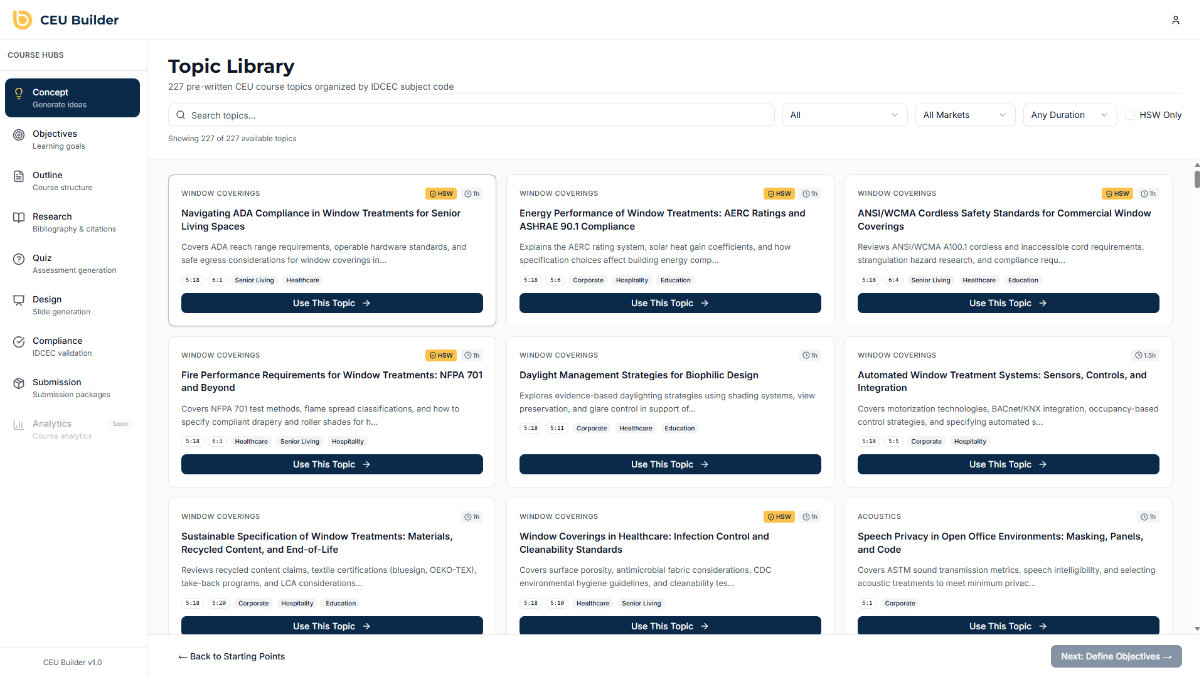
Tools like CEU Builder automate outlines, quizzes, and compliance checks for IDCEC, compressing development timelines from months to weeks. Automation handles routine formatting and compliance verification while preserving human expertise for strategic content decisions.
Common pitfalls that delay approval include:
- Overly promotional content that reads like a sales presentation rather than education
- Learning objectives that are vague or unmeasurable
- Insufficient citations or improperly formatted references
- Assessments that don’t adequately test the stated learning objectives
- Content that lacks sufficient depth or technical rigor for professional audiences
Pro Tip: Leverage pre-built templates and AI tools to accelerate development from months to hours. The key is using automation for structure and compliance while investing human expertise in content that positions your products as solutions to real design challenges. Review the IDCEC CEU course development checklist before starting to ensure you capture every required element.

Submitting your course and managing approvals step by step
With course development complete, you’re ready to navigate the submission and approval process. Following these steps precisely prevents delays and ensures first-pass approval.
- Log into your IDCEC provider account on idcec.org using the credentials established during provider registration.
- Complete the course submission form with all required metadata including course title, description, learning objectives, and delivery format.
- Upload all course materials including slide deck, speaker script, assessment questions, and bibliography.
- Pay the appropriate approval fee based on your delivery format (see fee table below).
- Submit for IDCEC review and monitor your account for reviewer questions or requests for clarification.
- Receive approval notification typically within 4-6 weeks if all requirements are met.
- Obtain your CC- course code which serves as the official identifier for tracking and reporting.
| Delivery Format | Approval Fee | Typical Use Case |
|---|---|---|
| In-class/Live presentation | $11 | Lunch-and-learns, trade show presentations, rep-delivered sessions |
| Distance learning/On-demand | $60 | Video courses, webinars, self-paced online modules |
The fee difference reflects IDCEC’s administrative burden for verifying distance learning compliance. In-class courses are simpler to audit because delivery happens in controlled environments. Distance learning requires additional verification mechanisms to ensure participants actually complete the content.
Upon approval, IDCEC assigns your course a unique CC- code (example: CC-123456). This code appears on all certificates and enables architects to report credits to their licensing boards. You must include this code in all course marketing and delivery materials.
Delivery and reporting requirements vary by format. For in-class courses, you must:
- Track attendance with sign-in sheets capturing participant names and contact information
- Issue certificates to all participants who complete the full course duration
- Maintain records for potential IDCEC audits (typically 3-5 years)
- Report aggregate attendance data to IDCEC quarterly or annually based on your provider agreement
For distance learning courses, additional requirements include:
- Implementing systems to verify identity and prevent certificate fraud
- Tracking completion metrics including time spent and assessment scores
- Issuing certificates only after participants pass the required assessment
- Providing detailed reporting to IDCEC on demand
Pro Tip: Maintain thorough records and use digital tools for accurate reporting to avoid compliance issues. Spreadsheet tracking is sufficient for small programs, but manufacturers planning high-volume delivery should invest in learning management systems that automate certificate generation and reporting. Reference the IDCEC accreditation step-by-step guide for detailed submission workflows.
Troubleshooting common CEU compliance challenges and ensuring ongoing success
Even with careful preparation, manufacturers encounter predictable challenges during CEU program development and delivery. Understanding these obstacles in advance helps you build preventive systems.
Frequent compliance pitfalls include:
- Incomplete documentation: Missing bibliography entries, vague learning objectives, or insufficient assessment questions trigger automatic rejections. Build comprehensive checklists before submission.
- Missed reporting deadlines: IDCEC requires periodic reporting on course delivery and attendance. Late reports can result in provider status suspension.
- Content drift over time: Courses approved in 2026 may fall out of compliance by 2028 as IDCEC updates requirements or industry standards evolve. Schedule annual content audits.
- Certificate management failures: Issuing certificates to participants who didn’t complete requirements or failing to include proper CC- codes creates audit risk.
- Inadequate record retention: IDCEC can audit your program years after course delivery. Maintain organized records of all attendance, certificates, and course materials.
To maximize specification success, prioritize Health, Safety, Welfare content in your course topics. While no empirical benchmarks exist for approval rates, the high volume of courses (3500+) suggests the process is viable for manufacturers who prioritize HSW topics for specifier appeal. Architects actively seek courses addressing life safety, accessibility, sustainability, and building performance because these topics directly support their professional responsibilities.
High-volume course offerings amplify manufacturer influence exponentially. A single course creates one touchpoint with architects. Five courses covering different product categories or application scenarios create five opportunities to position your brand as the educational authority. This breadth makes your company the default reference when architects face design challenges in your domain.
Recommended strategies for sustainable success:
- Leverage compliance guides and digital workflows to maintain consistency across multiple courses and delivery instances
- Establish quarterly content review cycles to identify courses needing updates or refreshes
- Integrate CEU data with your CRM to track which architects engage with which topics, enabling precise follow-up
- Train sales teams on how to promote courses without aggressive selling, positioning education as a value-add service
- Monitor completion rates and feedback to identify which topics resonate most strongly with your target audience
Transparent record-keeping protects against audit risk while providing valuable business intelligence. When you track which architects complete which courses, you’re building a database of specification-capable decision-makers who have self-identified interest in your product categories. This data drives targeted outreach far more effective than cold prospecting. Consult the CEU compliance challenges guide for detailed troubleshooting frameworks.
Streamline your CEU compliance with CEU Builder
Navigating IDCEC compliance requirements consumes significant time and expertise that most hospitality manufacturers lack internally. CEU Builder eliminates this friction through automation, industry specialization, and a 100% first-pass approval guarantee.
Our platform handles every compliance element automatically, from bibliography formatting to assessment question generation to submission documentation. You focus on strategic positioning while we ensure technical requirements are met perfectly. The result is 4-6 week timelines from kickoff to approved course, compared to 6-12 months for manufacturers attempting in-house development.
For hospitality manufacturers targeting architects and designers, we provide tailored solutions that connect your product advantages to the specification criteria design professionals use on real projects. Our courses teach rather than sell, positioning your brand as the expert resource architects remember when projects require your product category.
Explore our IDCEC accreditation guide for detailed process walkthroughs, review our IDCEC course approval guide for submission best practices, and discover why manufacturers are ditching attendance metrics in favor of specification-focused CEU strategies. CEU Builder transforms compliance from obstacle into competitive advantage.
Frequently asked questions
How long does the IDCEC course approval process take?
Typical approval timelines run 4-6 weeks from submission to final approval, assuming your course meets all compliance requirements on first review. Thorough preparation before submission is critical because rejected courses restart the entire timeline. CEU Builder’s 100% first-pass approval rate eliminates this risk by building compliance into every development stage. Manufacturers attempting in-house development without IDCEC expertise often face 6-12 month delays from initial concept to approved course.
What are the costs associated with becoming an IDCEC provider?
Corporate registration costs $420 annually, waived for the first year if you’re an ASID partner. Preferred Provider status costs $6,000 annually with a $500 first-year discount. Beyond registration, each course submission requires approval fees of $11 for in-class delivery or $60 for distance learning formats. These fees cover IDCEC’s administrative review and ongoing accreditation maintenance. Budget for annual provider renewal fees plus per-course submission costs when planning your CEU program economics.
How can hospitality manufacturers maximize architect and designer engagement with CEUs?
Deliver courses through interactive formats like lunch-and-learns that provide value beyond credit fulfillment. IDCEC CEUs open doors to architects and designers via these sessions, influencing specifications without overt sales pitches. Prioritize Health, Safety, Welfare topics that address real design challenges architects face on hospitality projects. Content teaching acoustic performance, fire safety, accessibility compliance, or sustainability connects directly to specification criteria. Subtle influence through education builds trust and preference that translates to specifications months later when architects start projects requiring your product category.
What happens if my course gets rejected during IDCEC review?
Rejection requires identifying the specific compliance gaps, revising course materials to address reviewer concerns, and resubmitting for another full review cycle. This process typically adds 6-12 weeks to your timeline and wastes internal resources on rework. Common rejection reasons include insufficient learning objectives, inadequate assessments, missing citations, or overly promotional content. Working with specialized providers who understand IDCEC requirements eliminates this risk through built-in compliance verification before submission.
Can I update an approved course or do I need to resubmit for accreditation?
Minor updates like correcting typos or refreshing statistics typically don’t require resubmission. Substantial changes affecting learning objectives, content structure, or delivery format require submitting the revised course for new approval. IDCEC distinguishes between administrative updates and material changes that impact educational value. When in doubt, contact IDCEC directly or work with a compliance specialist to determine whether your planned updates trigger resubmission requirements. Annual content audits help identify when refreshes become necessary to maintain relevance and compliance.
Recommended
