

IDCEC CEU courses yield 10x ROI for hospitality brands

Most hospitality manufacturers view continuing education courses as compliance checkboxes that fulfill architect requirements without driving real business outcomes. That’s a costly misconception. When properly designed and strategically deployed, IDCEC-accredited CEU courses transform into demand generation engines that influence specifications, shorten sales cycles, and deliver measurable returns up to 10 times the development investment. This guide explores the IDCEC CEU standards that separate effective courses from generic content, the accreditation requirements that ensure industry recognition, and the strategic approaches that convert educational touchpoints into specification requests and revenue growth.
Table of Contents
- Introduction To IDCEC And CEU Standards
- Detailed IDCEC CEU Accreditation Requirements
- Aligning CEU Course Content With Architect Needs
- Common Pitfalls And Accreditation Failures Explored
- Accelerating Accreditation And Market Entry
- Measuring Business Impact Of CEU Programs
- Practical Steps To Develop And Submit IDCEC CEU Courses
- How CEU Builder Accelerates Your IDCEC Accreditation
- Frequently Asked Questions About IDCEC CEU Accreditation
Key takeaways
| Point | Details |
|---|---|
| IDCEC requires non-proprietary content and measurable learning objectives aligned with design professional competencies. | Promotional material triggers automatic rejection during accreditation review. |
| Inexperienced providers face 30%+ first-time rejection rates, delaying market entry by 6-12 months. | Every failed submission wastes internal resources and postpones revenue impact. |
| Aligning course topics with actual architect search behavior increases specification inquiries by 40%. | Strategic content design connects product features directly to design challenges architects face. |
| A single $10,000 CEU course generating 200 completions typically produces 4 specifications worth $100,000+ each. | The perpetual shelf life creates sustained lead generation beyond initial development cost. |
Introduction to IDCEC and CEU standards
IDCEC (Interior Design Continuing Education Council) serves as the authoritative accreditation body for continuing education credits in the interior design profession across the United States and Canada. Design professionals rely on IDCEC-recognized courses to fulfill annual licensing and certification requirements mandated by professional organizations including ASID, IIDA, and IDC.
The credit calculation system operates on a straightforward formula: 1 CEU unit equals 50 minutes of instructional content. A 60-minute course awards 1.2 CEU credits, while a 90-minute presentation generates 1.8 credits. This standardized measurement ensures consistency across all approved providers.
For hospitality manufacturers entering the CEU space, understanding baseline compliance requirements prevents costly rejections:
- Non-proprietary content rules prohibit promotional material or product-specific marketing disguised as education
- Learning objectives must be clear, measurable, and directly aligned with design professional competencies
- Course structure requires documented instructional design with defined outcomes
- Major design organizations recognize IDCEC CEUs for fulfilling continuing education requirements
Manufacturers who grasp these foundational standards position themselves to create courses that satisfy both accreditation bodies and architect learning needs. The CEU compliance requirements for hospitality manufacturers demand strategic planning from the initial concept stage.
Detailed IDCEC CEU accreditation requirements
IDCEC enforces rigorous criteria that separate compliant educational content from thinly veiled product promotion. Understanding these specific requirements before development begins eliminates the revision cycles that plague inexperienced providers.
Content restrictions form the first major hurdle. Proprietary promotional material is strictly prohibited under accreditation standards. Courses must teach design principles, application techniques, or industry knowledge without positioning specific brands or products as preferred solutions. Educational value supersedes marketing objectives.
Learning objectives require precise formulation:
- Each objective must state a measurable outcome using action verbs like “identify,” “analyze,” or “apply”
- Objectives connect directly to design professional competencies recognized by licensing boards
- Vague statements like “understand sustainability” fail to meet measurability standards
- Objectives guide both course content development and exam question creation
Exam requirements validate learner comprehension and academic rigor. Questions must test understanding rather than recall of promotional claims. The exam structure demonstrates that participants absorbed educational content and can apply concepts to real-world design scenarios.
Bibliography standards demand academic-level documentation. Every factual claim, statistic, or expert opinion requires proper citation in recognized format. Source quality matters as much as citation formatting.
Health, Safety, and Welfare (HSW) content carries special significance in the design profession. Courses seeking HSW credit designation must dedicate at least 75% of content to topics directly impacting occupant safety, building code compliance, or public welfare. HSW credit commands higher value among architects because many licensing jurisdictions require specific HSW credit hours annually.
Manufacturers who master these requirements streamline the path to IDCEC approval without sacrificing strategic business objectives.
Aligning CEU course content with architect needs
Strategic course design starts with understanding what architects actually search for and need to learn, not what manufacturers want to teach. This distinction separates demand-generating education from ignored compliance content.

Research into architect search behavior reveals high-demand topic areas. Using architect search data to select course topics increases completion rates by up to 25%. Design professionals seek practical knowledge that solves project challenges they face regularly: acoustic performance in open-plan restaurants, fire-rated material specifications for hotels, or sustainable material selection criteria for LEED projects.
Effective content strategy connects product features directly to design challenges:
- Frame technical specifications as solutions to architect pain points rather than product attributes
- Use real project scenarios that demonstrate application rather than theoretical concepts
- Structure learning objectives around specification criteria that favor your product category
- Emphasize HSW content to increase course acceptance and practical relevance
Courses linking product features to architect challenges generate 40% more specification inquiries compared to generic educational content. The connection happens because architects remember solutions to problems they encounter, not product specs presented in isolation.
Pro Tip: Build courses around actual specification case studies from completed hospitality projects. Architects engage more deeply with content showing real-world application versus hypothetical scenarios. Include project photos, specification challenges encountered, and solutions implemented to create memorable learning experiences.
The strategic approach to offering CEU courses to architects balances educational integrity with business objectives through careful topic selection and content framing.
Common pitfalls and accreditation failures explored
Understanding why courses fail accreditation prevents expensive delays and resource waste. The most common rejection triggers stem from fundamental misunderstandings about IDCEC requirements.
Proprietary content represents the leading rejection cause, affecting roughly 30% of submissions from inexperienced providers. Manufacturers struggle to distinguish between teaching specification criteria and promoting specific products. Phrases like “our superior solution” or comparative claims against competitors trigger automatic rejection.
Learning objectives fail when they lack measurability or relevance:
- “Understand acoustic performance” provides no measurable outcome
- “Identify three factors affecting reverberation time in restaurant environments” meets measurability standards
- Objectives disconnected from design professional competencies fail relevance tests
- Too many or too few objectives relative to course length raises compliance flags
Exam and bibliography deficiencies cause preventable rejections. Exam questions testing brand preference rather than concept application fail academic standards. Bibliographies missing proper formatting or relying on promotional materials rather than authoritative sources trigger rejection.
In-house development attempts frequently extend timelines by 6 to 12 months when teams lack IDCEC expertise. Marketing departments underestimate the complexity of compliance requirements and overestimate their ability to navigate accreditation processes without specialized knowledge.
Pro Tip: Conduct a thorough compliance audit before submitting any course to IDCEC. Check every learning objective for measurability, scan all content for proprietary language, verify bibliography formatting, and confirm exam questions test concepts rather than brand preference. Catching errors before submission saves months of revision cycles.
Manufacturers who understand how to manage CEU approvals for first-pass success avoid these costly mistakes through systematic compliance checking.
Accelerating accreditation and market entry
Traditional CEU development approaches create unnecessary delays that postpone revenue impact and extend time to market. Understanding the efficiency differences between development methods helps manufacturers choose the optimal path.
In-house development using internal marketing teams typically requires 6 to 12 months from concept to accreditation. The extended timeline reflects learning curves around IDCEC requirements, revision cycles after initial rejection, and competing priorities that delay progress. The 30%+ rejection rate for first-time submitters adds months to already lengthy timelines.
Third-party generic providers offer faster timelines but sacrifice hospitality industry expertise. These generalist firms understand IDCEC requirements but lack deep knowledge of architect needs in hotel, restaurant, or senior living design. The resulting courses achieve accreditation but generate minimal business impact because content fails to resonate with the target audience.
CEU Builder’s done-for-you service compresses development to 4-6 weeks with a 100% first-pass approval rate. The acceleration comes from reverse-engineered processes and custom tools that handle routine compliance tasks while preserving strategic thinking for content that differentiates manufacturers.
| Approach | Timeline | First-Pass Rate | Business Impact |
|---|---|---|---|
| In-house development | 6-12 months | ~70% | Variable, often low |
| Generic third-party | 3-6 months | ~85% | Moderate |
| CEU Builder | 4-6 weeks | 100% | High specification lift |
The strategic advantage extends beyond speed. Courses designed with both compliance and business goals in mind position manufacturers as industry experts while teaching specification criteria that favor their product categories.
Acceleration strategies include:
- Systematic compliance checking at every development stage
- Custom tools automating bibliography formatting and exam generation
- Deep hospitality industry expertise informing topic selection
- Proven processes eliminating revision cycles
Manufacturers following the fast IDCEC accreditation workflow reach market in weeks rather than quarters, capturing specification opportunities competitors miss during lengthy development cycles. The comprehensive IDCEC accreditation guide details every stage of the accelerated process.
Measuring business impact of CEU programs
CEU courses generate quantifiable business outcomes that justify development investments and prove strategic value beyond brand awareness metrics.
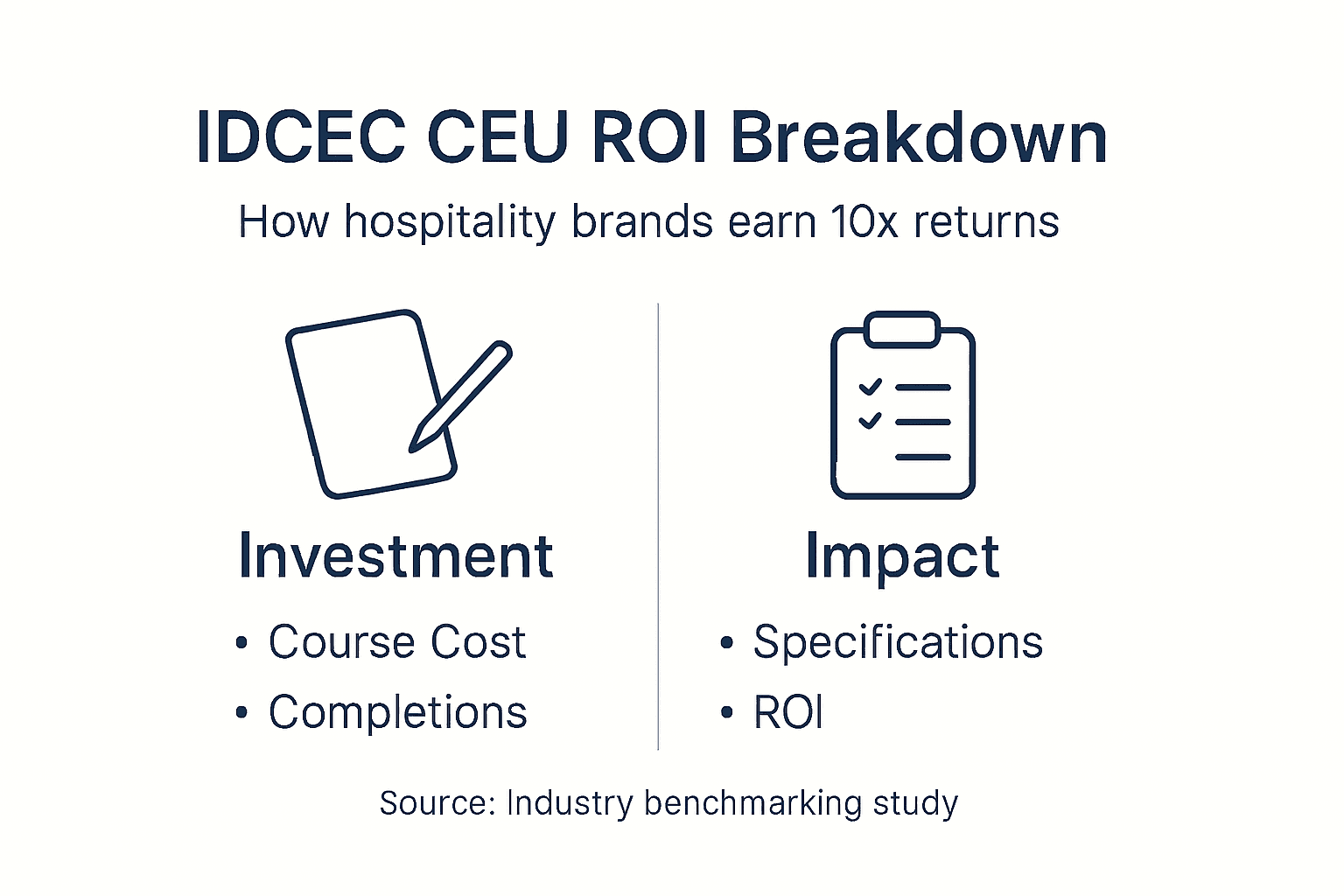
A typical $10,000 course investment generating 200 architect completions in year one creates 200 touchpoints with specification-capable decision-makers. Each completion represents 45 to 60 minutes of focused attention in an educational context where the manufacturer is positioned as expert rather than vendor.
Specification conversion rates provide the clearest ROI metric. Industry data shows that well-designed CEU programs convert approximately 2% of course participants into active specifiers. For a course with 200 completions, that translates to 4 specifications directly attributable to the educational content.
In hospitality projects where furniture, lighting, or material packages frequently exceed $100,000, a single specification often returns 10 times the course development investment. Four specifications from one course generate $400,000 in project value from a $10,000 initial cost.
The perpetual shelf life of CEU courses amplifies ROI over time:
- Courses built in 2026 continue generating completions through 2027, 2028, and beyond
- No additional development cost occurs after initial creation
- Platform hosting supports indefinite course availability
- Each additional completion costs essentially nothing while maintaining specification conversion potential
Beyond direct specification tracking, CEU programs improve sales efficiency. Conversations with architects who completed your course start from credibility and shared knowledge rather than cold introduction. Sales cycles shorten because educational content pre-qualified interest and established expertise.
Lead quality metrics show measurable improvement. Architects self-identify interest through topic selection, providing sales teams with intelligence about which product categories resonate with specific prospects. CRM data tracking course completions enables precise targeting and personalized follow-up.
A $10,000 CEU investment typically generates 200 completions, 4 product specifications, and 10x ROI in year one, with indefinite lead generation continuing beyond initial development.
Practical steps to develop and submit IDCEC CEU courses
Navigating the IDCEC submission process requires systematic execution across multiple stages. Following a proven framework eliminates guesswork and prevents costly mistakes.
- Register as an IDCEC CEU provider. Complete the initial provider application including organizational information, contact details, and program descriptions. Provider registration represents a one-time requirement before any course submissions.
- Conduct architect-focused topic research. Analyze search behavior data, review competitor course offerings, and identify gaps in available educational content. Select topics that balance architect interest with strategic business objectives.
- Develop clear, measurable learning objectives. Write 3 to 5 objectives using action verbs that describe specific, testable outcomes. Ensure objectives align with design professional competencies recognized by licensing bodies.
- Create non-proprietary content with HSW focus. Structure course material to teach design principles and application techniques without promoting specific brands. Dedicate 75% of content to health, safety, and welfare topics for maximum credit value.
- Prepare exam questions and bibliography. Write 8 to 12 questions testing concept comprehension rather than brand preference. Compile a properly formatted bibliography citing all sources used in course development.
- Submit course documentation through IDCEC portal. Upload complete application including learning objectives, course outline, exam questions, bibliography, and supporting materials. Ensure all forms are fully completed before submission.
- Respond promptly to IDCEC feedback. Address any questions or revision requests within the specified timeframe. Quick responses prevent delays in final approval.
Pro Tip: Maintain detailed tracking of all submission materials with version control. Keep backup copies of every document submitted to IDCEC. If revisions are requested, having organized records speeds the response process and ensures consistency across all materials.
Manufacturers following this systematic approach to getting IDCEC approval minimize delays and maximize first-pass success rates. The detailed IDCEC course approval steps provide additional guidance for each stage.
How CEU Builder accelerates your IDCEC accreditation
Transforming CEU strategy from theory to execution requires expertise most hospitality manufacturers lack internally. CEU Builder eliminates the learning curve and resource burden through proven processes and guaranteed outcomes.
Our done-for-you service delivers 100% first-pass IDCEC accreditation in 4 to 6 weeks. We handle everything from initial topic research through final approval, with your only role being content review before launch. The service combines deep compliance expertise with strategic content design focused on architect engagement and specification generation.
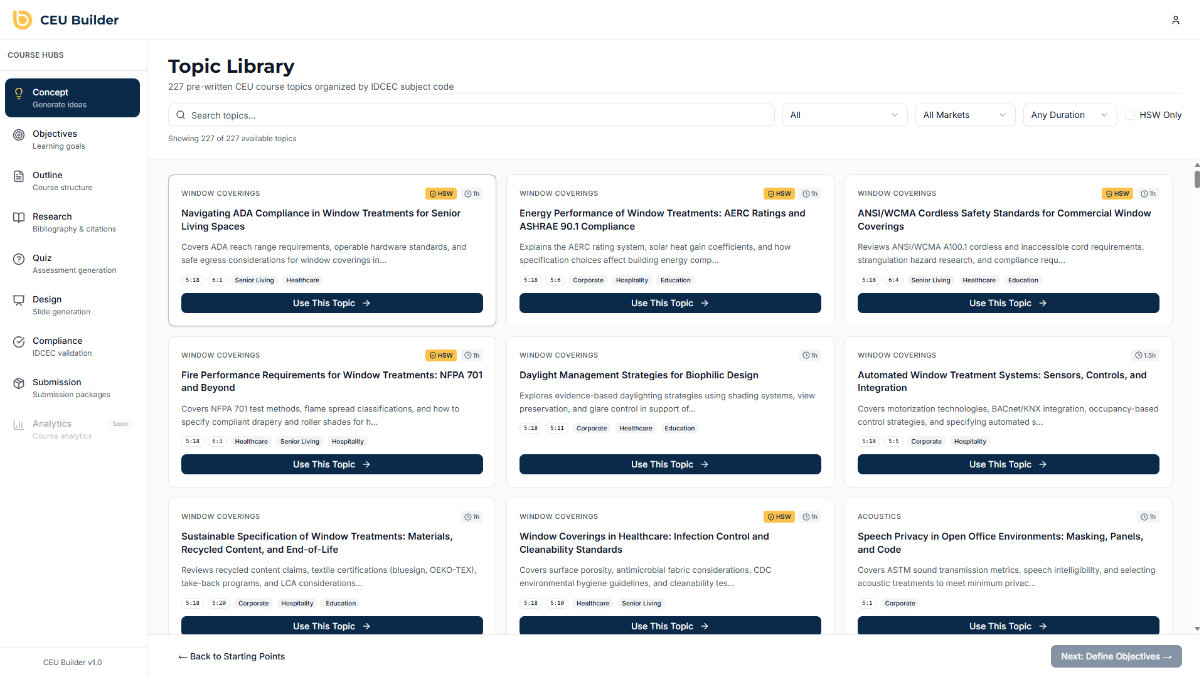
The approach differs fundamentally from generic providers. We specialize exclusively in hospitality manufacturers and IDCEC accreditation, creating domain expertise that generalist firms cannot match. Our courses are designed to drive specifications and revenue, not simply fulfill compliance requirements.
You reduce internal resource demands while accelerating time to market. Marketing teams avoid the 6 to 12 month learning curve and 30%+ rejection rates that plague in-house development attempts. The 100% approval guarantee means if IDCEC denies accreditation, we fix it for free until approval is granted.
Explore our comprehensive guide to getting IDCEC approval to understand the full process and strategic advantages of working with specialists who guarantee first-pass success.
Frequently asked questions about IDCEC CEU accreditation
What are the main reasons IDCEC rejects CEU courses?
Proprietary promotional content represents the leading rejection cause, affecting approximately 30% of first-time submissions from inexperienced providers. Unclear or non-measurable learning objectives create the second most common failure point. Missing or improperly formatted bibliographies and exam questions testing brand preference rather than concept comprehension round out the top rejection triggers.
How can I design CEU content that architects find valuable?
Start by researching actual architect search behavior and learning needs rather than assuming what they want to know. Frame product features as solutions to design challenges architects face on real projects. Use real specification case studies showing practical application rather than theoretical concepts. Emphasize HSW content to increase relevance and credit value.
What is Health, Safety, and Welfare (HSW) credit and why is it important?
HSW credit designates courses focused on topics directly impacting occupant safety, building code compliance, or public welfare. Many architect licensing jurisdictions require specific HSW credit hours annually, making these courses more valuable to design professionals. IDCEC requires at least 75% of course content to address HSW topics for this designation.
How long does the IDCEC accreditation process usually take?
Timelines vary dramatically based on approach and expertise. In-house development by teams lacking IDCEC experience typically requires 6 to 12 months with 30%+ rejection rates adding further delays. Generic third-party providers compress timelines to 3 to 6 months. Specialized providers like CEU Builder achieve 4 to 6 week timelines with 100% first-pass approval rates through systematic compliance processes.
What business benefits do hospitality manufacturers see from CEU programs?
Well-designed CEU courses generate measurable specification increases, with typical programs converting approximately 2% of participants into active specifiers. A $10,000 course investment generating 200 completions produces roughly 4 specifications worth $100,000+ each, delivering 10x ROI. Additional benefits include shortened sales cycles, improved lead quality, and sustained lead generation through the course’s indefinite shelf life.
Recommended
