

Course content auditing: boost CEU success in 2026

Most hospitality marketing teams believe course content auditing means checking for typos and outdated dates. The reality is far more strategic. Effective auditing evaluates whether training materials drive business outcomes like architect specifications and market positioning. For manufacturers investing in IDCEC-accredited courses, systematic content evaluation determines whether your continuing education program generates revenue or collects digital dust.
Table of Contents
- Understanding Course Content Auditing And Its Impact
- Common Pitfalls And Expert Strategies For Effective Course Audits
- Leveraging Evaluation Models And Data To Optimize Course Content
- Applying Course Content Auditing To Drive Architect Specifications And Market Positioning
- How CEU Builder Supports Your Course Content Auditing And Accreditation Goals
- Frequently Asked Questions
Key takeaways
| Point | Details |
|---|---|
| Strategic evaluation | Course content auditing assesses relevance, accuracy, and alignment with organizational goals beyond surface-level corrections. |
| Performance outcomes | Regular audits identify outdated information and content gaps, improving learner engagement and business metrics. |
| Decision frameworks | Using keep, refresh, merge, or remove criteria simplifies audit choices and accelerates content optimization. |
| Business alignment | Connecting audit results to specification rates and market positioning transforms education into demand generation. |
| Competitive advantage | Comprehensive auditing differentiates manufacturers through superior course quality and architect trust. |
Understanding course content auditing and its impact
Course content auditing involves evaluating the relevance, accuracy, and effectiveness of training materials to ensure they align with organizational objectives and learner needs. This process goes beyond grammatical corrections. It examines whether each module serves strategic purposes and delivers measurable value to architects taking your courses.
For hospitality manufacturers, audits directly impact bottom-line results. Successful audits often lead to improved learner engagement (increased course completion rates by 15-20%), better knowledge retention (10-15% improvement), and enhanced job performance (5-10% increase in KPIs). When architects complete your courses and retain technical specifications, they’re more likely to specify your products six months later during project design phases.
The hospitality sector presents unique audit requirements. Your courses must address real design challenges architects face in hotels, restaurants, and senior living facilities while positioning your products as solutions. Generic content fails this test. Auditing ensures materials stay current with continuing education best practices that architects actively seek.
“Content auditing transforms compliance requirements into competitive advantages. Manufacturers who systematically evaluate their educational materials create specification opportunities competitors miss.”
Major benefits include:
- Higher architect engagement through relevant, timely content
- Stronger alignment between course objectives and business goals
- Maintained IDCEC compliance as standards evolve
- Increased specification influence through strategic positioning
- Resource efficiency by identifying reusable versus outdated materials
Common pitfalls and expert strategies for effective course audits
Common pitfalls include neglecting subject matter experts (SMEs), ignoring learner feedback, and failing to update content regularly. These mistakes compound over time. A course built in 2024 using 2023 building codes immediately loses credibility with architects who need current regulatory information for 2026 projects.
Many manufacturers audit once at launch, then never revisit content. This approach guarantees decay. Architects notice outdated product specifications, deprecated design standards, and irrelevant case studies. Your competitor who audits quarterly captures specifications you miss.

The keep, refresh, merge, or remove framework streamlines decision-making. Keep modules that remain accurate and valuable. Refresh sections needing updated statistics or examples. Merge redundant content that dilutes focus. Remove obsolete material that confuses learners or wastes their time.
Using structured frameworks and tailoring audits to the target audience leads to nuanced and effective content improvements. Hospitality manufacturers need different audit criteria than healthcare or education providers. Your architects care about acoustic performance, material durability in high-traffic environments, and aesthetic trends in commercial interiors.
Pro Tip: Involve cross-functional teams including sales reps who hear architect objections, product managers who track specification data, and instructional designers who understand learning psychology. Use consistent evaluation criteria across all courses to maintain quality standards and identify patterns requiring systematic fixes.
Effective IDCEC-accredited CEU course strategies incorporate continuous auditing from initial development. Build review checkpoints into your course calendar. Schedule quarterly content scans for minor updates and annual comprehensive audits for strategic alignment.
Leveraging evaluation models and data to optimize course content
The ADDIE model incorporates formative and summative evaluation at every course development stage. Analysis, Design, Development, Implementation, and Evaluation form a cycle, not a linear path. Each phase feeds insights back into earlier stages, creating continuous improvement loops that keep content fresh and effective.
Formative evaluation happens during course delivery. You monitor architect engagement metrics, track question difficulty, and identify where learners struggle. Summative evaluation measures final outcomes like completion rates, exam scores, and specification lift. Both types inform audit decisions.
Implementing audit cycles for hospitality continuing education:
- Establish baseline metrics before launching new content
- Track architect engagement data during initial course runs
- Collect feedback through post-course surveys and sales team reports
- Analyze completion rates and exam performance by module
- Compare specification data for architects who took courses versus those who didn’t
- Schedule quarterly content reviews based on metric thresholds
- Execute annual strategic audits examining topic relevance and competitive positioning
Regular audits reduce need for major course overhauls up to 30%, saving time and resources. Small, frequent updates prevent content drift that requires expensive rebuilds. You maintain IDCEC accreditation without resubmission hassles.
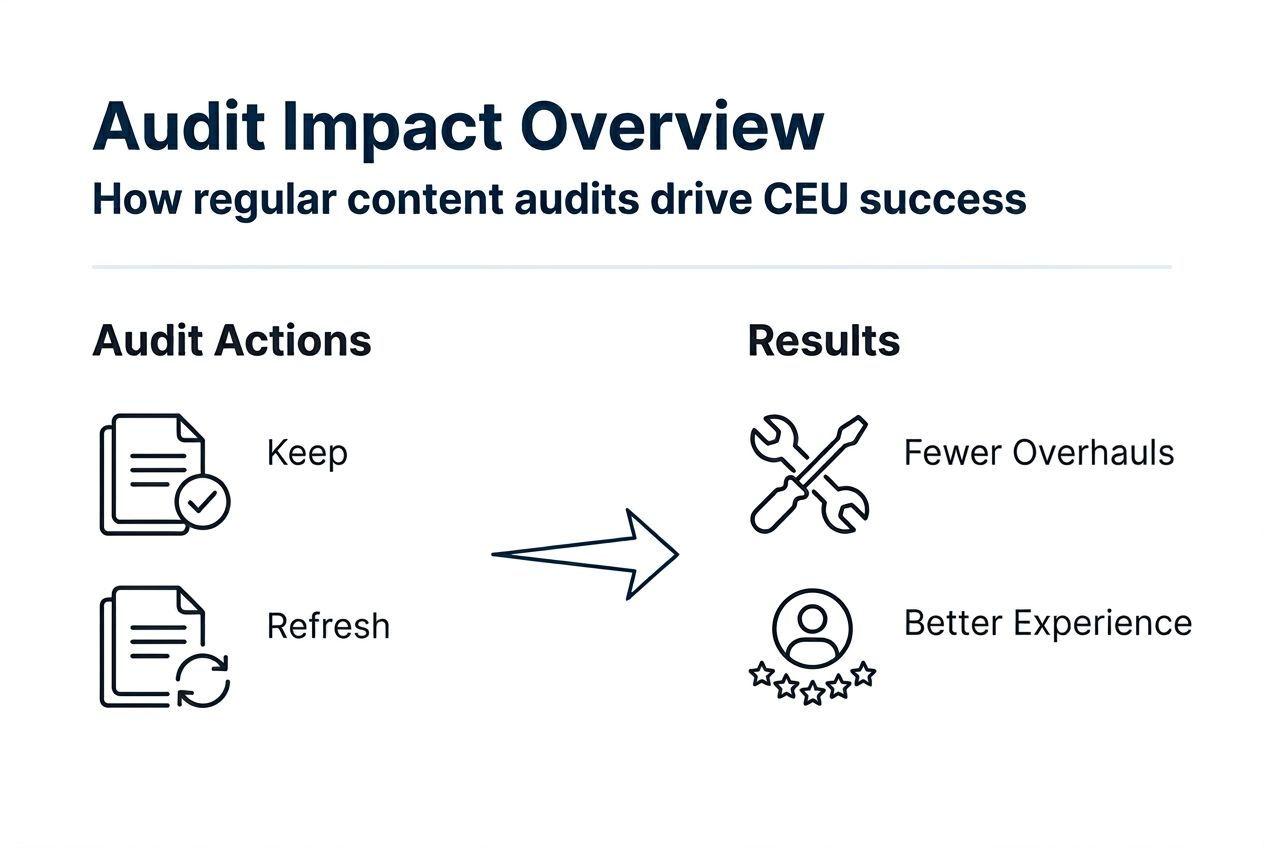
| Audit Frequency | Content Accuracy | Course Overhaul Rate | Learner Experience |
|---|---|---|---|
| Quarterly | 92-97% | 12% over 3 years | Highly positive |
| Annual | 78-85% | 35% over 3 years | Mixed feedback |
| None | 52-68% | 73% over 3 years | Frequently negative |
Pro Tip: Implement continuous evaluation during live course runs by monitoring real-time engagement metrics. If architects consistently skip a module or fail specific exam questions, you’ve identified improvement opportunities before negative patterns solidify. Early detection prevents specification losses from poor content experiences.
The course lifecycle and ADDIE model integration requires linking audit metrics to business KPIs. Track how many architects who completed Module 3 on acoustic solutions specified your sound control products within six months. This data proves ROI and guides future audit priorities.
Applying course content auditing to drive architect specifications and market positioning
Architects control product specifications worth billions annually in hospitality projects. Course evaluation best practices reveal which content features influence their specification decisions and which create friction without value.
Interactive system selectors and detailed technical information from audits can increase specification rates by 10-18%. When architects can input project parameters and receive specific product recommendations during your course, they’re building specification templates in real time. This engagement translates directly to purchase orders.
Including sound control information boosts architect preference by 12-20%. Hospitality projects demand acoustic performance data. If your audit reveals missing decibel ratings or STC values, adding this technical content immediately improves specification likelihood.
| Content Feature | Specification Influence | Implementation Complexity |
|---|---|---|
| Interactive product selectors | High (10-18% lift) | Medium |
| Detailed acoustic data | High (12-20% lift) | Low |
| Generic product overviews | Low (2-4% lift) | Low |
| Outdated case studies | Negative impact | N/A (remove) |
| Current sustainability metrics | Medium (7-11% lift) | Medium |
Audit-led content improvements transform courses from educational obligations into specification engines:
- Adding interactive calculators for material quantities architects need
- Including downloadable specification language they paste directly into project documents
- Updating case studies with recently completed hospitality projects showing real-world applications
- Expanding technical data sections with performance metrics architects require for compliance
- Integrating sustainability information addressing LEED and WELL building standard requirements
These enhancements boost market positioning by establishing your brand as the authority architects trust for technical accuracy. When your course teaches them how to specify acoustic solutions correctly, you’re not just another vendor. You’re the expert who solved their knowledge gap.
The architect specification process in 2026 increasingly emphasizes sustainability and innovation. Audits must verify your content addresses carbon footprint reduction, circular economy principles, and biophilic design trends. Architects specify manufacturers who understand current design philosophies.
Course development driving specifications requires constant vigilance. Competitor products evolve. Building codes change. Design trends shift. Your audit process catches these changes before they erode your educational credibility and specification rates.
How CEU Builder supports your course content auditing and accreditation goals
CEU Builder’s done-for-you service includes comprehensive content auditing as part of the development process. We analyze existing materials to identify what’s worth keeping and what needs replacement. Our instructional designers apply systematic evaluation criteria ensuring every module serves strategic purposes aligned with your specification goals.
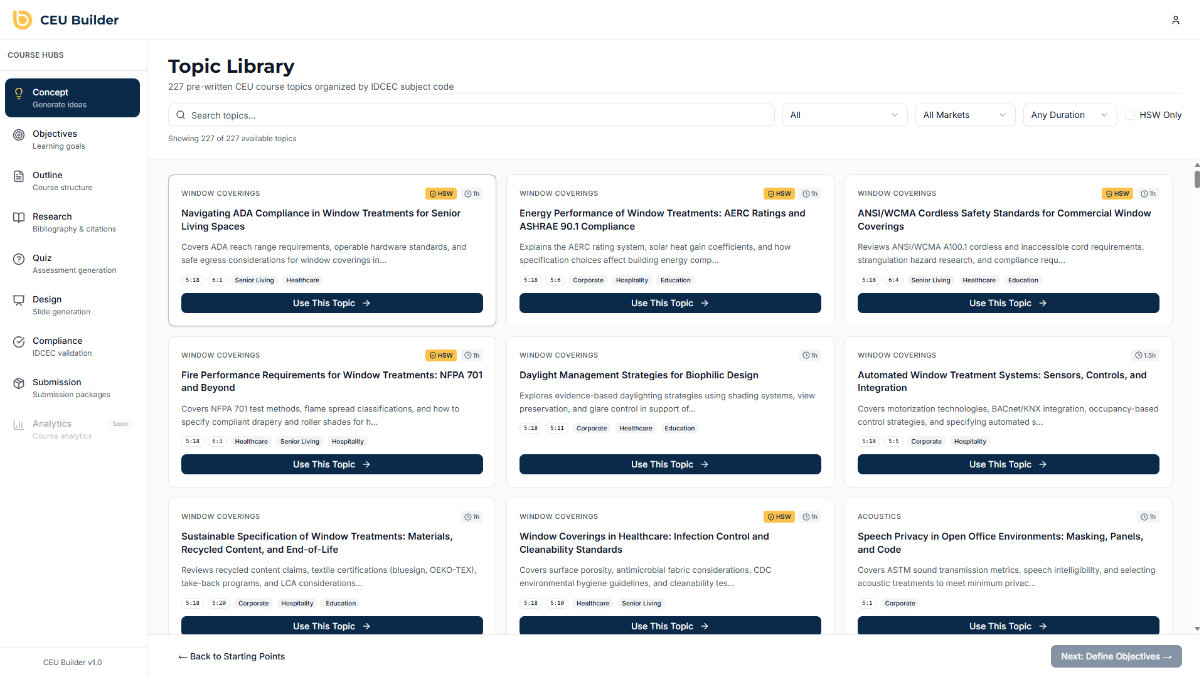
Our 100% first-pass IDCEC accreditation rate stems from rigorous content auditing before submission. We catch compliance issues, relevance gaps, and effectiveness problems that cause rejections. Manufacturers working with CEU Builder avoid the costly rebuilds that waste months when courses fail accreditation.
For hospitality brands wanting to optimize existing courses, our $2,000 course refresh service updates outdated decks to current IDCEC requirements and modern design standards. This targeted auditing extends asset life without full redevelopment costs. Learn more about our step-by-step IDCEC accreditation process and how systematic CEU course development incorporates continuous evaluation.
Frequently asked questions
What is course content auditing?
Course content auditing systematically evaluates training materials for relevance, accuracy, effectiveness, and alignment with organizational goals. It examines whether courses deliver measurable value to learners and achieve business objectives like increased architect specifications. Unlike simple proofreading, auditing assesses strategic fit and performance outcomes.
How often should hospitality manufacturers audit CEU course content?
Quarterly reviews catch minor issues like outdated statistics or new product launches. Annual comprehensive audits examine strategic alignment, competitive positioning, and topic relevance. Manufacturers with multiple courses benefit from staggered schedules spreading audit workload across the year while ensuring no content goes more than 12 months without evaluation.
How do course audits increase architect specification rates?
Audits identify content gaps preventing specifications, like missing technical data or unclear application guidance. Adding interactive tools, specification language, and current case studies directly influences architect decisions. Regular evaluation ensures courses stay relevant to design challenges architects face, maintaining your position as their trusted resource when selecting products for hospitality projects.
What steps start auditing course content with limited resources?
Begin with completion data identifying which modules architects abandon. Survey recent course takers asking what information was missing or unhelpful. Review competitor courses noting topics and features you lack. Prioritize updating modules with lowest completion rates or highest abandonment. Even basic metric tracking and learner feedback provide actionable audit insights without extensive resource investment.
How do audits fit into the CEU course development lifecycle?
Auditing occurs throughout development, not just after launch. Initial content analysis during discovery identifies usable existing materials. Formative evaluation during beta testing catches issues before full release. Post-launch audits measure actual performance against objectives. Continuous evaluation creates feedback loops improving current courses while informing future development decisions, making auditing integral to the complete lifecycle.
Can course content auditing improve IDCEC accreditation success?
Systematic auditing before submission catches compliance issues causing rejections. Evaluating learning objectives against IDCEC standards, verifying bibliography quality, and testing exam question effectiveness prevent common failure points. Manufacturers who audit thoroughly achieve higher first-pass approval rates, avoiding the 6-12 month delays and rebuilding costs that failed accreditations create.
Recommended
