

Guide to creating effective branded coursework for IDCEC

Creating IDCEC-accredited branded coursework presents a significant challenge for hospitality product manufacturers. Over 50% of first-time submissions fail, causing delays that can stretch 6-12 months and waste tens of thousands in internal costs. This guide provides actionable strategies to develop coursework that balances brand messaging with compliance requirements, helping marketing and sales professionals succeed on the first attempt. You’ll learn how to navigate accreditation requirements, select topics that resonate with architects, avoid common pitfalls, and leverage CEU courses as demand generation tools that drive specifications and revenue.
Table of Contents
- Key takeaways
- Understanding IDCEC accreditation requirements
- Preparing your coursework: focusing on niche topics and avoiding common pitfalls
- Executing development and submission for successful accreditation
- Verifying success and leveraging CEUs to drive specifications
- Explore expert solutions for IDCEC-accredited coursework
- FAQ
Key Takeaways
| Point | Details |
|---|---|
| High first submission failure | More than half of first submissions fail, causing 6 to 12 months of delays and substantial internal costs. |
| Measurable learning objectives | Learning objectives must align with measurable outcomes that demonstrate technical competency rather than vague claims. |
| Minimal brand mentions | Brand mentions should be minimal, with the bulk content focusing on technical principles, industry challenges, and data driven solutions. |
| Proactive compliance checklist | Create a pre development compliance checklist listing every IDCEC requirement and assign team members to verify before submission to prevent many rejections. |
Understanding IDCEC accreditation requirements
The IDCEC accreditation process requires submitting a detailed course outline, complete slide deck, and comprehensive reference list. Evaluators scrutinize every element for commercial bias, learning objectives alignment with technical standards, content rigor, exam question quality, and adherence to adult learning principles. This rigorous review process explains why so many first attempts fail.
Commercial bias represents the most common rejection trigger. Your course content must deliver genuine educational value rather than function as an extended sales presentation. IDCEC permits minimal brand mentions, typically limited to brief introductions and closing slides. The bulk of your content needs to focus on technical principles, industry challenges, and data-driven solutions that architects can apply across multiple product options.
Learning objectives must align with measurable outcomes that demonstrate technical competency. Vague objectives like “understand product benefits” get rejected immediately. Instead, craft specific objectives such as “calculate moisture vapor transmission rates for substrate applications in high-humidity hospitality environments” or “evaluate acoustic performance specifications for open-plan restaurant designs.” These concrete, technical objectives signal serious educational intent.
Exam questions serve as another critical evaluation point. Questions must test comprehension and application of course material, not brand recall. Effective questions present scenarios where architects apply learned principles to solve design challenges. Poor questions simply ask which brand offers specific features. The distinction matters enormously to IDCEC reviewers who can spot thinly disguised marketing instantly.
Adult learning principles require that content respects professional expertise while building new knowledge. Architects and designers are sophisticated learners who respond poorly to condescending explanations or oversimplified concepts. Your course should acknowledge their existing knowledge base while introducing technical depth that enhances their specification capabilities.
The IDCEC course approval process involves multiple review stages where evaluators assess whether your submission meets these standards. Understanding submission mechanics helps you avoid technical rejections unrelated to content quality. File formats, bibliography formatting, and documentation completeness all factor into approval decisions.
Pro Tip: Create a compliance checklist before development begins. List every IDCEC requirement and assign team members to verify each element before submission. This simple step prevents 80% of technical rejections that waste review cycles.
Successful manufacturers recognize that avoiding commercial bias requires strategic content design from the start, not last-minute editing to remove brand references. Build your course around technical problems architects face, then position your products as one solution among several approaches. This framing satisfies IDCEC requirements while subtly establishing your brand as the knowledgeable resource architects remember during specification decisions.
With clear accreditation requirements in mind, you’re ready to prepare your team and materials to meet these exacting standards efficiently.
Preparing your coursework: focusing on niche topics and avoiding common pitfalls
Topic selection determines whether your course generates genuine architect interest or languishes unused despite accreditation approval. Generic introductory topics like “Overview of Hospitality Furniture” fail to engage design professionals who already understand basic concepts. Instead, focus on specific technical challenges architects encounter on real projects.
Niche topics tied to hospitality design problems create immediate relevance. Consider courses addressing moisture vapor transmission in substrate applications for hotel bathrooms, acoustic performance optimization in open-plan restaurant environments, or LEED credit strategies for senior living facilities. These focused topics demonstrate expertise while teaching specification criteria that naturally favor your products.

The branded coursework approach requires balancing education with subtle persuasion. Your content should teach technical principles that architects can apply broadly, while the examples, case studies, and specification criteria you emphasize naturally lead toward your product category. This approach satisfies IDCEC’s anti-bias requirements while building preference through education rather than promotion.
Scientific anchors strengthen credibility and support technical depth. Reference LEED standards, building code requirements, ASTM testing protocols, or peer-reviewed research that establishes objective performance benchmarks. These references demonstrate that your course content meets academic standards rather than simply promoting product features.
Common pitfalls that trigger rejections include:
- Excessive brand name repetition throughout slides and speaker notes
- Product comparison tables that obviously favor your offerings
- Learning objectives focused on brand awareness rather than technical competency
- Exam questions testing brand recall instead of principle application
- Overly broad topics lacking sufficient technical depth
- Missing or inadequate reference citations for factual claims
- Content that reads like marketing collateral rather than educational material
The IDCEC accreditation workflow shows that over 50% of first-time submissions fail, with brand overuse and insufficient technical focus representing the primary rejection reasons. Manufacturers who understand these patterns before development begins save months of revision cycles and thousands in wasted effort.
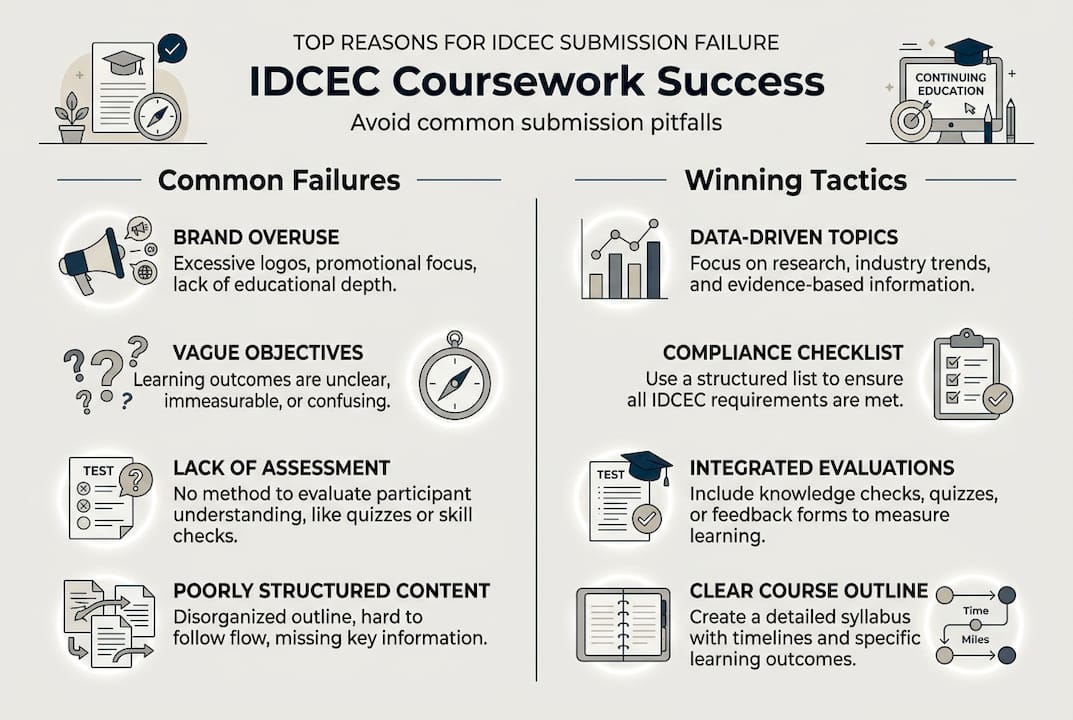
Data-driven content separates successful courses from rejected submissions. Instead of claiming “our products perform better,” present comparative testing data showing performance across multiple solutions, objective measurement protocols, and specification criteria architects can verify independently. This approach builds credibility while positioning your products within a broader technical context.
Pro Tip: Before finalizing your topic, search what architects actually query online related to your product category. Tools like Google Keyword Planner reveal whether design professionals search for “moisture control in hotel bathrooms” (high volume, specific need) versus “bathroom flooring options” (generic, low intent). Target topics with demonstrated architect interest.
Avoid the temptation to cover too much ground in a single course. A focused 45-minute presentation on acoustic performance in restaurant design delivers more value than a superficial 60-minute overview of all hospitality acoustics applications. Depth beats breadth for both IDCEC approval and architect engagement.
After selecting the right niche topic and understanding pitfalls to avoid, you’re ready to execute development and submission with confidence.
Executing development and submission for successful accreditation
Development execution requires systematic attention to detail across multiple deliverables. Your submission package includes the complete slide deck, detailed speaker notes, bibliography with properly formatted citations, learning objectives, and exam questions with answer keys. Each element must meet IDCEC standards independently while supporting the overall educational narrative.
Slide deck development follows instructional design principles that optimize learning retention. Visual hierarchy guides attention to key concepts. Data visualizations present complex information accessibly. Technical diagrams illustrate principles that text alone cannot convey effectively. Every slide should advance learning objectives rather than simply displaying information.
Develop your content following this sequence:
- Define 3-5 specific learning objectives that articulate measurable technical competencies
- Outline the logical flow connecting objectives to content sections
- Research and compile authoritative sources supporting every factual claim
- Draft speaker notes with complete technical explanations and examples
- Design slides that visually reinforce speaker content without duplicating text
- Create exam questions testing application of learned principles to realistic scenarios
- Format bibliography according to academic citation standards
- Review entire package against IDCEC compliance checklist
The review stage catches problems before submission. Assign different team members to evaluate content quality, technical accuracy, IDCEC compliance, and brand balance. Fresh eyes identify issues that developers miss after extended content immersion. This internal review process prevents obvious mistakes that waste official review cycles.
| Development stage | Timeline | Key deliverables |
|---|---|---|
| Research and planning | Week 1 | Learning objectives, content outline, source list |
| Content creation | Week 2-3 | Complete slide deck, speaker notes, exam questions |
| Internal review | Week 3-4 | Compliance verification, technical accuracy check |
| IDCEC submission | Week 4 | Formatted package with all required documentation |
| Official review | Week 5-10 | IDCEC evaluation and feedback |
Submit early to allow adequate review time. The typical approval timeline spans 4-6 weeks with proper preparation and submission. Rushing development or submitting incomplete packages extends this timeline significantly when reviewers request clarifications or revisions.
Prepare for feedback rounds by building revision time into your project schedule. Even well-prepared submissions occasionally receive requests for minor adjustments. IDCEC reviewers might ask for additional citations, clarification of learning objectives, or exam question modifications. Responding promptly to these requests keeps approval on track.
Proper execution reduces first-pass failure rates dramatically. Manufacturers who invest time in thorough preparation, comprehensive internal review, and complete documentation avoid the costly delays that plague rushed or inadequate submissions. The difference between 6-week approval and 6-month rejection cycles often comes down to systematic attention to detail during development.
Pro Tip: Create a master template incorporating all IDCEC formatting requirements before content development begins. Slide layouts, citation formats, and documentation structure should match IDCEC specifications exactly. This template approach eliminates formatting errors that trigger technical rejections unrelated to content quality.
The CEU Builder platform streamlines execution by providing compliance tools, formatting templates, and review checklists that guide development through every stage. These resources help internal teams avoid common mistakes while maintaining the creative control manufacturers value.
With development and submission complete, you’re ready to verify success and leverage your accredited courses as demand generation assets.
Verifying success and leveraging CEUs to drive specifications
Measuring course impact requires tracking metrics beyond simple completion counts. Effective measurement connects educational engagement to business outcomes that matter: specification requests, project wins, and revenue attribution. Design your tracking systems before course launch to capture data that demonstrates ROI.
Track these key performance indicators:
- Course completion rates by firm size and project type
- Specification requests from architects who completed courses
- Project wins where CEU engagement preceded specification decisions
- Sales cycle length for CEU-engaged prospects versus cold outreach
- Revenue attributed to accounts with course completion history
Position coursework as technical resources rather than marketing materials. When sales teams reference courses during architect conversations, they should emphasize educational value and technical depth rather than promotional intent. This positioning maintains the credibility that makes CEU courses effective while naturally transitioning to product discussions.
Leverage CEUs to build lasting relationships with design professionals. Architects who invest 45-60 minutes learning from your course content develop familiarity with your technical expertise and product capabilities. This extended engagement creates preference that brief sales calls cannot match. When specification decisions arise months later, these architects remember the manufacturer who taught them valuable skills.
| Approach | Engagement depth | Specification influence | Scalability |
|---|---|---|---|
| Generic education | Low (compliance focus) | Minimal (no differentiation) | High (broad topics) |
| Branded CEU courses | High (technical depth) | Strong (preference building) | Medium (niche focus) |
| Traditional sales | Medium (product focus) | Variable (relationship dependent) | Low (time intensive) |
The business case for CEU courses demonstrates measurable returns. One manufacturer attributed $37.1M in specifications to their educational program, positioning their brand as the trusted technical partner architects consulted for complex design challenges. This outcome reflects strategic course design that connected product capabilities to real architect needs.
Successful manufacturers integrate CEU courses throughout their marketing and sales operations. Trade show presentations reference course content. Email sequences offer educational value before product pitches. Sales conversations start from positions of credibility established through teaching. This integrated approach multiplies course impact beyond standalone educational offerings.
Compare the lifetime value of a single accredited course to traditional marketing investments. A $10,000 course development investment generates ongoing completions and specifications for years without additional content costs. Trade show booths require $30,000-$50,000 annually for premium positioning. Print advertising costs $5,000-$15,000 per placement with no engagement tracking. Field sales calls run $200-$500 in loaded costs per meeting. The economics favor educational assets with indefinite shelf lives.
The ROI from IDCEC CEU courses compounds over time as course libraries expand. Manufacturers with comprehensive educational portfolios establish market leadership positions that competitors struggle to overcome. Being recognized as the brand that teaches architects valuable skills creates competitive moats that traditional marketing cannot replicate.
Verification extends beyond financial metrics to qualitative feedback. Survey course participants about content relevance, technical depth, and application to real projects. This feedback guides topic selection for future courses while demonstrating commitment to genuine educational value rather than promotional intent.
With verified success and optimization strategies in place, you’re positioned to scale educational programs that drive sustainable competitive advantages.
Explore expert solutions for IDCEC-accredited coursework
Developing IDCEC-accredited coursework internally requires significant expertise, time, and risk management. Many hospitality manufacturers partner with specialized providers who understand both accreditation requirements and specification dynamics. CEU Builder offers proven workflows and compliance tools that compress traditional 90-180 day development cycles into 4-6 week timelines while maintaining 100% first-pass approval rates.
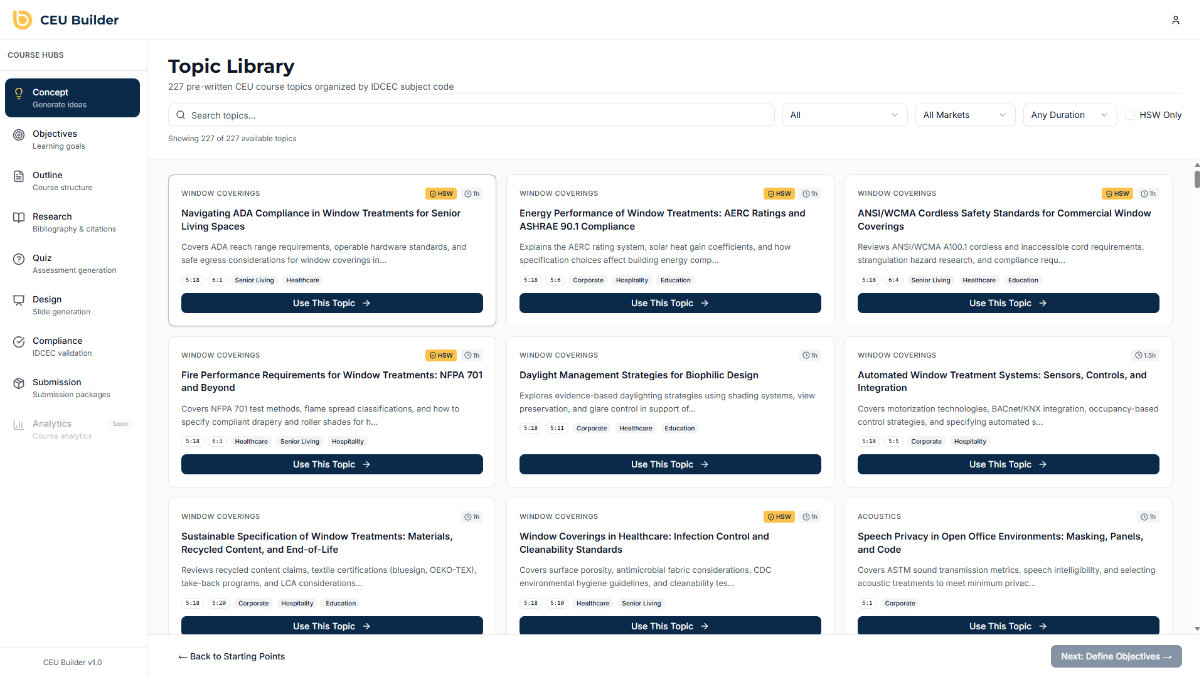
The platform supports manufacturers who want to build courses efficiently without sacrificing quality or risking costly rejections. Clients report increased specification wins and measurable ROI through courses designed to drive business outcomes rather than simply fulfill compliance requirements. Whether you need complete done-for-you service or tools to accelerate internal development, understanding the IDCEC course approval process and following the proven accreditation workflow positions your educational program for success. Explore how IDCEC CEU courses deliver 10x ROI for hospitality brands committed to educational marketing strategies.
FAQ
What common mistakes cause IDCEC submission failures?
Excessive brand mentions throughout course content represent the primary rejection trigger. IDCEC evaluators reject courses that function as extended sales presentations rather than genuine education. Overly broad topics lacking technical depth also fail frequently, as do weak exam questions that test brand recall instead of principle application. Manufacturers succeed by focusing on specific technical problems, limiting brand references to introduction and conclusion slides, and creating exam questions that assess real-world application skills.
How can hospitality manufacturers choose the best topics for branded CEU courses?
Focus on specific technical problems architects encounter on hospitality projects. Research what design professionals actually search for online related to your product category. Topics like moisture control in hotel bathrooms, acoustic performance in restaurants, or LEED strategies for senior living facilities demonstrate immediate relevance. Avoid generic overviews that fail to engage sophisticated professionals. Niche topics with demonstrated architect interest generate higher completion rates and stronger specification influence than broad introductory content.
What is the typical timeline from submission to IDCEC course approval?
Properly prepared submissions typically receive approval within 4-6 weeks of submission. This timeline assumes complete documentation, compliance with formatting requirements, and content meeting technical standards. Incomplete or non-compliant submissions extend timelines significantly when reviewers request clarifications or revisions. Manufacturers who invest in thorough preparation and internal review before submission avoid delays that can stretch to 6-12 months for rejected courses requiring complete rebuilds.
How do accredited CEU courses drive sales and specifications for hospitality products?
CEU courses position manufacturers as technical experts rather than vendors, fundamentally shifting architect perception and preference. Design professionals who invest 45-60 minutes learning from your content develop familiarity with your expertise and product capabilities. This extended engagement creates specification preference that brief sales calls cannot achieve. Courses also generate measurable business outcomes including direct specification requests, shorter sales cycles, and revenue attribution to educational engagement. One manufacturer attributed $37.1M in specifications to their CEU program by positioning their brand as the trusted technical resource architects consulted for complex design challenges.
Recommended
