

Course compliance checklist for IDCEC accredited CEUs

Marketing and product managers at hospitality manufacturers face a critical challenge: IDCEC accreditation delays can cost months and thousands in wasted effort. Failed submissions harm time-to-market and revenue potential when architects wait for approved courses. A structured course compliance checklist streamlines approval, ensures first-pass success, and positions your educational content to drive specifications effectively.
Table of Contents
- Selection Criteria: What Makes An Effective Course Compliance Checklist?
- Compliance Checklist Essentials: The 11 Core Elements Every Course Needs
- Comparing Development Models: Done-For-You Vs DIY Platform Approaches
- Avoiding Pitfalls: Common Accreditation Challenges And How To Solve Them
- Scaling Up: Multi-Course Programs And Strategic Positioning For Specification Growth
- Summary And Situational Recommendations: Choosing The Right Compliance Approach For Your Team
- Get Started With Expert IDCEC Course Compliance Solutions
Key takeaways
| Point | Details |
|---|---|
| Structured checklists accelerate IDCEC accreditation | Compliance checklists reduce submission delays and ensure reliable first-pass approvals for hospitality manufacturers. |
| Core elements cover objectives, design, and submission | Essential checklist items include learning objectives, instructional design, assessments, bibliographies, and documentation. |
| Done-for-you vs DIY models offer different tradeoffs | Done-for-you delivers guaranteed approvals in 4-6 weeks; DIY platforms cost less but require internal expertise. |
| Common pitfalls include misaligned objectives and incomplete bibliographies | Proactive checklist safeguards prevent costly rejections caused by vague learning goals and non-compliant citations. |
| Multi-course programs amplify specification growth | Scaling with coordinated checklists creates competitive positioning and deeper architect engagement across product lines. |
Selection criteria: what makes an effective course compliance checklist?
After reviewing the key takeaways, you need to understand what defines a compliance checklist that delivers fast approvals and business results. An effective checklist starts with strategic topic research aligned with architect needs to ensure course relevance and business impact. Without this foundation, your content risks missing the mark with design professionals who control specifications.
Your checklist must include measurable learning objectives directly mapped to IDCEC standards, which are critical for compliance. Vague objectives invite rejection. Specific, action-oriented goals that architects can apply to real projects pass review consistently.
Instructional design quality determines whether your course engages or bores architects. Slide decks, speaker scripts, and content flow must enhance knowledge retention and maintain attention through 45-60 minute sessions. Poor design wastes the specification opportunity you worked hard to create.

Assessment and evaluation methods validate learning and satisfy IDCEC requirements. Exam questions must test comprehension and application, not just recall. Weak assessments signal low educational value and risk accreditation denial.
Submission and documentation management reduces approval delays through organized, complete filings. Missing documents or formatting errors trigger rejection cycles that push launch dates back by months. Following 7 essential steps in CEU course development keeps submissions clean and compliant.
Pro Tip: Early collaboration with IDCEC accreditation specialists significantly reduces resubmission risk. Their expertise catches issues before they become costly problems.
Compliance checklist essentials: the 11 core elements every course needs
With selection criteria clear, you need the specific checklist items that secure first-pass accreditation. Courses with these 11 core elements achieve 100% first-pass IDCEC accreditation success, eliminating the risk of rejection cycles that waste time and money.
-
Define specific, measurable learning objectives aligned to IDCEC standards. Objectives must state what architects will know or do after completing your course. Vague goals fail review.
-
Create engaging instructional design including slide decks and speaker scripts. Visual learning optimization and consistent delivery depend on professional design that maintains attention.
-
Develop robust, specification-focused exam questions. Questions should test application of course concepts to real hospitality projects, reinforcing your products’ advantages.
-
Compile a bibliography meeting academic and IDCEC accreditation standards. Citations must follow proper formatting and include credible sources that support course content.
-
Implement thorough submission management with revision tracking. Organized documentation prevents missing materials and formatting errors that trigger rejection.
-
Include participant evaluation and course feedback components. IDCEC requires mechanisms for learners to assess course quality and provide improvement input.
-
Integrate industry-relevant content tailored to hospitality manufacturer products. Content must balance educational value with strategic positioning of your solutions to specification challenges.
-
Maintain proper documentation for all course materials. Complete records of slides, scripts, assessments, and supporting materials satisfy compliance audits.
-
Ensure accessibility and inclusivity standards adherence. Courses must accommodate diverse learning needs and meet ADA requirements for design professionals.
-
Adopt quality assurance processes for content accuracy. Technical errors and outdated information undermine credibility and risk accreditation issues.
-
Coordinate ongoing compliance checks post-launch. Regular audits ensure your course maintains IDCEC standards as regulations and best practices evolve.
Understanding how to offer CEU courses effectively requires mastering these elements. The continuing education compliance workflow for hospitality brands integrates these components into repeatable processes.
Comparing development models: done-for-you vs DIY platform approaches
After detailing checklist essentials, you need to evaluate which development model fits your team’s resources and risk tolerance. Done-for-you services achieve 100% first-pass IDCEC accreditation in 4-6 weeks versus 8-12 weeks typical for DIY platforms, compressing time-to-market significantly.
| Factor | Done-For-You | DIY Platform |
|---|---|---|
| Timeline | 4-6 weeks | 8-12 weeks |
| Cost per course | $10,000 | $99/month subscription |
| Accreditation risk | Zero (100% guarantee) | Higher (user expertise dependent) |
| Creative control | Expert-driven optimization | Full internal control |
| Internal resource load | Minimal (review only) | Substantial (content creation) |
| Specification optimization | Built-in strategic positioning | Requires internal expertise |
Done-for-you services cost approximately $10,000 per course but eliminate rejection risk entirely. Every submission gets approved on the first attempt because experienced instructional designers build compliance into every development stage. Your team’s only role is reviewing content before launch.
DIY platforms cost $99 per month and allow unlimited course creation, making them economical for manufacturers building multiple courses. However, success depends on internal compliance expertise that most marketing teams lack. Without deep IDCEC knowledge, rejection rates increase substantially.
Risk profiles differ dramatically between models. Done-for-you guarantees first-pass approval, protecting your timeline and budget from costly resubmission cycles. DIY approaches offer no such guarantee, exposing you to delays that push market entry back by quarters.
Control varies by model. DIY platforms provide complete creative direction over content and messaging. Done-for-you services optimize for specification impact based on proven frameworks, which may limit customization but consistently delivers business results.
Outcome focus separates strategic from tactical approaches. Done-for-you services optimize courses for specification impact, not just compliance. DIY platforms provide tools but require you to develop specification strategy internally.
Pro Tip: Hybrid approaches can combine platform flexibility with expert consultation to balance control and compliance. Consider starting with done-for-you to learn best practices, then transition to DIY for subsequent courses.
Understanding course development for manufacturers helps you select the model that matches your team’s capabilities and strategic objectives.
Avoiding pitfalls: common accreditation challenges and how to solve them
Having contrasted development models, you need to understand compliance failures that derail accreditation and how checklists prevent them. Misaligned learning objectives and incomplete bibliographies are top causes of IDCEC rejection, wasting months and requiring complete course rebuilds.
Common pitfalls include:
-
Vague or misaligned learning objectives: Objectives that don’t specify measurable outcomes or connect to IDCEC standards fail review consistently. Architects need to know exactly what they’ll learn and apply.
-
Incomplete or non-compliant bibliographies: Citations missing proper formatting, insufficient sources, or non-credible references trigger automatic rejection. Academic standards apply to professional education.
-
Poor exam question quality: Questions testing only recall rather than application fail to demonstrate learning depth. IDCEC expects assessments that validate architects can use course knowledge on real projects.
-
Neglected submission follow-up: Missing deadline responses or incomplete documentation requests stall approvals indefinitely. Active submission management keeps reviews moving forward.
Checklist safeguards prevent these failures through systematic controls:
-
Regular alignment workshops ensure learning objectives connect to both IDCEC standards and architect application needs before content development begins.
-
Automated citation formatting tools eliminate bibliography errors by standardizing source documentation according to academic requirements.
-
Standardized exam question templates guide question development toward application-focused assessments that satisfy IDCEC depth requirements.
-
Proactive submission management tracks IDCEC communication, responds to requests immediately, and maintains organized documentation throughout the review process.
Importance of clear communication with IDCEC cannot be overstated. Reviewers appreciate organized submissions and responsive providers. Building positive relationships accelerates approvals and provides guidance when questions arise.
Best practices implement ongoing compliance monitoring post-submission. IDCEC standards evolve, and creating CEU courses for hospitality brands requires staying current. Regular audits catch issues before they become problems. Following a step-by-step accreditation guide for IDCEC providers ensures you maintain compliance throughout your course lifecycle.
Scaling up: multi-course programs and strategic positioning for specification growth
After discussing pitfalls, you need to understand how scaling with multi-course programs amplifies market impact. Multi-course CE programs significantly enhance cumulative specification inquiries and brand positioning, creating competitive advantages difficult for rivals to overcome.
Transforming single courses into multi-course packages requires coordinated checklist adaptations. Each course must maintain compliance individually while contributing to broader strategic positioning. Topics should sequence logically, building architect knowledge progressively.
Pricing strategies for bundled courses provide economic advantages:
- Single course: $10,000, 4-6 weeks
- Two-course series: $18,000, 6-10 weeks (most popular)
- Three-course series: $25,000, 10-12 weeks
Multi-course packages deliver timeline efficiencies. Developing three courses separately would take 12-18 weeks, but coordinated development compresses this to 10-12 weeks through parallel workflows.
Strategic topic sequencing aligned to product lines, hospitality trends, and regulation updates maximizes impact. Courses covering complementary topics (acoustic performance, material durability, sustainability standards) create comprehensive educational positioning.
| Program Type | Timeline | Investment | Architect Touchpoints | Specification Lift | Revenue Impact |
|---|---|---|---|---|---|
| Single Course | 4-6 weeks | $10,000 | 150-200 annually | 2-4 specifications | 2-4x ROI |
| Two-Course Series | 6-10 weeks | $18,000 | 300-400 annually | 6-10 specifications | 5-8x ROI |
| Three-Course Series | 10-12 weeks | $25,000 | 450-600 annually | 12-18 specifications | 10-15x ROI |
Benefits of broad topic coverage versus deep dives depend on your strategic goals. Broad coverage across multiple product categories maximizes total architect reach. Deep dives establish expertise in specific application areas, creating stronger positioning for particular product lines.
Competitive differentiation comes from demonstrating comprehensive education commitment. Architects remember manufacturers who invested in their professional development. When specification decisions arise, that credibility translates to preference. Understanding the 7 benefits of CEU accreditation for hospitality brands clarifies why scaled programs create lasting competitive moats.
Multi-course development for manufacturers requires maintaining checklist discipline across all courses while optimizing for cumulative strategic impact.
Summary and situational recommendations: choosing the right compliance approach for your team
Now you can decide which compliance and course creation approach best suits your team profile and business objectives. Matching your capabilities to the right model optimizes success and ROI.
Recommend done-for-you model for:
- Teams wanting fast, low-risk launches without internal resource allocation
- Manufacturers lacking CEU development expertise or IDCEC knowledge
- Companies prioritizing guaranteed first-pass approval over creative control
- Organizations testing CEU strategy before broader commitment
Advocate DIY platform for:
- Teams with content expertise and dedicated marketing resources
- Manufacturers building multiple courses and seeking cost efficiency
- Companies wanting full creative control over messaging and positioning
- Organizations committed to developing long-term internal educational capability
Suggest hybrid or pilot course approaches for:
- Teams uncertain about CEU strategy effectiveness for their products
- Manufacturers wanting to test market response before scaling investment
- Companies lacking clarity on optimal topic selection
- Organizations needing proof of concept before executive buy-in
Emphasize checklist adoption as foundational for compliance, regardless of model. Whether you build courses internally or outsource development, systematic compliance verification prevents costly rejections.
“The difference between manufacturers who succeed with continuing education and those who fail isn’t budget or product quality. It’s disciplined execution of compliance fundamentals aligned with architect learning needs. A rigorous checklist transforms accreditation from gamble to certainty, and educational content from compliance theater to specification engine.”
Matching compliance approach and course creation model to team capabilities and business goals optimizes success. Start by honestly assessing your internal expertise, resource availability, and strategic timeline. Then select the model that fits your reality, not your aspirations.
Understanding how to get IDCEC approval and the complete course development process ensures you make informed decisions aligned with your business objectives.
Get started with expert IDCEC course compliance solutions
You’ve learned how course compliance checklists accelerate IDCEC accreditation and drive specification results. Now you need proven expertise to execute your strategy.
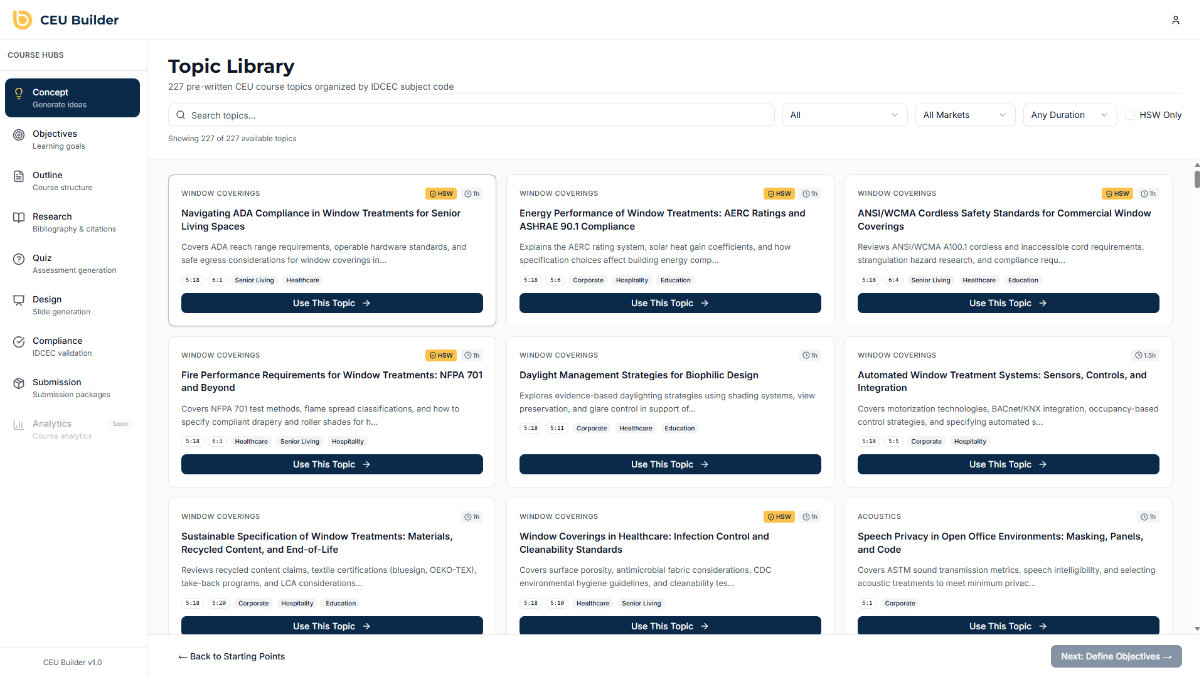
CEU Builder’s done-for-you and platform services are tailored specifically for hospitality manufacturers seeking guaranteed first-pass approvals and accelerated 4-6 week timelines. Our 100% accreditation success rate eliminates the risk of costly rejections that delay market entry and waste resources.
Pro Tip: Start with CEU Builder’s step-by-step accreditation guide to streamline your journey from concept to approved course.
Whether you choose done-for-you services with complete project management or DIY platform access with compliance tools, you’ll benefit from our reverse-engineered IDCEC processes and hospitality industry expertise. Explore detailed service options and success stories showing how manufacturers like yours achieved 10x ROI through strategic continuing education.
Ready to transform your continuing education from compliance burden to demand generation engine? Review how to get IDCEC approval for your course or visit CEU Builder to discuss your specific accreditation goals and timeline.
FAQ
What is the IDCEC and why is its accreditation important for hospitality manufacturers?
The Interior Design Continuing Education Council (IDCEC) sets standards for continuing education courses that influence interior design specification decisions. Accreditation validates course quality and enables the credits architects and designers require annually for professional licensing. When your courses carry IDCEC accreditation, design professionals trust the educational value and prioritize attending, giving you specification influence.
How does a course compliance checklist accelerate IDCEC approval?
Compliance checklists ensure all IDCEC standards are met before submission through systematic verification of learning objectives, bibliographies, assessments, and documentation. They minimize costly revisions and speed the first-pass approval rate by catching issues during development rather than after rejection. Structured checklists transform accreditation from unpredictable process to reliable outcome.
What are the main differences between done-for-you and DIY course development models?
Done-for-you offers fast, guaranteed accreditation with expert handling in 4-6 weeks at $10,000 per course, requiring minimal internal resources. DIY platforms are cost-effective at $99 monthly with more creative control but require substantial internal compliance expertise and take 8-12 weeks with higher rejection risk. Your choice depends on whether you prioritize speed and certainty or control and learning.
How can multi-course programs enhance a hospitality manufacturer’s specification influence?
Multi-course programs deepen architect engagement through multiple educational touchpoints and generate cumulative specification inquiries across broader product portfolios. They create competitive moats by showcasing your comprehensive education commitment, which architects remember when making specification decisions months later. Scaled programs deliver 10-15x ROI versus 2-4x for single courses through amplified reach and authority positioning.
Recommended
