

Why CEU compliance matters: boost hospitality specs & trust

Most marketing and sales teams in hospitality manufacturing treat CEU compliance as paperwork. Fill out the forms, get the stamp, move on. But that framing is costing you real revenue. Accredited CEUs build trust, shorten sales cycles, and improve specification rates in ways that traditional marketing simply cannot replicate. When you understand how compliance actually works, and what architects need from it, you stop seeing it as a burden and start seeing it as one of the most efficient demand generation tools available to a hospitality manufacturer.
Table of Contents
- What is CEU compliance and who does it affect?
- The business case: How accredited CEUs drive specs, trust, and ROI
- Standards, pitfalls, and competitive advantage in CEU compliance
- Practical strategies to optimize CEU compliance for hospitality brands
- The uncomfortable truth about CEU compliance: What most brands miss
- Get help building CEU programs that deliver results
- Frequently asked questions
Key Takeaways
| Point | Details |
|---|---|
| CEU compliance is a sales driver | Accredited CEU programs can yield higher trust and more project specifications for hospitality manufacturers. |
| Accreditation unlocks competitive advantage | Rigorous compliance allows brands to outpace smaller rivals and avoid margin-eroding price competition. |
| Strategic execution matters | Generic CEU content fails; carefully crafted, educational programs dramatically boost sales results. |
| Technology and tracking amplify ROI | Integrating digital tools and CRM tracking with CEUs multiplies their impact on specifications and revenue. |
What is CEU compliance and who does it affect?
CEU stands for Continuing Education Unit. It is a standardized measure of professional learning, where one CEU typically equals ten hours of instruction. For architects and interior designers, completing a required number of CEUs each year is not optional. It is tied directly to their professional license.
The American Institute of Architects (AIA) and the Interior Design Continuing Education Council (IDCEC) are the two primary bodies that govern this in the hospitality design space. AIA requirements mandate that members complete 18 Learning Units (LUs) annually, with 12 of those in Health, Safety, and Welfare (HSW) topics. IDCEC follows a similar framework with its own accreditation standards for course providers.
As a hospitality manufacturer, you are not required to comply with anything. But your customers are. That distinction matters enormously. CEU compliance is mandatory for architects and designers to maintain their licenses, and they are actively searching for accredited courses to fulfill those requirements every year.
Here is what that means for you in practice. When you offer an IDCEC-accredited course, you are giving architects something they genuinely need. You are not interrupting their day with a sales pitch. You are solving a real professional problem while positioning your brand as the expert in the room.
Key things hospitality manufacturers need to know about CEU compliance in hospitality:
- Architects need 18 LUs per year (12 in HSW) to maintain AIA membership
- IDCEC accreditation is the standard for interior design professionals
- Courses must be non-promotional and education-first to qualify
- Manufacturers who offer accredited courses gain direct access to specification-capable decision-makers
- Not all top CEU providers understand the hospitality vertical, which creates an opening for brands that do
The compliance framework is not your obstacle. It is your entry point.
The business case: How accredited CEUs drive specs, trust, and ROI
With the basics in mind, let’s look at exactly how compliance impacts bottom-line results using real metrics.
The numbers are hard to ignore. Accredited CEUs build 40% higher trust, shorten sales cycles from 9 months to 6, boost specification rates from 3% to 8%, and reduce cost per lead from $450 to $180. That is not a marginal improvement. That is a structural shift in how your sales pipeline performs.
| Metric | Without accredited CEUs | With accredited CEUs |
|---|---|---|
| Trust level (A&D audience) | Baseline | +40% higher |
| Average sales cycle | 9 months | 6 months |
| Specification rate | 3% | 8% |
| Cost per lead | $450 | $180 |
Think about what a jump from 3% to 8% in specification rate means across 200 architect completions in a single year. That is the difference between 6 specs and 16 specs, from one course, with no additional ad spend.
“CEU education positions manufacturers as trusted advisors rather than vendors, and that trust directly translates into specification preference when project decisions are made.”
The reason this works is straightforward. Architects who sit through 45 to 60 minutes of genuinely useful education leave with a mental model built around your product category. When a project calls for acoustic flooring, sustainable textiles, or code-compliant lighting, they reach for the brand that taught them the criteria. That is not luck. That is positioning.

For your sales team, this changes the conversation entirely. A rep following up after a course completion is not cold calling. They are continuing a relationship that already started with value. That is why 10x ROI with CEU courses is achievable, and why turning CEUs into specs is a repeatable process, not a one-time win.
Pro Tip: Add CEU completion data to your CRM. When a rep knows which architect took which course, follow-up conversations become targeted, relevant, and far more likely to convert.
Standards, pitfalls, and competitive advantage in CEU compliance
Data proves the value, but achieving compliance is not trivial. Many brands fail here, and that failure creates a real opening for those who get it right.
IDCEC and AIA standards require unbiased, non-promotional content with a minimum of one hour of instruction, at least 75% focused on HSW topics, and updates every three years. Violations result in rejection, and roughly 50% of first-time submissions fail to meet these standards.
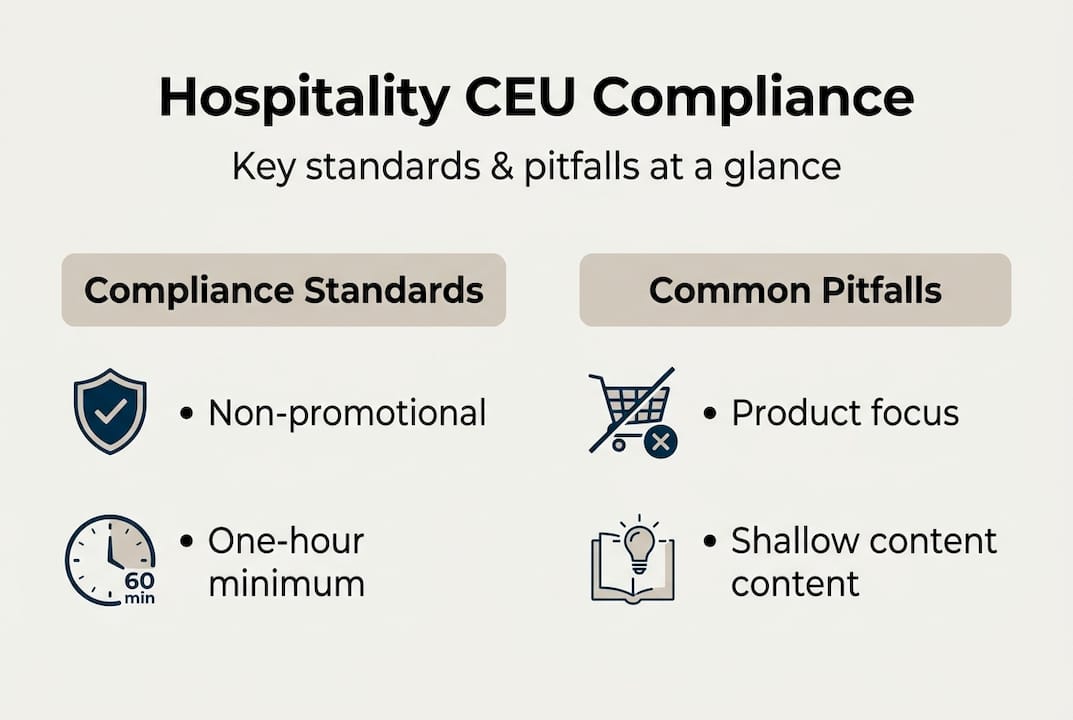
| Criteria | Pass | Fail |
|---|---|---|
| Content tone | Educational, unbiased | Promotional, product-focused |
| HSW coverage | 75% or more | Below 75% |
| Course length | Minimum 1 hour | Under 1 hour |
| Update frequency | Every 3 years | Outdated or never refreshed |
| Learning objectives | Specific, measurable | Vague or missing |
The most common pitfalls are predictable. Generic content that reads like a product brochure. Insufficient HSW focus because the team prioritized features over code and safety topics. Outdated material that was never refreshed after the initial approval. Each of these is avoidable with the right process.
Here is the competitive insight most brands miss: smaller competitors often skip CEU development entirely because the compliance requirements feel too complex. That is not a problem. That is an opportunity. Every brand that opts out leaves the educational space open for you to own.
Steps to clear compliance bottlenecks and speed approval:
- Start with IDCEC compliance best practices before writing a single slide
- Map your learning objectives to specific HSW topics first, then build content around them
- Keep product mentions minimal and contextual, never central
- Build a bibliography from credible third-party sources to support every technical claim
- Schedule a compliance audit before submission, not after
For compliance for hospitality manufacturers, the right topic selection also matters. Explore innovative CEU topic ideas that align with what architects are actively searching for, rather than what your marketing team assumes they want. Reviewing AIA provider standards early in the process saves significant rework later.
Pro Tip: Frame your course around the problem architects face, not the product you sell. A course on fire-rated wall assembly compliance will always outperform a course titled “Introduction to our product line.”
Practical strategies to optimize CEU compliance for hospitality brands
To turn compliance into a true market advantage, hospitality manufacturers need tactical plans. Here are proven strategies to implement now.
Best practice strategies focus on architect pain points like energy codes, lifecycle costs, acoustic performance, and sustainability standards. These are the topics architects are required to know and actively seek out. When your course addresses a real professional challenge, completion rates climb and your brand earns credibility that outlasts the session.
Digital tools are accelerating what used to take months. Learning Management Systems (LMS) allow you to deliver courses on demand, track completions automatically, and issue certificates without manual effort. AI-assisted content development compresses the drafting process. And immersive formats like virtual reality walkthroughs are showing measurable gains in both engagement and specification conversion, particularly for spatial products like flooring, lighting, and furniture.
Strategies for improving spec rate and ROI from your CEU program:
- Choose topics tied to code changes, sustainability certifications, or safety standards that architects must understand
- Use an LMS to capture completion data and feed it directly into your CRM for sales follow-up
- Build a post-course email sequence that shares relevant spec sheets, case studies, or product guides
- Track specification rate before and after course launch to establish a measurable baseline
- Refresh course content every two to three years to maintain accreditation and stay current
- Align course topics across your product portfolio so each course creates a natural pathway to the next
The follow-up workflow is where most brands leave money on the table. Offering CEU courses is only half the equation. The CEU-to-spec workflow that connects course completion to a sales conversation is what actually closes the loop. Sales reps who reference course content in their outreach report shorter conversations and higher close rates because the architect already trusts the brand.
For formats, immersive design CEUs are gaining traction as a way to differentiate from standard slide-based presentations. If your product has a strong visual or spatial story, this format can significantly increase both engagement and recall.
Pro Tip: Shift your internal framing from “we need to offer a CEU” to “we are building a specification pipeline.” That single mindset change will improve every decision you make about topic selection, content quality, and follow-up execution.
The uncomfortable truth about CEU compliance: What most brands miss
Stepping back, here is the hard-hitting perspective: CEU compliance is the most misunderstood sales lever in hospitality manufacturing.
Most marketing teams treat it as a checkbox. They build one generic course, submit it, and consider the job done. The course gets approved, a handful of architects complete it, and nothing measurable happens. The team concludes that CEUs do not work. What they actually proved is that compliance theater does not work.
The brands that choose the right CEU credit path and treat education as a sales engine see dramatically different results.
“Strategic CEU execution has driven 491% increases in qualified leads and contributed to over $120M in attributed revenue. The difference is not the format. It is the intent behind the program.”
True leaders in this space build educational authority deliberately. They pick topics that architects are actively searching for. They structure content to teach specification criteria that naturally favor their products. They use completion data to prioritize their sales outreach. And they refresh their courses on a schedule, not when someone remembers to do it.
The brands that do this consistently do not just win more specs. They become the reference point in their category. Competitors are measured against them, not the other way around.
Pro Tip: Build a quarterly feedback loop. Survey architects who completed your course, ask what they found most useful, and use that input to improve the next version. The brands that iterate fastest build the strongest educational moats.
Get help building CEU programs that deliver results
Ready to put these insights into action? Here are tailored resources and services to guide your next steps.
If you are serious about turning CEU compliance into a specification engine, the starting point is a clear strategy, not just a course. Our IDCEC accreditation guide walks you through exactly what drives faster specs and higher trust scores in 2026.
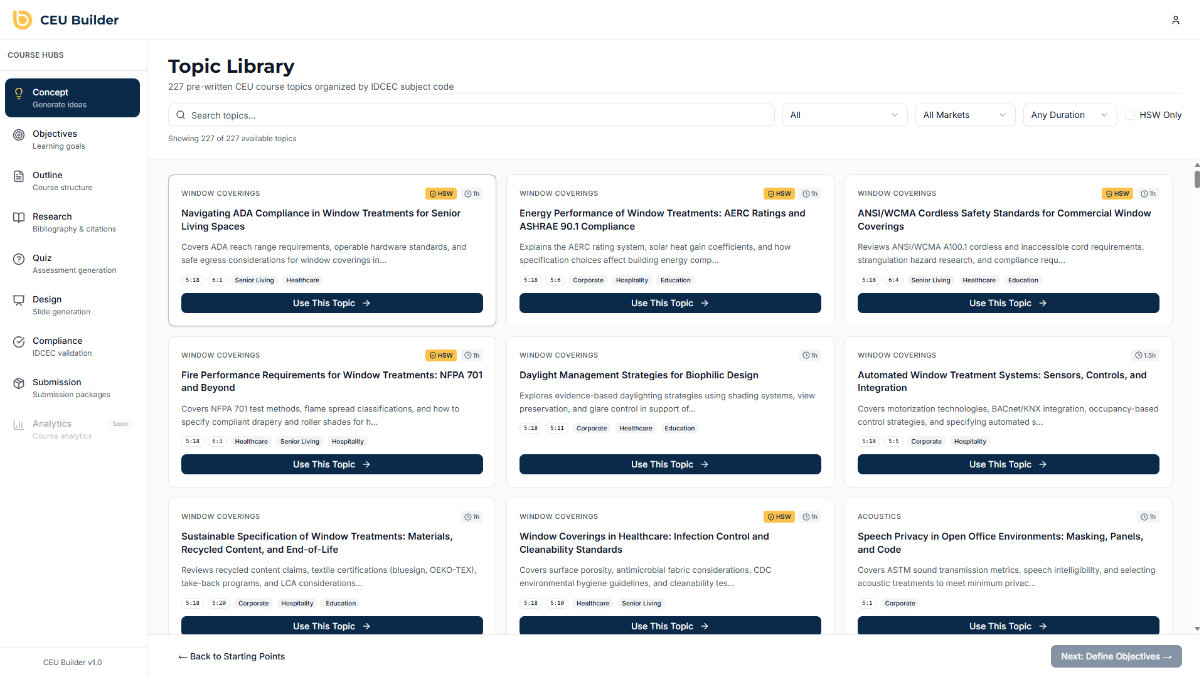
For teams ready to build, our resource on creating effective branded coursework covers how to structure content that passes accreditation and actually moves architects toward specification. And if you want a step-by-step walkthrough of the submission process, our guide on getting IDCEC approval removes the guesswork entirely. Whether you want a done-for-you course in four to six weeks or a platform to build your own, we are here to help you move fast and get it right the first time.
Frequently asked questions
What are the core requirements for AIA and IDCEC CEU compliance?
AIA requires 18 learning units per year, with 12 in Health, Safety, and Welfare topics. IDCEC standards require non-promotional content, at least 75% in HSW, and course updates every three years.
How does offering accredited CEUs help hospitality manufacturers?
Providing accredited CEUs builds trust with architects, improves specification rates, and reduces cost per lead by as much as 60%, shifting your brand from vendor to trusted advisor.
What are the most common reasons for CEU accreditation failure?
Most rejections stem from promotional or generic content, insufficient HSW focus, or outdated material. Roughly 50% of first-attempt submissions fail due to these avoidable issues.
How can hospitality manufacturers measure the ROI of their CEU programs?
Track specification rate increases, reduced sales cycle length, and cost per lead over time. Brands with strategic programs see spec rate gains of 15 to 45% when execution is consistent and follow-up workflows are in place.
Recommended
