

CEU Approval Process: Win More Specs in Hospitality

Most hospitality manufacturers believe the CEU approval process is a bureaucratic nightmare that drains time and resources. The reality? Manufacturers who streamline CEU approval see 50% faster specs and 40% higher trust with architects and interior designers. This article breaks down every step of the approval process, compares IDCEC and AIA frameworks, and delivers actionable strategies to accelerate your path from course concept to specification wins.
Table of Contents
- What is the CEU approval process and why does it matter?
- AIA vs. IDCEC: How approval frameworks differ
- Core steps in the CEU approval process for hospitality manufacturers
- CEU course design: How to guarantee approval the first time
- Advanced strategies: Speed, partnerships, and accelerating spec wins
- Unlock faster CEU approval and spec wins with expert support
- Frequently asked questions
Key Takeaways
| Point | Details |
|---|---|
| AIA vs. IDCEC differences | Know how their processes, fees, and spec value compare to set your CEU strategy. |
| Design for first-pass approval | Focus on educational rigor and HSW content—over 50% of first submissions fail for bias or weak objectives. |
| Accelerate specs with CEUs | Streamlined CEU approval increases specification speed and builds trust with your A&D buyers. |
| Leverage tech and partnerships | Use compliance tools and industry discounts for faster, cheaper course approval. |
What is the CEU approval process and why does it matter?
Continuing Education Units (CEUs) are the currency architects and interior designers need to maintain professional licenses. When your hospitality manufacturing brand offers accredited courses, you’re not just checking a compliance box. You’re creating a strategic asset that positions your products in front of decision-makers during their learning moments.
CEU approval is managed by AIA CES for architects and IDCEC for interior designers. Both organizations verify that courses meet rigorous educational standards before granting accreditation. Without approval, your course carries zero weight with design professionals who need verified credits.
The business case is straightforward. CEU courses yield measurable specification and trust ROI for manufacturers. When an architect spends 45-60 minutes learning from your educational content, they remember your brand when selecting products months later. This beats the five-minute sales pitch every time.
Strategic benefits of CEU approval:
- Direct access to specification-capable decision-makers
- Extended engagement windows that build genuine expertise
- Positioning as industry expert rather than vendor
- Measurable lead generation with completion tracking
- Competitive differentiation in crowded hospitality markets
The approval process validates your content meets professional standards. Design professionals trust accredited courses because third-party organizations have verified the educational rigor. This trust transfers to your brand and products.
“Architects actively seek IDCEC-accredited courses that fulfill licensing requirements while teaching them about materials and design approaches relevant to their work. The manufacturer who provides that education becomes the trusted resource.”
For hospitality manufacturers selling through architect and designer channels, CEU approval transforms marketing from interruption to invitation. You’re offering something design professionals actively want: credits they need anyway, delivered with genuine educational value. Learn more about branded CEU course advantages and how CEU compliance impacts your specification pipeline. Additional continuing education guidelines provide context for professional requirements.
AIA vs. IDCEC: How approval frameworks differ
Understanding the structural differences between AIA and IDCEC approval frameworks helps you allocate resources strategically. Each organization serves distinct audiences with unique requirements and timelines.
AIA CES emphasizes provider subscriptions and ongoing audits, while IDCEC operates on a per-course fee model with partnership opportunities through ASID and NKBA. These structural differences create different strategic advantages depending on your target audience.

| Feature | AIA CES | IDCEC |
|---|---|---|
| Primary Audience | Architects | Interior Designers |
| Fee Structure | Annual provider subscription | Per-course submission |
| Approval Timeline | 2-4 weeks typical | Variable, can be expedited |
| Partnership Discounts | Limited | ASID/NKBA members save on fees |
| Audit Requirements | Regular provider audits | Course-specific review |
| HSW Designation | Required for health/safety/welfare content | Optional but valuable |
Annual fees and review timelines differ significantly between organizations. AIA requires upfront provider registration with annual renewal, making it cost-effective if you plan multiple courses. IDCEC charges per course, which works better for manufacturers testing the CEU strategy with a single offering.
Strategic considerations for choosing your path:
- Target architects primarily? AIA approval is essential
- Focus on interior designers? IDCEC should be your priority
- Serve both audiences? Dual accreditation maximizes reach
- Limited budget? Start with IDCEC’s per-course model
- Building a course library? AIA’s subscription model scales better
Many hospitality manufacturers pursue both accreditations because their products get specified by architects and interior designers. A hotel furniture manufacturer benefits from reaching both the architect designing the space and the interior designer selecting finishes. Explore detailed comparisons of AIA vs IDCEC paths and review IDCEC provider details for current requirements.
Core steps in the CEU approval process for hospitality manufacturers
The approval process follows a predictable sequence. Understanding each step helps you allocate time and resources effectively while avoiding common pitfalls that delay approval.
Step-by-step approval sequence:
-
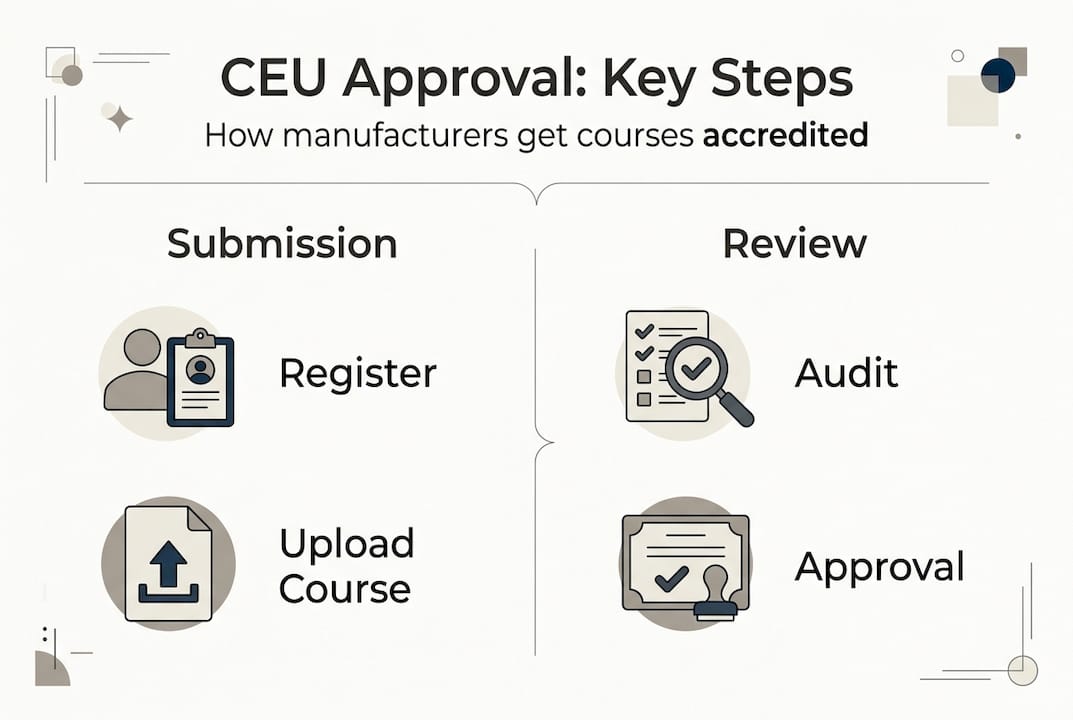
Provider Registration – Complete organizational paperwork with IDCEC or AIA. This one-time setup establishes your manufacturer as an approved education provider. Timeline: 1-2 weeks. Cost: $420-$6,000 annually depending on provider tier.
-
Course Design – Develop learning objectives, content outline, and instructional materials. This phase determines whether your course will pass compliance review. Timeline: 2-4 weeks for experienced teams. Cost: Internal resources or $10,000 for done-for-you service.
-
Compliance Audit – Verify content meets HSW requirements, includes proper citations, and balances education with product information. Timeline: 1 week. Cost: Included in development or $1,500 standalone.
-
Submission – File complete application with all required documentation through the provider portal. Timeline: 1-2 days for portal submission. Cost: Included in provider fees.
-
Review Period – Accreditation body evaluates course against standards. Timeline: 2-4 weeks typical. Cost: No additional fees beyond provider registration.
-
Revision (if needed) – Address reviewer feedback and resubmit. Timeline: 1-3 weeks depending on scope. Cost: Internal resources or included in approval guarantee.
-
Approval & Launch – Receive accreditation, set up certificates, and begin delivery. Timeline: 1 week for setup. Cost: Platform hosting or LMS fees.
| Step | Timeline | Responsible Party | Common Failure Points |
|---|---|---|---|
| Provider Registration | 1-2 weeks | Manufacturer or partner | Incomplete paperwork |
| Course Design | 2-4 weeks | Instructional designer | Weak learning objectives |
| Compliance Audit | 1 week | Compliance specialist | Commercial bias |
| Submission | 1-2 days | Provider administrator | Missing documentation |
| Review Period | 2-4 weeks | IDCEC/AIA reviewers | Content quality issues |
| Revision | 1-3 weeks | Content team | Misunderstanding feedback |
| Approval & Launch | 1 week | Technical team | Platform configuration |
Over 50% of first attempts are rejected for commercial bias or weak learning materials. The most common failure point is treating the course as a product brochure rather than genuine education. Reviewers spot promotional content immediately and reject courses that prioritize selling over teaching.
Pro Tip: Reduce first-pass rejection by aligning content to IDCEC and AIA HSW requirements from day one. Use technology tools that check compliance automatically before submission. This catches issues early when they’re easy to fix rather than after reviewers reject your application.
Common pitfalls include over-promotion of specific products, lack of measurable learning objectives, missing bibliography with academic sources, and assessments that don’t test actual learning. Address these during course design rather than after rejection. Resources for offering CEU courses and the IDCEC checklist help you avoid these mistakes. Review ASID provider resources for additional guidance.
CEU course design: How to guarantee approval the first time
First-time approval depends on exceptional course design that balances educational rigor with strategic positioning. Most rejections happen because manufacturers skip critical design elements that reviewers expect.
Six elements every successful course includes:
- Clear Learning Objectives – Specific, measurable outcomes that define what participants will know or be able to do after completion
- HSW Alignment – Content that addresses health, safety, or welfare considerations relevant to design professionals
- Content Rigor – Academic-level information with proper citations, research backing, and expert perspectives
- Adult Learning Principles – Instructional design that respects professional learners with real-world application
- Valid Assessments – Exam questions that test comprehension and application, not just recall
- Complete Bibliography – Properly formatted citations for all factual claims and research references
Design dos and don’ts:
- Do focus on teaching specification criteria that happen to favor your products
- Don’t create product brochures disguised as education
- Do include third-party research and industry standards
- Don’t rely solely on your company’s marketing materials
- Do test actual learning with application-based questions
- Don’t use simple recall questions that anyone could answer
- Do position your brand as expert through teaching
- Don’t make explicit sales pitches within course content
Most first-time in-house submissions are rejected for commercial bias or lack of rigor. Reviewers expect academic-level content with proper citations, HSW focus, and objective testing. When manufacturers treat courses as extended advertisements, rejection is guaranteed.
“Revisions after rejection can delay your process by 6-12 months and waste tens of thousands in internal resource costs. The manufacturers who succeed on first submission invest in proper instructional design from the start.”
Pro Tip: Use generic education to position products strategically. Teach architects about acoustic performance standards in hospitality environments, then naturally reference how specific product features meet those standards. This approach passes compliance review while building preference for your solutions.
The difference between approved and rejected courses often comes down to tone and framing. Approved courses teach design professionals something valuable they didn’t know. Rejected courses try to convince them to buy something. Explore course development tips and faster CEU approval data. Additional insights on course development for manufacturers provide practical frameworks.
Advanced strategies: Speed, partnerships, and accelerating spec wins
Manufacturers who want more than minimum compliance can accelerate approval timelines and maximize specification impact through strategic approaches.
Five tactics for accelerating approval:
-
Deploy Technology Tools – Custom GPT tools handle bibliography formatting, exam question generation, and compliance checking automatically, eliminating human error on routine requirements.
-
Use Pre-Vetted Content – Start with instructional design templates that have passed review multiple times, reducing the risk of structural issues.
-
Prepare for Audits – Maintain documentation from day one rather than scrambling when reviewers request additional information.
-
Leverage Expert Review – Have experienced instructional designers audit content before submission to catch issues reviewers will flag.
-
Build Revision Capacity – Plan time and budget for potential revisions rather than treating first submission as final.
ASID and NKBA partnerships offer IDCEC approval fee discounts for members. If your team includes designers with these affiliations, you can reduce per-course costs significantly. Technology can cut approval timelines to 4-6 weeks compared to the 90-180 day traditional cycle.
Topic selection for guaranteed relevance:
Choose course topics that align with what architects and designers actually search for and need to learn. Hospitality-relevant topics like acoustic performance, sustainability standards, and accessibility compliance consistently see high approval rates and specification impact.
“Technology tools can cut approval timelines to 4-6 weeks while partnerships reduce costs. The manufacturers who combine both approaches reach market faster and more economically than competitors attempting manual processes.”
Selecting topics strategically means understanding the intersection of your product expertise and architect learning needs. A lighting manufacturer might create courses on circadian rhythm design in hospitality environments or energy code compliance for commercial interiors. Both topics teach valuable information while positioning the manufacturer’s products as solutions. Discover 10x CEU ROI strategies and how fast CEU course delivery boosts influence. Review NKBA provider partners for partnership opportunities.
Unlock faster CEU approval and spec wins with expert support
You now understand the complete CEU approval process, from initial registration through final accreditation. The question is whether you’ll spend 6-12 months navigating this process internally or compress the timeline to 4-6 weeks with expert support.
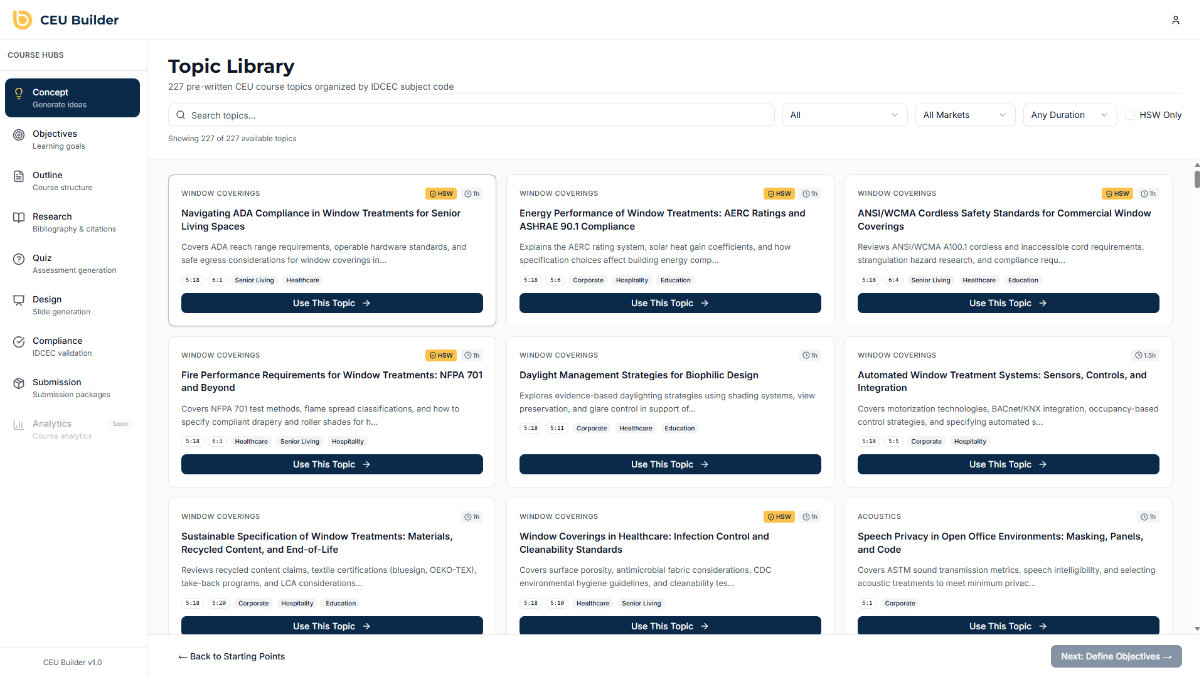
Manufacturers who work with specialized CEU development partners avoid the costly mistakes that delay approval and waste resources. A step-by-step IDCEC guide walks you through provider registration, course development, and submission management. When you’re ready to get 50% faster specs and 40% higher trust with design professionals, expert support eliminates the learning curve. The guide to creating effective branded coursework provides frameworks for balancing education with strategic positioning. Your specification pipeline depends on courses that pass approval the first time and deliver genuine value to architects and interior designers.
Frequently asked questions
How long does CEU approval take for hospitality manufacturers?
With best practices and technology tools, approval completes in 4-6 weeks. Manual or first-time attempts often take 90-180 days due to learning curves and revision cycles.
What is the main reason CEU courses get rejected?
Most rejections happen due to commercial bias in materials or weak learning objectives and assessments. Reviewers reject courses that prioritize selling over teaching.
Can one course be submitted for both AIA and IDCEC approval?
Yes, but the course must meet unique compliance standards of both organizations, including HSW content for AIA and proper learning objectives for IDCEC.
What fees should I budget for CEU course approval?
Expect to budget $420 annually for IDCEC corporate providers and $6,000 for preferred tier, plus AIA annual subscription fees and per-course development costs.
What topics guarantee the best specs and approval rates?
Courses on hospitality-relevant topics like acoustics and sustainability consistently see high approval rates and specification impact because they address real design challenges.
Recommended
