

Checklist for CE course approval: ensure IDCEC success

Securing CE course approval for IDCEC accreditation remains one of the most critical challenges facing marketing and sales professionals in hospitality manufacturing. With architects and designers requiring continuing education credits to maintain licensure, your ability to deliver accredited courses directly influences specification outcomes and revenue growth. A comprehensive checklist streamlines the approval process, reduces costly revision cycles, and positions your brand as an educational authority. This guide outlines the essential criteria, common pitfalls, and actionable steps to achieve first-pass IDCEC approval in 2026 while maximizing engagement with design professionals who control product selection decisions.
Table of Contents
- Defining Your CE Course Approval Criteria
- Essential Components Of Your CE Course Checklist
- Comparing Common Pitfalls And Approval Hurdles
- Deciding Your Next Steps: Implementing The Checklist For Hospitality Manufacturers
- Streamline Your IDCEC CEU Course Approval With CEU Builder
- What Is The Typical Timeline For IDCEC CE Course Approval?
- How Many Continuing Education Hours Are Required For Interior Designers In Florida?
- What Are Best Practices To Ensure First-Pass IDCEC Approval?
- Can Hospitality Manufacturers Develop Their Own CEU Courses?
Key takeaways
| Point | Details |
|---|---|
| Compliance checklist | Following IDCEC standards and state requirements ensures faster approval and reduces resubmission risk. |
| Structured courses | Well-designed instructional content accelerates approval timelines and boosts designer engagement. |
| Approval criteria | Understanding specific requirements helps avoid costly revision cycles that delay market entry. |
| Expert guidance | Using proven submission strategies streamlines the approval process and maximizes first-pass success rates. |
Defining your CE course approval criteria
IDCEC accreditation serves as the gold standard for continuing education courses targeting architects and interior designers in hospitality manufacturing. The approval process requires meeting specific standards that validate educational quality, instructional integrity, and professional relevance. Understanding these foundational criteria before course development begins saves months of revision work and thousands in wasted resources.
IDCEC accreditation matters because it signals to design professionals that your course meets rigorous educational standards. Architects actively seek accredited courses that fulfill mandatory continuing education requirements while teaching them practical knowledge applicable to real projects. When your course carries IDCEC accreditation, it becomes a legitimate professional development resource rather than promotional content disguised as education.
State licensing requirements add another layer of complexity to approval criteria. Florida requires 20 hours of continuing education per renewal cycle for licensed interior designers, establishing a baseline that influences course development across the industry. These state mandates create predictable demand for accredited courses while setting minimum quality thresholds that approval committees enforce rigorously.
Content quality standards extend beyond basic information delivery to encompass instructional design principles that promote actual learning. Approval committees evaluate whether courses include clear learning objectives, structured content progression, appropriate assessment methods, and practical application opportunities. Courses that simply present product specifications without teaching transferable skills or industry knowledge face rejection regardless of technical accuracy.
Essential documentation requirements include provider eligibility verification, course content outlines, faculty qualifications, and compliance attestations. The continuing education compliance guide details specific documentation standards that manufacturers must meet before submission. Missing even a single required document triggers automatic rejection, restarting the entire approval timeline.
Industry regulations governing course development cycles include ethical standards prohibiting overtly promotional content, accessibility requirements ensuring ADA compliance, and assessment protocols verifying knowledge retention. Understanding what course approval involves helps manufacturers align internal development processes with external approval expectations from the outset.
Pro Tip: Review IDCEC’s current provider handbook before starting course development to identify any recent policy changes that might affect your submission strategy or content requirements.
Essential components of your CE course checklist
A comprehensive approval checklist transforms the complex IDCEC submission process into manageable steps that marketing and sales teams can execute systematically. Each checklist component addresses specific approval requirements that committees evaluate during the review process.

Required documentation starts with provider registration forms establishing your organization’s eligibility to offer continuing education. Course content outlines must detail the scope, sequence, and learning progression across all instructional modules. Learning objectives need to specify measurable outcomes using action verbs that describe what participants will be able to do after completing the course. Faculty qualifications documentation proves that instructors possess relevant expertise and credentials recognized by the design professional community.
Compliance components include ethical standards attestations confirming your course prioritizes education over product promotion. ADA accessibility guidelines require that all course materials accommodate participants with disabilities through alternative formats, captions, and screen reader compatibility. The AORN Approval Unit provides detailed instructions showing how approval committees evaluate compliance across multiple dimensions simultaneously.
Course assessment methods must include quizzes, surveys, or other evaluation tools that measure knowledge retention and application capability. IDCEC requires proof that participants actually learned course content rather than simply attending a presentation. Assessment questions should test understanding of key concepts, ability to apply information to realistic scenarios, and retention of critical specification criteria that influence product selection decisions.
Post-launch evaluation and feedback collection mechanisms demonstrate your commitment to continuous improvement. Approval committees want evidence that you will monitor course effectiveness, gather participant input, and make iterative refinements based on actual usage data. The step-by-step accreditation guide outlines specific evaluation protocols that satisfy IDCEC’s quality assurance requirements.
Course delivery logistics including registration systems, certificate generation, completion tracking, and record retention policies must align with IDCEC standards. Your checklist should verify that technical infrastructure supports seamless participant experiences while maintaining audit trails that prove compliance during potential reviews. Understanding the IDCEC course approval steps helps you configure systems correctly before submission rather than discovering gaps during committee review.
Pro Tip: Create a master checklist template that includes every required element with assigned responsibilities and completion deadlines, then use this template for every course submission to ensure nothing gets overlooked.
Comparing common pitfalls and approval hurdles
Analyzing frequent submission errors reveals patterns that separate successful first-pass approvals from courses requiring multiple revision cycles. Understanding these pitfalls helps you implement preventive measures during course development rather than discovering problems after rejection.
Incomplete documentation represents the most common approval obstacle. Manufacturers often submit courses with missing faculty credentials, inadequate learning objective specifications, or insufficient assessment tools. Each missing element triggers rejection and adds weeks to the approval timeline. The Florida continuing education requirements illustrate how state licensing boards maintain strict documentation standards that IDCEC mirrors in its approval process.
| Compliant Submission Factor | Non-Compliant Submission Factor |
|---|---|
| Clear measurable learning objectives using action verbs | Vague goals like “understand” or “learn about” without measurable outcomes |
| Structured content with logical progression and transitions | Random information presentation without instructional flow |
| Assessment questions testing application and analysis | Quiz items requiring only recall of basic facts |
| ADA-compliant materials with alternative formats available | PDF-only content without accessibility accommodations |
| Faculty credentials documented with relevant certifications | Instructor qualifications assumed without verification |
Unclear learning objectives cause approval delays because committees cannot evaluate whether course content actually delivers promised outcomes. Objectives must specify exactly what participants will be able to do, using measurable action verbs that describe observable behaviors or demonstrable skills. Generic statements about “understanding concepts” or “learning principles” fail to meet IDCEC’s specificity requirements.
Top five pitfalls that trigger rejection include:
- Ignoring ADA accessibility standards by providing materials in only one format without accommodations for participants with disabilities
- Submitting courses with insufficient faculty credentials or failing to document instructor qualifications adequately
- Creating overtly promotional content that prioritizes product features over educational value and practical application
- Developing assessment tools that test only basic recall rather than comprehension, analysis, or real-world application
- Missing required documentation elements like bibliographies, course outlines, or provider attestations
Managing CEU approvals for first-pass success requires understanding that approval committees apply consistent evaluation criteria across all submissions. Courses that meet every requirement on the first attempt move through review quickly, while those with any deficiencies face rejection regardless of overall quality. The binary nature of approval decisions means that 95% compliance still results in 100% rejection.
The course approval workflow demonstrates how systematic checklist adherence prevents common errors. Manufacturers who audit their submissions against detailed checklists before filing catch errors internally rather than discovering them through rejection notices. This proactive approach compresses approval timelines from months to weeks while eliminating costly revision cycles.
Pro Tip: Conduct a pre-submission audit using a third-party reviewer who can identify gaps that internal teams might overlook due to familiarity with the content.
Deciding your next steps: implementing the checklist for hospitality manufacturers
Transforming approval criteria into operational workflows requires deliberate implementation planning that integrates checklist discipline into your course development process. The following steps provide a roadmap for applying the approval checklist systematically.
-
Establish cross-functional course development teams that include marketing professionals, product experts, instructional designers, and compliance specialists who each bring essential perspectives to the approval process.
-
Map your internal development timeline to IDCEC approval requirements, identifying which checklist items need completion at each project stage and assigning clear ownership for every deliverable.
-
Create standardized templates for learning objectives, course outlines, assessment questions, and documentation packages that embed approval criteria into reusable formats your team can customize for each course.
-
Implement quality gates at key development milestones where teams pause to verify checklist completion before proceeding to the next phase, catching errors early when they are easiest to fix.
-
Document your approval process including successful submission examples, rejection lessons learned, and committee feedback patterns that inform future course development decisions.
-
Establish communication protocols for liaising with IDCEC approval committees, including designated points of contact, response procedures for committee questions, and escalation paths for addressing unexpected issues.
-
Deploy tracking systems that monitor submission status, approval timelines, and revision requirements across your entire course portfolio, enabling data-driven process improvements.
-
Schedule regular checklist reviews that incorporate new IDCEC guidance, industry best practices, and internal lessons learned from previous submissions.
Cross-functional collaboration proves essential because no single team possesses all the expertise required for successful approval. Marketing understands audience needs and competitive positioning. Product teams know technical specifications and application details. Instructional designers structure content for optimal learning. Compliance specialists ensure regulatory alignment. Integrating these perspectives through systematic checklist application produces courses that satisfy both approval committees and design professional learners.
Communication tips for effective committee liaison include responding promptly to information requests, providing complete answers that address underlying concerns rather than just surface questions, and maintaining professional courtesy even when facing unexpected revision requirements. Building positive relationships with approval committee members creates goodwill that can expedite future submissions.
Tracking tools should capture submission dates, review milestones, approval decisions, revision requests, and final approval dates for every course. This data reveals patterns in approval timelines, identifies recurring issues that need process corrections, and demonstrates continuous improvement to stakeholders evaluating your CEU program’s effectiveness. Understanding how to get IDCEC approval includes recognizing that systematic tracking enables predictable outcomes.
Iterative improvement based on approval feedback transforms each submission into a learning opportunity that strengthens future courses. When committees request revisions, analyze why the original submission missed requirements and update your checklist to prevent recurrence. This continuous refinement approach compounds over time, progressively improving your first-pass approval rate. Learning how to create effective IDCEC-accredited CEU courses means building organizational capability that persists beyond individual course projects.
Streamline your IDCEC CEU course approval with CEU Builder
Navigating IDCEC approval requirements demands specialized expertise that most hospitality manufacturers lack internally. CEU Builder eliminates approval uncertainty through proven processes that achieve 100% first-pass success rates. Our team handles every aspect of course development and submission, from initial strategy through final approval, compressing traditional 90-180 day timelines into 4-6 weeks.
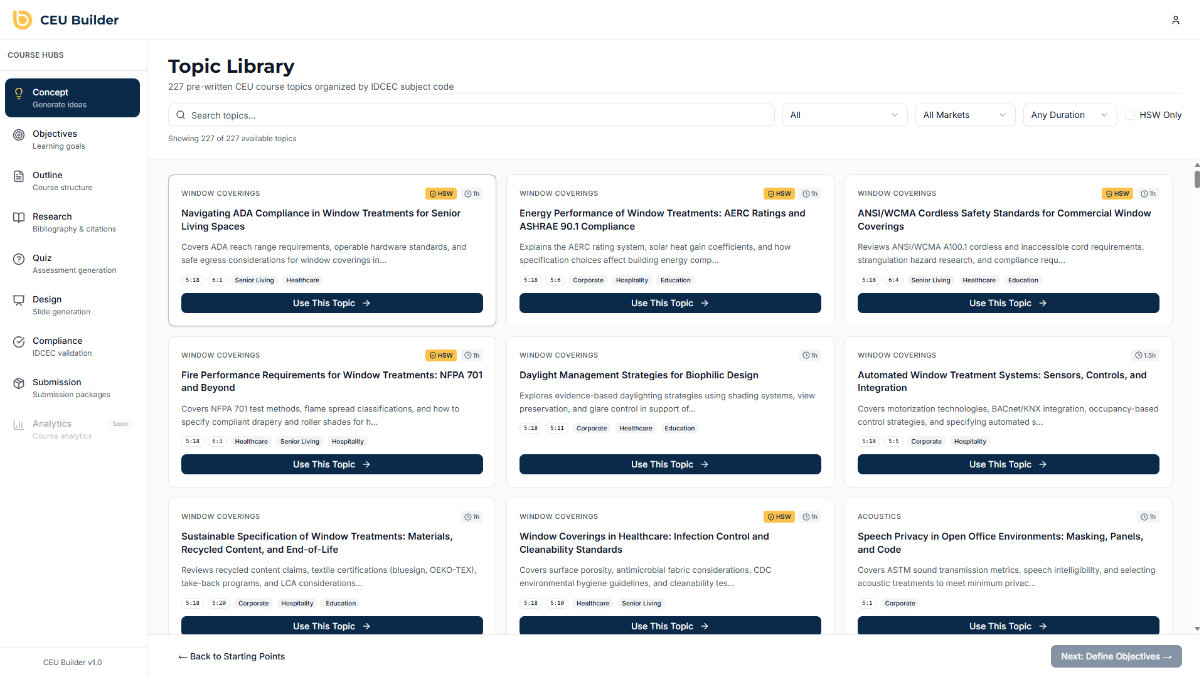
We reverse-engineered the IDCEC approval process to identify exactly what committees evaluate and how to satisfy every requirement systematically. This methodology produces courses that meet approval standards while delivering genuine educational value that drives architect engagement and product specifications. Our IDCEC accreditation guide provides transparency into approval requirements, while our done-for-you service handles the complex execution.
Manufacturers working with CEU Builder gain immediate access to expertise that would take years to develop internally. We know which course topics architects actually want, how to structure content for maximum engagement, and what documentation approval committees require. This knowledge translates directly into faster approvals, higher completion rates, and measurable specification lift. Understanding the complete IDCEC course approval process helps you appreciate why specialized expertise matters.
Pro Tip: Leverage CEU Builder’s workflow tools and approval expertise to achieve first-pass IDCEC approval while your team focuses on core business activities rather than navigating complex accreditation requirements.
What is the typical timeline for IDCEC CE course approval?
IDCEC approval typically takes 4-6 weeks from submission to final decision, assuming your course meets all requirements on the first review. Incomplete submissions or courses requiring revisions can extend timelines to 12-16 weeks or longer. The approval duration depends heavily on submission quality, with complete, well-structured courses moving through review significantly faster than those with missing documentation or unclear learning objectives.
How many continuing education hours are required for interior designers in Florida?
Licensed interior designers in Florida must complete 20 continuing education hours per renewal cycle to maintain active licensure. This requirement creates consistent demand for quality CEU courses among design professionals working on hospitality projects throughout the state. Understanding state-specific requirements helps manufacturers develop courses that address actual market needs.
What are best practices to ensure first-pass IDCEC approval?
Ensure checklist completeness by verifying every required document, form, and content element before submission. Follow submission guidelines precisely, formatting materials exactly as IDCEC specifies. Pre-audit course materials using your approval checklist to catch errors internally. Maintain open communication with IDCEC representatives to clarify any ambiguous requirements. Consider using expert resources like CEU Builder that specialize in first-pass IDCEC approval to eliminate approval risk entirely.
Can hospitality manufacturers develop their own CEU courses?
Yes, hospitality manufacturers can develop and obtain IDCEC approval for their own CEU courses, creating powerful tools for increasing product specification opportunities. Successful in-house development requires understanding IDCEC requirements, investing in instructional design expertise, and committing resources to the approval process. Many manufacturers find that developing CEU courses internally builds valuable organizational capability while creating educational assets that drive long-term specification growth.
Recommended
