

Create effective IDCEC-accredited CEU courses in 2026

Hospitality manufacturers waste months and thousands of dollars developing CEU courses that fail IDCEC accreditation on the first attempt. Without understanding compliance requirements or architect learning preferences, these efforts drain budgets and delay market entry. This guide provides clear steps and expert strategies to efficiently create accredited CEU content that drives architect engagement and specification impact.
Table of Contents
- Prerequisites And Preparation For IDCEC CEU Content Creation
- Aligning Course Topics With Architect Needs And Market Research
- Step-By-Step Course Design And IDCEC Accreditation Submission
- Common Accreditation Pitfalls And How To Fix Them
- Leveraging Technology And Automation For Faster Course Creation
- Scaling Education Programs: Multi-Course Packages And Strategic Expansion
- Measuring Success: Outcomes, Metrics, And ROI From CEU Programs
- Troubleshooting And Common Mistakes To Avoid
- How CEU Builder Can Help You Create Accredited CEU Courses
- Frequently Asked Questions
Key takeaways
| Point | Details |
|---|---|
| Prerequisites matter | Provider registration and subject matter experts must be secured before IDCEC course development begins. |
| Align with architect needs | Market research ensures topics match what design professionals actually search for and want to learn. |
| Follow structured process | Step-by-step instructional design and submission workflow guarantees IDCEC compliance and timely approval. |
| Avoid common pitfalls | Expert guidance and revision cycles prevent the high rejection rates caused by compliance errors. |
| Technology accelerates delivery | AI tools and automation cut traditional 90-180 day timelines down to 4-6 weeks. |
Prerequisites and preparation for IDCEC CEU content creation
Before developing any course, manufacturers must complete foundational requirements that ensure compliance readiness and resource alignment. Skipping these steps leads to delays and rejection.
Provider registration requires a $750 annual fee before any course can be submitted to IDCEC. This one-time setup establishes your company as an approved education provider. Budget for this upfront cost as part of your planning process.
Assess your internal resources honestly. You need subject matter experts who understand hospitality products deeply. Marketing capacity to manage course promotion matters. Technology tools for content creation and delivery must be in place. Without these foundations, even the best course strategy fails.
Architects must earn 10 CEU hours every two years for professional licensing. This creates steady demand for relevant continuing education. Understanding this requirement helps you position courses as valuable solutions rather than optional content.
Essential preparation checklist:
- Complete IDCEC provider registration and pay annual fees
- Identify internal subject matter experts with product knowledge
- Secure marketing resources for course promotion and tracking
- Invest in instructional design capabilities or partnerships
- Budget for submission fees and potential revision costs
Pro Tip: Start the provider registration process 4-6 weeks before course development begins. This prevents bottlenecks when you’re ready to submit.
| Resource Type | Requirement | Budget Impact |
|---|---|---|
| IDCEC Registration | Annual provider fee | $750 |
| Subject Matter Experts | Internal staff time | Variable |
| Instructional Design | Tools or services | $2,000-$10,000 |
| Technology Platform | LMS hosting | $99-$1,500/month |
Technology platforms for content delivery should support certificate generation, completion tracking, and IDCEC compliance documentation. Evaluate options based on your internal expertise and timeline priorities.
Aligning course topics with architect needs and market research
Selecting the right topics determines whether architects engage with your content or ignore it completely. Product brochure approaches fail because they prioritize selling over teaching.

Conduct market research to understand what architects actively search for and need to learn. Search behavior reveals pain points and knowledge gaps. Industry trends show emerging topics that attract attention. This data-driven approach increases relevance and completion rates.
Architects avoid courses that feel like sales pitches. Focus on educational value aligned with their professional licensing requirements. Teach specification criteria, design best practices, and technical knowledge. Position your products as solutions within a broader educational context.
Topic selection framework:
- Analyze architect search behavior using keyword research tools
- Review competitor course offerings to identify gaps
- Survey your sales team about common customer questions
- Examine industry publications for trending design challenges
- Validate topics against IDCEC content requirements
Pro Tip: Check examples of successful CEU topics to understand what resonates with design professionals in hospitality markets.
Market research reveals what architects want to learn versus what manufacturers assume they need. This gap causes many course failures. A $2,500 investment in upfront research prevents wasted development on topics that generate zero engagement.
Integrate search data and professional insights into every topic decision. High-performing courses teach architects something valuable they’ll use on real projects. The manufacturer’s products become natural reference points within that educational framework.
Step-by-step course design and IDCEC accreditation submission
Executing course development requires structured workflows that maintain quality while ensuring compliance at every stage.
Course creation workflow:
- Draft content using instructional design best practices tailored to hospitality professionals
- Define clear learning objectives that align with IDCEC standards and architect needs
- Develop exam questions linked directly to each learning objective for compliance
- Create slide decks optimized for visual learning and professional delivery
- Write comprehensive speaker scripts that ensure consistent messaging
- Compile bibliographies meeting academic standards with proper citations
- Submit through IDCEC online portal with complete documentation
- Monitor submission status and respond promptly to revision requests
Learning objectives must be measurable and specific. Vague goals like “understand products” fail accreditation. Strong objectives state exactly what architects will be able to do after completing the course.
Exam questions test retention and application of learning objectives. Each question must clearly link to a specific objective. Provide justification for correct answers that reinforces key concepts.
IDCEC course approvals typically take 3 weeks from submission to initial decision. Plan for additional time if revisions are required. Incomplete documentation extends this timeline significantly.
Compliance documentation requirements:
- Complete course outline with timing and structure
- Detailed learning objectives with measurable outcomes
- Exam questions with answer justifications
- Bibliography citing all referenced sources
- Slide deck with speaker notes
- Proprietary product information limited to allowed slides
Submit through the IDCEC portal carefully. Missing fields or incomplete sections trigger automatic rejections. Review every form field twice before final submission.
The course development process becomes faster with experience, but first-time submissions require extra attention to detail. Budget 8-12 weeks for DIY approaches or 4-6 weeks for expert-managed services.
Understanding how to offer CEU courses effectively requires mastering both content quality and technical compliance. Both elements must work together for successful accreditation.
Common accreditation pitfalls and how to fix them
Most course rejections stem from predictable compliance errors that expert guidance prevents.
Top rejection reasons include insufficient content, improper proprietary information use, and missing bibliographies. These issues cause 30-40% failure rates industry-wide. First-time submitters face even higher rejection risks without proper preparation.
Insufficient content means slides lack detail, speaker notes are incomplete, or bibliographies don’t meet academic standards. IDCEC reviewers need comprehensive materials to verify educational value. Thin content signals low quality and gets rejected immediately.
Proprietary product information must be restricted to specific slides clearly marked in your submission. Spreading product names throughout educational content violates compliance rules. Limit product mentions to designated sections that don’t compromise learning objectives.
Common mistakes and solutions:
- Insufficient slide detail: Add comprehensive speaker notes explaining each concept
- Missing bibliography: Cite every factual claim with proper academic formatting
- Weak learning objectives: Use measurable verbs and specific outcomes
- Poor exam questions: Link each question explicitly to learning objectives
- Excessive product focus: Restrict proprietary info to allowed slides only
Pro Tip: The course approval process rewards thorough documentation. Spend extra time on bibliographies and speaker notes to avoid rejections.
Exam questions must test comprehension, not promote products. Write questions that assess whether architects learned the educational content. Provide thorough justifications showing how correct answers connect to learning objectives.
“Without expert guidance, manufacturers face 30-40% rejection rates that waste months and require complete course rebuilds. Strategic preparation and compliance focus eliminate these costly failures.”
Engage CEU experts or proven services to manage compliance complexity. The cost of professional help is far less than the expense of failed submissions and delayed market entry.
Revision cycles take additional weeks when rejections occur. Factor this risk into your timeline planning. Services with 100% first-pass approval rates eliminate this uncertainty entirely.
Leveraging technology and automation for faster course creation
AI tools and automation platforms transform course development from months-long projects into 4-6 week sprints.
Custom GPT tools generate bibliographies in proper academic format, eliminating hours of manual formatting. Exam question creation becomes systematic rather than subjective. Compliance checks catch errors before submission, preventing rejections.
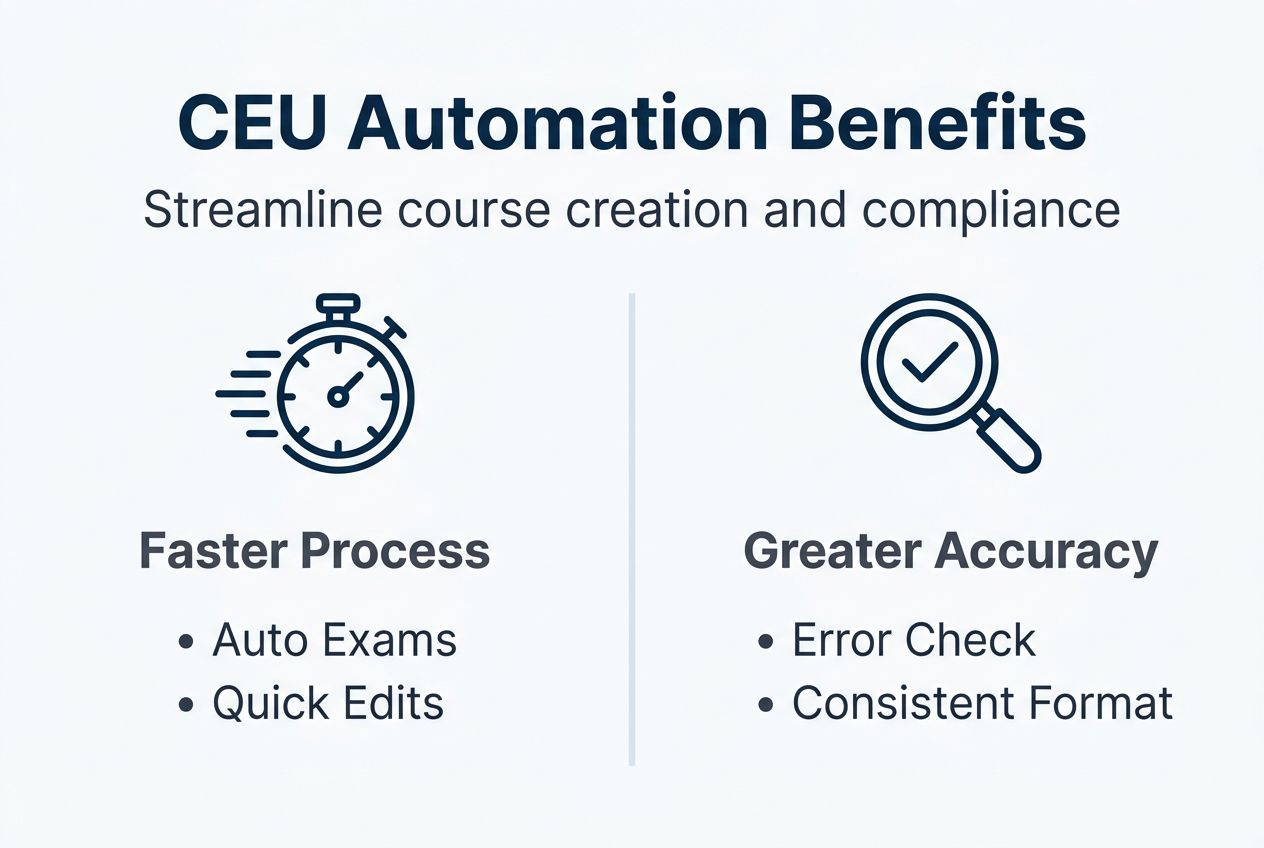
Systematizing content creation cuts traditional 90-180 day timelines dramatically. Automation handles repeatable tasks like citation formatting and exam structure. Human expertise focuses on strategic elements like topic selection and learning design.
Technology applications in CEU development:
- GPT-powered bibliography generation with automatic formatting
- AI-assisted exam question creation linked to learning objectives
- Automated compliance checking against IDCEC requirements
- Template-based slide deck design for visual consistency
- Workflow management tools tracking development milestones
Balance automation with human judgment. AI excels at routine tasks but strategic thinking requires expertise. Instructional designers shape educational flow and engagement. Compliance specialists verify IDCEC requirements. Technology multiplies their effectiveness.
Choose platforms that integrate with IDCEC submission portals. Seamless data transfer prevents manual entry errors. Tracking systems monitor submission status automatically.
Plan technology adoption based on internal capabilities. Teams with strong technical skills benefit most from DIY platforms. Companies lacking expertise should partner with services providing both technology and strategic guidance.
The fast course lifecycle enabled by automation gives manufacturers competitive advantages. Reaching market weeks faster means capturing architect attention before competitors.
Scaling education programs: multi-course packages and strategic expansion
Single courses establish presence, but comprehensive libraries create competitive moats.
Multi-course packages offer distinct value tiers. Single courses ($10,000) provide entry points for testing CEU strategy. Two-course series ($18,000) create multiple touchpoints with architect audiences. Three-course packages ($25,000) establish comprehensive educational positioning across product lines.
Balance topic breadth versus depth strategically. Broad coverage across product categories reaches more architects. Deep dives into specific applications build expert authority. Your market position and resources determine the right approach.
| Package | Investment | Timeline | Best For |
|---|---|---|---|
| Single Course | $10,000 | 4-6 weeks | Testing CEU strategy |
| Two-Course Series | $18,000 | 6-10 weeks | Multiple product lines |
| Three-Course Series | $25,000 | 10-12 weeks | Complete market coverage |
Multi-touch educational engagement builds deeper specification influence over time. Architects who complete multiple courses from one manufacturer develop strong brand preference. This loyalty translates into specification decisions months later.
Scaling considerations:
- Resource allocation for managing multiple course developments
- Topic sequencing that builds knowledge progressively
- Marketing bandwidth to promote expanded course library
- Budget flexibility for incremental investment
- Timeline management across parallel course projects
Weigh ROI gains from package expansion against development costs. Two courses reach twice as many architects with different learning needs. Three courses position you as the comprehensive education leader in your category.
Consider resource requirements honestly. Scaling too fast strains internal teams and compromises quality. Phased expansion over 6-12 months maintains standards while building your library systematically.
Measuring success: outcomes, metrics, and ROI from CEU programs
Effective CEU programs generate measurable business outcomes beyond completion counts.
Track course approval rates as your primary quality metric. First-pass approvals indicate strong compliance understanding. Multiple revision cycles signal process weaknesses requiring correction.
Monitor completion rates to gauge architect engagement. Industry averages range from 40-60% for quality courses. Higher rates suggest strong topic selection and content delivery. Lower rates indicate misalignment with architect needs.
Measure specification increases directly linked to CEU graduates. Track which architects who completed courses later specified your products. This direct attribution demonstrates ROI clearly.
Key performance indicators:
- First-pass IDCEC approval rate (target: 100%)
- Course completion rate (benchmark: 50%+)
- Specification requests from course graduates
- Revenue attributed to CEU-influenced projects
- Cost per specification compared to traditional marketing
Calculate ROI by comparing revenue gains from specifications versus course development investment. A single $100,000 hospitality project specification returns 10x on a $10,000 course investment. Multiple specifications compound returns exponentially.
Pro Tip: Set up tracking systems before launching courses. Retroactive attribution is difficult and often incomplete.
Course completion data reveals which architects are interested in which topics. Use this intelligence for precise sales targeting. Architects who engaged with specific content signal buying intent for related products.
Data-driven insights refine future courses and justify continuing education budgets. Demonstrating clear specification lift and revenue impact secures ongoing investment from leadership.
Troubleshooting and common mistakes to avoid
Preventing typical challenges keeps CEU projects on schedule and within budget.
Internal delays derail timelines when resources aren’t dedicated properly. Secure committed time from subject matter experts before starting. Clarify responsibilities across marketing, product, and sales teams upfront.
Common pitfalls to prevent:
- Underestimating IDCEC documentation requirements
- Creating product brochures instead of educational content
- Ignoring architect learning preferences in topic selection
- Slow response to revision feedback extending approval cycles
- Poor tracking preventing ROI measurement and attribution
Documentation requirements exceed most manufacturers’ initial expectations. IDCEC demands comprehensive speaker notes, detailed bibliographies, and thorough exam justifications. Budget adequate time for these compliance elements.
Course content must prioritize architect education over product promotion. The 85% teaching / 15% product focus ratio maintains credibility while positioning your solutions naturally.
Respond promptly to revision feedback when it occurs. Delays compound quickly. A one-week response delay adds three weeks to your approval timeline.
Plan for continuous improvement based on post-approval results. Track which topics generate highest engagement. Measure which courses drive most specifications. Use these insights to refine future development.
Review content quality best practices regularly to maintain high standards across all courses.
Apply proven accreditation management strategies to prevent common errors that cause rejections and delays.
How CEU Builder can help you create accredited CEU courses
Creating IDCEC-accredited courses requires expertise most manufacturers lack internally. CEU Builder eliminates this barrier with proven systems and guaranteed results.
Our done-for-you service delivers 100% first-pass IDCEC approval in 4-6 weeks. We handle everything from initial research through final accreditation. You review content before launch, we manage all compliance complexity.
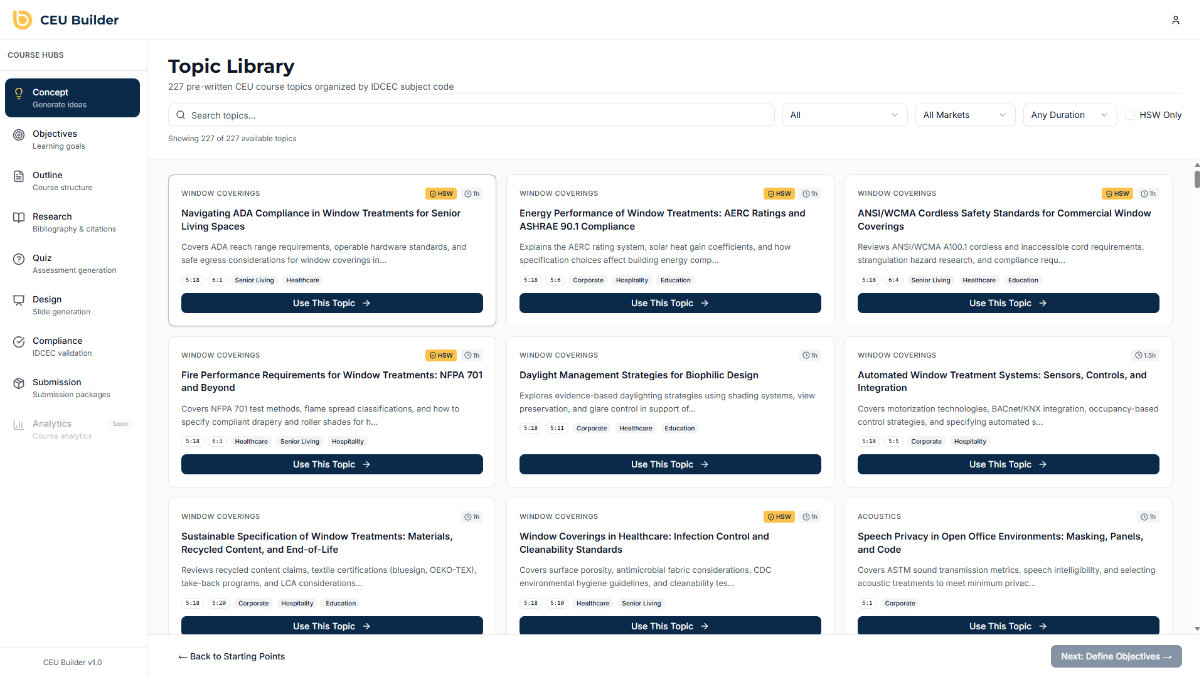
The platform integrates instructional design, compliance verification, and submission management specifically for hospitality manufacturers. Custom GPT tools accelerate development without sacrificing quality. Expert oversight ensures every course meets IDCEC standards perfectly.
Explore our step-by-step accreditation guide to understand the complete process. Learn how to get IDCEC approval efficiently without costly mistakes. Review our complete course lifecycle showing exactly how we achieve perfect approval rates.
Partner with CEU Builder to streamline your course creation and amplify architect engagement starting today.
Frequently asked questions
What is the required CEU hour commitment for architects in hospitality?
Architects must complete 10 CEU hours within each two-year licensing cycle to maintain professional credentials. IDCEC-accredited courses satisfy these requirements for hospitality industry professionals seeking relevant education.
How long does the IDCEC accreditation process typically take?
Course approval by IDCEC takes approximately 3 weeks from submission to initial decision. Additional time may be required for revisions if content issues or incomplete documentation trigger resubmission requests.
What are common reasons courses get rejected by IDCEC?
Insufficient content detail, improper proprietary information placement, and missing bibliographies cause most rejections. These compliance errors lead to 30-40% failure rates for manufacturers without expert guidance.
Should manufacturers use done-for-you CEU services or DIY platforms?
Done-for-you services offer fastest timelines and guaranteed first-pass approval but require higher upfront investment. DIY platforms provide control and lower costs but demand internal expertise and longer development periods. Your choice depends on resource availability, timeline urgency, and internal capabilities.
Recommended
