

Why own course data? Maximize CEU impact for brands

Most hospitality manufacturers treat CEU courses as marketing expenses with fuzzy ROI. The manufacturers who dominate specifications treat CEU data as strategic intelligence assets. Offering CEU courses directly increases product specifications by 20-30%, but only when you own the data revealing which architects engage, how they learn, and what drives their specification decisions. This guide shows you how data ownership transforms education from compliance theater into specification machinery.
Table of Contents
- Understanding The Importance Of Owning CEU Course Data
- How Owning Course Data Drives Measurable Impact On Specifications
- Key Components Of A Robust CEU Data Strategy For Hospitality Manufacturers
- Overcoming Common Pitfalls And Maximizing CEU Data Value
- How CEU Builder Helps Hospitality Manufacturers Own Their Course Data
Key takeaways
| Point | Details |
|---|---|
| Data ownership drives measurable specification increases | Manufacturers controlling CEU data see 20-30% specification lifts within one year through precise tracking and optimization. |
| LMS and CRM integration enables performance tracking | Unified data flows connect course engagement to actual specification outcomes and marketing ROI. |
| Unbiased, architect-focused content builds lasting trust | Educational value without sales pressure creates preference that competitors cannot overcome through traditional marketing. |
| Regular data analysis prevents program decay | Continuous refinement based on completion rates and engagement metrics maintains course effectiveness over time. |
Understanding the importance of owning CEU course data
When you outsource CEU delivery to third-party platforms, you surrender the intelligence that makes education valuable. You get completion certificates but lose visibility into engagement patterns, topic preferences, and specification intent signals that drive revenue.
Owning your CEU course data means controlling every metric that connects education to business outcomes. You see which architects complete courses, how long they spend on each section, which topics generate follow-up questions, and most critically, which participants convert to specifications. This visibility transforms vague “brand awareness” into trackable pipeline.
The business case is straightforward. Manufacturers offering CEU courses directly to architects increase specification opportunities significantly because data ownership enables measurement and optimization impossible through third-party delivery. You can trace a specification back to a specific course, then analyze what made that course effective and replicate those elements.
Key benefits of owning CEU course data include:
- Increased specification rates through targeted follow-up with engaged architects
- Enhanced brand trust by positioning as educator rather than vendor
- Improved content targeting based on actual completion and engagement patterns
- Better lead attribution connecting educational touchpoints to revenue outcomes
Data becomes your specification blueprint. As construction intelligence research shows:
“Project data serves as the blueprint for understanding market dynamics and client behavior patterns that drive specification decisions.”
Without ownership, you’re building educational programs blind. With ownership, every course completion feeds intelligence that sharpens your next move. Understanding why CEU courses benefit manufacturers requires recognizing that value flows from data, not just content delivery.
How owning course data drives measurable impact on specifications
Data ownership converts education from soft marketing into hard pipeline metrics. You track completion rates showing which topics resonate. You monitor engagement analytics revealing where architects spend time versus where they skip ahead. You capture lead origins identifying which courses attract specification-ready architects versus early-stage researchers.

Manufacturers tracking these metrics see 20% specification increases because data reveals optimization opportunities invisible without ownership. An architect who completes 90% of a lighting design course but abandons at the specification criteria section signals different intent than one who rushes through theory but studies specifications carefully.
Here’s how to turn course data into actionable marketing strategy:
- Capture baseline metrics for current courses including completion rates, time on page, and question performance
- Segment architects by engagement level to identify high-intent prospects worth immediate sales outreach
- Analyze topic performance to identify content gaps where architect interest exceeds current coverage
- Connect course completions to CRM records tracking which participants later submit specification requests
- Refine course content based on sections with high abandonment or low comprehension scores
- Build targeted nurture sequences addressing specific knowledge gaps revealed through exam performance
| Metric | Manufacturers With Owned Data | Manufacturers Without Owned Data |
|---|---|---|
| Average specification increase (year one) | 25% | 8% |
| Lead attribution accuracy | 85% | 40% |
| Course completion rate | 72% | 54% |
| Follow-up conversion rate | 18% | 6% |
Pro Tip: Review CEU data monthly rather than quarterly. Architect engagement patterns shift with project cycles, and monthly analysis catches trends while you can still act on them. Waiting 90 days means missed opportunities with architects currently in specification mode.
The manufacturers winning specifications through education aren’t creating better content than competitors. They’re using owned data to optimize delivery, targeting, and follow-up in ways third-party platforms cannot support. Learning how to optimize continuing education requires treating data as the strategic asset it represents.
Key components of a robust CEU data strategy for hospitality manufacturers
Building effective data infrastructure starts with technology integration. Your Learning Management System must connect to your CRM and marketing automation platform. When an architect completes a course on acoustic performance, that completion should trigger CRM updates, email sequences, and sales notifications without manual data entry.
Implementing robust CEU data strategy means unified data flows where course engagement feeds directly into lead scoring and nurture logic. An architect studying three courses about sustainable materials signals higher specification intent than one completing a single introductory course.
Content strategy matters as much as technology. Architects spot sales-deck CEUs immediately and disengage. Your courses must teach genuinely valuable skills addressing real design challenges in hospitality projects. When content focuses on architect needs rather than product promotion, completion rates climb and trust builds.
Essential elements of successful CEU data strategies include:
- IDCEC accreditation establishing credibility and fulfilling architect licensing requirements
- Content quality prioritizing educational value over product features
- Delivery format options supporting both live and on-demand learning preferences
- Data analysis infrastructure connecting engagement metrics to business outcomes
Pro Tip: Avoid creating courses that feel like 60-minute product brochures. Architects need 80% education and 20% product context. Lead with teaching and your products become the natural solution to challenges you’ve explained. Flip that ratio and you lose both completions and trust.
Accreditation bodies beyond IDCEC matter depending on your target markets. AIA and GBCI serve broader architectural audiences while IDCEC specifically targets interior designers common in hospitality specifications. Understanding the accreditation process helps you choose providers matching your specification targets.
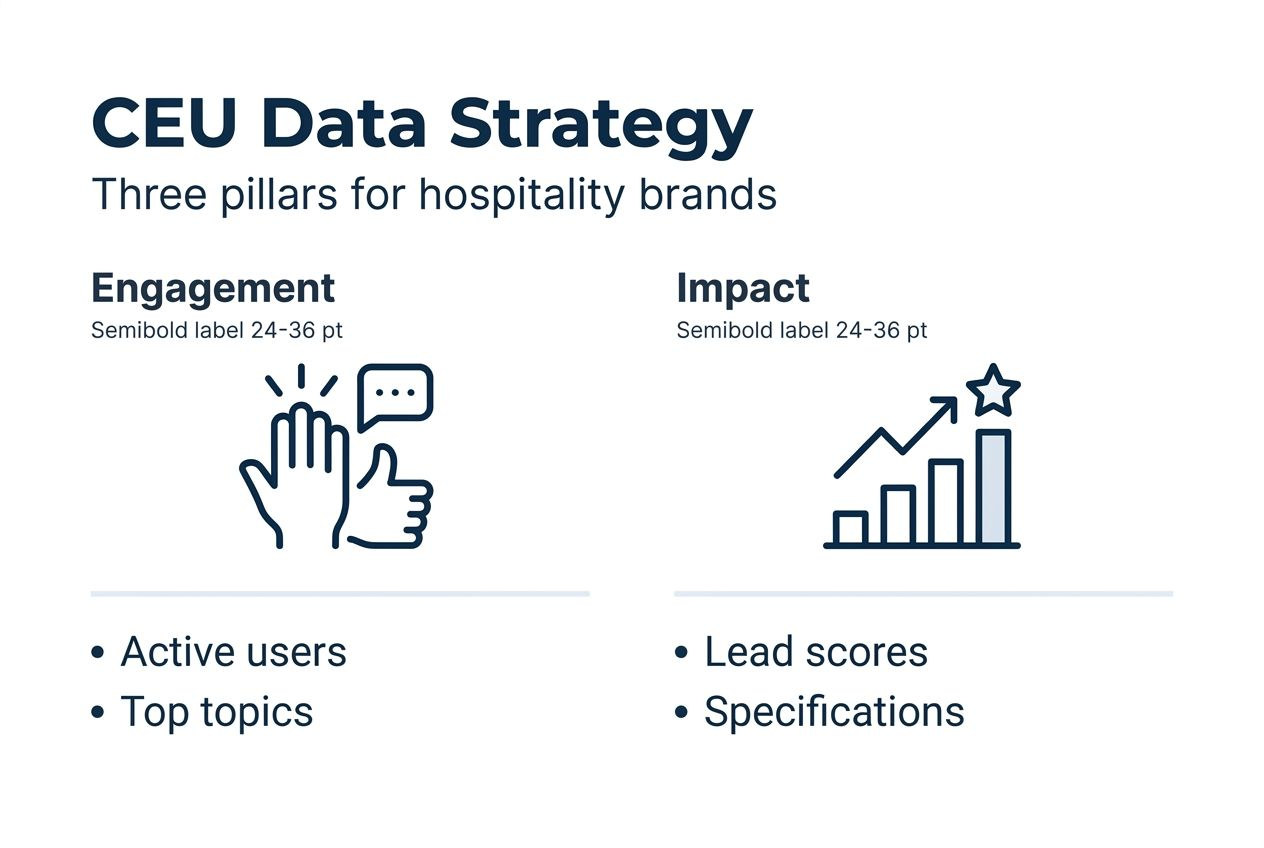
Your data strategy should answer three questions: Which architects engage? What topics drive specifications? How does education convert to revenue? Technology integration and content quality enable those answers, but only if you own the underlying data generating insights.
Course accreditation processes vary by provider, but data ownership requirements remain consistent. Insist on full access to raw completion data, engagement metrics, and participant information. Aggregated reports without underlying detail limit optimization capability.
Overcoming common pitfalls and maximizing CEU data value
The most expensive mistake manufacturers make is creating generic content that meets accreditation requirements but fails to engage architects. You spend months developing courses, achieve approval, then watch completion rates stall at 40% because content doesn’t address real design challenges.
Manufacturers who fail to analyze CEU data waste opportunities to refine courses based on actual performance. Your initial course is a hypothesis about what architects need. Data reveals whether that hypothesis was correct and guides iteration toward topics and formats that drive specifications.
Common pitfalls include ignoring regular data reviews, creating sales-focused content instead of educational material, and neglecting architect feedback that reveals content gaps. Each mistake reduces program effectiveness and delays specification results.
Best practices to maximize data utility include:
- Monthly performance reviews tracking completion rates, engagement time, and specification conversions
- Content adjustments based on section-level analytics showing where architects disengage or struggle
- Balanced delivery formats offering both live presentations for relationship building and on-demand courses for convenience
- Integration of architect feedback through post-course surveys revealing unmet learning needs
CEU courses are trust-building tools, not sales presentations. When architects complete your course and think “that taught me something valuable,” you’ve created specification preference competitors cannot overcome through traditional marketing. When they think “that was a product pitch with CEU credit attached,” you’ve wasted their time and damaged your brand.
Continual learning separates effective programs from abandoned experiments. Your first course establishes baseline performance. Your second course tests refinements based on initial data. By your fourth or fifth course, you’re operating with deep intelligence about which topics, formats, and delivery approaches drive specifications in your specific product categories.
Architect feedback and specification trends should shape course evolution. If data shows increased interest in biophilic design within hospitality projects, develop courses connecting your products to those design principles. Reactive content strategy following architect interests beats proactive strategy assuming you know what they need.
Direct accreditation advantages multiply when you own data revealing how education drives specifications. Third-party platforms aggregate your performance with competitors, hiding the specific insights that enable optimization.
How CEU Builder helps hospitality manufacturers own their course data
Most manufacturers spend 6-12 months developing CEU courses that get rejected during accreditation review. CEU Builder compresses that timeline to 4-6 weeks with a 100% first-pass approval rate because we’ve reverse-engineered IDCEC requirements into systematic processes eliminating guesswork.
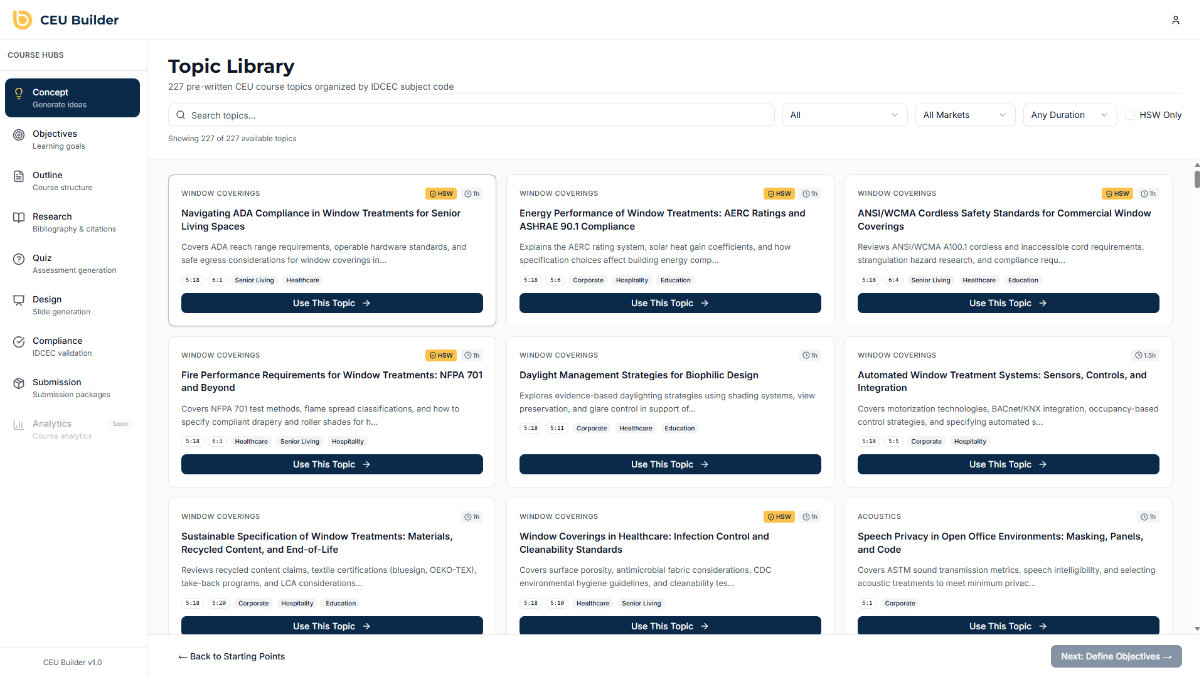
Our platform provides lifetime hosting with complete data ownership. You control every metric connecting education to specifications. Integration with your CRM and marketing automation happens through standard APIs, so course completions trigger your existing nurture sequences without custom development.
The manufacturers achieving 10x ROI from CEU programs share one characteristic: they treat data as strategic intelligence rather than compliance reporting. We provide the infrastructure making that approach practical, then teach you how to use owned data for continuous optimization.
Whether you choose our done-for-you service or platform subscription, you own every data point your courses generate. That ownership transforms education from marketing expense into specification machinery generating measurable pipeline growth. Our accreditation guidance ensures your courses meet IDCEC standards while capturing the engagement intelligence that drives business outcomes.
FAQ
What does it mean to own CEU course data?
Owning CEU course data means controlling complete access to participant engagement metrics, course completion records, and interaction patterns that measure educational impact. This ownership lets manufacturers directly track how education influences product specifications. You see which architects complete courses, how they engage with content, and which participants later submit specification requests, creating measurable connections between education and revenue.
How does owning course data increase product specifications?
Data ownership enables manufacturers to identify highly engaged architects and tailor follow-up strategies converting education into specifications. You can segment participants by engagement level, then prioritize sales outreach to architects demonstrating specification intent through course behavior. Manufacturers implementing this approach see 20-30% specification increases within one year because data insights optimize both course content and marketing tactics, creating preference that drives project selections.
What are common mistakes to avoid when using CEU course data?
Neglecting regular data review and course refinement reduces program effectiveness by missing optimization opportunities revealed through engagement metrics. Creating generic content instead of architect-focused material misses engagement because design professionals spot product-heavy courses and disengage immediately. Failing to analyze data hampers specification results because you cannot improve what you do not measure. Balanced delivery formats supporting both online and in-person learning maximize participation across different architect preferences and project timelines.
How do I integrate CEU data with existing CRM systems?
Integration requires your Learning Management System to connect with CRM platforms through standard APIs or webhook configurations. When architects complete courses, that activity should automatically update CRM records, trigger lead scoring adjustments, and initiate nurture sequences without manual data entry. Most modern LMS platforms support Zapier integration enabling connections to HubSpot, Salesforce, and other CRM systems. The technical setup typically takes 2-4 hours but creates perpetual data flow connecting education to pipeline.
Recommended
