

Advantages of branded CEU courses for manufacturers

Hospitality product manufacturers face a persistent challenge: how do you capture the attention of architects and designers who control billions in specification decisions? Traditional marketing falls short because design professionals value education over advertising. Branded accredited CEU courses offer a unique solution, positioning your brand as a trusted expert while fulfilling the continuing education requirements architects need annually. This article examines the key advantages of branded CEU courses, from enhanced visibility to measurable ROI, helping you determine whether this strategy deserves investment in your 2026 marketing plan.
Table of Contents
- Why Accreditation Is The Foundation Of CEU Course Value
- Top Advantages Of Branded CEU Courses For Hospitality Manufacturers
- Comparing Branded CEU Courses With Other Marketing Methods
- How To Choose And Implement Branded CEU Courses Effectively
- Enhance Your Brand With Accredited CEU Courses
Key takeaways
| Point | Details |
|---|---|
| Accreditation builds trust | IACET Standard provides a framework for quality and credibility that unaccredited courses lack. |
| Visibility increases dramatically | Branded CEU courses position manufacturers as educators, creating 45-60 minutes of focused engagement with decision-makers. |
| Specifications rise measurably | Architects who complete your course naturally prefer your products when making project selections. |
| ROI can reach 10x | A single course generating 200 completions can deliver multiple specifications worth hundreds of thousands in project value. |
Why accreditation is the foundation of CEU course value
Accreditation separates legitimate continuing education from marketing disguised as learning. Architects and designers need verifiable credits that satisfy licensing board requirements. When they invest time in a course, they need confidence that the credit will count.
The IACET Standard provides a framework for quality and credibility in CEU programs. This accreditation ensures consistency, auditability, and recognition across professional licensing boards. Without it, your course lacks the quality framework that architects trust.
Unaccredited CEUs create risk for design professionals. Licensing boards may reject credits, forcing architects to repeat education or face compliance penalties. This risk makes unaccredited courses unattractive regardless of content quality. Your brand suffers by association if you offer education that doesn’t meet professional standards.
Accredited courses gain immediate credibility. When architects see IACET or IDCEC accreditation, they know the content meets rigorous standards. This trust extends to your brand, positioning you as a manufacturer who understands professional requirements and delivers legitimate value.
The continuing education compliance guide explains specific requirements for different accreditation bodies. Key elements include:
- Learning objectives aligned with professional competencies
- Assessment mechanisms that test comprehension
- Documentation proving instructional quality
- Ongoing compliance monitoring and reporting
“Accreditation isn’t just a badge. It’s proof that your educational content meets the standards architects depend on for career advancement and professional credibility.”
Manufacturers who skip accreditation save money initially but sacrifice the trust that drives specification decisions. Architects remember brands that respect their professional requirements. They avoid brands that waste their time with credits that won’t count.
Top advantages of branded CEU courses for hospitality manufacturers
Branded CEU courses deliver strategic advantages that traditional marketing cannot match. These benefits compound over time, creating competitive positioning that’s difficult for rivals to overcome.
Enhanced brand visibility happens naturally when architects spend 45-60 minutes learning from your content. Unlike trade show conversations or email campaigns that compete for seconds of attention, CEU courses create extended engagement where architects actively focus on your expertise. This visibility positions your brand as an industry authority rather than just another vendor.
Specification opportunities increase because educated architects specify products they understand. When your course teaches acoustic performance standards in hospitality environments, architects naturally consider your acoustic solutions when hotel projects require those specifications. The education creates preference by connecting product capabilities to real project challenges.

Long-term engagement extends beyond the initial course completion. Architects who found value in your education return for additional courses, recommend your content to colleagues, and remember your brand months later when specifications are needed. This ongoing relationship replaces one-time marketing touches with sustained educational partnership.
Measurable ROI separates CEU courses from brand awareness campaigns. IDCEC CEU courses deliver 10x ROI for hospitality brands through trackable completions, specification requests, and project wins. A $10,000 course generating 200 architect completions creates 200 specification-capable touchpoints. If just 2% specify your products into projects averaging $100,000 in product value, that’s $200,000 in specifications from a $10,000 investment.
The timing advantage is critical. Architects build knowledge bases before projects begin. When they complete your course six months before starting a hotel renovation, your brand becomes their reference point when specifications are written. Reactive sales approaches miss this window because specifications are often determined before sales teams learn about projects.
Pro Tip: Track course completions in your CRM and trigger sales follow-up 30-60 days after completion. This timing catches architects when course concepts are fresh but before project specifications are finalized.
Key advantages include:
- Direct access to decision-makers who control specifications
- Educational positioning that builds trust faster than advertising
- Data revealing which architects engage with which product topics
- Competitive differentiation in markets where education is rare
- Perpetual lead generation from courses with indefinite shelf lives
Comparing branded CEU courses with other marketing methods
Hospitality manufacturers invest in multiple marketing channels. Understanding how CEU courses compare to alternatives clarifies where they fit in your strategy.
| Marketing Method | Credibility | Engagement Duration | Specification Influence | Cost per Lead | Measurability |
|---|---|---|---|---|---|
| Branded CEU Courses | High (accreditation-backed) | 45-60 minutes | Direct (education shapes preference) | $50-$150 | Excellent (completion tracking) |
| Trade Shows | Medium (presence-based) | 5-10 minutes | Indirect (awareness only) | $200-$400 | Poor (badge scans) |
| Print Advertising | Low (promotional) | 30-60 seconds | Minimal (passive exposure) | $500-$1,000 | Very Poor (no tracking) |
| Sales Calls | Medium (relationship-based) | 15-30 minutes | Moderate (if timing aligns) | $200-$500 | Good (CRM tracking) |
| Webinars | Medium-High (content-dependent) | 30-45 minutes | Moderate (not accredited) | $100-$250 | Good (registration tracking) |
CEU courses provide accreditation-backed credibility that other methods lack. While trade shows create brief awareness and advertising generates passive exposure, CEU courses position you as an educator fulfilling professional requirements. This distinction matters to architects who value legitimate learning over promotional content.
Engagement duration separates CEU courses from every alternative. A 45-minute course delivers more teaching time than a dozen sales calls. This extended engagement allows you to explain complex product benefits, address specification criteria, and demonstrate application knowledge that influences future decisions.
The specification influence is direct rather than indirect. Trade show conversations might generate interest, but CEU courses teach architects how to specify your products correctly. This education removes barriers to specification by building competence and confidence.
Cost efficiency improves over time. A trade show booth costs $30,000-$50,000 annually for premium positioning. A $10,000 CEU course generates leads indefinitely without recurring costs. The math favors education as courses age and completion numbers grow.
Key comparison points:
- CEU courses create educational authority that advertising cannot
- Accreditation provides third-party validation absent from promotional content
- Extended engagement time allows deeper product education
- Specification influence happens proactively before projects begin
- Perpetual lead generation without recurring investment
How to choose and implement branded CEU courses effectively
Successful CEU programs require strategic planning and execution. These guidelines help manufacturers maximize impact while avoiding common pitfalls.
1. Identify clear educational goals aligned with audience needs. Start by researching what architects actually search for and need to learn. Topics should address real design challenges in hospitality projects, not just promote product features. When goals align with architect interests, completion rates and specification outcomes improve dramatically.
2. Partner with accredited providers for compliance and credibility. IDCEC accreditation requires expertise most manufacturers lack internally. Attempting DIY course development without understanding compliance requirements wastes 6-12 months and often results in rejection. Specialized providers compress timelines to 4-6 weeks while ensuring first-pass approval.
3. Develop engaging, brand-relevant content with measurable outcomes. Content must teach valuable concepts while naturally positioning your products as solutions. Learning objectives should connect to specification criteria that favor your offerings. Exam questions should reinforce key differentiators and application knowledge.
4. Leverage analytics to track specification and engagement impacts. Course completion data reveals which architects engage with which topics. This intelligence enables precise sales follow-up and targeted outreach. CRM integration ensures no completion goes unnoticed or unfollowed.
5. Integrate courses into broader marketing and sales processes. CEU courses work best as part of a comprehensive strategy. Sales teams need training on how to promote courses without being pushy. Trade show presence should highlight educational offerings. Email sequences should nurture course completions toward specification conversations.
Pro Tip: Start with one high-quality course rather than multiple mediocre offerings. A single excellent course that generates strong completion rates and specifications proves the concept and builds momentum for expanding your educational library.
Implementation best practices:
- Survey existing architect relationships to identify high-interest topics
- Audit internal content assets to determine what’s reusable
- Set realistic completion goals based on your audience size
- Establish tracking mechanisms before launch to capture data from day one
- Plan sales follow-up processes that respect the educational relationship
The step-by-step accreditation guide walks through specific requirements for IDCEC provider registration and course submission. Key milestones include provider setup, learning objective development, content creation, exam design, and final submission management.
Timing matters for launch coordination. Align course releases with trade shows, product launches, or industry events where architects are actively seeking education. This strategic timing maximizes initial completions and creates momentum.
Enhance your brand with accredited CEU courses
Transforming continuing education from compliance theater into demand generation requires expertise most manufacturers lack internally. CEU Builder specializes in fast, accredited course development specifically for hospitality product manufacturers targeting architects and designers.
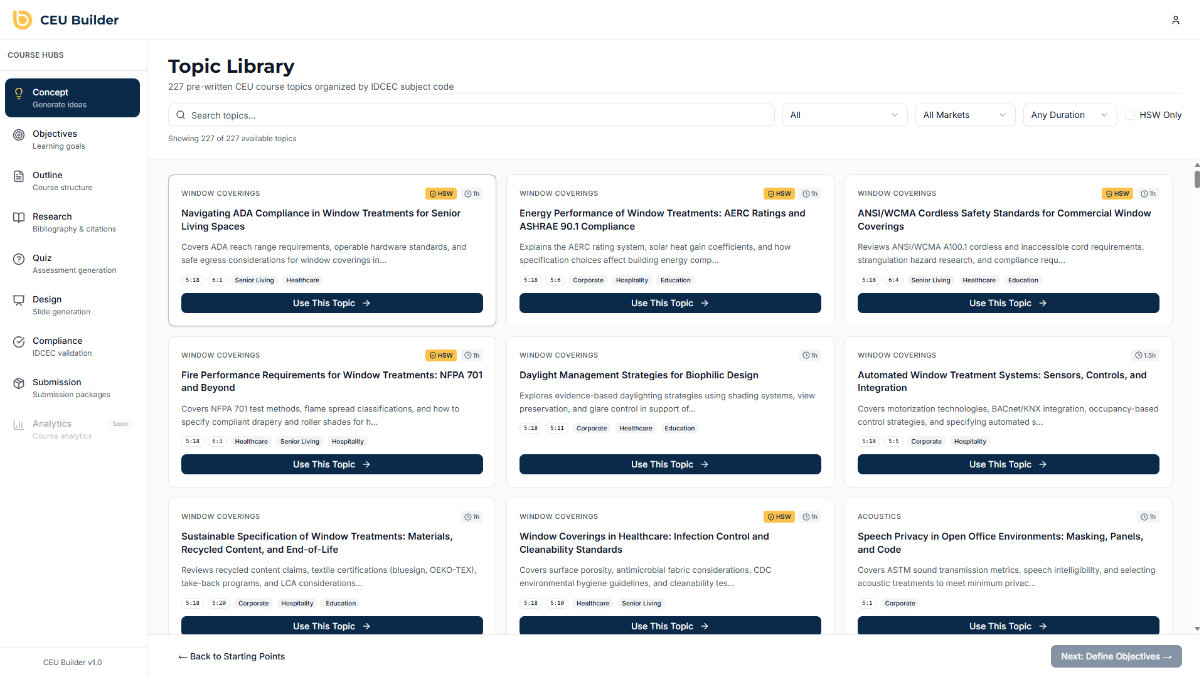
Our done-for-you service compresses traditional 90-180 day timelines to just 4-6 weeks from kickoff to IDCEC approval. We maintain a 100% first-pass accreditation rate, eliminating the costly failures that waste months and require complete rebuilds. Every course includes strategy research, instructional design, slide deck creation, speaker scripts, exam development, and complete submission management.
The results speak clearly. IDCEC CEU courses deliver 10x ROI for hospitality brands through measurable specification lift and extended architect engagement. Our clients see direct specification requests from architects who completed their courses, sales conversations that start from positions of credibility, and CRM data revealing which design professionals engage with which product topics.
Whether you need a single course to test the strategy or a comprehensive educational portfolio, we guide you through every step. Our IDCEC approval process handles the complex accreditation requirements while you focus on reviewing content and preparing for launch. The complete accreditation guide explains exactly what’s required and how we ensure compliance at every stage.
FAQ
What is a branded CEU course?
A branded CEU course is continuing education offered under your company name that teaches architects and designers while positioning your products as solutions to design challenges. These courses fulfill professional licensing requirements while building preference for your brand. Unlike generic education, branded courses connect learning objectives to your product capabilities and competitive advantages.
How do branded CEU courses increase product specifications?
Branded CEU courses educate architects on product benefits, performance criteria, and specification requirements. This education builds competence and confidence in specifying your products correctly. Architects who understand your solutions through structured learning naturally prefer them when projects require those capabilities. The educational relationship creates trust that advertising cannot match.
Why is accreditation important for CEU courses?
Accreditation ensures course quality meets industry standards that licensing boards recognize. IACET and IDCEC accreditation provide architects confidence that credits will count toward their professional requirements. Without accreditation, architects risk wasting time on education that won’t satisfy licensing obligations. Accredited courses signal your brand respects professional standards and delivers legitimate value.
Can small hospitality manufacturers benefit from branded CEU courses?
Small manufacturers often see the strongest ROI from CEU courses because they lack the brand awareness larger competitors enjoy. A well-designed course levels the playing field by positioning smaller brands as educators and experts. Building accredited courses in 45 days makes the strategy accessible regardless of company size. Even a single course generating 100-150 completions annually creates meaningful specification opportunities.
How long does it take to develop an accredited CEU course?
Timeline depends on whether you work with specialized providers or attempt internal development. Expert providers like CEU Builder complete courses in 4-6 weeks from kickoff to IDCEC approval. Internal development typically requires 6-12 months and often results in accreditation rejection. The complexity of compliance requirements, instructional design standards, and submission processes makes expertise valuable. Fast timelines require understanding what IDCEC reviewers expect and building compliance into every development stage.
Recommended
