

Education compliance explained: your guide to IDCEC success

Many hospitality manufacturers assume that launching a continuing education unit (CEU) course simply means packaging product knowledge into a presentation. That assumption is costly. IDCEC is the centralized registry for approving and tracking interior design CEUs, and it evaluates every course for genuine educational value over promotion. True compliance means meeting a specific set of standards that prioritize what architects and designers learn, not what you sell. This guide breaks down exactly what education compliance requires, how the approval process works, and what pitfalls to avoid so your course gets approved the first time.
Table of Contents
- What does education compliance mean for IDCEC courses?
- IDCEC compliance process: Registration to approval
- Key compliance requirements and common pitfalls
- Tracking compliance and CEUs: Registry and reporting
- Industry crosswalk: IDCEC, ASID/IIDA, and AIA requirements
- How CEU Builder accelerates compliance and maximizes specification
- Frequently asked questions
Key Takeaways
| Point | Details |
|---|---|
| Compliance focuses on education | IDCEC approval requires delivering real learning value, not just product or sales information. |
| Follow defined processes | Successful CEU approval follows structured steps from provider registration to final audit-ready records. |
| HSW and multi-org acceptance | HSW-designated courses maximize recognition with ASID, IIDA, and AIA. |
| Track and document everything | Maintain updated records in the IDCEC registry and stay prepared for audits. |
| Strategic alignment matters | Adapting your courses for overlapping requirements increases specification opportunities. |
What does education compliance mean for IDCEC courses?
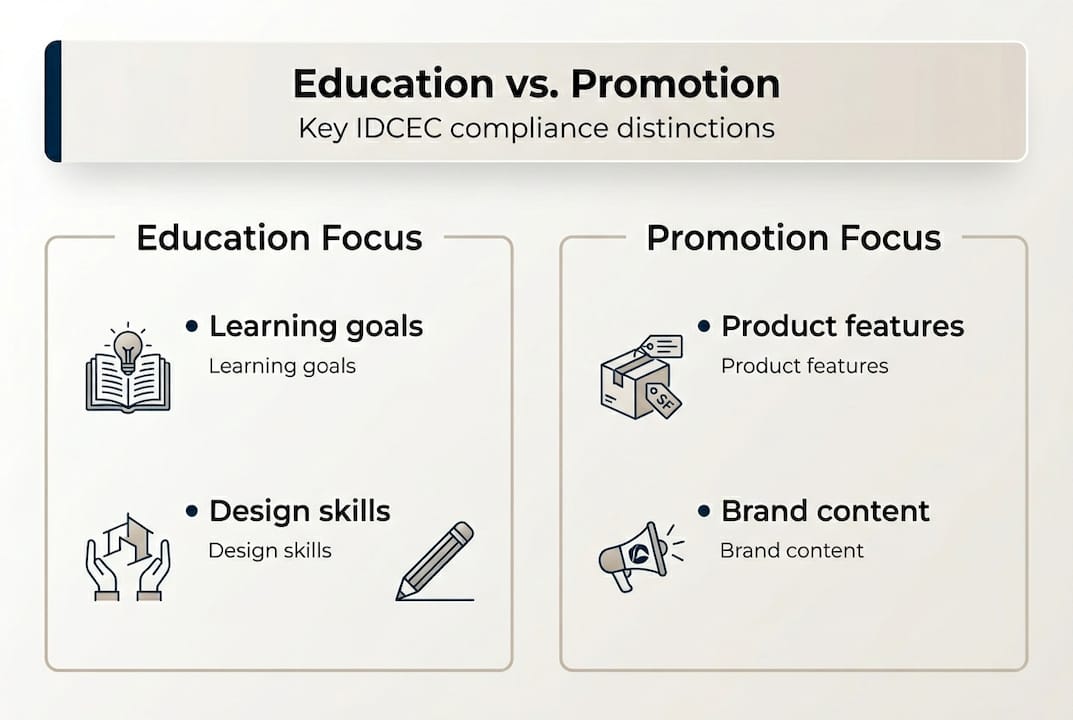
Compliance in the IDCEC context is not about checking a box. It means your course content meets a defined standard for educational rigor, neutrality, and relevance to interior design practice. IDCEC evaluates courses for educational value rather than promotional intent, which is a meaningful distinction for manufacturers who are used to leading with product benefits.
Here is what compliance actually requires:
- Educational objectivity: Content must teach principles, applications, or technical knowledge that benefits the designer, not just the manufacturer.
- No overt sales messaging: Product names can appear, but the course cannot function as a sales pitch or product catalog.
- HSW designation eligibility: Health, Safety, and Welfare (HSW) courses carry extra weight because many state licensing boards require HSW credits specifically. If your topic connects to occupant safety, material performance, or building code compliance, pursuing HSW status is worth the effort.
- Audit readiness: Providers must maintain attendance records, completion data, and course materials in case IDCEC conducts a compliance audit.
- Provider accountability: You are responsible for the accuracy and ongoing relevance of your course content.
“Pure product training and exam prep content disqualifies a course from IDCEC approval; HSW designation is preferred for licensing purposes, and audits require documented proof of compliance.”
The distinction between education and promotion is where most first-time providers stumble. A course on acoustic performance in hospitality spaces qualifies. A course on why your acoustic panel line outperforms competitors does not. The content must stand on its own educational merit.
IDCEC compliance process: Registration to approval
Understanding what compliance means is the first step. Knowing the exact sequence of actions to get there is what separates manufacturers who launch in weeks from those who spend months in revision cycles.
Here is the step-by-step process:
- Choose your provider type. Providers must register with IDCEC as individual, corporate, or preferred providers before submitting any course. ASID partners receive first-year fee discounts, which is worth checking before you register.
- Complete provider registration. Submit your organization’s information, agree to IDCEC’s provider standards, and pay the registration fee. This is a one-time setup step.
- Develop your course outline. Define your learning objectives, course structure, and content scope before building the full course. IDCEC reviews the outline as part of the submission.
- Build the full course. Create your slide deck, speaker script, exam questions, and bibliography. Every element must align with your stated learning objectives.
- Submit for review. Upload your completed course through the IDCEC portal, pay the course submission fee, and wait for reviewer feedback.
- Respond to revisions (if needed). IDCEC may request changes before granting approval. Address every comment specifically and resubmit promptly.
- Receive approval and launch. Once approved, your course is listed in the IDCEC registry and architects can earn credit for completing it.
| Stage | Key action | Common delay |
|---|---|---|
| Provider registration | Submit org info and pay fee | Incomplete documentation |
| Course outline | Define learning objectives | Objectives too product-focused |
| Full course build | Script, slides, exam, bibliography | Missing bibliography or weak exam |
| Submission | Upload via IDCEC portal | Formatting errors in submission |
| Review and approval | Respond to IDCEC feedback | Slow response to revision requests |
Pro Tip: Write your learning objectives before you write a single slide. Objectives that start with measurable verbs like “identify,” “evaluate,” or “apply” signal educational intent to IDCEC reviewers immediately. Review the full IDCEC provider accreditation steps before you begin to avoid surprises mid-process.
If you want a detailed walkthrough of getting IDCEC approval for your specific course type, that resource covers the submission portal requirements in depth.
Key compliance requirements and common pitfalls
Once you understand the stages, it helps to see what good compliance looks like versus what gets courses rejected. The gap is usually smaller than manufacturers expect, but the consequences of missing it are significant.
What qualifies:
- Courses that teach design principles, material science, code compliance, or application methodology
- HSW content tied to occupant health, fire safety, indoor air quality, or structural performance
- Courses that reference products as examples within a broader educational framework
- Content supported by a credible bibliography with peer-reviewed or industry-standard sources
What gets rejected:
- Pure product training and exam prep content that lacks broader educational value
- Courses where the primary takeaway is “buy this product” rather than “understand this concept”
- Missing or inadequate exam questions that do not test comprehension
- No bibliography, or a bibliography that only cites the manufacturer’s own marketing materials
| Compliance factor | Strong approach | Weak approach |
|---|---|---|
| Learning objectives | Measurable, design-focused | Vague or product-centered |
| Course content | Principle-based with product examples | Product-first with minimal context |
| Exam questions | Test application and understanding | Recall of product specs only |
| Bibliography | Peer-reviewed and industry sources | Manufacturer brochures only |
| HSW designation | Tied to safety or welfare outcomes | No connection to HSW criteria |
Pro Tip: Before submitting, run your course through a compliance audit by asking one question about every slide: “Does this teach the designer something they can apply on any project, or does it only apply if they buy our product?” If the answer is the latter, revise that slide.
For manufacturers building their first course, the guide on creating branded coursework shows how to integrate your brand without triggering rejection. The IDCEC courses checklist is also a practical tool for verifying every requirement before submission.
Tracking compliance and CEUs: Registry and reporting
Approval is not the finish line. Ongoing compliance means managing records, tracking completions, and staying audit-ready throughout the life of your course.
Here is how the tracking infrastructure works:
- IDCEC registry transcripts: All approved course completions are tracked via transcripts in the IDCEC registry. Architects can access their records directly, and providers can pull completion reports.
- Self-reporting for non-IDCEC credits: If a designer completes a course that was not submitted through IDCEC, they must self-report those credits. As a provider, you are responsible for giving them the documentation they need to do that accurately.
- Mobile app for event tracking: IDCEC offers a mobile app that supports credit tracking at live events and trade shows. If you present at HD Expo or NeoCon, this tool lets attendees log credits in real time.
- Audit record maintenance: Keep attendance logs, completion certificates, and course materials organized and accessible. IDCEC audits are not announced in advance.
The practical implication for your team: build your record-keeping system before you launch, not after. Retroactively reconstructing attendance data is time-consuming and creates compliance risk. Understanding the full scope of CEU registry benefits also reveals how completion data can feed directly into your sales and marketing pipeline.

Industry crosswalk: IDCEC, ASID/IIDA, and AIA requirements
IDCEC does not operate in isolation. Architects and designers belong to multiple professional organizations, each with its own CEU requirements. Understanding how these systems overlap lets you build one course that satisfies multiple audiences.
| Organization | CEU requirement | Accepts IDCEC credits | HSW requirement |
|---|---|---|---|
| ASID | 10 CEUs biennially | Yes | Recommended |
| IIDA | 10 CEUs biennially | Yes | Recommended |
| CIDQ (NCIDQ) | HSW-designated IDCEC courses auto-count as HSW | Yes | Required for licensure |
| AIA | LU/HSW credits required | Cross-accepted with AIA | Required for many credits |
The strategic insight here is that IDCEC approves courses but does not mandate that designers take them. Organizations like ASID and IIDA mandate the credits, and their members look to IDCEC-approved courses to fulfill those requirements. When your course carries HSW designation, it becomes eligible across IDCEC, ASID, IIDA, and often AIA simultaneously.
- A single HSW course can satisfy requirements for designers licensed through NCIDQ, ASID members, IIDA members, and AIA architects at the same time.
- This multiplier effect means your $10,000 course investment reaches a broader audience without additional development cost.
- Strategically aligning your topic with HSW criteria from the start is far easier than retrofitting an existing course.
“IDCEC approves courses but does not mandate CEUs itself. Organizations like ASID and IIDA set the requirements, and their members rely on IDCEC-approved content to fulfill them. Courses cross-accepted with AIA expand your reach even further.”
For manufacturers thinking about AIA accreditation strategies alongside IDCEC, or trying to understand the IDCEC vs AIA credit comparison, both paths can work together rather than compete.
How CEU Builder accelerates compliance and maximizes specification
If your team has read this far, you understand that IDCEC compliance is a structured process with real consequences for getting it wrong. The good news is that you do not have to navigate it alone.
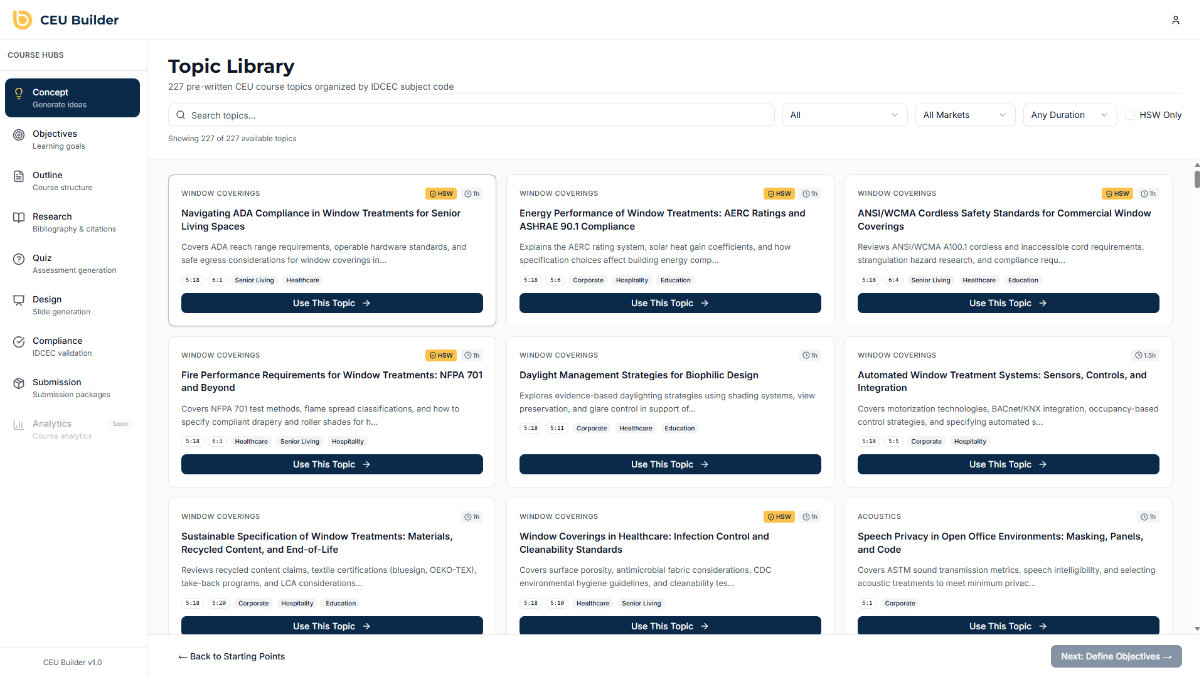
CEU Builder handles every stage of compliance and course development for hospitality manufacturers, from provider registration through final IDCEC approval, with a 100% first-pass approval rate. That means no revision cycles that drag on for months, no rejected submissions that waste internal resources, and no guessing about what IDCEC reviewers want to see. Our clients move from kickoff to approved course in 4 to 6 weeks. If you want a clear starting point, the step-by-step IDCEC accreditation guide walks through every requirement in sequence. When you are ready to move forward, explore the full process for getting your CEU course approved or see how our approach to accelerating specs and trust turns approved courses into specification opportunities.
Frequently asked questions
What types of courses qualify for IDCEC approval?
Courses must be educational, non-promotional, and relevant to interior design practice. Pure product training and exam prep content alone do not qualify for IDCEC accreditation.
Do IDCEC-approved courses count toward ASID or IIDA requirements?
Yes, ASID and IIDA accept IDCEC-approved courses toward their 10 CEU biennial requirements, especially courses carrying HSW designation.
How are IDCEC CEUs tracked and documented?
Approved credits are tracked via transcripts in the IDCEC registry, but courses not submitted through IDCEC must be self-reported by the designer or provider.
Can one CEU course satisfy multiple organization requirements?
Yes. Courses with HSW designation are widely accepted across IDCEC, ASID, IIDA, and often AIA, as IDCEC courses cross-accept with multiple professional bodies.
What is the typical timeline for IDCEC course approval?
Most providers should plan for several weeks from submission to approval. Providers must register first, and complete documentation at every stage is the single biggest factor in reducing delays.
Recommended
