

AIA accreditation examples: IDCEC CEU strategies 2026

Hospitality manufacturers investing in continuing education face a complex decision: which AIA accreditation approach delivers the fastest market entry, highest architect engagement, and strongest specification influence? Selecting the wrong path costs months in delays, thousands in wasted resources, and missed opportunities to position products before competitors. Understanding proven accreditation examples and their strategic differences ensures marketing and sales teams choose methods aligned with internal capabilities, budget constraints, and revenue goals while avoiding common pitfalls that derail first-time efforts.
Table of Contents
- How To Choose The Right AIA/IDCEC Accreditation Approach
- Example 1: CEU Builder’s Done-For-You Accreditation Service
- Example 2: Internal Team Using CEU Builder Platform Subscription
- Example 3: Multi-Course Series For Comprehensive Coverage
- Pricing And Timeline Comparison Across Examples
- Situational Recommendations: Choosing The Best Accreditation Example For Your Needs
- Summary And Next Steps To Achieve IDCEC Accreditation Success
- Why Choose CEU Builder For Your IDCEC Accreditation Journey
- Frequently Asked Questions
Key takeaways
| Point | Details |
|---|---|
| Accreditation approach impacts speed and risk | First-pass accreditation success determines whether you launch in weeks or face costly rejections requiring months of rework. |
| Three primary models serve different needs | Done-for-you services, DIY platforms, and multi-course packages each optimize for different resource levels and strategic objectives. |
| Pricing varies from $99/month to $25,000+ | Budget allocation depends on whether you prioritize speed, control, or comprehensive market coverage across product portfolios. |
| Timeline ranges from 4 weeks to 12+ weeks | Choosing the right model aligns development speed with market entry goals and competitive positioning windows. |
| Architect engagement quality matters most | Content relevance to actual design challenges drives completion rates and specification influence more than accreditation alone. |
How to choose the right AIA/IDCEC accreditation approach
Selecting an accreditation method requires evaluating five critical factors that determine success. Each factor impacts whether your CEU course generates measurable specifications or becomes another forgotten compliance asset.
First-pass approval rate separates proven approaches from risky experiments. First-pass accreditation success matters because IDCEC rejections reset timelines by 3-6 months and require complete content rebuilds. Manufacturers lacking accreditation experience face rejection rates exceeding 60% on initial submissions. This delay costs market positioning when competitors launch educational content first.
Architect learning preferences shape content effectiveness beyond accreditation compliance. Courses addressing real hospitality design challenges like acoustic performance, material durability, or code compliance generate 3-4x higher completion rates than product-focused presentations. Generic content meets IDCEC standards but fails to engage time-constrained design professionals seeking actionable knowledge.
Development timeline determines competitive advantage windows. Faster market entry positions manufacturers as educational resources before architects begin project specifications. A 4-week development cycle captures specification opportunities that 12-week timelines miss entirely.
Budget structures influence scalability and long-term program viability. Single course investments test market response. Multi-course commitments build comprehensive educational portfolios that create specification moats competitors cannot easily replicate.
Internal resource availability dictates whether done-for-you services or platform tools better match organizational capacity. Teams with subject matter experts and marketing bandwidth can execute platform-based development. Organizations lacking these resources benefit from outsourced expertise that guarantees results without internal resource drain.
Pro Tip: Audit your team’s IDCEC knowledge and available bandwidth before selecting an approach. Underestimating complexity causes 70% of failed in-house accreditation attempts.
Evaluation criteria for accreditation approaches:
- Guaranteed first-pass approval eliminates rework risk
- Content alignment with architect search behavior and learning needs
- Development speed matching market entry and competitive timing goals
- Pricing models supporting single course tests or multi-course portfolios
- Resource requirements fitting available internal expertise and capacity
Manufacturers applying these criteria to accreditation examples make informed decisions that accelerate market entry while minimizing risk and resource waste.
Example 1: CEU Builder’s done-for-you accreditation service
The done-for-you model handles complete course development from strategy through IDCEC approval. This approach suits manufacturers wanting immediate results without allocating internal resources to unfamiliar accreditation processes.
CEU Builder achieves 100% first-pass IDCEC approval within 4-6 weeks by managing every development stage. The manufacturer’s only involvement is content review before launch. This eliminates the learning curve that causes most first-time accreditation failures.

Service components include full strategy and research identifying what architects actually search for and need to learn. Instructional designers create complete speaker scripts, high-impact slide decks, and exam questions testing comprehension. IDCEC submission management handles complex filing requirements and compliance verification.
Pricing starts at $10,000 per single course. This investment includes strategy, development, submission, revisions, lifetime platform access, and the 100% approval guarantee. If IDCEC denies accreditation, fixes are free until approval is granted.
Ideal clients lack internal subject matter experts familiar with IDCEC requirements or marketing teams experienced in educational content development. These manufacturers recognize CEU strategic value but need external expertise to execute effectively.
Speed advantages compress traditional 90-180 day timelines by 80-95%. Manufacturers reach market in weeks rather than quarters, capturing specification opportunities competitors pursuing slower approaches miss entirely.
Pro Tip: Done-for-you services work best when manufacturers can clearly articulate product differentiators and target architect pain points. Strong product knowledge accelerates strategy sessions and content accuracy.
Done-for-you service key benefits:
- Zero accreditation risk with guaranteed first-pass approval
- Fastest timeline from concept to market-ready course
- No internal resource allocation beyond content review
- Expert strategy aligning topics with architect search behavior
- Complete submission management through complex IDCEC portal
This model appeals to manufacturers prioritizing speed and certainty over maintaining internal control of creative direction.
Example 2: Internal team using CEU Builder platform subscription
Platform subscriptions empower internal teams to build courses while accessing tools that accelerate development and ensure compliance. This DIY approach works for manufacturers with subject matter experts and marketing expertise who want creative control.
The $99 monthly subscription provides complete LMS hosting, IDCEC compliance tools guiding users through accreditation requirements, custom certificate generation, and unlimited course creation capacity. Internal teams typically complete courses in 8-12 weeks.
Platform tools automate bibliography formatting, compliance checking, and certificate delivery. This reduces errors that cause IDCEC rejections while preserving strategic control over messaging and content positioning.
Subscription economics favor manufacturers planning multiple courses. Three courses developed through the platform cost approximately $1,200 in subscription fees versus $30,000 for three done-for-you courses. This 96% cost reduction makes sense when internal capacity supports development workload.
Course accreditation workflow management becomes sustainable for organizations building long-term educational programs. Teams develop institutional knowledge about IDCEC requirements and architect preferences that compounds with each course built.
Best-fit organizations have dedicated marketing teams, product managers with deep technical knowledge, and organizational commitment to educational content as strategic priority. These teams can execute faster than external providers once they understand processes and tools.
Key platform subscription advantages:
- Full creative control over content and strategic positioning
- Cost-effective for multi-course development programs
- Builds internal capability and institutional knowledge
- Unlimited course creation without per-course fees
- Faster iteration once team masters process and tools
The platform model requires 8-12 weeks initially but accelerates as teams gain experience. Second and third courses often complete in 6-8 weeks as processes become familiar.
Example 3: Multi-course series for comprehensive coverage
Multi-course packages deliver broader educational impact while reducing per-course costs. These series suit manufacturers targeting complete product portfolios or addressing multiple design challenges architects face.
Two-course series cost $18,000 and typically complete in 6-10 weeks. This package saves $2,000 versus purchasing courses individually while creating multiple architect touchpoints across different topics or product categories.
Three-course series cost $25,000 with 10-12 week timelines. This comprehensive approach saves $5,000 compared to individual purchases while establishing manufacturers as educational authorities across broader subject areas.
Multi-course packages create specification moats by positioning manufacturers as experts teaching multiple relevant topics. Architects completing three courses from one manufacturer develop stronger specification preference than those completing single courses from three different manufacturers.
Strategic coverage approaches include addressing entire product portfolios, exploring different application scenarios, or teaching complementary design considerations. A furniture manufacturer might create courses on ergonomics, material selection, and acoustic performance rather than three furniture-focused courses.
Package benefits compound over time as courses generate ongoing completions without additional development costs. Three courses capturing 600 annual architect completions create 600 specification-capable touchpoints perpetually.
| Package | Investment | Timeline | Per-Course Cost | Best For |
|---|---|---|---|---|
| Two Courses | $18,000 | 6-10 weeks | $9,000 | Manufacturers launching multiple courses to create initial impact |
| Three Courses | $25,000 | 10-12 weeks | $8,333 | Brands wanting comprehensive coverage of product categories or design approaches |
Cost savings comparison:
- Single course: $10,000 per course
- Two-course series: $9,000 per course (10% savings)
- Three-course series: $8,333 per course (17% savings)
Multi-course strategies maximize architect engagement breadth while optimizing development budgets for manufacturers committed to educational positioning as competitive advantage.
Pricing and timeline comparison across examples
Direct comparison clarifies how pricing, timelines, and strategic benefits differ across accreditation approaches. Understanding these distinctions helps manufacturers select methods matching specific goals and constraints.
Done-for-you single courses cost $10,000 with 4-6 week timelines. This delivers fastest market entry with zero accreditation risk through guaranteed first-pass approval. Manufacturers lacking internal expertise or requiring immediate competitive positioning benefit most.
Platform subscriptions cost $99 monthly with 8-12 week initial timelines. This approach favors manufacturers with internal subject matter experts and marketing teams capable of managing development. Cost advantages emerge when building multiple courses over time.
Multi-course packages range from $18,000 for two courses to $25,000 for three courses. Timelines extend to 6-12 weeks depending on package size. These options optimize per-course costs while building comprehensive educational portfolios.
| Approach | Investment | Timeline | First-Pass Guarantee | Best For |
|---|---|---|---|---|
| Done-For-You Single | $10,000 | 4-6 weeks | Yes | Manufacturers needing speed and certainty without internal resources |
| Platform Subscription | $99/month | 8-12 weeks | No | Teams with expertise wanting control and building multiple courses |
| Two-Course Series | $18,000 | 6-10 weeks | Yes | Companies launching multiple courses for broader impact |
| Three-Course Series | $25,000 | 10-12 weeks | Yes | Brands building comprehensive educational presence |
Speed-to-market advantages matter most when competitive positioning windows are narrow. A 4-6 week timeline captures architect attention before slower competitors launch similar content. Benefits of CEU accreditation multiply when manufacturers establish educational authority first.
Budget allocation considerations:
- Testing market response: Single done-for-you course minimizes risk
- Building portfolio: Platform subscription optimizes cost per course
- Comprehensive launch: Multi-course series balances speed and breadth
- Guaranteed results: Done-for-you eliminates accreditation failure risk
Timeline differences impact competitive advantage. Faster development positions manufacturers before architects begin project specifications. Slower timelines risk missing specification windows when architects have already formed product preferences.
First-pass approval guarantees separate risk-free approaches from methods requiring accreditation expertise. Done-for-you and multi-course packages eliminate rejection risk. Platform subscriptions require internal capability to achieve first-pass success.
Situational recommendations: choosing the best accreditation example for your needs
Matching accreditation approaches to specific manufacturer situations ensures optimal resource allocation and strategic outcomes. Four scenarios represent common decision contexts.
Start with single done-for-you course when testing CEU strategy viability with minimal risk. This approach proves market response and architect engagement before committing larger budgets. The $10,000 investment and 4-6 week timeline provide fast validation without internal resource allocation.
Choose platform subscription when having strong internal subject matter experts and dedicated marketing support. Teams with bandwidth to manage 8-12 week development timelines and desire for creative control benefit from $99 monthly costs and unlimited course capacity.
Select multi-course series when launching comprehensive educational programs targeting full product portfolios. Two or three-course packages optimize per-course costs while establishing broad educational authority. These work best for manufacturers committed to education as long-term competitive strategy.
Prioritize guaranteed first-pass approval when lacking IDCEC experience or facing tight market timing windows. Accreditation management complexity causes most first-time failures. Services guaranteeing approval eliminate costly delays and rework.
Pro Tip: Match your choice to honest assessment of internal capacity and expertise. Overestimating team capability causes 70% of DIY accreditation failures. Underestimating creates unnecessary outsourcing costs when internal execution would succeed.
Decision framework by situation:
- Testing CEU viability with minimal commitment: Done-for-you single course
- Building multiple courses with internal expertise: Platform subscription
- Launching comprehensive educational portfolio: Multi-course series
- Lacking IDCEC experience but needing speed: Done-for-you with approval guarantee
- Balancing budget constraints with quality requirements: Platform for teams with expertise, done-for-you without expertise
Timeline management aligns development speed with strategic goals. Competitive windows closing within 8 weeks require done-for-you speed. Longer planning horizons accommodate platform-based development timelines.
Budget optimization strategies depend on course quantity plans. Single course tests justify done-for-you costs. Multi-course roadmaps favor platform subscriptions or package pricing delivering per-course savings.
Summary and next steps to achieve IDCEC accreditation success
Effective CEU courses generate measurable specification lift and revenue growth when built using proven accreditation approaches aligned with manufacturer capabilities and strategic goals. Understanding differences between done-for-you services, platform subscriptions, and multi-course packages prevents costly missteps.
Key lessons guide selection decisions. First-pass approval rates eliminate rework delays and resource waste. Content relevance to architect learning needs drives completion rates and specification influence. Development timelines impact competitive positioning windows. Budget structures must match multi-course plans and internal capacity realities.
Selecting approaches matching your situation accelerates success. Manufacturers lacking IDCEC experience benefit from done-for-you services guaranteeing first-pass approval in 4-6 weeks. Teams with subject matter expertise and marketing bandwidth can execute platform-based development in 8-12 weeks. Organizations committed to comprehensive educational portfolios optimize costs through multi-course series.
Partnering with experienced firms like CEU Builder mitigates risk through proven processes, 10x ROI outcomes, and guaranteed accreditation success. Internal development requires significant expertise investment that specialized providers already possess.
Critical next steps:
- Audit internal IDCEC knowledge and available development capacity
- Define strategic goals for single course tests versus portfolio builds
- Align budget allocation with chosen approach and course quantity plans
- Begin with architect-centric topic research identifying real learning needs
- Establish clear learning objectives addressing specification criteria
Starting with proper foundation ensures CEU investments generate tangible business outcomes rather than becoming compliance exercises without strategic impact.
Why choose CEU Builder for your IDCEC accreditation journey
CEU Builder delivers the hospitality industry’s only 100% first-pass IDCEC accreditation guarantee, eliminating the risk and delays that derail manufacturer CEU programs. Whether you need complete done-for-you service, platform tools for internal teams, or multi-course packages, we provide solutions matching your resources and goals.
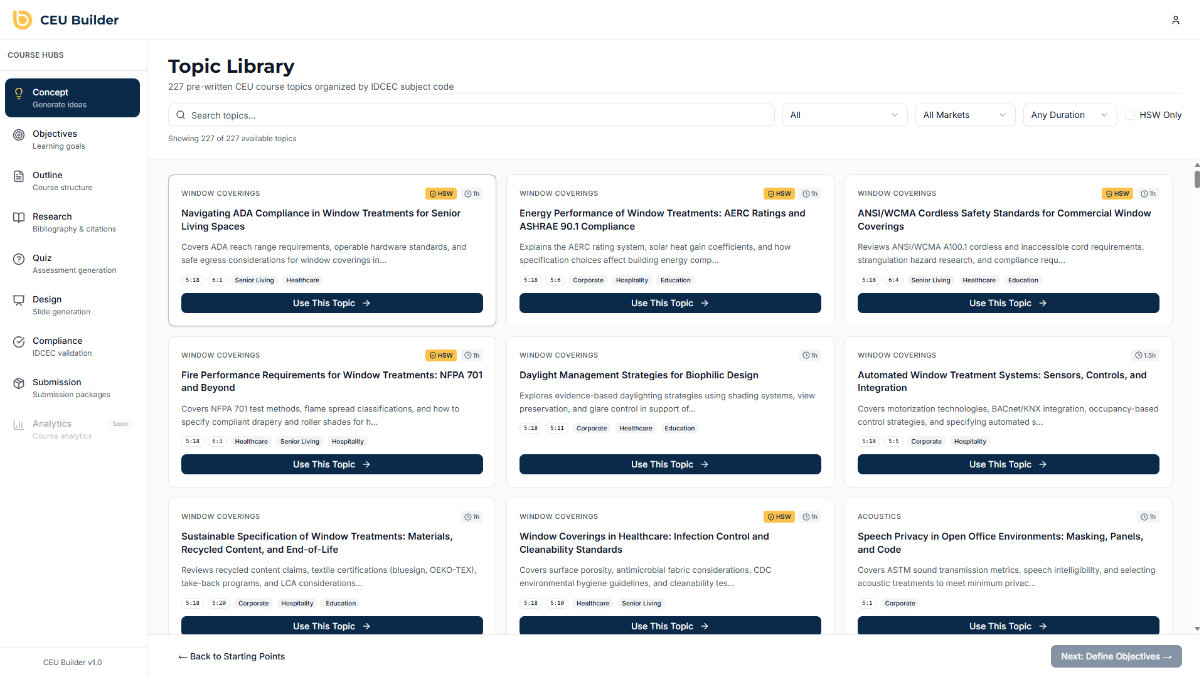
Our step-by-step accreditation approach compresses traditional 90-180 day timelines to 4-6 weeks through reverse-engineered processes and custom tools handling compliance complexity. Every course aligns with what architects actually search for and need to learn, not generic content meeting minimum standards.
Flexible pricing serves manufacturers at every stage. Test market response with $10,000 single courses. Build portfolios through $99 monthly platform subscriptions. Launch comprehensive programs with $18,000-$25,000 multi-course series delivering per-course savings. Expert support minimizes risk while accelerating specifications and trust through strategic educational positioning. Manufacturers ready to transform continuing education into demand generation engines can get IDCEC approval efficiently and effectively.
Frequently asked questions
What is IDCEC accreditation and why is it important for hospitality manufacturers?
IDCEC accreditation validates continuing education courses meet AIA standards for professional development credits. Architects and designers must complete accredited courses annually to maintain licenses. Offering accredited education positions manufacturers as trusted experts while creating 45-60 minute engagement windows with specification-capable decision-makers. Accredited courses generate higher completion rates and stronger specification influence than unaccredited content.
How long does the AIA/IDCEC accreditation process typically take?
Done-for-you services deliver IDCEC approval in 4-6 weeks through expert management of complex submission requirements. Internal teams using platform tools typically require 8-12 weeks for initial courses, accelerating to 6-8 weeks as they gain experience. Traditional DIY approaches without specialized tools often extend to 6-12 months and face high rejection rates requiring complete rebuilds.
What are common challenges when submitting CEU courses for AIA accreditation?
IDCEC requirements are complex and poorly documented, causing 60%+ rejection rates for first-time submitters lacking accreditation expertise. Common failures include inadequate learning objectives, missing bibliography standards, incorrect exam question formats, and content perceived as sales-focused rather than educational. Generic content meeting minimum standards gets approved but generates poor architect engagement and specification results.
How can accredited CEUs effectively influence architect specifications?
Courses addressing actual hospitality design challenges like code compliance, material performance, or acoustic solutions generate 3-4x higher completion than product-focused presentations. Architects remember manufacturers who taught valuable content when selecting products months later. Educational positioning before projects begin creates specification preference traditional sales approaches cannot achieve. Tracking completion data reveals which architects engage with which topics, enabling precise follow-up aligned with demonstrated interests.
Recommended
