

Faster CEU approval drives 25% more hospitality specs

Most hospitality manufacturers assume CEU approval timelines are administrative details with minimal business impact. That assumption costs them specifications. Manufacturers offering IDCEC-approved CEUs experience a 25% increase in engagement and inquiries about product specifications, and those who accelerate approval capture this advantage months before competitors. In 2026, the gap between typical 90-day approval processes and accelerated 45-day workflows determines which brands reach design professionals during active project planning versus after specifications are set. This guide explains why approval speed directly impacts your bottom line and how to compress timelines without sacrificing accreditation quality.
Table of Contents
- Understanding The Impact Of CEU Approval Speed
- Why IDCEC Accreditation Matters For Hospitality Manufacturers
- Comparing Typical Vs Accelerated CEU Approval Timelines
- Practical Strategies To Achieve Faster CEU Approval In 2026
- Accelerate Your IDCEC CEU Approval With CEU Builder
- Why Is Faster CEU Approval Important For Manufacturers?
Key takeaways
| Point | Details |
|---|---|
| Approval speed impacts engagement | Faster IDCEC accreditation leads to 25% higher specification inquiries from design professionals. |
| Timing aligns with design cycles | Courses launched earlier reach architects during active project planning phases. |
| Accreditation signals quality | IDCEC-approved courses achieve 30% higher completion rates than non-accredited alternatives. |
| Streamlined workflows reduce delays | Accelerated processes cut approval time from 90 days to 45 days or less. |
| ROI improves with speed | Earlier market entry extends the revenue-generating lifespan of educational assets. |
Understanding the impact of CEU approval speed
Continuing Education Units (CEUs) are standardized measures of professional development participation. For interior designers, IDCEC (Interior Design Continuing Education Council) accreditation validates that courses meet rigorous educational standards. When hospitality product manufacturers create IDCEC-accredited courses, they position themselves as educators rather than vendors, which fundamentally changes how design professionals engage with their brands.
Approval speed matters because manufacturers offering IDCEC-approved CEUs experience a 25% increase in engagement and inquiries about product specifications. This isn’t correlation. Faster approval means your course reaches architects and designers months earlier, during the critical window when they’re researching solutions for upcoming projects. A course approved in February influences specifications for projects breaking ground in Q2, while a course approved in May arrives after those decisions are finalized.
Design professionals operate on education cycles that align with licensing renewal periods. They actively seek CEU opportunities at specific times of year. Missing these windows means your course sits idle while competitors capture attention. The fast CEU approval process ensures your content reaches market when demand peaks rather than during valleys.
Consider the math: if your typical approval process takes 90 days and you start development in January, your course launches in April. An accelerated 45-day process launches the same course in mid-February. That six-week advantage means your content is available during peak Q1 education-seeking behavior, when designers are fulfilling annual requirements and actively researching products for spring and summer projects.
Key factors driving engagement from faster approval include:
- Earlier brand exposure during active project research phases
- Alignment with designer education-seeking behavior patterns
- Extended revenue-generating lifespan for educational assets
- Competitive positioning before rival manufacturers launch similar content
The IDCEC standards for CEUs remain constant regardless of approval speed, but manufacturers who compress timelines without sacrificing quality gain measurable market advantages. Getting IDCEC approval faster means capturing specifications that would otherwise go to competitors who launched earlier.
Why IDCEC accreditation matters for hospitality manufacturers
IDCEC operates as the recognized standard for interior design continuing education. State licensing boards reference IDCEC when evaluating which courses qualify for professional credit. For manufacturers, this recognition translates directly into course credibility and completion rates.
IDCEC-accredited courses are perceived as 30% more valuable and lead to higher completion rates. Design professionals prioritize accredited content because it fulfills licensing requirements while teaching practical knowledge. Non-accredited courses, regardless of quality, don’t meet regulatory mandates and therefore attract minimal professional participation.
The trust signal from accreditation affects specification behavior. When an architect completes your IDCEC-approved course, they associate your brand with professional-grade education. This perception carries into product selection decisions months later. The IDCEC approval workflow ensures your content meets standards that design professionals recognize and value.
Completion rates matter because incomplete courses generate zero specification value. A designer who starts but abandons your course gains no product knowledge and forms no brand preference. The 30% completion rate advantage from accreditation means more design professionals actually finish your content, absorb your messaging, and remember your products when specifications are needed.
Accreditation also affects course discoverability. Design professionals search for IDCEC-approved content specifically. They filter course databases by accreditation status because only approved courses count toward licensing requirements. Without IDCEC approval, your course is invisible to the primary audience you’re trying to reach.
Pro Tip: Submit courses for IDCEC accreditation before launch rather than after initial distribution. Retroactive accreditation requires re-promoting content to audiences who already ignored the non-accredited version, while pre-launch approval ensures your first impression includes the credibility signal that drives engagement.
The IDC accreditation value survey demonstrates that design professionals actively seek recognized credentials. They’re required to complete continuing education regardless, so they choose courses offering both practical knowledge and regulatory compliance. Manufacturers providing both elements capture attention competitors miss. Managing CEU approvals efficiently ensures you reach market with full credibility intact.
Comparing typical vs accelerated CEU approval timelines
Typical CEU approval processes stretch 90 to 180 days from initial submission to final accreditation. These extended timelines result from incomplete documentation, misalignment with IDCEC standards, reviewer backlogs, and multiple revision cycles. Each delay compounds, pushing launch dates further from optimal market windows.

Accelerated workflows compress approval to 45 days or less by addressing common failure points before submission. The IDCEC accreditation guide outlines requirements that, when followed precisely, eliminate the revision cycles that extend typical timelines.
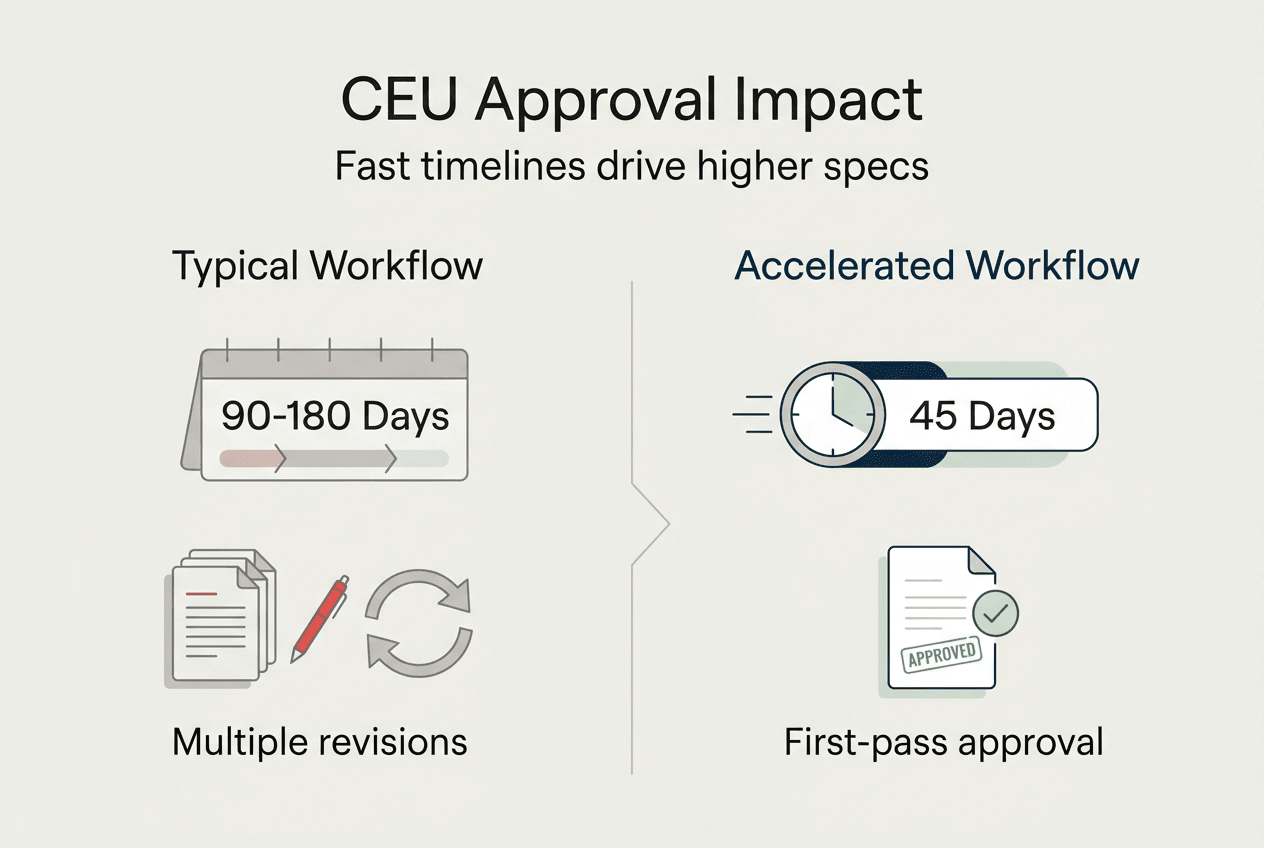
Here’s how timelines compare:
| Process Stage | Typical Timeline | Accelerated Timeline | Time Saved |
|---|---|---|---|
| Content development | 30-45 days | 20-25 days | 10-20 days |
| Internal review | 15-20 days | 5-7 days | 10-13 days |
| IDCEC submission prep | 10-15 days | 3-5 days | 7-10 days |
| IDCEC review | 30-45 days | 15-20 days | 15-25 days |
| Revision cycles | 20-60 days | 0 days | 20-60 days |
| Total timeline | 105-185 days | 43-57 days | 62-128 days |
The revision cycle elimination drives the largest time savings. First-pass approvals avoid the 20 to 60 days consumed by resubmission, additional review, and approval confirmation. Manufacturers who understand IDCEC requirements thoroughly build compliant content from the start rather than discovering gaps after initial rejection.
Florida requires 20 hours of continuing education per renewal cycle, creating predictable demand windows when designers actively seek courses. Accelerated approval ensures your content is available during these high-demand periods rather than launching after peak interest passes.
Shorter timelines also align better with product launch schedules. When you’re introducing new hospitality furniture lines, lighting systems, or material innovations, educational content should reach market simultaneously with product availability. A 90-day approval process means your CEU course launches a quarter after your product does, missing the critical introduction window when design professionals are most receptive to learning about innovations.
Pro Tip: Map your CEU approval timeline backward from target launch dates rather than forward from submission dates. If you need courses available for spring trade shows, start development in November using accelerated workflows rather than hoping typical processes finish in time.
The benefits of faster IDCEC accreditation extend beyond time savings into competitive positioning, revenue acceleration, and market leadership establishment.
Practical strategies to achieve faster CEU approval in 2026
Accelerating CEU approval requires systematic approaches that address the root causes of delays. Here are proven strategies hospitality manufacturers use to compress timelines:
-
Identify trending topics before development starts. Courses aligned with current industry trends and challenges maximize engagement and specification opportunities. Research what design professionals are actively searching for rather than assuming your product features automatically interest them.
-
Engage CEU specialists during content planning, not after creation. Specialists who understand IDCEC requirements build compliance into initial outlines, eliminating the revision cycles that extend timelines.
-
Align credit hours with state requirements like Florida’s 20-hour renewal cycle. Courses offering credit amounts that match common state mandates attract higher enrollment because designers can efficiently fulfill requirements.
-
Implement structured documentation workflows that capture all required elements during development rather than scrambling to compile them before submission.
-
Conduct internal compliance audits using IDCEC checklists before official submission. Catching gaps internally is faster than waiting for reviewer feedback.
Best practices for IDCEC alignment include:
- Writing learning objectives that focus on designer skill development rather than product promotion
- Structuring content to teach specification criteria, application knowledge, and design problem-solving
- Creating exam questions that test comprehension and application rather than simple recall
- Compiling bibliographies from credible industry sources rather than marketing materials
- Formatting submissions exactly as IDCEC requires to avoid administrative delays
The steps for CEU course development provide a framework that, when followed systematically, produces first-pass approvals. The course development process emphasizes building compliance into every stage rather than treating accreditation as a final hurdle.
Data shows manufacturers using structured workflows achieve measurably better outcomes:
| Metric | Typical Approach | Accelerated Approach | Improvement |
|---|---|---|---|
| First-pass approval rate | 45-60% | 95-100% | 50-55% increase |
| Average approval time | 120 days | 48 days | 60% reduction |
| Revision cycles required | 1.8 average | 0.1 average | 94% reduction |
| Time to market | 150 days | 60 days | 60% faster |
Pro Tip: Establish relationships with IDCEC reviewers through provider registration and early consultation. Reviewers offer guidance on borderline content decisions before formal submission, shortening feedback loops and preventing rejection surprises.
The IDCEC continuing education insights reveal that courses teaching practical application rather than theoretical concepts achieve higher completion rates and better specification outcomes. Design professionals value education that solves real project challenges over content that simply describes product features. CEU course approval benefits multiply when content quality matches approval speed.
Accelerate your IDCEC CEU approval with CEU Builder
CEU Builder compresses typical 90 to 180-day approval timelines into 45-day workflows without sacrificing accreditation quality. Our clients achieve measurable specification increases because their courses reach design professionals during active project planning rather than after decisions are finalized. We maintain a 100% first-pass IDCEC approval rate, meaning every course we submit gets accredited on the first attempt.
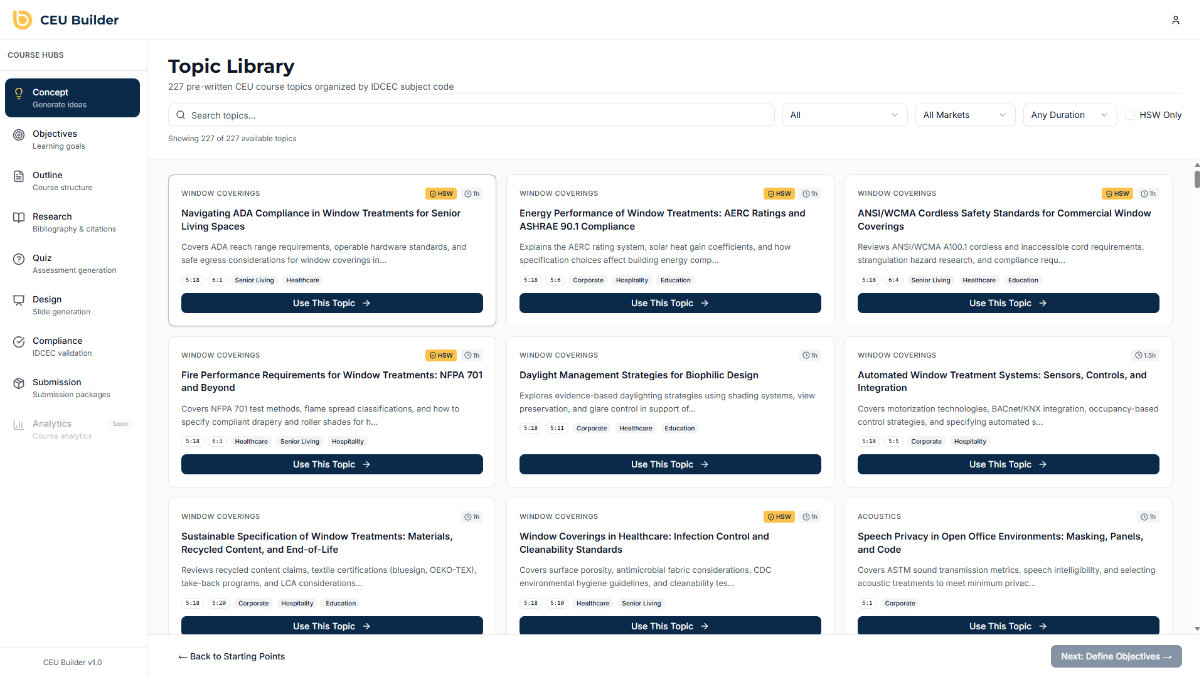
Our done-for-you service handles strategy, content development, compliance auditing, and IDCEC submission management. You review content before launch, we handle everything else. The result is IDCEC-accredited courses that position your hospitality products as specification preferences rather than commodity options. The IDCEC accreditation benefits include higher engagement, increased specifications, and extended brand authority that compounds over time.
Whether you need a single course to test CEU strategy or a comprehensive educational portfolio, getting IDCEC approval faster means capturing specifications competitors miss. Our accreditation guide for providers demonstrates the systematic approach that eliminates delays and ensures first-pass success.
Pro Tip: Start CEU development three months before your next major product launch or trade show appearance. Accelerated approval ensures educational content is ready when design professional attention is highest.
Why is faster CEU approval important for manufacturers?
What factors cause delays in CEU approval?
Incomplete documentation is the primary delay driver. IDCEC requires specific learning objectives, bibliographies, exam questions, and compliance attestations. Missing any element triggers rejection and resubmission cycles that add 30 to 60 days. Misalignment with IDCEC content standards causes similar delays when courses focus too heavily on product promotion rather than designer education. High submission volumes during peak periods create reviewer backlogs, though well-prepared submissions move through queues faster. Insufficient internal quality checks before submission mean preventable errors reach reviewers rather than being caught internally. The CEU approval process provides checklists that eliminate these common failure points.
How does faster CEU approval increase specification rates?
Design professionals specify products they learned about during active project research phases. Courses launching earlier reach architects when they’re building knowledge bases for upcoming projects rather than after specifications are set. Faster approval leads to 25% more engagement and specification inquiries because manufacturers capture attention during optimal timing windows. Higher course completion rates from IDCEC accreditation mean more designers actually finish content and retain product knowledge. Extended asset lifespan from earlier launch means courses generate specifications for longer periods before requiring updates. The CEU course approval benefits compound as courses reach more designers over extended timeframes.
What common mistakes slow CEU approvals?
Submitting incomplete applications without all required documentation guarantees rejection and resubmission delays. Ignoring IDCEC content guidelines by creating product-focused courses rather than education-focused content triggers compliance failures. Delayed responses to reviewer feedback extend timelines because IDCEC pauses reviews until manufacturers provide requested information. Poor internal review before submission means easily caught errors reach IDCEC reviewers rather than being fixed internally. These mistakes are preventable through systematic workflows and compliance checklists. Managing CEU approvals effectively requires understanding requirements before development starts rather than discovering gaps after submission.
How often must interior designers complete CEUs?
Most states require continuing education on multi-year renewal cycles, typically every two to three years. Florida requires 20 hours of continuing education every renewal cycle, creating predictable demand windows when designers actively seek courses. Requirements vary by state, but the pattern is consistent: designers must complete specific credit hours within defined timeframes to maintain professional licenses. This creates recurring opportunities for manufacturers offering valuable, accredited education. Regular CEU availability is critical because designers fulfill requirements continuously rather than in single annual bursts. The Florida CE requirements demonstrate typical state mandates that drive designer education-seeking behavior.
Recommended
