

IDCEC approval guide for hospitality manufacturers 2026

You’ve invested in creating a continuing education course for interior designers, labeled it ‘IDCEC approved,’ and launched it to your hospitality clients. Months later, you discover designers can’t use it for their required credits. This confusion stems from misunderstanding what IDCEC approval actually means and how it differs from other accreditations. True IDCEC approval opens doors to specification influence and revenue growth, but only when courses meet specific standards that many manufacturers overlook.
Table of Contents
- Understanding IDCEC Approval: What It Means And Why It Matters
- Health, Safety, And Welfare Criteria: The Core Of IDCEC Course Standards
- The Benefits Of IDCEC Approval For Hospitality Manufacturers
- Steps To Develop And Secure IDCEC Approval For Your CEU Course
- Discover How CEU Builder Can Help You Secure IDCEC Approval
- Frequently Asked Questions
Key takeaways
| Point | Details |
|---|---|
| IDCEC approval validates course quality | Courses must meet strict interior design professional standards set by the Interior Design Continuing Education Council. |
| HSW designation requires 75% relevant content | Health, safety, and welfare credits demand that three-quarters of instructional time covers public protection topics. |
| Approval drives designer engagement | IDCEC-accredited courses fulfill mandatory professional requirements, increasing course uptake and specification influence. |
| Different bodies have distinct criteria | IDCEC approval doesn’t guarantee acceptance by state boards like LSBID, which have separate content requirements. |
| Strategic course design ensures compliance | Following specific development steps and documentation standards increases first-pass approval chances. |
Understanding IDCEC approval: what it means and why it matters
IDCEC approval signifies that a continuing education course meets specific standards for interior design professionals. The Interior Design Continuing Education Council evaluates courses based on content accuracy, learning objectives, and instructor qualifications. When your course earns this designation, designers can confidently apply those credits toward their professional development requirements.
Many hospitality manufacturers assume any course marketed to designers automatically qualifies as approved education. This misconception leads to wasted development time and missed specification opportunities. IDCEC approval requires deliberate course design that addresses professional competencies rather than product promotion.
The approval process matters because interior designers face mandatory continuing education requirements to maintain their credentials. They actively search for courses that fulfill these obligations while teaching them practical skills for hospitality projects. When you offer genuinely approved courses, you create value exchanges where designers get required credits and you gain 45 to 60 minutes of focused attention from specification decision-makers.
IDCEC approval enhances course credibility in three specific ways:
- Designers trust that approved courses meet professional standards
- State licensing boards recognize IDCEC credits for renewal requirements
- Course listings appear in searchable databases where designers find continuing education
Understanding how to get IDCEC approval transforms your educational content from generic marketing material into strategic specification tools. The difference between claiming a course is approved and earning actual IDCEC accreditation determines whether designers engage with your content or dismiss it as promotional.
True IDCEC approval creates specification advantages that generic education cannot replicate. Designers remember manufacturers who provided valuable, accredited learning when selecting products months later.
Health, safety, and welfare criteria: the core of IDCEC course standards
The HSW designation represents the gold standard for IDCEC-approved courses. Health, safety, and welfare courses must dedicate at least 75% of content and instructional time to topics that protect public welfare and environmental quality. This threshold separates substantive professional education from surface-level product overviews.

AIA guidelines influence IDCEC standards by defining acceptable HSW topics. These include building codes, accessibility standards, fire safety, indoor air quality, and sustainable design practices. When your hospitality furniture or lighting products connect to these topics, you can design courses that qualify for HSW credits while showcasing your solutions.
Meeting the 75% content rule requires strategic course architecture. Consider a lighting manufacturer creating a course about hospitality design. If 45 minutes of a 60-minute course covers code-compliant emergency lighting, circadian rhythm impacts on guest wellness, and energy efficiency standards, the course qualifies for HSW designation. The remaining 15 minutes can highlight specific product applications without disqualifying the entire course.
Common HSW qualification pitfalls include:
- Focusing too heavily on product features instead of design principles
- Failing to connect content explicitly to health, safety, or welfare outcomes
- Using vague learning objectives that don’t address professional competencies
- Neglecting to document the 75% threshold in course materials
Pro Tip: Map your course content to specific building codes or LEED criteria. This documentation proves HSW relevance and strengthens your IDCEC submission.
The IDCEC accreditation checklist helps manufacturers verify HSW compliance before submission. Courses that meet HSW standards command higher completion rates because designers prioritize credits that fulfill the most stringent professional requirements.
| Course Type | HSW Content Requirement | Typical Designer Priority |
|---|---|---|
| HSW Designated | Minimum 75% health, safety, welfare topics | High (fulfills strictest requirements) |
| General IDCEC | Relevant to interior design practice | Medium (fulfills basic requirements) |
| Non-Accredited | No specific standard | Low (no professional credit) |
The benefits of IDCEC approval for hospitality manufacturers
IDCEC approval allows manufacturers to offer courses that interior designers need to maintain professional credentials, directly driving specifications and revenue. When designers take your approved course to earn required credits, they learn about your products in an educational context rather than a sales pitch. This positioning shift creates trust that influences specification decisions months after course completion.
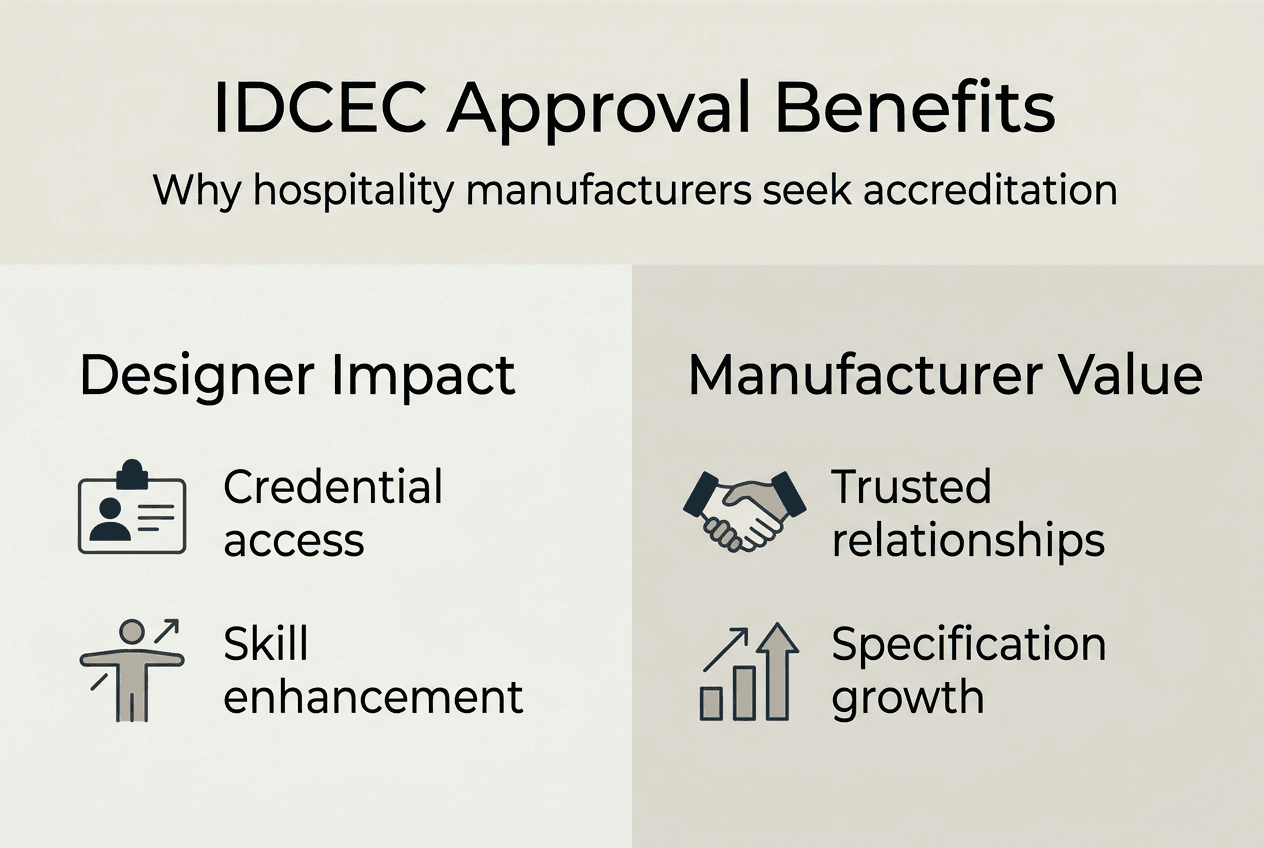
Approved courses fulfill mandatory professional requirements that designers must meet annually. Instead of competing for attention through cold calls or trade show booths, you provide genuine value that designers actively seek. This dynamic transforms your marketing from interruptive to invited.
Marketing advantages of IDCEC-approved courses include:
- Searchable listings in IDCEC databases where designers find continuing education
- Credibility signals that position your brand as industry expert
- Extended engagement windows where 60-minute courses replace 5-minute sales conversations
- Data collection showing which designers engaged with which product topics
Building trusted relationships with design professionals requires consistent value delivery. Well-designed IDCEC courses serve as relationship-building tools that establish your expertise before designers need your products. When a hotel project requires acoustic solutions six months after a designer completed your acoustic performance course, you become the reference point.
Monetary benefits extend beyond immediate specifications. A single approved course generating 200 designer completions creates 200 touchpoints with decision-makers. If 2% of those designers specify your products into hospitality projects averaging $100,000 in product value, that’s $200,000 in influenced specifications from a $10,000 course investment.
Pro Tip: Track course completion data in your CRM to identify high-potential designer prospects. Designers who complete multiple courses signal strong interest in your product categories.
The ROI from IDCEC courses compounds over time because approved courses have indefinite shelf lives. A course built in 2026 continues generating completions and specifications in 2027 and beyond with no additional development cost. This creates perpetual lead generation infrastructure that traditional marketing cannot match.
Continuing education success for manufacturers requires viewing IDCEC approval as strategic investment rather than compliance exercise. Courses designed to drive specifications deliver measurable business outcomes that justify development costs.
Steps to develop and secure IDCEC approval for your CEU course
Creating IDCEC-compliant courses requires understanding eligibility criteria before development begins. Your organization must register as an IDCEC provider, a one-time process involving application fees and organizational documentation. Courses must include clear learning objectives, qualified instructors, and assessment mechanisms that verify participant understanding.
The development and submission process follows these critical steps:
- Register your organization as an IDCEC education provider
- Develop course content meeting HSW or general IDCEC standards
- Create learning objectives aligned with interior design competencies
- Design assessment questions testing content retention
- Compile instructor credentials demonstrating subject matter expertise
- Prepare course bibliography with credible sources
- Submit application through IDCEC portal with required documentation
- Respond to reviewer feedback if revisions are requested
Typical approval timelines range from four to six weeks when all criteria are met. Incomplete submissions or courses missing HSW documentation face delays extending to three months or more. First-pass approval rates vary widely across providers, with specialized studios achieving 100% approval while general providers often require multiple revision rounds.
Required documentation includes:
| Document Type | Purpose | Common Mistakes |
|---|---|---|
| Learning Objectives | Define participant outcomes | Vague objectives not tied to competencies |
| Course Outline | Show content structure and timing | Missing HSW percentage documentation |
| Instructor Credentials | Prove subject expertise | Insufficient professional background |
| Bibliography | Support content accuracy | Unreliable sources or missing citations |
| Assessment Questions | Verify learning retention | Questions testing product recall not concepts |
Pro Tip: Write learning objectives using measurable verbs like analyze, evaluate, or apply. Avoid passive verbs like understand or learn that cannot be assessed.
Best practices for speeding approval include front-loading HSW content documentation, using IDCEC-approved instructors when possible, and following the course approval process precisely. Understanding the approval workflow prevents common submission errors that trigger rejection.
Manufacturers choosing how to get IDCEC approval face a decision between internal development and specialized support. Internal development offers creative control but requires deep IDCEC knowledge and risks costly approval failures. Specialized providers compress timelines and eliminate rejection risk through systematic compliance processes.
Discover how CEU Builder can help you secure IDCEC approval
CEU Builder streamlines IDCEC course approval through reverse-engineered processes that achieve 100% first-pass accreditation rates. Our done-for-you service handles everything from initial research through final approval in four to six weeks, eliminating the six to twelve month timelines typical of internal development.
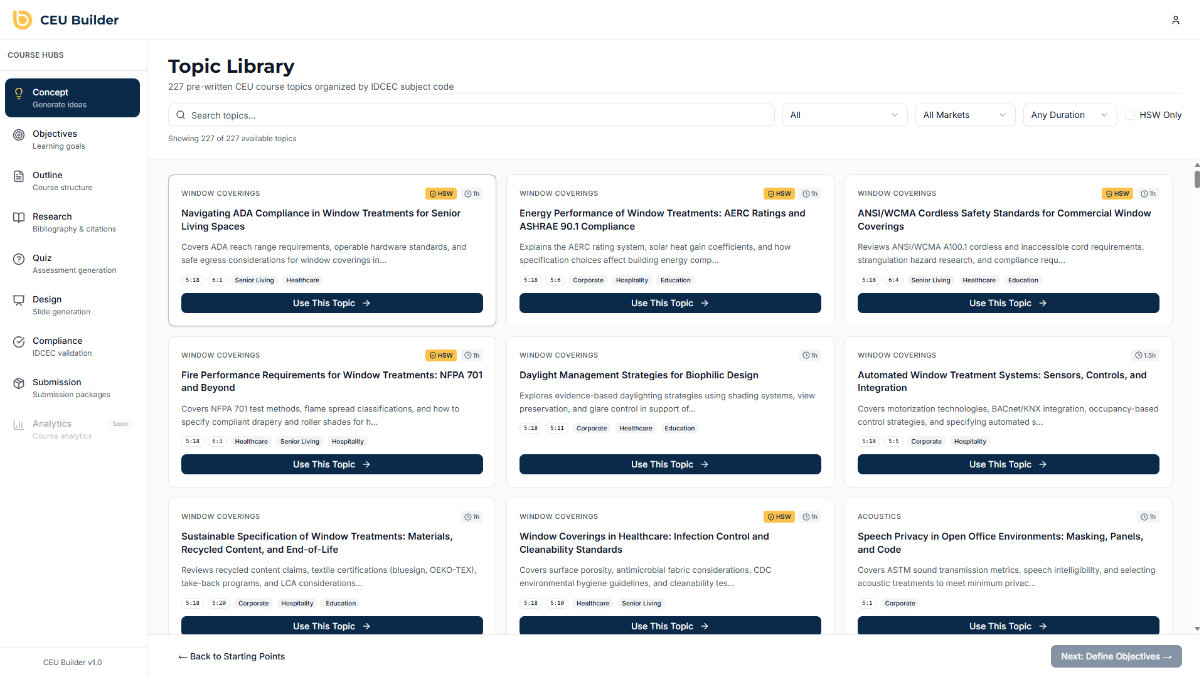
The platform optimizes course content for both IDCEC compliance and specification influence. We design learning objectives that meet accreditation standards while teaching designers specification criteria favoring your products. This dual focus transforms continuing education from compliance exercise into demand generation engine.
Proven results show manufacturers achieving 10x ROI through strategically designed IDCEC courses. Understanding the course approval process and knowing how to get IDCEC approval positions your hospitality brand as educational authority. Explore IDCEC CEU course ROI to see how approved courses drive specifications and revenue growth.
Frequently asked questions
What is the difference between IDCEC approval and LSBID credit?
IDCEC approval represents broader accreditation recognized across multiple states and professional organizations. LSBID credit specifically applies to Louisiana State Board of Interior Design requirements. Courses designated as general will not qualify for LSBID credit even with IDCEC approval. A course can earn IDCEC accreditation while failing to meet LSBID’s more restrictive content standards. Verify specific state board requirements before assuming IDCEC approval guarantees acceptance everywhere.
How long does the IDCEC approval process typically take?
Standard IDCEC approval occurs within four to six weeks when all criteria are met and documentation is complete. Incomplete submissions or courses requiring significant revisions extend timelines to eight to twelve weeks. Factors expediting approval include clear HSW documentation, qualified instructor credentials, and precise learning objectives. Delays typically stem from missing bibliography citations, vague learning outcomes, or insufficient assessment questions. First-pass approval eliminates revision rounds that add months to the process.
Can manufacturers create courses that qualify for health, safety, and welfare credits?
Manufacturers can absolutely create HSW-qualifying courses by focusing content on public protection topics. At least 75% of course content must relate to health, safety, and welfare as defined by IDCEC and AIA guidelines. Connect your products to building codes, accessibility standards, fire safety, or sustainable design practices. A furniture manufacturer might create an HSW course about ergonomic seating standards in hospitality environments. The key is emphasizing design principles and code compliance over product features.
How does IDCEC approval help increase product specifications?
IDCEC-approved courses build trusted relationships with designers by providing required professional credits while educating them about product applications. Designers remember manufacturers who taught them valuable skills when selecting products for projects. The educational context positions you as expert rather than vendor, creating credibility that influences specification decisions. Approved courses also generate data showing which designers engaged with which topics, enabling targeted follow-up. This strategic positioning drives specifications more effectively than traditional sales approaches.
What happens if a course is labeled IDCEC approved but lacks other accreditations?
Just because a course advertises IDCEC approval does not automatically mean it qualifies for other accrediting bodies like LSBID or specific state boards. Each organization maintains distinct approval criteria and content requirements. Designers must verify that courses meet their specific licensing board standards. Manufacturers should clearly communicate which accreditations each course holds and avoid implying universal acceptance. Transparency about accreditation scope builds trust and prevents designer frustration when credits are rejected by their state boards.
Recommended
