

Multi-provider accreditation explained: boost specs with CEUs

Hospitality manufacturers face a unique challenge: architects and designers control billions in product specifications, yet traditional marketing approaches fail to capture their attention. Multi-provider accreditation allows hospitality manufacturers to become approved continuing education providers through bodies like IDCEC and AIA, transforming compliance requirements into specification engines. When you understand how multi-provider accreditation works and which paths deliver the strongest returns, you position your products in front of decision-makers during the critical moments when they’re building knowledge and forming preferences. This guide clarifies what multi-provider accreditation entails, how to navigate the process successfully, and why it matters for manufacturers seeking specification preference in hospitality markets.
Table of Contents
- Key takeaways
- What is multi-provider accreditation and why it matters
- The accreditation process: steps, timelines, and common pitfalls
- IDCEC vs AIA: understanding accreditor differences and implications
- Creating accredited CEU courses that influence hospitality specs
- Explore expert resources for accreditation success
- Frequently asked questions about multi-provider accreditation
Key Takeaways
| Point | Details |
|---|---|
| Multi provider accreditation | It allows manufacturers to become approved providers delivering CEUs through bodies such as IDCEC and AIA. |
| Course content standards | Submissions must meet educational standards beyond simple product promotion. |
| Specification uplift potential | Accredited CEUs can accelerate product specifications by up to 50 percent. |
| Audience by accreditor | IDCEC serves interior designers while AIA targets licensed architects with stricter compliance requirements. |
| Expert guidance benefits | Manufacturers often benefit from expert guidance to avoid common accreditation pitfalls. |
What is multi-provider accreditation and why it matters
Multi-provider accreditation represents your ability to deliver continuing education credits through multiple recognized accrediting bodies that architects and designers trust for professional license renewal. For hospitality manufacturers, this means becoming an approved provider capable of offering courses that fulfill mandatory continuing education requirements while simultaneously positioning your products as specification solutions.
IDCEC (Interior Design Continuing Education Council) serves interior designers who specify furnishings, finishes, and materials in hospitality projects. These professionals need CEU credits to maintain their certifications and actively seek courses that teach them about products they’ll specify into hotels, restaurants, and senior living facilities. When you earn IDCEC accreditation, you gain direct access to the designers making material and furniture selections for projects worth hundreds of thousands in product value.
AIA (American Institute of Architects) accreditation targets licensed architects who control broader project specifications including structural systems, building envelopes, and architectural elements. While AIA courses reach a different audience, they matter for manufacturers whose products require architectural specification or whose sales depend on architect approval even when designers make final selections.
The strategic value of multi-provider accreditation lies in the unique exchange it creates. Architects and designers must complete continuing education annually. They’re already searching for courses. When you provide valuable, accredited education that fulfills professional license renewal requirements, you capture 45 to 60 minutes of focused attention from decision-makers who are actively learning about topics relevant to their work. This positions you as expert rather than vendor, fundamentally shifting how design professionals perceive your brand when specification decisions arise months later.
Multi-provider accreditation matters because it transforms compliance requirements into competitive advantages:
- Design professionals remember manufacturers who taught them valuable skills when selecting products for projects
- Educational positioning builds trust that traditional advertising cannot achieve
- CEU courses generate measurable specification lift and qualified leads
- Accredited content has indefinite shelf life, creating perpetual lead generation infrastructure
The accreditation process: steps, timelines, and common pitfalls
Obtaining multi-provider accreditation requires navigating specific submission requirements, understanding realistic timelines, and avoiding the pitfalls that cause first-time failure rates exceeding 50% for manufacturers attempting the process without expert guidance.
The accreditation submission process demands these core elements:
- Provider registration: Initial paperwork establishing your organization as an approved continuing education provider with the accrediting body
- Course materials: Complete slide decks, speaker scripts, and visual assets that deliver educational content
- Learning objectives: Specific, measurable statements defining what participants will know or be able to do after completing the course
- Assessment instruments: Exam questions testing comprehension and application of course concepts
- Bibliography: Academic citations supporting factual claims and demonstrating educational rigor
- Compliance documentation: Proof that content meets accreditor standards for educational value, time allocation, and non-promotional focus
Timeline realities separate successful manufacturers from those who waste months on failed attempts. The typical 6 to 12 month timeline reflects what happens when internal teams navigate accreditation without understanding requirements. Development takes 3 to 4 months. Submission review adds 2 to 3 months. Revisions after rejection consume another 3 to 6 months. This extended timeline delays market entry and wastes internal resources on content that may never get approved.

Expert-guided processes compress this timeline to 4 to 6 weeks from kickoff to approval. The acceleration comes from understanding exactly what accreditors require, building compliance into every development stage, and avoiding the common pitfalls that trigger rejections.
Common rejection causes include:
- Excessive product promotion: Courses that read like sales presentations rather than educational content get rejected immediately
- Inadequate learning objectives: Vague or unmeasurable objectives fail to demonstrate educational value
- Insufficient assessment: Exam questions that test recall rather than comprehension and application
- Missing documentation: Incomplete bibliographies, unsigned forms, or technical submission errors
- Time allocation problems: Content that doesn’t justify the claimed credit hours
“The difference between first-pass approval and costly rejection often comes down to understanding what accreditors actually evaluate. Most manufacturers focus on content quality while missing compliance requirements that trigger automatic denials.”
Pro Tip: Use a CE course approval checklist that maps every accreditor requirement to specific deliverables. This ensures nothing gets missed during development and submission, dramatically improving your approval odds.
The financial impact of accreditation failures extends beyond obvious costs. A rejected course wastes $15,000 to $30,000 in internal resource costs when you factor in marketing team time, subject matter expert involvement, and project management overhead. The delayed market entry means competitors capture specification opportunities while you’re rebuilding content. The opportunity cost of 6 to 12 months without an accredited course often exceeds the direct development costs.
IDCEC vs AIA: understanding accreditor differences and implications
Choosing between IDCEC and AIA accreditation requires understanding how each body serves different audiences, enforces different requirements, and delivers different strategic advantages for hospitality manufacturers seeking specification preference.
IDCEC targets interior designers who control furniture, finishes, and material specifications in hospitality projects. These professionals work directly on hotel guestroom designs, restaurant interiors, and senior living common areas. They specify the seating, casegoods, textiles, lighting, and surfacing materials that represent the bulk of hospitality product specifications. For manufacturers in these categories, IDCEC accreditation provides direct access to the decision-makers who write specifications.
AIA focuses strictly on licensed architects whose scope covers building systems, structural elements, and architectural specifications. While architects influence product selections, they often defer to interior designers for furniture and finish decisions. AIA courses reach professionals who control larger project decisions but may not directly specify the products hospitality manufacturers sell.
Compliance and auditing requirements differ significantly between accreditors:
| Aspect | IDCEC | AIA |
|---|---|---|
| Target audience | Interior designers, NCIDQ certificate holders | Licensed architects |
| Audit frequency | Periodic spot checks | Regular audits with record retention requirements |
| Documentation burden | Moderate, focused on educational standards | High, with detailed participant tracking |
| Approval timeline | 4 to 8 weeks typical | 6 to 12 weeks typical |
| Renewal requirements | Course updates as standards change | Annual provider renewals with documentation |
| Cost structure | Lower administrative overhead | Higher due to audit compliance |
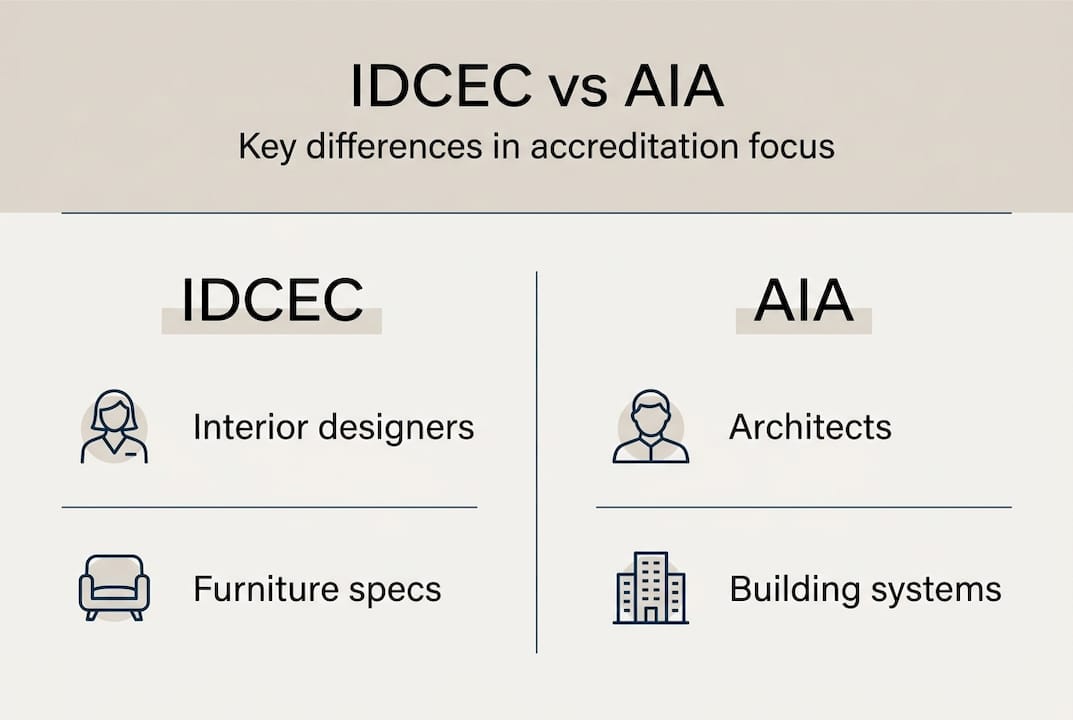
Hospitality manufacturers typically prefer IDCEC accreditation for practical reasons. Interior designers represent the primary specification decision-makers for furniture, textiles, lighting, and materials. IDCEC accreditation tends to drive more immediate specification preference because the audience directly controls purchase decisions rather than influencing them indirectly. The lower administrative burden and faster approval timelines allow manufacturers to reach market quickly and focus resources on course promotion rather than compliance management.
Strategic considerations when choosing accreditation paths:
- Product category alignment: Furniture and finish manufacturers benefit most from IDCEC; building system manufacturers may prefer AIA
- Audience reach: IDCEC courses typically generate higher completion rates among hospitality-focused designers
- Administrative capacity: AIA’s audit requirements demand dedicated compliance resources
- Market positioning: IDCEC positions you with decision-makers; AIA positions you with influencers
Some manufacturers pursue dual accreditation to maximize reach, but this strategy works best after establishing success with one accreditor. Starting with IDCEC allows you to prove the specification impact of continuing education before investing in the more demanding AIA compliance requirements. The comparison between accreditation paths reveals that most hospitality manufacturers see stronger ROI from IDCEC courses that directly reach specification decision-makers.
Creating accredited CEU courses that influence hospitality specs
Developing courses that earn accreditation while driving specifications requires balancing educational depth with strategic product positioning. The most effective courses teach genuine skills that architects and designers apply to real projects while naturally favoring your products as specification solutions.
Courses must avoid sales pitch tone and focus on genuine educational value with comprehension exams that test learning rather than product recall. Accreditors reject content that reads like marketing collateral. Your course needs to teach concepts, explain principles, and provide frameworks that help design professionals make better decisions. The strategic positioning happens through topic selection and specification criteria rather than overt product promotion.
Key topics that resonate with architects in hospitality include:
- Durability and lifecycle performance: Teaching how to evaluate material longevity in high-traffic hospitality environments
- Specification criteria: Explaining the technical factors that determine product suitability for different applications
- Code compliance: Clarifying fire ratings, accessibility standards, and safety requirements for hospitality projects
- Sustainability and certifications: Detailing environmental standards and how to specify products that meet green building requirements
- Acoustic performance: Teaching sound control principles critical for guest satisfaction in hotels and restaurants
Structuring exams to test comprehension and application ensures accreditation approval while reinforcing specification knowledge. Effective exam questions ask participants to apply concepts to scenarios, evaluate product specifications against project requirements, or identify appropriate solutions for specific design challenges. This approach tests genuine learning while teaching the evaluation criteria that favor your products.
Pro Tip: Align course topics with architect pain points by researching what design professionals actually search for when seeking hospitality solutions. Search data reveals the questions architects ask, the problems they’re trying to solve, and the knowledge gaps your course can fill. This research-driven approach ensures your educational content addresses real needs rather than assumed interests.
Educating architects through hospitality-specific topics accelerates specs by 50% and boosts trust by 40% because the learning experience positions you as industry expert and trusted resource. When an architect takes your course about acoustic performance in hotel environments six months before starting a project, your brand becomes the reference point when acoustic solutions are needed. This timing advantage is impossible to achieve through reactive sales approaches that engage prospects after specifications are already determined.
Accredited education positions manufacturers as trusted experts rather than vendors through several mechanisms:
- Authority building: Teaching establishes credibility that advertising cannot achieve
- Extended engagement: 45 to 60 minute courses replace 5 minute sales pitches
- Knowledge transfer: Architects remember manufacturers who taught them valuable skills
- Specification framing: Learning objectives teach evaluation criteria that favor your products
The most successful courses balance educational integrity with strategic positioning. You teach genuine principles that improve design outcomes while naturally demonstrating why your products represent optimal solutions. This approach satisfies accreditor requirements for educational value while driving the specification preference that justifies course investment. When you’re ready to develop courses that meet these standards, creating CEU courses requires understanding both instructional design principles and specification dynamics unique to hospitality manufacturing.
Explore expert resources for accreditation success
Navigating multi-provider accreditation successfully requires understanding complex requirements, avoiding costly pitfalls, and developing courses that drive specifications rather than simply fulfilling compliance requirements. The IDCEC provider accreditation guide walks you through every step from initial registration through course approval, clarifying the specific documentation and compliance requirements that separate successful submissions from rejected attempts. When you understand IDCEC accreditation benefits including the 50% specification acceleration and 40% trust increase, the strategic case for investment becomes clear. For manufacturers ready to develop courses that position products effectively while meeting educational standards, resources on creating CEU courses for hospitality provide the frameworks and examples that translate accreditation knowledge into specification results.
Frequently asked questions about multi-provider accreditation
What is the main difference between IDCEC and AIA accreditation?
IDCEC targets interior designers who directly specify furniture, finishes, and materials in hospitality projects, while AIA focuses on licensed architects with broader building system responsibilities. IDCEC typically delivers stronger specification impact for hospitality manufacturers because interior designers control the product categories most manufacturers sell. AIA requires more extensive audit compliance and record retention, creating higher administrative burdens for providers.
How long does the accreditation process usually take?
Typical timelines span 6 to 12 months when manufacturers navigate accreditation internally without expert guidance. This includes 3 to 4 months for development, 2 to 3 months for review, and additional months for revisions after rejection. Expert-guided processes compress this to 4 to 6 weeks from kickoff to approval by building compliance into every development stage and avoiding the common pitfalls that trigger rejections and delays.
What are common reasons for course accreditation rejection?
Excessive product promotion represents the leading rejection cause, as courses reading like sales presentations fail educational standards immediately. Inadequate learning objectives that lack measurable outcomes, insufficient assessment instruments testing only recall rather than comprehension, missing documentation including incomplete bibliographies, and time allocation problems where content doesn’t justify claimed credit hours all trigger denials. First-time failure rates exceed 50% for manufacturers attempting accreditation without understanding these specific requirements.
Can manufacturers handle accreditation internally or is expert help recommended?
Manufacturers with dedicated instructional design expertise and deep understanding of accreditor requirements can handle accreditation internally, but most lack this specialized knowledge. The 50% first-time failure rate reflects the complexity of compliance requirements that aren’t obvious from published guidelines. Expert help eliminates the risk of rejected submissions that waste months and tens of thousands in internal resource costs while compressing timelines by 80% to 95%. The decision depends on whether you have internal capacity and expertise versus the cost of failed attempts and delayed market entry.
How does accreditation impact product specification in hospitality?
Accredited courses accelerate specifications by positioning manufacturers as educational authorities before projects begin, when architects are building knowledge and forming preferences. The 45 to 60 minute educational engagement creates trust and credibility that traditional sales approaches cannot achieve. Architects who learn specification criteria from your course naturally prefer your products when making selections months later. Measurable impacts include 50% faster specification cycles, 40% higher trust levels, and qualified lead generation from design professionals who self-identify interest through course selection.
Recommended
