

Course compliance best practices for IDCEC accreditation

Hospitality manufacturing companies face a delicate balancing act when developing continuing education courses. You need to satisfy IDCEC’s strict accreditation requirements while creating content that genuinely educates architects and designers. Miss compliance criteria and your course gets rejected, wasting months of effort. Focus only on rules without educational value and you lose the specification influence that makes CEU investment worthwhile. This article outlines proven best practices for achieving both goals, covering compliance criteria, topic selection strategies, and decision frameworks that help you choose the right approach for your organization.
Table of Contents
- Understanding IDCEC Compliance Criteria For CEU Courses
- Selecting Effective CEU Topics Relevant To Hospitality Manufacturing
- Comparing Course Compliance Strategies And Tools For 2026
- Making The Right Compliance Decisions For Hospitality Manufacturers
- Get Expert Help With Your IDCEC Course Compliance
- FAQ
Key takeaways
| Point | Details |
|---|---|
| IDCEC compliance demands clear objectives | Courses must include explicit learning outcomes and avoid purely promotional content to pass accreditation review. |
| Topic relevance drives engagement | Hospitality manufacturers should focus on subjects like acoustics, sustainability, and indoor air quality that solve real design challenges. |
| Compliance checklists improve success | Structured verification tools catch common errors before submission, significantly increasing first-pass approval rates. |
| Strategy selection impacts outcomes | Comparing in-house development, third-party partnerships, and platform solutions helps identify the best fit for your goals and resources. |
Understanding IDCEC compliance criteria for CEU courses
IDCEC accreditation requires hospitality manufacturers to meet specific standards that separate legitimate continuing education from thinly disguised product marketing. Approved CEUs exclude purely promotional or product-training focused content, meaning your course cannot function as an extended sales pitch. The accreditation body evaluates whether content teaches transferable knowledge that architects and designers can apply across multiple projects and product categories.
Clear learning objectives form the foundation of compliant courses. You must articulate exactly what participants will know or be able to do after completing your program. These objectives need specificity, stating measurable outcomes rather than vague aspirations. For example, “Participants will identify three acoustic treatment strategies for hotel lobbies” passes muster, while “Participants will understand acoustics better” fails to meet standards.
Timing requirements also factor into compliance decisions. IDCEC expects courses to deliver substantial educational value, typically requiring 45-60 minutes of instruction for a single CEU credit. Shorter presentations lack depth, while excessively long courses lose participant engagement. Your content structure should pace information delivery to maintain attention while covering material thoroughly.
Documentation standards create additional compliance requirements:
- Complete bibliographies citing authoritative sources
- Attendance verification systems tracking participant completion
- Assessment tools measuring knowledge retention
- Certificate generation meeting IDCEC formatting specifications
Credit requirements vary by professional organization. ASID and IIDA members need 10 CEUs every two years, while some states like Florida mandate 20 CEUs in specific circumstances. Understanding these variations helps you position courses appropriately for different audience segments.
Your education compliance guide for manufacturers should address these criteria systematically. Many marketing teams underestimate the complexity involved, assuming compliance simply means avoiding obvious product promotion. The reality involves dozens of technical requirements that IDCEC reviewers evaluate during the accreditation process.
“The difference between compliant and non-compliant content often comes down to framing. Teaching architects how to evaluate acoustic performance in hospitality spaces passes review. Explaining why your specific acoustic panels outperform competitors gets rejected.”
This distinction matters because it shapes your entire content development approach. You can mention your products within compliant courses, but only as examples illustrating broader principles. The educational framework must stand independent of your specific offerings, providing value even if participants never specify your materials.
Selecting effective CEU topics relevant to hospitality manufacturing
Topic selection determines whether your CEU course generates genuine specification influence or simply fulfills compliance requirements without business impact. Hospitality manufacturers succeed when they choose subjects that address real design challenges architects face while naturally positioning their products as solutions.
Hospitality manufacturing companies offer IDCEC-approved CEUs on topics like acoustics, sustainability practices, and indoor air quality because these subjects align with pressing industry concerns. Architects designing hotels, restaurants, and senior living facilities actively seek knowledge about these areas, making them high-engagement topics that drive course completion rates.

Acoustic performance represents a particularly effective topic for hospitality manufacturers. Hotels require sound isolation between guest rooms, restaurants need speech intelligibility despite ambient noise, and senior living facilities must balance privacy with safety monitoring. A course teaching acoustic design principles naturally creates opportunities to discuss materials, installation methods, and specification criteria where your products excel.
Sustainability content resonates strongly with design professionals facing increasing client demands for environmentally responsible projects. Topics might include:
- Material lifecycle analysis for hospitality applications
- Indoor environmental quality optimization strategies
- Energy-efficient lighting design for commercial interiors
- Water conservation approaches in hospitality environments
Indoor air quality has gained urgency since 2020, with architects and facility managers prioritizing ventilation, filtration, and material emissions. Courses addressing IAQ concerns position manufacturers of textiles, finishes, and furniture as partners in creating healthier hospitality spaces.
The key to topic selection involves identifying the intersection between your product expertise and architect information needs. You want subjects where you possess genuine authority while addressing questions architects actually ask. IDCEC approval guides for hospitality manufacturers emphasize this alignment as critical for both compliance success and business outcomes.
Relevant content increases course engagement because participants recognize immediate applicability to their work. When an architect takes your course on hospitality acoustics and then starts a hotel project two months later, your educational content becomes the reference framework they use for specification decisions. This timing creates specification influence that traditional marketing cannot achieve.
Consider evolving industry trends when planning your topic portfolio. Emerging areas like biophilic design, circadian lighting, and adaptive reuse of hospitality properties represent opportunities to establish educational authority before competitors enter the space. Examples of CEU course topics demonstrate how forward-thinking manufacturers position themselves as industry leaders through strategic topic selection.
Pro Tip: Survey your sales team about the technical questions architects ask most frequently. These recurring questions reveal knowledge gaps your CEU courses can address, creating content that directly supports specification conversations.
Comparing course compliance strategies and tools for 2026
Hospitality manufacturers use three primary approaches to ensure their CEU courses meet IDCEC standards, each offering distinct advantages depending on your organization’s resources, timeline, and strategic priorities.
In-house development gives you complete creative control and deep integration with your product knowledge. Your marketing and product teams understand your offerings thoroughly, enabling courses that naturally connect educational content with specification criteria. However, this approach requires significant time investment, typically 6-12 months for first-time course creators. Teams must learn IDCEC requirements including clear learning objectives, proper timing, and documentation standards through trial and error, often resulting in rejected submissions that restart the entire process.
Third-party partnerships accelerate development by leveraging external expertise in instructional design and accreditation management. Specialized providers understand IDCEC’s evaluation criteria and build compliance into every development stage. This approach compresses timelines to 4-6 weeks while eliminating rejection risk through proven processes. The tradeoff involves reduced control over content decisions and higher upfront costs compared to internal development.
Platform solutions offer a middle path, providing tools and templates that guide internal teams through compliant course creation. These systems typically include:
- Learning management infrastructure for course delivery
- Compliance checklists verifying IDCEC requirements
- Certificate generation meeting accreditation standards
- Tracking systems documenting participant completion
The comparison between these strategies reveals different value propositions:
| Strategy | Timeline | Control | Cost | Risk |
|---|---|---|---|---|
| In-house | 6-12 months | Complete | Internal resources | High rejection rate |
| Third-party | 4-6 weeks | Collaborative | $10,000+ per course | Minimal with guarantees |
| Platform | 8-12 weeks | High | $99-$299/month | Moderate with guidance |
Tracking software and accreditation management platforms have evolved significantly in 2026, incorporating automated compliance checking that flags potential issues before submission. These tools analyze content against IDCEC criteria, identifying problems like promotional language, missing learning objectives, or inadequate documentation. Early detection prevents costly revisions after rejection.
Ongoing compliance monitoring matters because IDCEC standards evolve. A course approved in 2024 might require updates to maintain accreditation in 2026. Your course compliance checklist should include regular audits ensuring existing courses continue meeting current requirements.
Pro Tip: Integrate compliance checks at every development stage rather than treating accreditation as a final step. This approach catches issues when they’re easy to fix, preventing major revisions that delay launch and inflate costs.
The right strategy depends on your organization’s specific situation. Manufacturers with dedicated instructional design staff and time flexibility might succeed with in-house development. Companies needing rapid market entry or lacking internal expertise benefit from third-party partnerships. Organizations committed to building long-term educational infrastructure while maintaining creative control find platform solutions most effective.
Consider also the volume of courses you plan to develop. Creating a single course might justify third-party services, while building a comprehensive CEU library over multiple years makes platform investment more economical. Optimizing continuing education requires matching your compliance approach to your broader strategic goals.
Making the right compliance decisions for hospitality manufacturers
Selecting the optimal compliance strategy requires evaluating multiple factors specific to your organization’s situation, resources, and educational objectives. Marketing and product leaders should work through a systematic decision framework rather than defaulting to the most familiar or least expensive option.
Start by assessing these critical decision factors:
-
Budget allocation: How much can you invest in CEU development this year? Consider both direct costs and internal resource time.
-
Timeline urgency: When do you need courses live? Trade show schedules, product launches, and competitive pressures affect timing requirements.
-
Internal expertise: Does your team include instructional designers, compliance specialists, or individuals with prior IDCEC experience?
-
Volume ambitions: Are you creating one course to test the concept or building a comprehensive educational portfolio?
-
Control preferences: How important is maintaining complete creative direction versus accelerating time to market?
-
Risk tolerance: Can your organization absorb potential accreditation failures and timeline delays?
A structured decision process helps you match compliance strategies to your specific needs. Begin by defining your primary objective. If speed matters most because you’re launching at an upcoming trade show, third-party partnerships deliver the fastest reliable path to accredited courses. If budget constraints dominate and you have internal capacity, platform solutions provide cost-effective tools for self-directed development.
Format considerations add another decision layer. Live courses delivered by company representatives create personal connections with architects but require scheduling coordination and presenter training. On-demand video courses offer 24/7 accessibility and scalability but lack the interactive engagement some participants prefer. Hybrid approaches combining recorded content with live Q&A sessions balance these tradeoffs.
Each format carries compliance implications. Live courses need detailed speaker scripts ensuring consistent delivery of approved content. On-demand videos require professional production meeting accessibility standards. Hybrid formats must document which components contribute to credit requirements and how completion gets verified.
Pro Tip: Leverage external expertise for your first course even if you plan eventual in-house development. Learning IDCEC requirements through hands-on collaboration with experienced providers accelerates your team’s capability building while ensuring initial success.
The business case for informed compliance decisions centers on return on investment. Effective CEU courses can yield up to 10x ROI for hospitality brands when they generate specification influence among target architects. A $10,000 investment in a professionally developed course that drives four project specifications easily returns $100,000 or more in product sales.
This math improves over time because courses have indefinite shelf lives. Your initial investment creates an educational asset that continues generating architect engagement and specifications for years without additional development costs. The lifetime value of a well-designed course far exceeds the upfront expense, making quality and compliance success more important than minimizing initial investment.
Higher approval rates from informed compliance decisions also protect your investment. Courses rejected during IDCEC review waste months of effort and require expensive rebuilds. First-pass approval eliminates this risk, getting your content to market faster while preserving budget for additional course development.
Strong compliance foundations also build industry trust. Architects and designers recognize quality continuing education and reward manufacturers who invest in genuine teaching rather than thinly disguised promotion. This credibility creates competitive advantages that compound as you expand your educational portfolio.
Your step-by-step accreditation guide should reflect these decision factors, helping you navigate the compliance process strategically rather than tactically. The goal is not simply getting courses approved but building educational infrastructure that drives measurable business outcomes while maintaining IDCEC standards.
Get expert help with your IDCEC course compliance
Navigating IDCEC accreditation requirements while creating educationally valuable content challenges even experienced marketing teams. CEU Builder specializes in helping hospitality manufacturers achieve both goals simultaneously, combining deep compliance expertise with strategic topic development that drives specifications.
Our proven process delivers IDCEC-accredited courses in 4-6 weeks with a 100% first-pass approval rate. We handle everything from initial strategy through final accreditation, eliminating the risk of costly rejections that delay your market entry. Every course includes complete instructional design, slide deck creation, exam development, and submission management.
Comprehensive resources support manufacturers at every stage. Our step-by-step accreditation guide walks you through the entire process, while detailed checklists ensure you meet every compliance requirement. Whether you choose done-for-you services or prefer our platform for internal development, you get the tools and expertise needed for success.
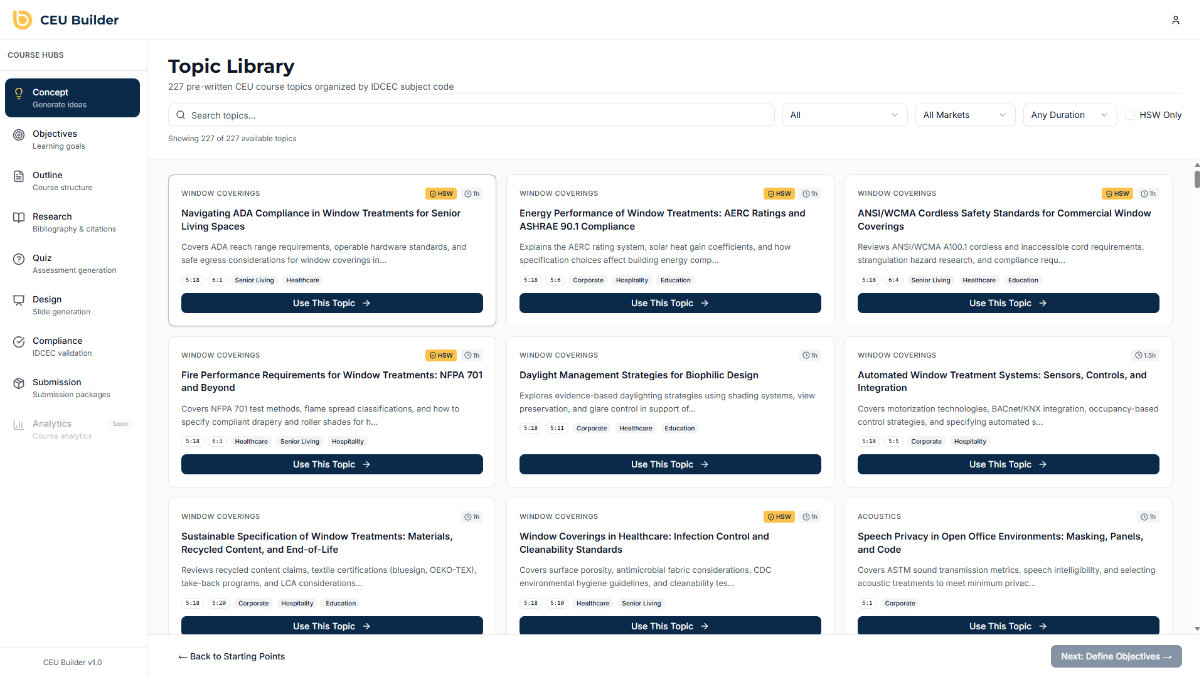
Professional services reduce risk while boosting educational impact. We know which topics architects actually want to learn, how to structure content for maximum engagement, and what compliance details IDCEC reviewers scrutinize during evaluation. This expertise translates directly into courses that generate specification influence rather than simply fulfilling credit requirements.
Pro Tip: Schedule early consultation to align your course development with hospitality manufacturing needs and architect preferences. Strategic planning before content creation ensures your educational investment delivers maximum business value.
Explore our resources on getting IDCEC approval for CEU courses and review our comprehensive continuing education compliance guide to understand the full scope of accreditation requirements and strategic opportunities.
FAQ
What are the most common reasons CEU courses fail IDCEC approval?
Courses typically fail accreditation when content focuses too heavily on product promotion rather than transferable educational principles. Missing or poorly defined learning objectives also trigger rejections, as do inadequate documentation, improper timing structures, and bibliographies lacking authoritative sources. Many manufacturers underestimate how strictly IDCEC evaluates the balance between teaching and marketing.
How can hospitality manufacturers select CEU topics that engage architects and designers?
Choose subjects addressing real design challenges in hospitality projects, like acoustic performance in hotels, sustainability practices for restaurants, or indoor air quality in senior living facilities. Align content with current industry trends and architect search behavior. Topics succeeding best solve practical problems architects face while naturally positioning your products as solutions. Review CEU course topic examples for proven approaches.
What tools simplify ongoing compliance management for CEU courses?
Learning management systems with built-in accreditation tracking features automate much of the compliance burden. These platforms generate certificates meeting IDCEC standards, document participant completion, and maintain required records. Automated reminders flag upcoming renewal requirements or standard updates. Compliance checklists integrated into your course compliance checklist catch potential issues before they cause problems.
How long does IDCEC accreditation typically take for first-time providers?
First-time providers using proven processes can achieve accreditation in 4-6 weeks from initial strategy through final approval. Organizations attempting in-house development without prior experience typically require 6-12 months, often experiencing rejections that extend timelines further. The difference comes from understanding IDCEC’s evaluation criteria and building compliance into every development stage rather than treating accreditation as a final hurdle.
Recommended
